Alcúdia Food & Wine Guide: Local Cuisine, Markets & Wine Estates
Come to Alcúdia in late September and something shifts. The beach crowds thin, the light turns honeyed and low, and the restaurants that have been feeding tourists arròs brut all summer suddenly seem to exhale and remember who they actually are. The kitchen doors stay open later. The wine list gets more interesting. The locals reappear at their own tables. If you are serious about eating and drinking well in the north of Mallorca – and you should be – this is the season that rewards the patient traveller most generously. Though it should be said: the food here is worth the journey in any month. The island has been producing exceptional ingredients since the Romans were growing olives in these hills, and Alcúdia, sitting between the Bay of Pollença and the ancient walled old town, has long been one of the best places in Mallorca to eat as well as to simply be.
The Character of Mallorcan Cuisine – What to Expect on Your Plate
Mallorcan food is not the food of performance. It does not arrive under glass cloches or come deconstructed into twelve small anxieties. It is the food of people who have lived close to the land and sea for a very long time and have learned, through centuries of necessity and no small amount of pleasure, how to use everything well.
The foundations are Mediterranean in the broadest sense – olive oil, garlic, pulses, pork, fish – but the Mallorcan kitchen has its own firmly held opinions about how these should be treated. Sofrit pagès, a rich meat and potato stew seasoned with saffron and cloves, is the kind of dish that tastes like it was made three days ago (this is a compliment). Frit mallorquí, a deeply savoury offal and vegetable fry, is served everywhere and is genuinely delicious if you approach it without preconceptions. Tumbet – layers of aubergine, courgette, potato and tomato, slow-cooked in olive oil – is the island’s answer to ratatouille, and by most measures a superior one.
Seafood in the Alcúdia area is worth particular attention. The bay delivers excellent langoustines, scorpionfish, sea bass and red mullet, and the local fishermen still operate from the small port to the south of the old town. Arròs brut – literally “dirty rice” – is the dish you will see on almost every menu, a saffron-tinted rice stew with game, pork and vegetables that sits somewhere between paella and something your grandmother would make if your grandmother were Mallorcan. Order it. It is not a tourist trap. It is genuinely one of the great rice dishes of the western Mediterranean.
Signature Dishes and Where to Find Them
Beyond arròs brut, there are several dishes that define eating in this part of Mallorca and that a serious visitor should seek out. Pa amb oli – bread rubbed with ripe tomato and dressed with local olive oil and salt – sounds too simple to matter until you eat it with good ingredients, at which point you understand immediately why Mallorcans eat it almost daily. It is the region’s best argument that restraint is its own form of sophistication.
Cocas are the island’s flatbreads, sold in bakeries and markets across Alcúdia, topped variously with vegetables, sardines, escalivada or sweet variants with pine nuts and candied fruit. The local sobrassada – a cured, spreadable sausage made from black pig with pimentón – appears on everything from cocas to cheese boards to restaurant amuse-bouches, and the quality variation between a good artisan sobrassada and a mediocre commercial one is considerable. Buy the former whenever you encounter it. The latter is the reason tourists go home thinking sobrassada is merely fine.
For dessert, ensaïmada is the spiral pastry that Mallorca has made its own – light, lard-enriched, dusted with icing sugar and sold in the round flat boxes that you will see passengers carrying onto planes at Palma airport like oversized hatboxes. In Alcúdia and the surrounding villages, the bakeries produce them fresh each morning. There is no reason to eat one that is not fresh.
The Wine of Mallorca – A Region Coming Into Its Own
Mallorca has two main wine appellations: Pla i Llevant in the centre-east and Binissalem in the central plain, and the wines produced under both have become increasingly serious over the past two decades. This is not damning with faint praise – the improvement has been real and dramatic. The island’s indigenous grape varieties, particularly Manto Negro (red) and Prensal Blanc (white), have been championed by a new generation of winemakers who understand that these are grapes worth taking seriously rather than blending away.
Manto Negro produces reds that are medium-bodied, earthy and aromatic – genuinely distinctive in a world where too many wines taste of nowhere. Callet, another native red variety, gives wines of greater structure and ageing potential. On the white side, Prensal Blanc makes fresh, mineral wines with good acidity, while producers have also had considerable success with Chardonnay and Viognier in the island’s warmer microclimates.
For visitors staying in or around Alcúdia, the wine estates of the Binissalem DOC are within comfortable driving distance – roughly forty minutes south through some of the most compelling landscape on the island. Several bodegas offer tastings by appointment, and spending a morning in the vineyards followed by a long lunch is one of those days that retrospectively justifies the entire trip.
Wine Estates Worth Visiting Near Alcúdia
The Binissalem wine region, centred on the town of the same name, is the obvious starting point for any serious wine exploration from Alcúdia. The vineyards here sit on the central Mallorcan plain, surrounded by almond trees and ancient stone walls, at an altitude that gives the grapes enough diurnal temperature variation to develop genuine complexity.
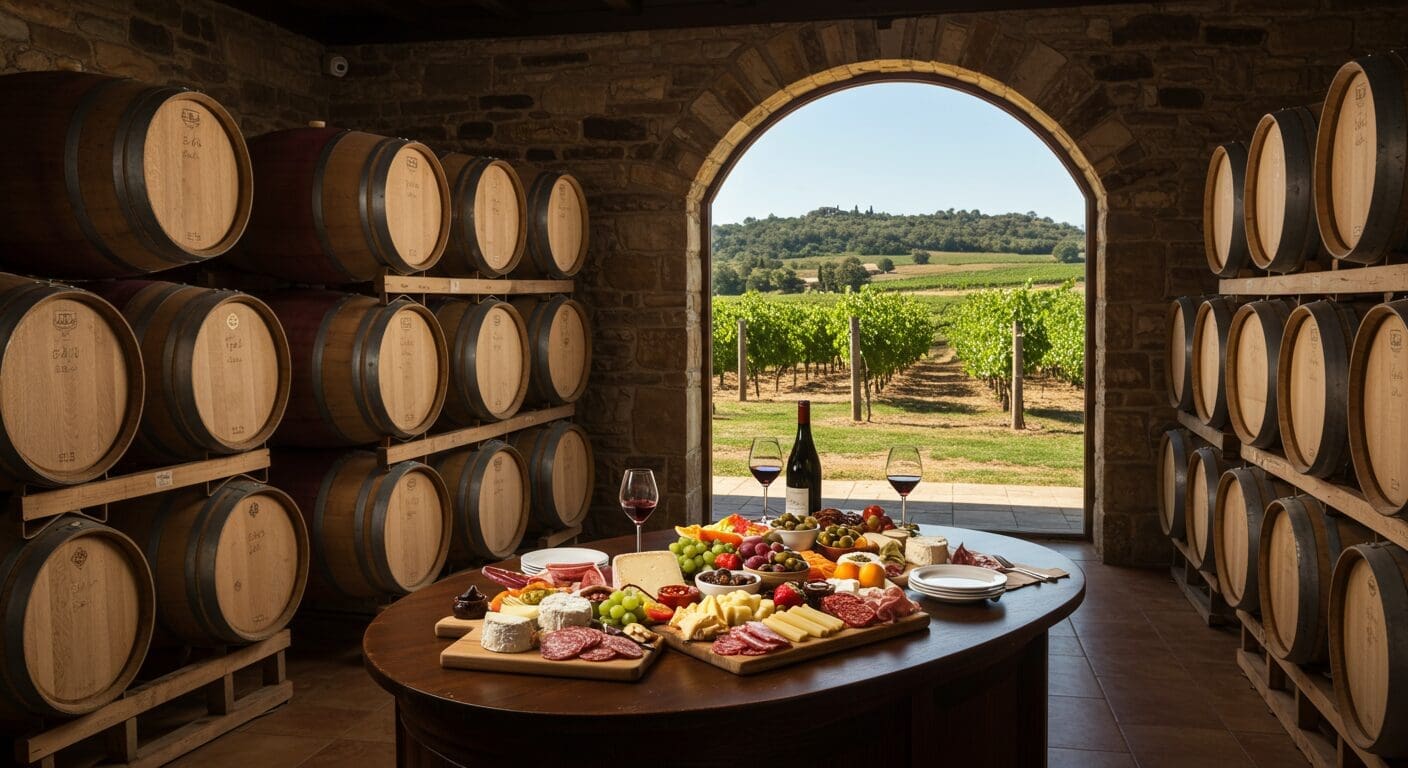
Several estates receive visitors and offer structured tastings, typically including a tour of the vineyards and cellar followed by wines paired with local charcuterie, cheeses and pa amb oli. This is wine tourism done at the right pace – unhurried, generous, conducted in a setting that makes the wine taste better than it would in a cold urban tasting room. Which is not to suggest the wines need the setting as a crutch. They do not. But context is everything, and drinking Manto Negro while looking out across the vines in October afternoon light is an experience that requires no embellishment.
To the east, the Pla i Llevant producers around Manacor and Felanitx are further afield but worth the journey for visitors interested in the island’s most experimental winemaking. Some of the island’s most talked-about small-production wines emerge from this part of Mallorca, often in quantities so limited that finding them outside the island is largely a matter of luck and timing.
Alcúdia’s Markets – Where the Serious Shopping Happens
Alcúdia hosts its main market on Tuesdays and Sundays, and while markets across the Balearics have a tendency to drift toward tourist-facing trinkets and mediocre sangria, Alcúdia’s retains a genuine working quality that makes it worth attending early and with purpose. The food stalls are the thing – local vegetables, olives cured in garlic and herbs, fresh cheeses, honey from the Serra de Tramuntana, sobrassada in various stages of cure, and seasonal produce that changes week by week through the year.
In autumn, look for the wild mushrooms – especially the rovellons (saffron milk caps) that appear in the hills after the first rains and which the locals treat with a reverence bordering on the religious. In spring, the broad beans and artichokes. In summer, the tomatoes and aubergines that make tumbet what it is. Shopping at the market and then cooking with what you have found is one of the great pleasures available to anyone staying in a villa with a proper kitchen – which, if you are staying somewhere worthy of the name, you will have.
The covered food market in Alcúdia’s old town is a quieter, year-round alternative for those who find the outdoor market overwhelming – smaller in scale, calmer in atmosphere, and reliably stocked with the kind of things you wish you could carry home in greater quantities.
Olive Oil – Mallorca’s Liquid Gold
The olive trees of Mallorca are not young. Some of the specimens you will see in the groves around the Serra de Tramuntana and in the villages of the interior are hundreds of years old – gnarled, silver-barked and entirely indifferent to passing trends in wellness culture. The oil they produce is Mallorca’s most quietly distinguished agricultural product: robust, peppery, fragrant with herbs and with a finish that lingers pleasantly.
The Tramuntana region to the west of Alcúdia produces olive oils of remarkable quality, and several estates offer tastings and mill visits during the harvest season, which typically runs from November through January. Watching the olives arrive from the grove and leave as oil – green-gold and almost aggressively fresh – within the space of a few hours is a lesson in what the words “cold-pressed” and “extra virgin” actually mean in practice rather than on a supermarket label.
For visitors who want to take something genuinely valuable home from Mallorca – something that will improve every meal they cook for the next several months – a bottle or two of properly made Mallorcan olive oil is the answer. Buy it from the producer rather than the airport. The difference will be immediately apparent.
Cooking Classes and Food Experiences
For those who want to move beyond eating and into understanding, cooking classes have become increasingly available across the Alcúdia area and the wider north of Mallorca. The best are grounded in proper Mallorcan technique rather than a tourist-friendly approximation of it – you will learn to make pa amb oli properly (there is more to it than it appears), to prepare arròs brut from scratch, and to understand why the island’s cuisine operates the way it does: what is in season, what grows here, what the pigs eat, why the olive oil tastes different from the Italian version you use at home.
Private cooking experiences can be arranged at your villa, with a local chef bringing the market to your kitchen and spending a morning teaching, cooking and eventually eating with you. This is, objectively, a better morning than most alternatives. Several villa concierge services in the Alcúdia area can arrange this on request, and it is the kind of experience that tends to travel well – you will be making arròs brut at home in November and boring your friends with what you know about Mallorcan wine, and both of these things will be entirely justified.
Wine and food pairing lunches at local estates, truffle-focused dinners in the autumn months (Mallorca has its own small truffle production, primarily black truffles from the central interior), and private guided market tours with a chef are all experiences available to those who plan ahead and choose their villa – and their concierge – accordingly.
The Best Food Experiences Money Can Buy in Alcúdia
Let us be direct about this. The best food experiences in and around Alcúdia are not in the restaurants along the seafront that advertise in three languages and feature photographs of the food on laminated menus. They are elsewhere, and finding them requires either local knowledge or the willingness to walk into the old town and trust your instincts.
The restaurants within and immediately around Alcúdia’s walled old town – the best preserved medieval fortification on Mallorca, which is itself the kind of architectural achievement that puts your surroundings into proper perspective – serve food of a consistently higher standard than the resort-facing establishments along the bay. Look for places where the menu changes with the season and where the wine list includes Mallorcan producers rather than just Spanish classics.
For a genuinely exceptional day, consider combining a morning at the Tuesday or Sunday market with a private chef lunch prepared at your villa – the chef shops alongside you, you drink local wine while lunch is prepared, and you eat in your own garden or terrace. This is the kind of experience that is impossible to replicate in a restaurant and that requires exactly the sort of property that makes a villa the right choice over a hotel. The setting does what the setting does. The food arrives tasting of the place you are in.
Private wine tours with an expert guide, evening tastings of artisan cheeses and charcuterie paired with island wines, early morning fishing trips followed by lunch prepared from the catch – these are the experiences that constitute what Alcúdia food culture looks like at its best. None of them are complicated to arrange if you start from the right base. For a broader picture of the destination and what it offers beyond the table, our Alcúdia Travel Guide covers the full scope of what this exceptional corner of Mallorca has to give.
Stay Well, Eat Better
Good food and good wine require a proper base from which to enjoy them – somewhere with a kitchen worth cooking in, a table worth sitting at, and a terrace from which the evening feels like an event in its own right. The finest experiences in this Alcúdia food and wine guide – the private chef lunches, the market mornings, the villa tastings, the long evenings with Mallorcan wine and a plate of good things – all presuppose a property that can hold them. Explore our collection of luxury villas in Alcúdia and find the right home for the kind of week Mallorca’s food and wine genuinely deserve.