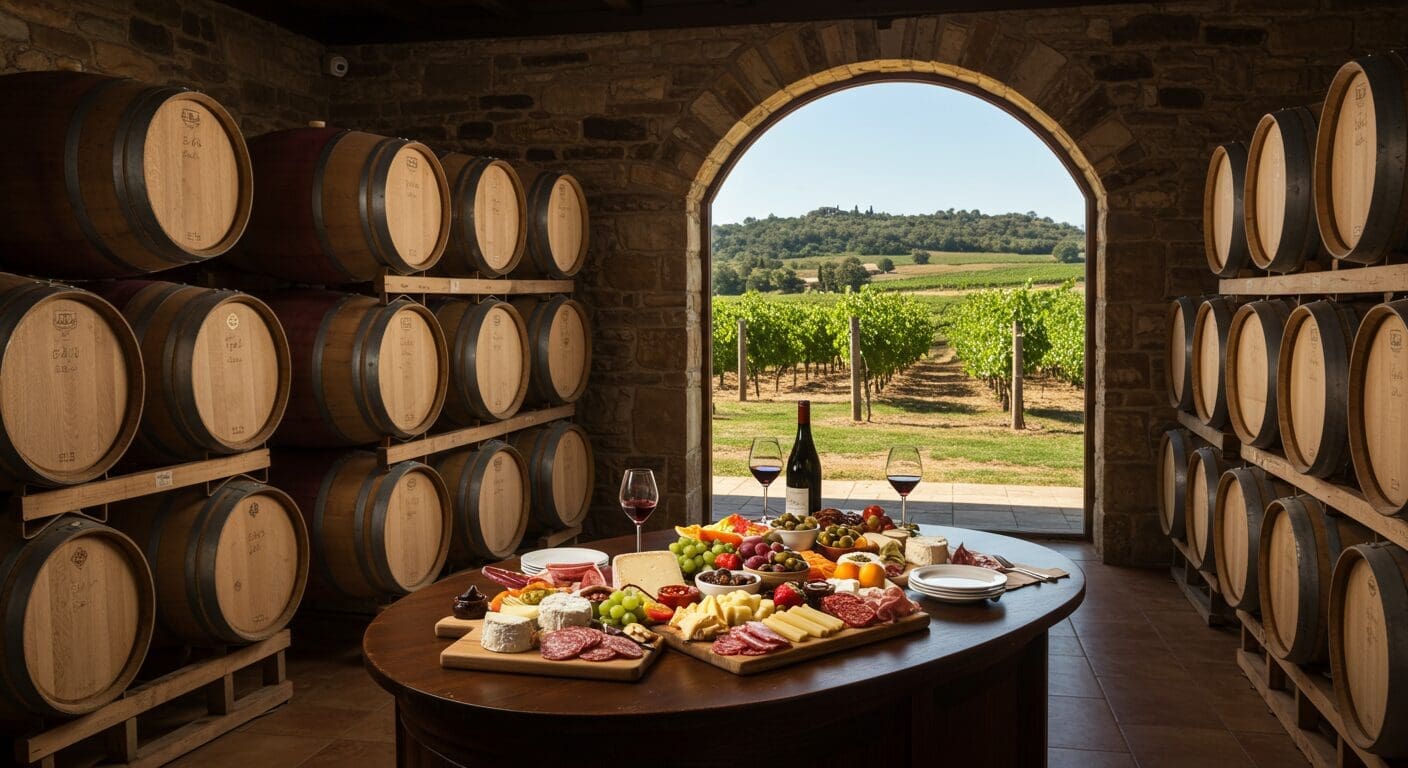
Bordeaux Food & Wine Guide: Local Cuisine, Markets & Wine Estates
It is eight in the morning and you are standing at a market stall in the Marché des Capucins with a small plastic cup of Sauternes in one hand and a sliver of Roquefort in the other, and you are doing this because someone very sensible suggested it and because, really, why would you not. The air smells of wet stone and good cheese. A woman to your left is conducting a serious negotiation over ceps. A man to your right is eating an oyster with the focused serenity of someone who has found religion. This is Bordeaux before it has even cleared its throat – and already it is one of the better mornings of your life.
Why Bordeaux is a Food and Wine Destination, Not Just a Wine Region
There is a persistent and mildly irritating assumption that Bordeaux exists purely as a backdrop for wine tourism – that visitors arrive, peer at labels, nod sagely at tannins they cannot quite identify, and leave. The reality is considerably more interesting. Bordeaux is a working port city with centuries of Atlantic and river trade woven into its cooking, a region where the forests give up truffles and wild mushrooms, the coast delivers oysters and langoustines, the farms produce some of France’s finest duck and lamb, and the markets operate with the kind of seriousness that makes you feel your own supermarket trips have been, frankly, a waste of everyone’s time.
This is Southwestern French cuisine at its most confident – rich, generous, deeply seasonal, and entirely uninterested in being fashionable. Understanding it properly, and eating your way through it with intention, is one of the most satisfying things a luxury traveller can do in France. Which is saying something, given the competition.
For the full picture of what the region offers beyond the table, our Bordeaux Travel Guide covers everything from the city’s architecture to its Atlantic coast escapes.
The Signature Dishes of the Bordeaux Table
Bordeaux cuisine is not a cuisine of restraint. It is built on duck fat, bone marrow, slow braises, and a deep structural respect for the animals and vegetables that make their way onto the plate. It is food designed to accompany wine rather than compete with it – which means the flavours are bold, the sauces are serious, and nobody is apologising for anything.
Entrecôte à la bordelaise is the city’s most iconic meat dish – a rib-eye steak served with a sauce made from shallots, bone marrow, red wine, and time. It sounds simple because it is, in the way that a well-made suit is simple. The execution is everything. Throughout the city you will find brasseries and bistros serving their own versions, each chef apparently convinced that theirs alone is definitive. They may all be right.
Lamprey – lamproie à la bordelaise – is a dish that requires a certain open-mindedness, which is to say that it is an eel-like river creature braised in its own blood and red wine and it is extraordinary. It is also the kind of thing you mention at dinner parties back home to gauge how adventurous your friends really are. Gratinéed oysters, duck confit, foie gras torchon, and civelles – tiny elvers fished from the Gironde estuary – round out a regional table that rewards curiosity enormously.
And then there is the canelé. Bordeaux’s signature pastry is a small, fluted cylinder of rum-and-vanilla custard beneath a deeply caramelised shell, and it is one of those things that sounds modest right up until the moment you eat one and immediately want another. They should be eaten warm, from a boulangerie or pâtisserie that makes them properly, and almost nowhere else.
The Markets: Where Bordeaux Does its Serious Shopping
The Marché des Capucins in the Saint-Michel quarter is the city’s great covered market, open from early morning and operating at a pitch of productive chaos that is enormously enjoyable to witness. The stalls here are not curated for tourists – they are where the city’s chefs, home cooks, and serious eaters come to buy ceps, truffles, charcuterie, regional cheeses, and whatever the season has decided to offer that week. The oyster bar at the back is not optional.
The Marché Victor Hugo, in a grander early twentieth-century building near the city centre, operates at a slightly higher altitude of refinement – the produce just as serious, the surroundings rather more photogenic. Market days in both venues are Tuesday through Sunday, and arriving with a clear schedule and a strong coffee is the recommended strategy.
Outside the city, the local village markets that appear across the Médoc, Saint-Émilion, and Périgord throughout summer offer the particular pleasure of buying directly from producers – a wheel of cheese or a jar of duck rillettes handed across a trestle table by the person who actually made it. There is no better provenance, and the prices are considerably more honest than those in the wine-bar-lined streets of Saint-Émilion’s medieval centre.
Bordeaux Wine: Beyond the Label
Any guide calling itself a Bordeaux food and wine guide has to address the wine seriously, and so: Bordeaux produces approximately 700 million bottles per year across 65 appellations, which means the category contains everything from wines you would serve at a Tuesday supper to bottles that require a bank conversation. Knowing which is which, and why, is the work of a lifetime – or, more practically, of a few days spent in the right company.
The Left Bank – the Médoc peninsula running north from the city along the Gironde – is the home of Cabernet Sauvignon-dominant blends and the great classified estates: Pauillac, Saint-Estèphe, Margaux, Saint-Julien. These are the wines that built Bordeaux’s international reputation and that still command, in certain vintages, the kind of prices that make serious collectors go very quiet. The Right Bank – Pomerol, Saint-Émilion – favours Merlot, producing wines that are generally more approachable younger, more immediately giving, and no less serious for it.
Sauternes, south of the city, produces sweet wines of extraordinary depth and complexity from botrytis-affected grapes – wines that pair with foie gras, with Roquefort, and, as established at eight in the morning at the Capucins market, with almost any cheese that deserves the company. Entre-Deux-Mers, the large region between the Garonne and Dordogne rivers, produces fresh, mineral dry whites that are criminally underpriced given how good they can be.
Wine Estates Worth Visiting – and How to Do it Properly
The great châteaux of Bordeaux do not, as a rule, simply open their doors on Saturday mornings. The top classified estates – Latour, Margaux, Mouton Rothschild, Pétrus – operate on a reservation-only basis and require either a trade connection, a serious purchasing relationship, or an introduction through a concierge or wine specialist with existing relationships. This is not snobbery so much as supply management. They are producing finite quantities of very serious wine and they cannot host every interested visitor. Getting access to them with the right context is, however, entirely possible and entirely worth the effort.
Château Pichon Baron and Château Pichon Longueville Comtesse de Lalande in Pauillac both offer architecturally dramatic visits – the latter in particular has a cellar and château interior that makes you feel briefly that you are living inside a different, rather better life. Château Smith Haut Lafitte in Pessac-Léognan combines serious wine production with the extraordinary Les Sources de Caudalie hotel and spa – a destination in itself, and one of the most complete luxury experiences in the wine world.
In Saint-Émilion, Château Angélus and Château Pavie sit at the very top of the classification pyramid. Smaller estates – Château Canon, Château Larcis Ducasse – offer visits that feel more personal and occasionally more illuminating, because the person walking you through the chai might actually be the winemaker rather than a hospitality coordinator. For truffle country and Périgord estates, heading northeast towards Bergerac and the Dordogne valley opens an entirely different, more rustic register of wine tourism – Pécharmant, Monbazillac – that rewards without requiring a major financial commitment.
Truffles, Ceps, and the Forest Economy
The Périgord Noir, accessible from Bordeaux in roughly an hour and a half, is one of France’s great truffle territories – and the black truffle, Tuber melanosporum, is a reason in itself to be in this part of France between December and March. The truffle markets at Périgueux and Sainte-Alvère are among the most atmospheric food experiences in the country: quiet, rather serious affairs conducted under covered markets or in village squares, where quantities that would seem extravagant anywhere else are weighed and exchanged with the focused energy of a commodities floor.
Several estates and truffle producers in the region offer guided hunting experiences – you are accompanied by a handler, a dog of impeccable professional focus, and the particular excitement of watching an animal locate something you had absolutely no idea was there. It is one of those activities that sounds slightly eccentric until you are actually doing it, at which point it becomes one of the most absorbing hours you have ever spent outdoors. The cooking class that often follows, built around that morning’s harvest, is not a bad way to spend the afternoon either.
Ceps – porcini mushrooms – are a Bordeaux autumn staple, appearing in markets from September and featuring on virtually every bistro menu worth visiting. They are prepared simply here: pan-fried in duck fat with garlic and flat-leaf parsley, or added to a risotto or a potato gratin. The simplicity is entirely deliberate. When something tastes that good on its own, restraint is not modesty – it’s confidence.
Cooking Classes and Culinary Experiences for the Serious Eater
Bordeaux has a well-developed culinary education scene, ranging from short market-to-table experiences to multi-day courses focused on specific techniques of Southwestern French cooking. The best experiences begin at the market, which is correct – understanding what is available, what is in season, and what the producer recommends is the foundational skill from which everything else follows.
Many luxury villas in the region can arrange private chef experiences and cooking sessions as part of their rental – a chef arriving with a crate of market produce and spending a morning teaching you the mechanics of a proper entrecôte sauce, or the precise technique for turning a raw cep into something you want to eat immediately, is the kind of thing that repays the investment every time you cook it at home afterwards. Wine pairing sessions, conducted either by a sommelier brought to the property or at a local estate, add a layer of knowledge that transforms subsequent restaurant visits considerably.
For those interested in going deeper, the Bordeaux wine school – the École du Vin de Bordeaux, attached to the Cité du Vin – offers structured tastings and education at a range of levels, from introductory sessions for genuinely curious beginners to more advanced structured tastings for those who already know their Pomerol from their Pauillac and want to go further. The Cité du Vin itself is worth an afternoon regardless – a serious, well-designed institution that treats wine as the global cultural phenomenon it actually is, rather than as a regional marketing exercise.
The Best Food Experiences Money Can Buy in Bordeaux
Gordon Ramsay’s restaurant at Château La Dame Blanche, the private dining tables at Château Smith Haut Lafitte, and the table of Le Pressoir d’Argent at the Grand Hôtel de Bordeaux – a two-Michelin-starred kitchen whose press for fresh Breton lobster is both the centrepiece of the dining room and an exercise in theatrical generosity – represent the city’s highest formal register. A dinner here, preceded by a walk around the Place de la Bourse and a glass of white Graves at the bar, is as good as this city gets when it is performing at full stretch.
But equally valid – and arguably more revealing – is a long lunch at a small bistro in the Chartrons district, working through a carafe of something honest and a steak that no one has described on Instagram. The Chartrons, historically Bordeaux’s wine merchant quarter, has evolved into the city’s most interesting neighbourhood for eating and drinking without ceremony, and its tables reward those who prefer to find their own way rather than follow a list. Ending the afternoon with a canelé from a boulangerie on the way back is not optional. Consider yourself informed.
Stay Well: Luxury Villas for Food and Wine Lovers
The obvious base for a proper Bordeaux food and wine itinerary is a property with a kitchen worth using – one where the truffle haul from Tuesday’s market can be turned into something remarkable on Wednesday morning, where the case of wine from the estate visit has somewhere sensible to be stored, and where a private chef can arrive without negotiating a cramped galley. A villa also places you close to the appellation you most want to explore – in the Médoc, in Pomerol, on the edge of Saint-Émilion – rather than in a hotel that requires a forty-minute drive before the serious part of the day begins.
Explore our collection of luxury villas in Bordeaux – properties chosen for their character, location, and their suitability for exactly the kind of trip described above. Whether you are planning a private wine tour, a culinary week for a small group of serious eaters, or simply a long stay in one of Europe’s most underrated gastronomic cities, we will find the right base for you.