Central Italy Food & Wine Guide: Local Cuisine, Markets & Wine Estates
Here is the thing every glossy food magazine gets wrong about eating in Central Italy: the best meal you will have will almost certainly not be in a restaurant. It will be at a farmhouse table somewhere in Umbria or the Val d’Orcia, produced by a woman who learned to cook from her grandmother and has strong opinions about the correct ratio of fat to lean in a wild boar ragu. The tablecloth will be checked. The wine will be unlabelled. You will have no idea what you are eating and it will be the finest thing you have tasted in years. This is not an accident. Central Italy – which for our purposes means Tuscany, Umbria, Le Marche and Lazio’s northern reaches – operates on the principle that exceptional ingredients, treated with restraint and confidence, require very little else. Understanding this is the beginning of understanding the food.
The Philosophy of Central Italian Cooking
If French cuisine is about technique and Spanish cuisine has spent the last two decades being about theatre, Central Italian cooking is quietly, stubbornly about the ingredient. A Florentine bistecca is aged beef, salt, heat and olive oil. That is it. A Umbrian lentil soup is lentils from Castelluccio – which grow at altitude and have a particular earthiness no other lentil quite replicates – a little soffritto, a drizzle of green oil. The restraint is not laziness. It is confidence, earned over centuries of knowing exactly where your food comes from.
The regional distinctions matter and locals will tell you so at length. Tuscany leans towards the meat-centric: thick-cut steaks, wild boar, game birds, offal served without apology in Florence’s lampredotto stalls. Umbria is quieter, more forest-floor in flavour – truffles, mushrooms, lentils, black chickpeas, cured meats from Norcia that have achieved something close to cult status. Le Marche, overlooked by most visitors, threads together the best of its neighbours: mountain cheeses, coastal seafood, handmade pasta that deserves significantly more international attention than it currently receives. Lazio brings its roman directness – guanciale, pecorino, a certain forthright relationship with pork fat that the further north you travel, the more people seem to pretend they don’t share.
Signature Dishes You Need to Know Before You Arrive
Consider this your pre-departure briefing rather than a menu to tick off. Though ticking them off is, admittedly, not the worst way to spend a fortnight.
Bistecca alla Fiorentina is Tuscany’s most famous export and deserves every word written about it. Cut from Chianina cattle – a breed that has been raised in the Val di Chiana since Roman times – it arrives at the table at least five centimetres thick, seared over wood embers, served rare to the point of alarm if you are not expecting it. Ordering it well done in Florence is technically legal but socially inadvisable.
Pici cacio e pepe is the Sienese answer to Rome’s famous pasta dish: fat, hand-rolled pici pasta with pecorino and black pepper. Simple on paper, deceptively difficult to execute, magnificent when done properly. Ribollita, Tuscany’s great bread-and-vegetable soup, is winter comfort in a bowl. Porchetta – whole roast pig, stuffed with herbs and slow-cooked until the skin becomes something between crackling and architecture – appears at every market worth visiting. In Norcia, the art of cured pork reaches a kind of quiet apotheosis: prosciutto, salami, salsiccia and the black truffle-laced sausages that make grown food writers go slightly glassy-eyed.
From Le Marche: vincisgrassi, a baked pasta layered with meat ragu and béchamel that predates lasagne and is better, according to anyone from Le Marche. Brodetto, the Adriatic fish stew, varies in recipe from port to port in ways that its proponents treat as a matter of profound regional identity. From Lazio: coda alla vaccinara, oxtail braised low and slow with tomato and celery, and the whole glorious canon of offal cookery that Rome has never seen any reason to be embarrassed about.
Central Italy’s Great Wines: What to Drink and Where It Comes From
This region produces some of Italy’s most important and most collectible wines, and fortunately also some of its most enjoyable everyday ones. The two categories do not always overlap as neatly as the marketing suggests.
Brunello di Montalcino is the grand duke of Tuscan reds: made exclusively from Sangiovese Grosso in a small zone south of Siena, it requires a minimum of five years’ ageing before release and can evolve in bottle for decades. It is authoritative, complex and occasionally priced accordingly. Its younger sibling, Rosso di Montalcino, offers similar DNA at considerably less expense and is the more sensible choice for a Tuesday lunch.
Vino Nobile di Montepulciano – not to be confused with the grape Montepulciano, which is a different thing entirely and the source of more wine list confusion than almost anything else – is the other great Sangiovese-based wine of southern Tuscany. Earthier than Brunello, more approachable in youth, very good indeed with bistecca or wild boar. Chianti Classico, produced between Florence and Siena in the original medieval zone, has undergone something of a quality revolution in the past twenty years. The Gran Selezione tier in particular produces wines of genuine depth and complexity. The flask-in-a-wicker-basket version of Chianti is a historical artefact. We do not mourn it.
Umbria makes two wines worth knowing well. Sagrantino di Montefalco is one of Italy’s most tannic red varieties, concentrated and structured, requiring time and patience – a wine that rewards the kind of drinker who plans ahead. Orvieto, the great white of central Umbria, ranges from crisp and everyday to, in its sweeter forms, genuinely complex and ageworthy. Le Marche’s Verdicchio, grown in the hills around Jesi and Matelica, is Italy’s finest white wine that most people outside Italy have not yet discovered. This situation will presumably correct itself.
Wine Estates Worth Visiting
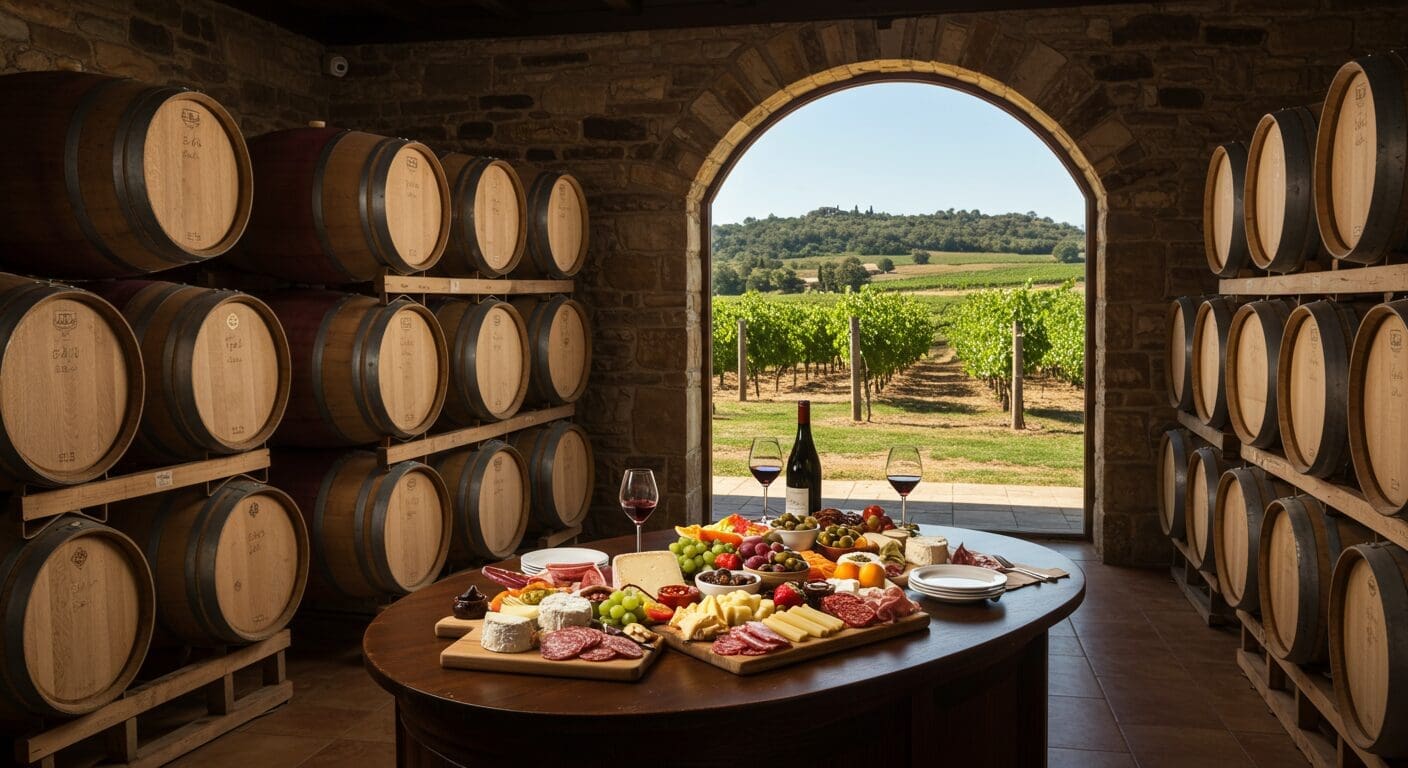
A visit to a serious wine estate in Central Italy is one of those experiences that reminds you why this way of travelling was invented. The landscape, the cellar, the tasting, the producer who has spent forty years obsessing over a single hillside – it assembles into something that no wine shop visit or restaurant list can replicate.
In Montalcino, the density of exceptional producers within a small territory is extraordinary. The town itself sits on a hill above the vineyards, and many estates offer visits by appointment: cellar tours, barrel tastings, and the particular pleasure of tasting library vintages with someone who actually made them. The estates range from historic names established in the nineteenth century to newer boutique producers taking a more experimental approach to Sangiovese. Both have arguments in their favour.
The Chianti Classico zone is better suited to a self-guided tour by car – a sequence of medieval villages, cypress-lined roads and family-run estates where the cellar tour often ends with the family asking if you would like to stay for lunch. The answer is yes. It is always yes. Around Montefalco in Umbria, the Sagrantino estates tend to be smaller, more intimate and less visited by the organised tour groups that occasionally descend on Tuscany in summer. Estate visits here often feel more like calling on a small farmer-producer than a ticketed attraction – which is precisely what makes them worth the detour.
Food Markets: The Heart of Central Italian Life
The food market is where Central Italy shows you what it thinks of itself, and what it thinks is: rather well. Markets here are not staged for tourists. They are working markets, attended by the people who cook, organised around the seasons and the produce that the season makes available. If you are buying strawberries in November at a Central Italian market, someone has failed somewhere in the supply chain.
Florence’s Mercato Centrale in San Lorenzo has a ground floor of genuine, historic market life – butchers, fishmongers, cheese sellers, the truffle vendor who appears in autumn with an expression of serene satisfaction – and an upper floor food hall that caters more specifically to the visitor. Both have value. The ground floor has more soul. In Siena, the Campo market, held in the famous shell-shaped piazza twice a week, is one of the more romantically located places in Europe to buy a piece of aged pecorino and some dried porcini. Orvieto’s market, set beneath the walls of the cathedral, operates on a similar principle of extraordinary setting meeting practical produce. Le Marche’s smaller town markets – particularly in the Macerata and Fermo provinces – remain almost entirely local in character and are all the better for it.
In autumn, the truffle markets of Umbria and the white truffle towns of the Marche interior take on an intensity that is particular to this part of the world: buyers, sellers and a great deal of expert sniffing. The white truffle season, running roughly from October to December, draws serious buyers from across Europe and prices that would make a reasonable person reconsider their relationship with fungi.
Truffle Hunting: One of the Great Food Experiences of Central Italy
Let us be honest about what truffle hunting actually is: you follow a dog through woodland for an hour or two, occasionally stumbling on tree roots, and the dog does all the work. This is not a criticism. The dogs are remarkable. The experience of watching a trained truffle hound work a hillside with absolute focused purpose, then signal its find by digging with a precision that seems almost theatrical, is genuinely one of the great food spectacles of the Italian countryside.
The black truffle territory of Umbria – particularly around Norcia and Spoleto – and the white truffle zones of Le Marche’s Apennine foothills both offer guided hunts with local trifolai (truffle hunters), usually followed by a meal featuring that morning’s finds. This is the kind of experience where the narrative of the day becomes as valuable as the food itself: the landscape, the hunter’s expertise, the history of their particular patch of woodland, and then the table where everything arrives dressed simply in the local oil and freshly made pasta. If you visit Central Italy in autumn and do not do this, it will nag at you later.
For black summer truffles, the season runs broadly from May through August. The prized black Périgord-style truffle (Tuber melanosporum) appears from November through March. White truffles (Tuber magnatum pico) peak between October and December and are traded by weight at prices that the uninitiated find alarming and the converted find entirely reasonable.
Olive Oil: Central Italy’s Other Great Liquid
Tuscany and Umbria produce some of Europe’s finest extra virgin olive oils, and the difference between these and the supermarket version is roughly the difference between a bespoke suit and something bought at an airport. Tuscan oils – particularly those from the area around Lucca and the hillside groves above Lake Trasimeno – tend towards a grassy, peppery intensity. The peppery finish that catches in the throat is a sign of quality polyphenols and freshness, not a fault, despite what people who prefer a milder oil will tell you.
The olive harvest in October and November transforms the landscape and the social calendar. Many estates and agriturismi open their mills to visitors during the harvest, and the opportunity to taste oil within hours of pressing – vivid green, almost luminous, with a flavour intensity that fades over the subsequent months – is not something easily forgotten. Some estates offer dedicated oil tourism experiences: grove walks, mill visits, tasting sessions structured like wine tastings with food pairings. It is a relatively recent formalisation of something producers have been happy to do informally for decades.
When shopping for oil, look for PDO-designated products from Chianti Classico, Terre di Siena or Colline Umbria, harvest-date labelled bottles, and cloudy (unfiltered) oil if you plan to use it quickly. Clear, filtered oil keeps better. Either way, buy more than you think you need and check airline carry-on regulations before you get to the airport.
Cooking Classes: Learning to Cook Central Italian Food
A well-designed cooking class in this region is less about technique – though you will learn technique – and more about understanding the logic of a cuisine. Why certain flavours work together. Why the soffritto gets this amount of time, not that amount. Why the pasta dough is rested. The knowledge accumulates and then, several months later at home, you find yourself making something that actually tastes like Italy, and you will be unreasonably pleased about it.
The best classes in Tuscany and Umbria tend to involve a morning at a market followed by an afternoon in a kitchen – either a farmhouse outside the city or a more formal culinary school. Some are hosted by private families as much as professional instructors. Many are set in agriturismi whose kitchens are the point, not an afterthought. Duration varies from half-day introductions to week-long immersive programmes that cover regional variations, wine pairing, bread-making and the particular art of fresh pasta in all its regional forms: pici in Siena, stringozzi in Umbria, maccheroni al ferretto in Calabria-influenced pockets of the Marche.
For families, cooking classes offer one of those rare experiences where children are actively useful rather than tolerantly accommodated. The pasta-rolling stage, in particular, tends to produce engaged small participants and a better product than you might expect.
The Best Food Experiences Money Can Buy in Central Italy
Central Italy rewards the traveller who is willing to spend thoughtfully rather than simply lavishly. The most expensive dinner in Florence is not necessarily the most memorable meal in Tuscany. This is, in fact, a liberating truth.
That said, certain experiences exist at a level of quality and curation that justify their positioning. A private truffle hunt followed by a white truffle dinner prepared by a private chef in a villa near Spoleto, with wines selected by a sommelier who knows both the estate and your palate, represents a kind of convergence of landscape, ingredient and craft that is genuinely difficult to replicate. Similarly, a private cellar tour and vertical tasting at a top Brunello estate – tasting a wine across fifteen or twenty vintages with the person who made it – is an education and an experience simultaneously.
Private market tours with a local guide who has relationships with specific vendors – the cheesemaker who brings the experimental aged sheep’s cheese that never makes the main table, the butcher who will talk you through his entire approach to Chianina beef – offer access that generic tours simply cannot. A bespoke food itinerary through Le Marche, beginning on the coast with brodetto and Verdicchio and moving inland to mountain cheeses, truffle-scented salumi and aged Sangiovese, structured around private villa accommodation and private dining, is the kind of trip that people describe for years afterwards. With an emphasis on years.
For the complete picture of how to plan your time in this region – covering everything from art cities to hilltop villages – our Central Italy Travel Guide covers the full scope of what this remarkable part of Italy has to offer.
Plan Your Table: A Food-Lover’s Base in Central Italy
The best way to experience all of this – the markets, the estates, the truffle hunts, the cooking classes, the lunches that begin at one o’clock and end when the light has changed – is with a private villa as your base. Not a hotel, with its fixed mealtimes and communal spaces, but a property with a kitchen you can actually use, a terrace where the evening meal can be as long or as leisurely as you choose, and enough privacy to feel genuinely immersed in the landscape rather than visiting it.
A villa in the Val d’Orcia puts you within range of the Brunello estates, the truffle country of Norcia and the hill towns of southern Tuscany simultaneously. An Umbrian farmhouse places you in the olive oil and Sagrantino belt with the food markets of Perugia and Spoleto within easy reach. A property in Le Marche’s Macerata hills gives you the underexplored food landscape of a region that has not yet been discovered by the volumes of visitors that occasionally take the shine off neighbouring Tuscany.
Explore our collection of luxury villas in Central Italy and find the right base for the food journey this region genuinely deserves.