Chania Travel Guide: Where to Stay, Eat & Explore in Luxury
The light hits the Venetian harbour at around seven in the morning in a way that makes you briefly question every life decision that led you somewhere else. The old lighthouse stands at the end of its narrow stone pier, the fishing boats are already out, and the curved Ottoman mosque at the waterfront – yes, Ottoman, we’ll get to that – reflects pink and amber off water so still it looks like it hasn’t been told what day it is yet. A cat sits on a bollard. A man in a white apron is arranging chairs outside a taverna. Somewhere, coffee is happening. This is Chania on a Tuesday, or a Saturday, or honestly any morning you choose to be here.
Chania is the kind of place that suits people who want more than a beach. It draws couples marking the big occasions – anniversaries, milestone birthdays, honeymoons that actually live up to the idea of honeymoons – as much as it draws families who want privacy and space to breathe, with children who can run freely around a private villa pool while the adults remember what a conversation feels like. It’s increasingly the destination of choice for groups of friends who’ve graduated from shared apartments and want something properly grown-up, and for remote workers who’ve realised that filing a Monday morning report feels considerably less grim when you’re doing it from a terrace above the Cretan Sea. Wellness-minded travellers come too, drawn by the unhurried pace, the extraordinary food, the walking, and the particular quality of silence you get in the hill villages above the coast. In other words: it works for almost everyone, as long as almost everyone has taste.
Getting Here Is Half the Story (The Good Half)
Chania has its own international airport – Ioannis Daskalogiannis Airport, known by its code CHQ, which is easier to say – located about 14 kilometres east of the Old Town. In summer, direct flights arrive from across Europe, including the United Kingdom, Germany, the Netherlands, Scandinavia and beyond. If you’re flying from further afield – the United States, for instance – you’ll typically connect through Athens, which is about 25 minutes by air. The Athens connection isn’t as tiresome as it sounds. Think of it as a brief interval before the main event.
From the airport to the Old Town, taxis take around 20 minutes and cost roughly €25-30. Pre-arranged private transfers are available and considerably more civilised if you’re arriving with luggage, children, or the kind of exhaustion that makes small negotiations feel enormous. Car hire is worth serious consideration if you plan to explore beyond the city – and you should plan to explore beyond the city. The roads west toward the Gramvousa Peninsula or south toward the White Mountains are the kind of drives that remind you what roads are for. A small SUV handles the mountain villages better than a city car, which is worth remembering when you’re booking and worth really remembering when you’re on a tight hairpin at altitude with a sheer drop on one side.
Within the Old Town itself, walking is the only sensible option. The streets are narrow, labyrinthine in the best possible way, and largely inaccessible to cars. Wear shoes you can actually walk in. The cobblestones are beautiful and entirely without mercy.
Where to Eat in Chania: From Harbour Tables to Hidden Courtyards
Fine Dining
The waterfront at the Venetian harbour offers some of the most genuinely pleasurable eating in all of Crete, and the standout address is Salis – an open-air restaurant right on the quay that manages the difficult trick of being atmospheric without being a tourist trap. The menu takes traditional Cretan recipes and treats them with intelligence rather than reverence: local organic ingredients, award-winning Cretan wines, and a kitchen with something to prove. The dish you must order is the Salis Cacio e Pepe – a pasta that has no business being this good in Greece, and yet here we are. It’s considered one of the highlights of the best restaurant tables in Crete, and after one forkful, you’ll understand why regulars plan their return trips around it.
Also on the harbour, Pallas sits roughly four metres from the water – close enough that you could, theoretically, drop a fork into the harbour, though the staff are too professional to let that happen. Traditional Greek and Mediterranean dishes, always using local produce, served with speed and warmth. The position is extraordinary: you eat while boats bob at arm’s length and the entire theatre of the Venetian port unfolds around your table. It is, in the most literal sense, dinner and a show.
For something more intimate, Thalassino Ageri is a romantic waterfront taverna set literally next to the sea – not near the sea, next to it – where the seafood is as fresh as seafood gets. Grab a table for sunset, order the octopus, and accept that you will be thinking about this meal on the flight home. The setting alone would justify a visit. The food makes you want to stay.
Where the Locals Eat
Tamam Restaurant sits on a backstreet just off the Venetian harbour, occupying an old Venetian building that makes modern restaurant design look rather effortful by comparison. The menu is Mediterranean with strong Greek and Cretan accents – simple food done with care and served in a room that feels like it has been feeding people happily for centuries. It has. Tamam is the kind of place where the tables are always full, the wine list is honest, and the shared plates keep arriving until you’re forced to admit defeat. One of the most consistently recommended restaurants in the Old Town, and consistently popular for good reason.
Lithos Taverna, also directly on the Venetian port, is the casual counterpoint to the grander harbour tables. Most seats have sweeping views of the lighthouse and harbour. The menu leans into traditional Cretan fare cooked in a wood stove – honest, warming, completely satisfying – but the evening menu stretches further, with contemporary twists that show genuine ambition. The Green Risotto with Grilled Calamari is the kind of dish that makes you wonder why you’d ever order anything else.
Beyond the harbour, the Central Market – the Agora, a magnificent 19th century covered market modelled on the one in Marseille – is where you go on a weekday morning to understand what Crete actually eats. Cheese counters, olive oil vendors, herb stalls piled with dried mountain thyme and dictamo, small counters serving coffee and pastries to people who have clearly been shopping here for forty years. It is entirely wonderful and costs almost nothing.
Hidden Gems Worth Seeking Out
Wander east from the Old Town along the coastal path toward the Koum Kapi neighbourhood and you’ll find a string of low-key tavernas that have very little interest in being discovered by people like you, which is precisely why you should find them. Small menus, chalk-board specials, tables practically on the pebble beach, and a clientele that is largely Chaniot. The food is straightforward Cretan – whatever’s good today, prepared simply, served with local wine or tsipouro, the Cretan firewater that will take you by surprise if you underestimate it.
In the hill villages above the city – Therisso, Meskla, Vatolakkos – small family-run tavernas serve slow-cooked lamb and greens from their own gardens at prices that feel almost apologetically low. These are weekend lunch destinations for Chania families and absolutely worth the drive. Take the road to Therisso through the dramatic gorge bearing the same name and you’ll arrive with an appetite and a sense of occasion.
The Geography of Chania: Why the West of Crete Plays by Its Own Rules
Crete is a long island – 260 kilometres from tip to tip – and the western end, where Chania sits, has always felt slightly apart from the rest. The White Mountains, the Lefka Ori, rise to over 2,400 metres and dominate the inland landscape with a severity that softens only slightly in summer. These are proper mountains: snowcapped from November to May, riddled with gorges, and home to a handful of isolated villages where old men still play backgammon outside kafeneions that have seemingly never modernised. Nobody is complaining.
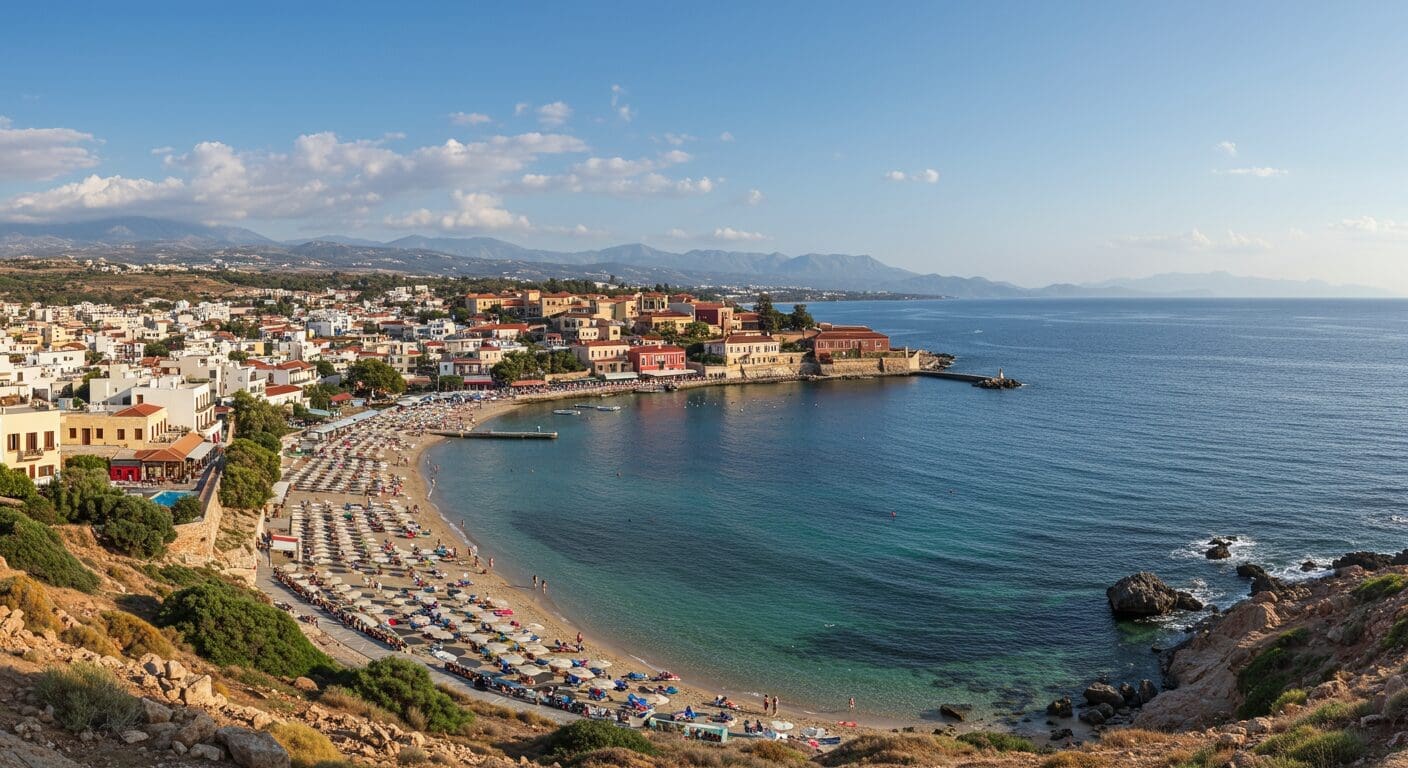
The coastline switches personality constantly. The north coast near the city offers long sandy beaches – Agia Marina, Platanias – that are developed and busy in July and August. Head west toward the Gramvousa Peninsula and the famous Balos Lagoon and the landscape becomes dramatically wilder: turquoise water, white sand, a 16th century Venetian fortress on a rocky outcrop, and the particular satisfaction of having made the effort to get there. Balos is accessible by boat from Kissamos or by a rough 4WD track – both options are perfectly doable, and both deliver one of those views that make people who’ve never been to Crete very suspicious that you’re exaggerating.
The south coast, reached by driving over or through the White Mountains, feels like a different island entirely. Loutro – a tiny white village accessible only by boat or on foot – is the kind of place where the absence of cars is not a hardship but a relief. Paleochora, Sougia, Agia Roumeli: each has its own character, each rewards a day trip or longer. The drive south through the mountains is not for the faint-hearted, but the scenery is the kind that justifies a hire car on its own merits.
The Old Town itself – the Venetian harbour, the narrow streets of Splantzia, the neighbourhood of Halepa where Eleftherios Venizelos was born – is remarkably compact and endlessly explorable. Two hours of wandering will turn up a Minoan ruin, a Turkish hammam, a Byzantine church, and a very good coffee. Often in the same street.
Things to Do in Chania: A Luxury Holiday That Never Gets Boring
There is a received wisdom that Greek island holidays are about doing nothing, and Chania is happy to accommodate that reading entirely. But it would be a minor tragedy to leave without doing at least some things. The Archaeological Museum, housed in a former Venetian church (later a mosque – the ceiling mosaics will disorient you in the best possible way), holds one of the finest collections of Minoan artefacts outside Heraklion. The displays are genuinely extraordinary: jewellery, pottery, tablets, statuary spanning four thousand years of civilisation. This is not a museum you visit because you feel you should. It’s one you come out of already planning a return.
The Venetian harbour is best experienced very early in the morning or after dark, when the coach-tour crowd has retreated. The lighthouse walk – the long narrow pier stretching out into the harbour – is perhaps twenty minutes out and back, and offers the kind of views of the Old Town that make it immediately obvious why Venetian merchants were happy to hold onto Crete for four centuries.
Boat trips to Balos and Gramvousa are a full-day commitment and absolutely worth making. The water around Balos is so transparently blue that it looks like a tourism board has doctored the photographs. It hasn’t. Day trips to Elafonisi Beach, on the southwest tip of the island, offer something even more improbable: pink-tinged sand, shallow lagoon water, and the faint sense that you’ve wandered onto a film set. Both require early starts, which the light will reward.
Wine tourism is quietly excellent in the Chania region. The slopes of the Apokoronas area and the villages around Kissamos produce some serious Cretan wines – indigenous varieties like Vidiano and Liatiko that you simply won’t find anywhere else. Several estates offer tastings; call ahead, bring cash, and leave time for a long afternoon.
Adventure in the White Mountains: Gorges, Seas and Everything Between
The Samaria Gorge is Europe’s longest gorge at 16 kilometres, carved through the White Mountains National Park – the only national park in Crete – and it is an extraordinary thing to walk. The trail begins at Xyloskalo, at 1,230 metres altitude, and descends all the way to the Libyan Sea at Agia Roumeli. The full walk takes six to eight hours at a comfortable pace; the terrain varies from wide open mountain plateau to a section called the Sideroportes – the Iron Gates – where the gorge narrows to three metres wide with walls 300 metres high. You emerge, somewhat dazed and extremely thirsty, at the sea, where a boat takes you to Hora Sfakion for the bus back. The logistics are well-organised. The experience is not easily forgotten.
For those who want the mountains without the full commitment, the Imbros Gorge offers a shorter (eight kilometres), less crowded alternative that locals quietly prefer. The Therisso Gorge is driveable and still dramatic. For genuine alpine walking, the Lefka Ori summit plateau – the Omalos high plain and beyond – offers multi-day routes for experienced hikers with proper equipment.
Diving and snorkelling in the waters off Chania reveal a Mediterranean seabed of unexpected complexity. Several dive centres operate out of the city and along the coast, with sites ranging from beginner-friendly reefs to deeper wrecks and caves for qualified divers. The water temperature is comfortable from May through October.
Sea kayaking along the north coast and around the Gramvousa Peninsula is increasingly popular and genuinely spectacular – the perspective from water level on the cliffs and headlands is entirely different from the view from above. Mountain biking in the foothills of the White Mountains offers well-organised guided routes for various fitness levels, with the considerable incentive of a taverna lunch at the bottom. Road cycling on the quieter inland routes is excellent in April, May and October, when the temperatures are kind and the roads are quiet.
Kitesurfing and windsurfing are well-served at Falasarna Beach, on the northwest coast, where the afternoon meltemi wind creates ideal conditions from late June through August. It’s a long, wide beach with professional schools and rental operations – the kind of place that makes people who’ve never tried kitesurfing briefly reconsider their life choices.
Chania with Children: When Privacy Makes the Difference
Chania is exceptionally good for families, though the quality of the experience depends enormously on where you stay. A hotel room on the strip at Platanias and a private villa with its own pool are not different versions of the same holiday. They are different holidays.
The beaches of the north coast are well-suited to younger children – shallow water, sand rather than pebbles, easy access, and plenty of beach tavernas where adults can have a proper lunch while children investigate interesting things in the shallows. Agia Marina and Platanias are the most family-oriented resort beaches; further west, Falasarna is larger, wilder and more beautiful, though the waves are more boisterous. Elafonisi’s lagoon water is famously shallow and warm, making it ideal for small swimmers.
The Old Town is entirely manageable with children who are old enough to walk – the harbour, the boats, the lighthouse, the ice cream at the market: it’s not difficult to make a morning here feel like an adventure. The Archaeological Museum engages curious children more than you might expect, particularly the Minoan exhibits. The boat trip to Balos is a proper day out that tends to appeal to children of all ages.
For babies and toddlers, the private villa with pool formula is essentially perfect: a controlled, shaded environment, no packing up and carrying everything to a public beach, nap times that don’t require military logistics, and adults who aren’t spending the entire holiday managing the gap between expectation and reality. There is something to be said for a holiday where the swimming pool is ten steps from the kitchen.
History You Can Actually Feel: Layers of Civilisation, One Street at a Time
Chania has been continuously inhabited for around five thousand years, which is the kind of fact that sounds routine until you’re standing in a street where the Minoans built first, then the Mycenaeans, then the Romans, then the Byzantines, then the Arabs, then the Byzantines again, then the Venetians for four centuries, then the Ottomans for two, then the Egyptians briefly (this is a detail that trips people up), then the Cretans themselves, finally and definitively, in 1913. The city wears all of this with remarkable lightness.
The Venetian period left the most visible legacy: the harbour itself, the lighthouse, the arsenali (the long vaulted shipyards along the waterfront where galleys were built and maintained), the city walls, and dozens of buildings throughout the Old Town that have been mosques and churches and warehouses and apartments, sometimes in that order. The Mosque of the Janissaries at the harbour entrance – built in 1645, the first Ottoman building in Crete – is the one that catches visitors off guard. It is now an exhibition space. It is, unquestionably, beautiful.
The neighbourhood of Splantzia, east of the harbour, is the most atmospheric part of the Old Town: a dense grid of narrow streets, Ottoman fountains, Byzantine churches with 14th century frescoes, and plane trees so old they shade entire squares. The execution tree still stands in Splantzia Square – a reminder that this neighbourhood was the site of considerable violence during the Ottoman period. The tavernas around it now serve very good wine. History continues.
The Halepa district, east of the Old Town, is where the European consulates were established in the 19th century and where the great Cretan statesman Eleftherios Venizelos was born. His house – now a museum – and the large stone mansion architecture of the neighbourhood offer a completely different reading of Chania from the medieval lanes of the centre. The Battle of Crete Museum, covering the extraordinary German airborne invasion of 1941 and the Cretan resistance, is sobering, moving, and essential.
Shopping in Chania: Leather, Olive Wood and Olive Everything
The Leather Lane – Skridlof Street, running parallel to the harbour – has been producing leather goods since the Venetian period and shows no sign of stopping. Sandals, bags, belts, jackets: made to order or off the shelf, in quality that ranges from tourist-grade to genuinely excellent. Going to Crete and not at least investigating the sandals is a choice, but perhaps not the right one.
Olive oil is the most obvious thing to bring home, and the quality in the Chania region is exceptional – the area around Kolymvari, on the north coast west of the city, produces extra-virgin oil of a standard that makes the supermarket version feel like a misunderstanding. Several producers sell directly; the Central Market in Chania has reputable vendors. Bring more bottles than you think you need. You will use them.
Cretan honey – particularly thyme honey from the White Mountains – is another item worth serious luggage-allocation. Cretan herbs, dried and packaged, travel well and perfume a kitchen for months. Dictamo (dittany of Crete), found only on the island, is an aromatic herb used medicinally for centuries; it makes an excellent tea and an even more interesting talking point.
Olive wood products – boards, bowls, utensils – are beautifully made and genuinely useful. The grain of aged Cretan olive wood is extraordinary. For ceramics, look for work by local potters in the craft shops around Splantzia; the quality varies but the best pieces are the kind of thing you use every day for twenty years.
The Agora – the covered Central Market – is worth visiting for shopping as much as eating. The cheese selection alone could occupy a serious hour: Graviera, Myzithra, Anthotyros – each with its own character, each worth sampling before buying. The market staff are, on the whole, perfectly happy to let you try things. This is not a place for the indecisive.
The Practical Matters: Everything You Need to Know Before You Land
Greece uses the euro. ATMs are plentiful in the Old Town and along the main tourist areas; smaller villages and mountain tavernas may be cash-only, so carrying some is wise. The language is Greek, which is both obvious and worth mentioning because even basic attempts at Greek – kalimera (good morning), efcharistó (thank you), parakalo (please) – are received with genuine warmth. Cretans in particular have a strong sense of local identity and appreciate visitors who treat the place as somewhere real rather than a backdrop.
Tipping is customary but not obligatory. Rounding up the bill or leaving five to ten percent at restaurants is standard practice. No one will chase you down the street, but the staff will remember you next time.
The best time to visit Chania for a luxury holiday is May, June, September and October. The weather in these months is warm to hot, the light is extraordinary, the sea is swimmable, and the crowds are proportionate rather than overwhelming. July and August are the hottest months – regularly above 35°C, occasionally above 40°C – and the most crowded. They are also the most intensely Mediterranean, with long evenings and a particular festive energy that some people love and others find exhausting. Both responses are correct.
April and early May are beautiful for walking and culture – the wildflowers on the mountain slopes are absurd in their abundance – though the sea may be cooler than you’d like for extended swimming. November through March is quiet, green, and dramatically atmospheric. Most tourist facilities close between November and April, but the city itself remains very much alive.
Safety is not a serious concern. Chania is a safe city by any European standard. Traffic on mountain roads deserves respect. The sun in July and August is not to be underestimated, particularly if you’re hiking. Drink more water than you think you need to, particularly in the gorges. The pharmacies are good, plentiful, and staffed by people who speak English.
Why a Luxury Villa in Chania Is Simply the Better Way to Do This
There is a version of a Chania holiday that involves a hotel room – adequate, comfortable, perhaps with a sea view if you’ve paid the premium – and then there is the version that involves a private villa with your own pool, your own terrace, your own kitchen full of whatever you asked the caretaker to stock before you arrived, and nobody else’s children in your swimming pool. The difference is not incremental. It is categorical.
For families, the villa formula solves problems before they exist. Babies sleep when they need to. Children who are tired and wet can be back inside in thirty seconds. Parents can have a drink by the pool after nine without arranging a babysitter. The communal experience of a proper house – cooking together, eating together on a terrace at dusk, the particular democracy of shared space – is something a hotel corridor simply cannot provide.
For groups of friends or multi-generational families – grandparents, parents, teenagers, small children all operating on entirely different schedules – a villa with multiple bedrooms, separate living areas, and a large pool becomes less a holiday choice and more a peace-keeping arrangement. The space to retreat, the space to come together: both matter, and both are possible only in a property large enough to accommodate the full complexity of the people you love.
For couples, the privacy of a villa – particularly one with a private pool and a view – provides something that no hotel, however luxurious, can quite replicate. The experience of swimming in your own pool at ten in the morning with no one else in sight, or eating dinner on your own terrace as the sun goes down over the Cretan Sea, is the kind of thing that people mean when they say a holiday changed them.
For remote workers – and there is no shame in this category; working from a terrace in Chania is objectively preferable to working from an open-plan office in most cities – the villa option provides reliable connectivity (many properties in the Excellence portfolio now have Starlink or high-speed fibre), a dedicated workspace, and the ability to close the laptop at lunchtime and be in the sea within the hour. This is what people mean by work-life balance, and Chania provides the life side of it in abundance.
Wellness-focused guests find that a villa stay in Chania has a quietly restorative quality that accumulates across a week in ways that are difficult to articulate and easy to feel. The mornings are early and cool enough for yoga on the terrace. The afternoons are for the pool, or a walk in the hills, or both. The evenings are long and warm. The food, by its very nature, is good for you: olive oil, fresh fish, vegetables, legumes, mountain herbs. This is the Mediterranean diet in its actual habitat, not its aspirational one. It tastes different here. It always does.
Excellence Luxury Villas offers a carefully selected portfolio of properties across the Chania region – from cliff-edge retreats above the Cretan Sea to village houses in the hills with private pools and panoramic views. If you’re ready to plan something properly, browse our collection of luxury holiday villas in Chania and find the one that fits your group, your occasion, and your idea of what a holiday should actually feel like.
More Chania Travel Guides
- Best Restaurants in Chania: Fine Dining, Local Gems & Where to Eat
- Chania Food & Wine Guide: Local Cuisine, Markets & Wine Estates
- Chania with Kids: The Ultimate Family Holiday Guide
- Best Time to Visit Chania: Month by Month Weather, Crowds & Tips
- Chania Luxury Itinerary: The Perfect 7-Day Guide
- Romantic Chania: The Ultimate Couples & Honeymoon Guide
What is the best time to visit Chania?
May, June, September and October offer the best combination of warm weather, swimmable sea, and manageable crowds. July and August are hotter – often exceeding 35°C – and more crowded, but deliver the full intensity of a Cretan summer with long evenings and a festive atmosphere. Spring (April to May) is excellent for walking, wildflowers and cultural sightseeing, though the sea is cooler. For a luxury villa holiday where you want warmth without the peak-season intensity, June and September are the sweet spot.
How do I get to Chania?
Chania has its own international airport (CHQ – Ioannis Daskalogiannis Airport), located about 14 kilometres east of the Old Town. Direct flights operate from across Europe in summer, including from the United Kingdom, Germany, the Netherlands and Scandinavia. Travellers arriving from further afield – including from the United States – typically connect through Athens, which is a short 25-minute flight. From the airport, taxis take around 20 minutes to the Old Town. Pre-arranged private transfers are recommended for groups and families arriving with luggage.
Is Chania good for families?
Chania is excellent for families. The north coast beaches offer shallow, calm water suitable for young children; the boat trip to Balos is a genuine adventure for all ages; and the Old Town is compact enough to explore with children in tow. The single biggest upgrade a family can make is choosing a private villa with a pool over a hotel – it transforms the holiday by providing space, flexibility, and a private outdoor environment that removes the daily logistics of beach trips. Families with babies and toddlers in particular find the private villa arrangement dramatically more relaxed.
Why rent a luxury villa in Chania?
A luxury villa in Chania offers privacy, space, and a quality of experience that hotels – however comfortable – simply cannot match. Your own pool, your own terrace, your own kitchen and living areas, and a staff-to-guest ratio that means requests are actually dealt with: these are not small things. For families, the flexibility of villa living is transformative. For couples, the privacy is the point. For groups, a shared villa experience – cooking, eating, swimming together – is categorically different from running into each other in a hotel corridor. Villas also provide a genuine base from which to explore the region at your own pace, on your own schedule.
Are there private villas in Chania suitable for large groups or multi-generational families?
Yes. The Excellence Luxury Villas portfolio in Chania includes properties ranging from intimate two-bedroom retreats for couples to large multi-bedroom estates comfortably accommodating twelve or more guests. Many larger properties feature separate wings or self-contained guest cottages, allowing different generations or friend groups to have genuine privacy while sharing common spaces – pool, terraces, dining areas. Several properties offer staffed options including housekeeping, private chefs and concierge services, which makes the logistics of a large-group holiday considerably more enjoyable for the person who would otherwise be doing all the organising.
Can I find a luxury villa in Chania with good internet for remote working?
Yes, and increasingly so. Many properties in the Excellence portfolio now offer high-speed fibre or Starlink connectivity, providing reliable internet suitable for video calls, large file transfers and the full demands of a working day. The practical reality of remote working from a Chania villa – strong coffee on a terrace, a morning swim before the first call, a sea view during the afternoon’s less interesting meetings – tends to make productivity feel considerably less like a chore. Properties with dedicated workspace or home-office setups are available; our team can advise on the best options for remote workers when you enquire.
What makes Chania a good destination for a wellness retreat?
Chania offers the conditions for genuine rest and restoration: exceptional food (the Cretan diet is genuinely one of the healthiest in the world, and it tastes like it in context), outstanding opportunities for outdoor exercise including hiking, swimming, cycling and sea kayaking, and a pace of life that actively resists urgency. A private villa with a pool provides the ideal base – mornings for yoga or a swim before the heat builds, afternoons for the pool or a walk in the hills, evenings for long dinners on the terrace. Several luxury properties also offer dedicated wellness amenities including outdoor pools, hot tubs, massage areas and private gyms. The light, the food, the silence in the mountains, and the particular quality of a Cretan evening combine to produce something that feels genuinely restorative rather than just relaxing.