
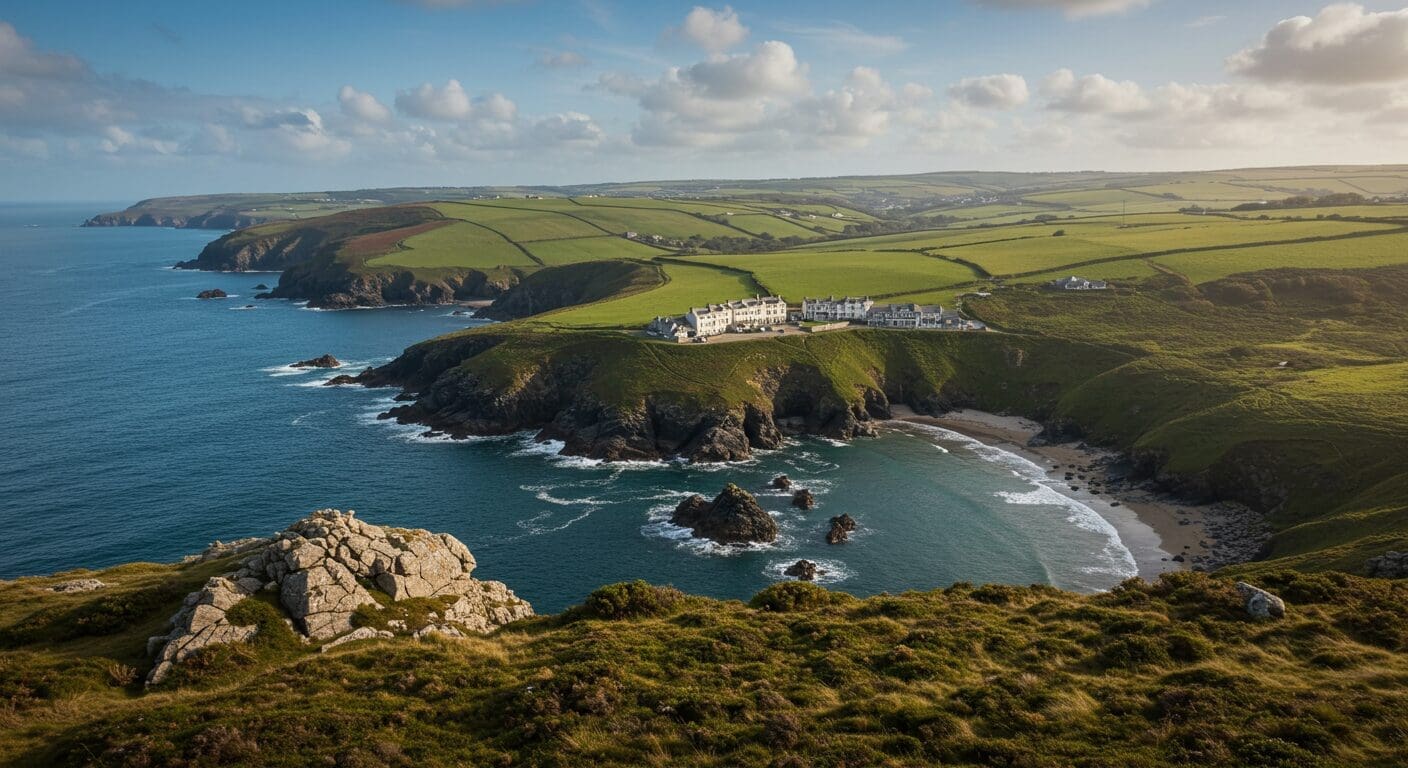
Cornwall Travel Guide: Where to Stay, Eat & Explore in Luxury
Here is a confession that may alarm the travel desk: Cornwall is not actually that far away. For anyone raised on a diet of British holiday mythology – the long queues on the A30, the search for parking in Padstow, the rain arriving precisely as the windbreaks go up – the county has always felt like a pilgrimage rather than a destination. Which is part of its enduring appeal, and also its problem. Cornwall rewards patience. It rewards the traveller who books the right place, times it correctly, and resists the urge to see everything. Those who arrive with a seven-site itinerary and a road map will see Cornwall’s surface. Those who arrive with a good villa, a slow morning, and a willingness to follow a coastal path until the only sound is the Atlantic will find something else entirely.
The county draws an unusually varied cast of travellers, and all of them are right to come. Families who want genuine privacy – no hotel corridors, no poolside timetables, no negotiating with other guests over sun loungers – find in a Cornish villa the kind of space that resets something in everyone. Couples marking a milestone, or simply needing the world to slow down for ten days, discover that Cornwall has an uncanny talent for making the rest of life feel very far away. Groups of old friends, the kind who have been talking about a reunion trip for two years, find here a landscape that offers just enough activity to fill the days without requiring anyone to be organised by nine in the morning. Remote workers – the laptop-and-good-wifi cohort who are quietly taking over the luxury villa market – have learned that Cornwall’s connectivity has improved dramatically, and that there are worse offices than a clifftop terrace above the Helford River. And the wellness-inclined traveller, tired of manufactured retreats and branded serenity, finds something rawer and more honest here: cold water, open sky, proper sea air, and the occasional sauna overlooking a cove.
Getting to the End of England – and Why It’s Worth Every Mile
Cornwall occupies the far southwestern tip of the United Kingdom, jutting into the Atlantic with an air of mild defiance, and getting there is – let us be honest – part of the experience. The M5 and A30 are the main arteries by road, and in peak summer they behave accordingly. The golden rule is to travel on a Saturday only if you enjoy contemplating motorway scenery for longer than strictly necessary. Friday departures are considerably more civilised.
Newquay Airport is the closest option for those flying, with direct services from London, Manchester, Birmingham, Edinburgh and Dublin. It is a small airport in the way that small airports used to be – efficient, unhurried, with the added bonus of being twenty minutes from a surf beach. Exeter Airport, slightly further east, offers additional routes and transfers of around ninety minutes to central Cornwall. For those travelling from London, the Great Western Railway Paddington to Penzance route is genuinely one of the more pleasurable train journeys in Britain – five hours or so, with sea views for the final stretch that make the journey feel like an arrival event in itself.
Once in Cornwall, a car is essentially non-negotiable for anyone staying in a rural villa. Public transport is improving, but the county’s greatest pleasures tend to be found at the end of lanes not served by any bus. A good four-wheel drive is useful in winter; in summer, something small enough to navigate the hedgerow-lined lanes of the Roseland Peninsula without losing a wing mirror is the wiser choice.
Where Cornwall Feeds You Extraordinarily Well
Fine Dining
Cornwall’s fine dining scene is, by any measure, disproportionately good for somewhere this rural. Credit for this goes partly to the ingredient base – the seafood, the dairy, the farms – and partly to the chefs who have decided, against most professional logic, that the far southwest is exactly where they want to cook.
Nathan Outlaw’s Restaurant in Port Isaac holds two Michelin stars and is the undisputed pinnacle of Cornish fine dining. Set above the village’s famously steep, narrow streets, it is the kind of place that confirms why people make reservations months in advance without quite knowing what they will eat. The set menu runs to around £140 per person, and the seafood is treated with the reverence it deserves – which is to say, with precision rather than fuss. Outlaw has done for Port Isaac something similar to what Rick Stein did for Padstow: made a small Cornish fishing village internationally relevant. The difference is that Port Isaac has remained, against the odds, relatively unspoiled.
Speaking of which: Rick Stein’s Seafood Restaurant in Padstow remains one of the great British institutions of its kind. The service is exceptional, the presentation inventive, and the seafood – as it has been since the 1970s – the whole point. Booking well in advance is essential; the restaurant has a waiting list and its own rooms with sea views, which tells you everything about the demand. Padstow also houses Paul Ainsworth at Number 6, a Michelin-starred room on Middle Street where absolutely everything is made in-house, including the bread, and the atmosphere is relaxed enough to make you forget you are eating at a Sunday Times Top 100 restaurant. It manages the rare trick of feeling both serious and genuinely enjoyable at the same time.
At The Headland Hotel above Fistral Beach, Ugly Butterfly by Adam Handling brings a more theatrical sensibility to the county’s fine dining map. The format is a ‘4×4’ menu exploring Cornish produce in creative combinations, with a hyper-local sourcing policy that extends to named local fishermen and farmers. The views over the Atlantic are, to use a technical culinary term, extremely distracting.
Where the Locals Eat
Coombeshead Farm, near Launceston, occupies a category of its own. When chefs Tom Adams and April Bloomfield took over the dairy farm in 2016, they created something that resists easy description – part restaurant, part rooms, entirely focused on what the farm and its surroundings can provide. The sourdough bread alone has generated considerable word of mouth. Dinner happens inside an old barn, the menu changes with what is growing or being raised on the property, and almost nothing has travelled far. It is, in the quietest possible way, one of the most impressive restaurants in the country. Securing a booking requires either forward planning or the kind of good fortune that usually only applies to parking in St Ives.
Beyond these headline names, Cornwall operates an excellent tier of fish-and-chip restaurants, crab shacks, and harbour-side cafes that are doing something more interesting than the tourist trade usually demands. The Cornish pasty question is best answered by seeking out a bakery rather than a gift shop. Proper Cornish ice cream, made with local clotted cream, is a non-negotiable.
Hidden Gems Worth Seeking Out
The best eating in Cornwall often happens in places that have no PR strategy and a hand-written specials board. Harbour towns like Mousehole, Porthleven, and St Mawes each have small restaurants and cafes that punch well above their apparent weight – places where the lobster was swimming yesterday and the wine list is shorter than the menu. The rule in Cornwall is: if there are fishing boats moored nearby and locals occupying most of the tables, you are in the right place. Trust the crab. Order the fish. And for the love of everything, do not ask for a well-done steak in a seafood restaurant.
A Peninsula of Distinct Personalities – How Cornwall’s Landscape Divides
Cornwall is long and thin – approximately seventy miles from its border with Devon to Land’s End – which means it operates less as a single destination and more as a collection of distinct territories, each with its own character and its own devoted following.
The north coast faces the Atlantic directly, which accounts for its drama. Newquay, Perranporth, Bude, Polzeath, Widemouth Bay – these are wave-shaped places, where the light is brighter, the wind is more persistent, and the beach culture has an almost Californian energy. Port Isaac sits on this coastline, quieter and more cinematic than its neighbours, made internationally familiar by the television series Doc Martin and apparently unbothered by the fact that people occasionally arrive expecting to find a fictional GP surgery.
The south coast – the Cornish Riviera, as it has been optimistically but not inaccurately called – is gentler. The rivers here form long tidal estuaries that push deep inland, creating the kind of wooded creeks that look like they belong in a different country. The Helford River is perhaps the most beautiful of these, lined with sailing villages and backed by ancient woodland. Falmouth, the county’s unofficial cultural capital, sits at the mouth of the Fal estuary with a genuinely excellent arts scene and a National Maritime Museum that is far more interesting than most people expect.
The Roseland Peninsula, southeast of Falmouth, is the place that Cornish regulars mention in hushed tones. Reached by a small ferry from St Mawes or by a single winding road, it is green, quiet, and disproportionately beautiful. St Just-in-Roseland church, set in a subtropical garden that reaches down to a tidal creek, is one of those places that stops conversation entirely.
Then there is Penzance, the Penwith Peninsula, the Minack Theatre carved into a clifftop, Sennen Cove, Land’s End itself – where the Atlantic makes its final, definitive point – and the extraordinarily light-filled artists’ enclave of St Ives, which has been attracting painters since the nineteenth century for reasons that become obvious approximately four minutes after arrival.
What to Do When You Are Not Simply Staring at the Sea
Cornwall has a useful quality for the luxury traveller: it provides excellent justification for doing almost nothing, while also offering world-class versions of almost everything.
The South West Coast Path – all 630 miles of it – is one of Britain’s great long-distance walking routes, running from Minehead in Somerset around the entire Cornish coastline to Poole in Dorset. You are not required to walk all of it. Most visitors select a stretch – the cliffs between St Ives and Zennor, the headlands around the Lizard, the dramatic approaches to Tintagel – and discover that a morning on the coast path does something profoundly useful to the nervous system. The views out to sea are, at various points, frankly surreal.
Surfing at Fistral Beach in Newquay is the county’s signature active experience. Cornwall’s position on the Atlantic coast, entirely unshielded from the ocean’s westerly swells, makes it one of the best surfing destinations in Europe. Surf schools operate year-round, and lessons are available for every level from absolute beginners to those looking to refine a technique they have been developing for years. The surfing community here is inclusive and genuine, which is not always the case at famous surf spots.
The Eden Project near St Austell remains one of Cornwall’s most legitimate attractions – two vast biomes housing ecosystems from the tropical rainforest to the Mediterranean scrub, set in a former china clay pit. It sounds like it shouldn’t work. It absolutely works. Tate St Ives is excellent and consistently underestimated. The Barbara Hepworth Sculpture Garden nearby is a genuine pilgrimage for anyone interested in twentieth-century art – her studio, left essentially as it was when she died in 1975, is one of the most affecting artist spaces in Britain.
Sailing on the Fal and Helford rivers, sea kayaking around the sea stacks of the Lizard, coasteering along the north coast, fishing trips from any number of small harbours – Cornwall’s activities list is long and genuinely varied. The county also rewards the slower pace: a drive across the central moors of Bodmin, a visit to the extraordinary Trebah or Glendurgan gardens on the Helford, or an afternoon in one of Falmouth’s independent galleries. There is something here for the person who needs to be doing something, and something for the person who needs to stop.
Where the Ocean Becomes an Adventure Rather Than a Backdrop
Cornwall takes its water sports seriously, and the geography makes it exceptionally well-suited to almost every discipline that involves the sea. The Atlantic northwest coast delivers consistent surf conditions that would be entirely respectable in Portugal or the Canary Islands. Fistral Beach and Polzeath are the most established surf zones, but Sennen Cove and Gwithian also produce excellent waves, with the added benefit of being slightly less busy.
Coasteering – that peculiarly Cornish activity involving wetsuits, life jackets, jumping off rocks into the sea, and somehow calling it a sport – has taken hold along the north coast and is now offered by numerous operators. It is exactly as exhilarating as it sounds and requires precisely zero prior experience, which democratises it usefully.
Sea kayaking and paddleboarding have grown enormously in popularity over the past decade, and rightly so. The Helford River and the Fal estuary offer flatwater paddling through scenery that is quietly extraordinary, while the sea caves and stacks around the Lizard and Cape Cornwall provide a more dramatic alternative. For those who prefer to go below the surface, the waters around the Lizard Peninsula – particularly around The Manacles reef – offer some of the best diving in England, with wrecks, seals, and clear Atlantic visibility on good days.
Sailing charters are available from Falmouth, Fowey, and St Mawes, ranging from half-day introductions to multi-day coastal cruises. Wild swimming has become an almost philosophical pursuit here – the cold-water swimming community in Cornwall has a devoted, slightly evangelical following, and the combination of sea temperature, sea air, and endorphins is genuinely difficult to argue with. Even in August, when the water reaches a temperature that certain guidebooks describe as “refreshing,” and the rest of us would describe as bracing at best.
Why Cornwall Works Brilliantly for Families – Even the Teenage Ones
Cornwall has been a family holiday destination since the Victorian railway opened up the southwest, and it remains one of the most reliably successful choices for families in the entire country. The reasons are partly geographical – the beaches are genuine, the rock pools are teeming, the countryside is safe and accessible – and partly structural, in that the county simply understands what families need without making a performance of it.
For families choosing a luxury villa over a hotel, the advantages are significant and immediate. A private pool changes the holiday dynamics entirely – no timetables, no other guests, no negotiating with the lifeguard over inflatables. Large villa properties in Cornwall frequently come with enclosed gardens, games rooms, cinema rooms, and direct coastal access, meaning that the logistics of keeping people of varying ages and energy levels happy are considerably simplified. Younger children can move freely between indoor and outdoor spaces. Teenagers, who might otherwise approach a countryside holiday with the enthusiasm of someone attending a lengthy meeting, tend to discover quite quickly that Cornwall offers surfing, sea kayaking, coasteering, and enough independence to make the whole thing their idea.
The Eden Project is excellent for children of any age who have the slightest curiosity about the natural world. The Cornish seal sanctuary at Gweek, the mining museums of the World Heritage-listed Cornish Mining Landscape, and the numerous adventure parks and outdoor activity centres around the county provide additional structure for those days when the beach is not enough. And the food culture – crab sandwiches, ice cream, proper pasties, fish and chips on a harbour wall – is a significant part of the family experience in a way that genuinely delivers on the promise.
The Deep History and Living Art Scene That Most Visitors Only Scratch
Cornwall is one of the oldest inhabited landscapes in Britain, and its history sits close to the surface – literally, in many cases, in the form of Neolithic standing stones and Bronze Age monuments scattered across the Penwith Peninsula with an almost casual frequency. The Men-an-Tol, the Merry Maidens stone circle, the Lanyon Quoit burial chamber – these are places that predate Stonehenge and yet are visited by a fraction of the crowds, which is either a genuine mystery or simply a reflection of how far away Cornwall feels from the rest of England.
The Cornish Mining World Heritage Site – covering the industrial landscape of the mid-Cornwall mining district and the Penwith coast – tells the story of a county that was, in the nineteenth century, a global industrial powerhouse. The engine houses that punctuate the coastal cliffs are among the most atmospheric pieces of industrial architecture in Britain. The Levant Mine and Beam Engine near St Just, still in operation as a working museum, is extraordinary.
Tintagel Castle, associated with the Arthurian legends and dramatically positioned on a headland above the sea, is another matter – the views are genuine, the atmosphere is powerful, and the new bridge connecting the mainland to the island on which the castle stands is an impressive piece of contemporary engineering. The legends themselves may be contested, but the location is not.
The St Ives art scene deserves particular attention. The town attracted artists from the 1880s onwards – initially the Newlyn School, then an extraordinary post-war cluster including Ben Nicholson, Barbara Hepworth, Naum Gabo, and Patrick Heron – drawn by a quality of light that painters have been struggling to describe accurately ever since. Tate St Ives, opened in 1993 and expanded in 2017, presents this legacy alongside contemporary work with genuine curatorial intelligence. The wider town is full of independent galleries, studios, and craft workshops, most of them the real thing rather than the decorative version.
Cornwall also celebrates its Celtic identity with a seriousness that surprises visitors expecting something purely folkloric. The Cornish language has been in revival since the mid-twentieth century – place names across the county are signposted bilingually, and there is a growing movement of native speakers and learners. The Golowan Festival in Penzance, midsummer celebrations, and the Flambeau procession at St Ives are cultural events rather than tourist performances. They are worth attending if your visit coincides.
Buying Something Worth Carrying Home
Cornwall produces a remarkable number of things worth buying, most of them entirely unsuitable for hand luggage. The pottery tradition – deep-rooted in St Ives and the surrounding area – continues to produce work of genuine quality, from small studios selling affordable pieces to established names whose work appears in national collections. Leach Pottery in St Ives, founded by Bernard Leach in 1920 and still operating today, is a place of pilgrimage for anyone interested in studio ceramics.
Food and drink from Cornwall travels well and constitutes some of the most thoughtful shopping the county offers. Cornish sea salt from the Lizard Peninsula, local honey, cold-pressed rapeseed oil, smoked fish from small Cornish smokehouses, and the extraordinary range of Cornish cheeses – Yarg being the most famous, Davidstow Cheddar the most widely consumed, and a growing number of artisan varieties in between – all make excellent gifts and, more importantly, excellent reasons to find a villa with a well-equipped kitchen.
The Cornish gin and whisky scene has developed considerably in recent years. Several independent distilleries now operate across the county, producing spirits that are genuinely distinctive and not simply trading on the Cornish branding opportunity. The local beer scene is similarly strong, with a number of craft breweries – Skinner’s and Trevithick’s among the most established – producing ales that reflect the character of the place with more accuracy than the labels suggest.
For clothing and textiles, the independent boutiques of St Ives, Falmouth, and Fowey offer interesting alternatives to the national chains, with a particular strength in outdoor and marine-influenced clothing that manages to be practical without being purely functional. Falmouth’s high street, considerably livelier and more interesting than its size suggests, rewards an unhurried afternoon.
The Practical Notes That Actually Matter
Cornwall operates on British pounds, naturally, and card payments are accepted almost universally – even at the more rural farm shops and some of the smaller harbour cafes, which have adapted faster than expected. Cash remains useful for parking machines, farmers’ markets, and the occasional village pub that maintains a principled relationship with the analogue world.
Tipping follows standard British practice: ten to fifteen percent in restaurants is usual and expected, with no obligation in cafes or pubs, though rounding up is always appreciated. Taxis and private hire drivers expect a tip in the same range.
The best time to visit is a genuinely interesting question. July and August deliver the warmest temperatures and the longest days, but also the highest prices, the busiest beaches, and the A30 at its most characterful. June and September are the choices of experienced Cornwall visitors – the light is excellent in both months, the Atlantic is surprisingly warm by September, the crowds have thinned to a manageable level, and the restaurant bookings become achievable again. For the surf, autumn and early winter produce the most consistent Atlantic swells. For walking and cycling, March through May and September through October are ideal. The county does not close in winter – several of the best restaurants operate year-round, and the landscape in January is both wild and entirely crowd-free.
The weather in Cornwall is its own entity and should be treated with respect. The county receives more sunshine than most of England, and the Gulf Stream keeps the winters mild, but the Atlantic delivers rain with a directness that renders standard umbrellas largely symbolic. A good waterproof jacket is not optional gear; it is the rational response to the environment.
Mobile phone coverage is variable and rural. Broadband connectivity in premium villa properties has improved significantly – properties with Starlink satellite internet now exist across the county, including in some of the most remote coastal locations. For those working remotely, this is worth checking specifically when booking; it is the difference between a blissful working holiday and a very expensive source of frustration.
Why a Luxury Villa in Cornwall is a Different Holiday Entirely
Cornwall has hotels – some of them excellent, a handful of them genuinely world-class. But the county reveals itself most fully from a private villa, and the reasons go beyond the obvious advantages of space and privacy.
A luxury villa in Cornwall gives you the mornings. This, more than anything else, is the argument. The ability to step out of a cliff-edge property at seven in the morning with a coffee and stand in front of the Atlantic without another guest in sight – this is a fundamentally different quality of experience than any hotel can offer, regardless of the thread count. Large villa properties across the county come with private pools heated to a useful temperature even in shoulder season, enclosed gardens where children can move freely, professional kitchen facilities that make sense of the county’s extraordinary produce markets, and cinema rooms for the inevitable wet evening.
For groups – friends reuniting after years, multi-generational families where everyone needs their own space but proximity is the point – a large Cornish villa offers a shared base that operates like a private estate. Several properties accommodate twelve or more guests without anyone feeling crowded. Separate wings, annexes, or cottages within the same estate allow different generations to coexist at the appropriate distance. Some properties come with staff – a housekeeper, a private chef, a concierge service – which removes the logistical friction entirely and allows the holiday to be exactly that.
For the wellness-focused traveller, Cornwall’s villa landscape has developed to meet a genuine need. Hot tubs and outdoor pools facing the sea, private yoga platforms, infrared saunas, cold plunge facilities, and easy access to the coast path have made the county one of the most credible wellness destinations in Britain. The air is doing half the work already. The landscape does the rest. The villa simply needs to stay out of the way.
Remote workers have discovered that Cornwall is, with the right property, among the most productive places in the country to be. The combination of excellent villa connectivity – increasingly via Starlink – dramatic outdoor surroundings that genuinely clear the mind between sessions, and the removal from the normal environmental cues of office or home creates a focus that many guests describe as surprising. It turns out that a good desk with an Atlantic view and nobody interrupting you actually works.
Excellence Luxury Villas offers an exceptional range of properties across the county, from clifftop estates on the north Atlantic coast to waterside retreats on the Helford and Fal rivers, each selected for the particular quality it offers. If Cornwall has been on your list – and for most people who know it well, it never really leaves the list – the right villa is the difference between a good holiday and one you will spend the next several years trying to replicate. Explore our full collection of luxury holiday villas in Cornwall and find the one that fits.
More Cornwall Travel Guides
- Best Restaurants in Cornwall: Fine Dining, Local Gems & Where to Eat
- Cornwall Food & Wine Guide: Local Cuisine, Markets & Wine Estates
- Cornwall with Kids: The Ultimate Family Holiday Guide
- Best Time to Visit Cornwall: Month by Month Weather, Crowds & Tips
- Cornwall Luxury Itinerary: The Perfect 7-Day Guide
- Romantic Cornwall: The Ultimate Couples & Honeymoon Guide
What is the best time to visit Cornwall?
June and September represent the sweet spot for most visitors – warm enough to swim, long enough days for walking and sailing, and meaningfully quieter than the peak July and August weeks. Prices are lower, restaurant bookings are more achievable, and the light in both months is exceptional. Surfers favour the autumn and early winter, when Atlantic swells are at their most consistent. Winter is genuinely underrated for those who want the coast and the countryside entirely to themselves – the mild Gulf Stream climate means Cornwall rarely feels as cold as the rest of Britain in January, and the dramatic weather can be spectacular from the right vantage point.
How do I get to Cornwall?
Newquay Airport is the most convenient option, with direct flights from London Gatwick, London Heathrow, Manchester, Birmingham, Edinburgh, and Dublin. Transfer times to most parts of Cornwall are between twenty minutes and ninety minutes depending on your destination. Exeter Airport offers additional routes with transfers of around ninety minutes to central Cornwall. By train, the Great Western Railway Paddington to Penzance service takes approximately five hours and is a genuinely pleasant journey, with sea views for the final stretch along the south coast. By road, the M5 and A30 are the main routes – avoid travelling on Saturday mornings in July and August unless you have developed a deep interest in motorway services.
Is Cornwall good for families?
Cornwall is one of the best family destinations in Britain, and it has been for good reason for well over a century. The beaches are exceptional, the rock pools genuinely alive, and the range of activities – from surfing lessons and coasteering to the Eden Project and the Cornish seal sanctuary – covers every age and energy level. For families choosing a luxury villa, the advantages extend further: a private pool, an enclosed garden, a large kitchen for feeding everyone at different times, and enough space that the adults can have a conversation undisturbed. Older children and teenagers, who might approach a countryside holiday with some scepticism, tend to find Cornwall’s water sports, surf culture, and general sense of coastal freedom considerably more compelling than they expected.
Why rent a luxury villa in Cornwall?
A luxury villa gives you the kind of holiday that a hotel structurally cannot. The mornings are yours – no communal breakfast times, no other guests at the pool, no negotiating the day’s schedule around anyone else’s. For families, a private pool and enclosed garden change the holiday dynamics entirely. For groups, a large villa provides shared space and genuine privacy simultaneously. Staff options – private chef, housekeeper, concierge – remove the logistical work and leave the actual holiday. The guest-to-staff ratio in a well-staffed villa is typically far higher than any hotel can offer at a comparable price point. And the ability to eat together, cook with local produce from the farmers’ market, and use the property as a genuine home base rather than simply a place to sleep is something guests consistently describe as transformative.
Are there private villas in Cornwall suitable for large groups or multi-generational families?
Yes, and Cornwall’s villa inventory is particularly strong in this category. Properties accommodating ten to sixteen guests are available across the county, from cliff-edge estates on the north Atlantic coast to river-fronting retreats on the Helford. Several larger properties include separate annexes, cottages within the grounds, or self-contained wings that allow different family generations or friend groups to have genuine privacy while sharing communal spaces. Private heated pools, games rooms, cinema rooms, and large kitchen-dining spaces designed for group entertaining are common features at this level. For multi-generational bookings in particular, the ability to choose a property with ground-floor accessible bedrooms and step-free garden access is worth discussing with the villa team.
Can I find a luxury villa in Cornwall with good internet for remote working?
Increasingly, yes. Cornwall’s connectivity reputation has improved significantly, and a growing number of premium villa properties now offer Starlink satellite internet as standard – delivering reliable high-speed connectivity even in remote coastal or rural locations where traditional broadband is patchy. When booking for remote working purposes, it is worth specifying this requirement directly so that the villa team can confirm the connection speeds and workspace available. Several properties are now designed with remote working in mind, with dedicated desk spaces, ergonomic chairs, and the kind of Atlantic view that makes a video call background entirely justifiable. The combination of excellent connectivity, dramatic outdoor surroundings, and genuine removal from normal office distractions creates a working environment that many guests find unexpectedly productive.
What makes Cornwall a good destination for a wellness retreat?
Cornwall’s case for wellness is built on fundamentals rather than amenities. The air quality along the Atlantic coast is measurably clean, the coastline provides immediate access to cold-water swimming with all its documented benefits, and the South West Coast Path offers walking of genuine intensity or gentle restorative pace depending on the day’s requirement. At the villa level, the county’s premium properties have developed to meet the demand: heated outdoor pools, hot tubs and cold plunge facilities, infrared saunas, private yoga platforms, and in some cases in-villa spa treatment services. Several villa properties have direct access to the coast path or to private beach areas. Local wellness practitioners – yoga teachers, massage therapists, cold-water swimming guides, and nutritional chefs – operate across the county and can be arranged through a villa concierge service. Cornwall does not try to manufacture the wellness experience; the landscape does most of it naturally.