Crete Travel Guide: Where to Stay, Eat & Explore in Luxury
Here is something the guidebooks rarely bother to tell you about Crete: it is not really a Greek island. Not in the way Mykonos or Santorini are Greek islands, at least. Those places exist in a kind of perpetual performance of themselves – the windmills, the sunsets, the influencers with their arms outstretched. Crete is something older and considerably less interested in your approval. It has its own dialect, its own cuisine, its own music, its own centuries-long habit of resisting whoever happens to be in charge at the time. The Minoans were here four thousand years ago building palace complexes of baffling sophistication while most of Europe was still working out what a wheel was. That continuity of character – proud, generous, slightly fierce, deeply proud of the table – is exactly what makes a luxury holiday in Crete feel like something more substantial than a holiday. It feels, oddly, like an education. A delicious one, but still.
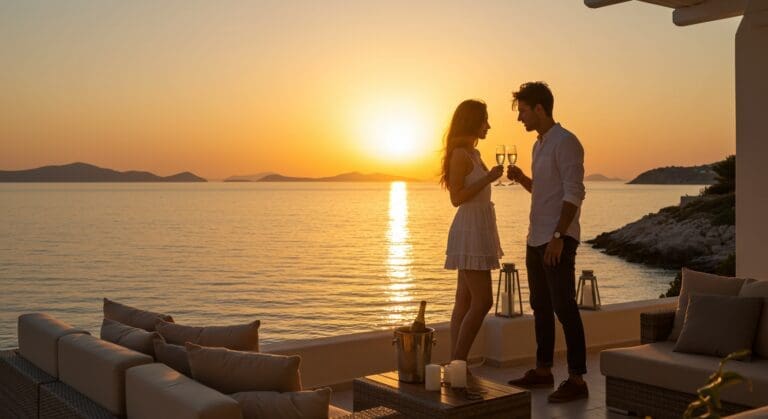
Crete works for a remarkably broad range of travellers, which is either a testament to the island’s range or a sign that it simply refuses to be categorised. Families seeking genuine privacy – the kind that doesn’t involve sharing a pool deck with sixty strangers – find it in abundance here, particularly in a well-appointed villa above an empty bay. Couples celebrating milestone anniversaries or honeymoons discover that the combination of serious food, serious wine, and landscapes of almost theatrical beauty does most of the heavy lifting. Groups of friends who’ve graduated from Airbnb to something with a private chef and a proper infinity pool find Crete inexhaustible – there is always another village, another gorge, another taverna that someone’s brother-in-law swears is the best in the region. Remote workers, increasingly, are discovering that fibre broadband has reached even the more remote parts of the island, making it entirely possible to spend three weeks working mornings, swimming afternoons, and eating extraordinarily well throughout. And wellness travellers – those seeking something more rigorous than a spa menu and a sunrise yoga class – find in Crete a place where the food itself is medicinal, the light is restorative, and the pace of life has been calibrated over millennia for exactly this purpose.
Getting to Crete: Further Than You Think, Easier Than You’d Expect
Crete is the largest of the Greek islands and, depending on which end you’re aiming for, this matters more than you might think. The island is roughly 260 kilometres long – about the same distance as London to Newcastle, which puts some perspective on the idea of “popping over” from the western to eastern coast for lunch. Plan your arrival accordingly.
There are two main international airports. Heraklion Nikos Kazantzakis (HER) sits in the north-centre of the island and handles the bulk of the summer traffic – direct flights operate from most major European cities throughout the season, and from London year-round with varying frequency depending on the airline’s seasonal whims. Chania International Airport (CHQ) serves the north-west and is often the more convenient option if your villa or itinerary is Chania-focused – the city itself is only about fifteen minutes away, which is a pleasure after a long flight. A third, smaller airport at Sitia in the east is useful for those heading to the Lasithi plateau or the far eastern reaches of the island, though connections are more limited.
Once you land, a hire car is not optional – it is, in fact, the single most important booking you will make. Crete rewards exploration and punishes those who rely on taxis. The roads range from excellent dual carriageway along the north coast to vertiginous single tracks through mountain villages that feel like they were designed specifically to test the nerve of anyone who hired anything larger than a Fiat 500. Drive accordingly. The north coastal road connects Chania, Rethymno, and Heraklion relatively efficiently. The south coast is slower, more dramatic, and considerably more rewarding.
Eating in Crete: Where the Mediterranean Diet Actually Lives
Fine Dining
Cretan cuisine is not Greek food with better olive oil. It is an entirely distinct culinary tradition – one shaped by altitude as much as coastline, by centuries of isolation, and by an agricultural landscape that has, somewhat miraculously, not yet been entirely overwhelmed by industrial farming. The island produces its own cheese, its own wine, its own honey, its own herbs, and its own extraordinarily good olive oil, and the best restaurants here know exactly what to do with all of it.
In Heraklion, Peskesi has become one of the most talked-about dining experiences in all of Greece – and earned the title of Best Organic Restaurant in Europe for 2025, which is the sort of accolade that tends to make reservations considerably harder to obtain. The menu is a serious reclamation project: ancient Cretan varieties of grain, pulse, and vegetable that had largely vanished from commercial agriculture, brought back to the table with both archaeological rigour and genuine culinary skill. The food is remarkable and the service matches it. Do not turn up without a reservation.
In Rethymno, Avli operates out of a beautifully preserved Venetian villa and produces food that justifies the setting rather than hiding behind it. The gastronomic menu draws heavily on Cretan ingredients prepared with considerable refinement – this is not a taverna dressed up in tablecloths, but a genuinely serious kitchen. They also offer cooking masterclasses for guests who want to take something more than a suntan home, which is the kind of addition that separates the great restaurants from the merely excellent.
For something that arrives with its own stretch of coast, Pelagos Sea Side Restaurant near Ierapetra in the south delivers beachfront fine dining at a level that south Crete has no particular obligation to offer, yet somehow does. The beetroot soup, the tableside-prepared salad, and the shrimp spaghetti are mentioned with something close to reverence by regulars. The exclusive beach area adjacent to the restaurant is a civilised addition that allows lunch to become an afternoon with minimal effort.
Where the Locals Eat
The honest answer is that locals eat at whatever taverna is run by someone they know, which is less helpful as travel advice than it sounds. What you are looking for is the place with no laminated menu, handwritten specials on a chalkboard, and a proprietor who appears personally invested in whether you enjoyed the lamb. These places exist in every village on the island and the quality variance, frankly, is lower than you’d expect. A mediocre Cretan taverna is still serving better ingredients than most European restaurants operate with.
In Chania’s Old Town, Tamam has been feeding visitors and locals alike for long enough to have earned its reputation without coasting on it. Set in a converted Turkish bathhouse a short walk from the Venetian Harbour, it serves a menu that blends traditional Cretan cooking with more cosmopolitan influences – the kind of place where you order too much because everything sounds good, and are vindicated entirely. The setting manages to be atmospheric without being theatrical, which is a balance that central Chania does not always achieve.
Cretan markets deserve an afternoon of anyone’s time. Heraklion’s central market on 1866 Street is the obvious starting point – stalls selling local cheeses, cured meats, wild herbs, honey, and olive oil of genuinely variable quality (ask questions, or accept samples, or both). The Saturday morning market in Chania is smaller and considerably more pleasant, less tourist-facing, and more likely to result in an unplanned conversation about which village produces the best graviera.
Hidden Gems Worth Seeking Out
Dounias, in the foothills of the Lefka Ori above Chania, is the kind of place that people describe in hushed, proprietary tones – as though discovering it constitutes some personal achievement. And in a sense it does, because it requires intent to reach and a willingness to surrender to someone else’s timing. The owner Stelios Trilyrakis has built a farm-to-table experience that takes the concept entirely literally: the vegetables come from the garden you can see, the cheese from cattle he raised, the olive oil from his own trees. The recipes are drawn from a tradition that predates the concept of recipe writing. It is, by some margin, one of the most honest meals you can eat in Greece.
The Shape of the Island: What to Know Before You Drive Anywhere
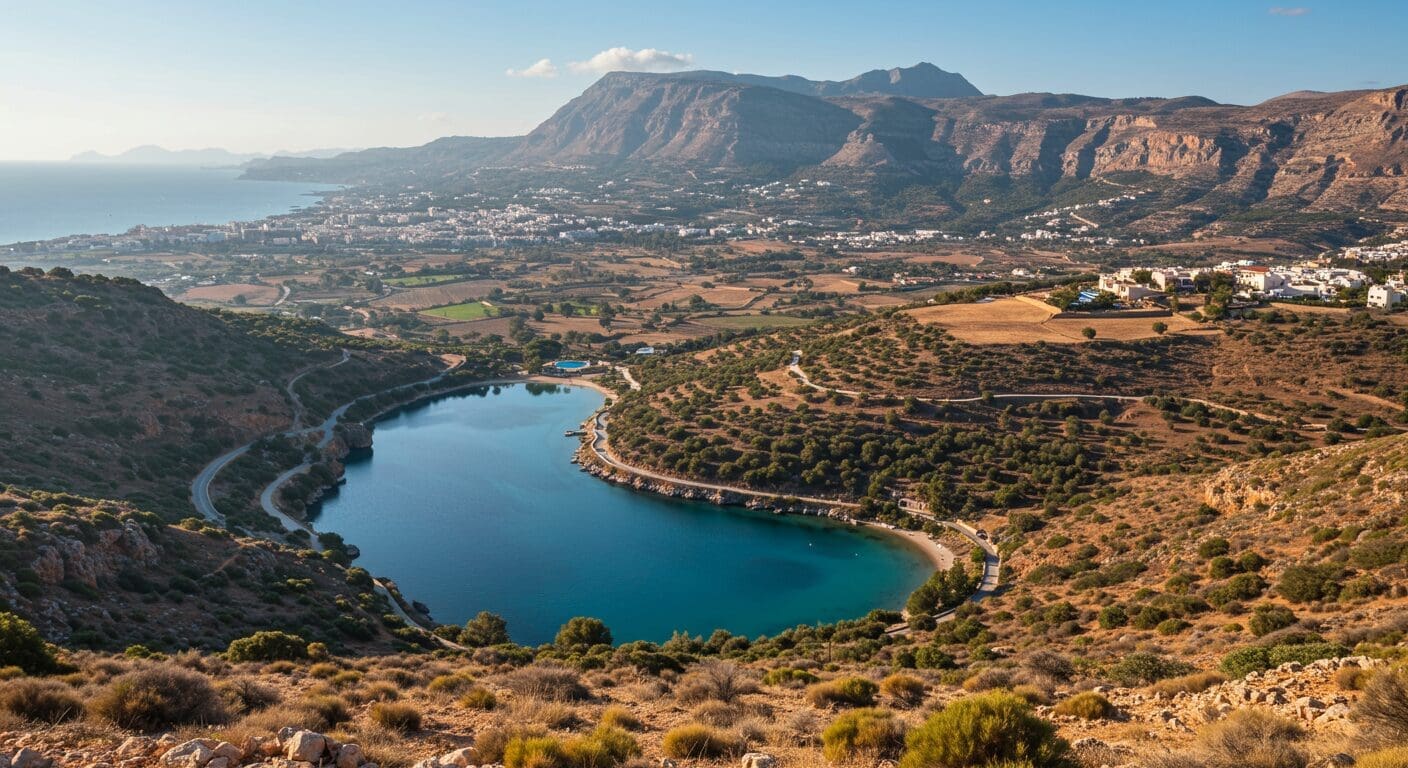
Crete divides, broadly, into four regional units running west to east: Chania, Rethymno, Heraklion, and Lasithi. Each has a distinct character and its own reasons to stay, and the mistake most first-time visitors make is treating the island as a single destination rather than four loosely connected ones.
Chania, in the west, is arguably the most immediately seductive. The Venetian harbour – all curved stone, bobbing fishing boats, and minarets that the Ottomans left behind – is genuinely as handsome as it looks in photographs, which is not something you can say about every famous view in Greece. The surrounding region offers both the dramatic mountain scenery of the White Mountains and the extraordinary beaches of the Balos lagoon and Elafonisi, the latter with its improbable pink-tinged sand.
Rethymno sits between Chania and Heraklion and possesses its own well-preserved Venetian old town, its own lighthouse, its own Venetian fortress, and a slightly more relaxed relationship with tourism than either of its neighbours. The beaches along the northern coast here are long, wide, and backed by dunes in places – a different aesthetic from the dramatic coves of the south but no less appealing when you want to spread out.
Heraklion is the capital and the largest city, and it rewards the effort required to see past its utilitarian outskirts. The Archaeological Museum is one of the finest in the Mediterranean. The nearby Palace of Knossos is justifiably essential. The food scene, as Peskesi alone demonstrates, is entirely serious.
Lasithi, in the east, is Crete at its quietest and, for many regulars, its most beautiful. The Lasithi plateau is a high agricultural plain ringed by mountains, dotted with windmill towers. The coastline around Elounda and Spinalonga offers some of the island’s most dramatic scenery. The town of Sitia, unhurried to the point of appearing slightly somnolent, is a reminder that not all of Crete has been arranged for your convenience.
Things to Do in Crete That You Will Actually Remember
The Heraklion Wine Trail deserves considerably more attention than it typically receives from visitors who assume Greek wine peaks at house retsina. It does not. The indigenous Cretan varietals – Vidiano, Kotsifali, Mandilari, Thrapsathiri – have been the subject of serious winemaking investment for two decades now, and the results have quietly become some of the most interesting bottles emerging from the Mediterranean. The region around Heraklion, particularly the Dafnes, Peza, and Archanes appellations, produces wines of real character. Several estates offer tastings and tours – the kind of afternoon that starts as an educational exercise and ends with you trying to work out the maximum allowance for checked luggage.
The Palace of Knossos, four thousand years old and five kilometres from Heraklion, is the obvious cultural pilgrimage and genuinely earns its fame. The scale of it – multiple storeys, sophisticated drainage systems, rooms painted with frescoes that suggest a civilisation of considerable visual sophistication – recalibrates your sense of how old human ambition actually is. The Evans reconstructions are controversial among archaeologists, but they help the imagination rather more than an undifferentiated pile of stones would. Go early. The site becomes very crowded by mid-morning, and the Minoans deserve better than to be experienced in a crush.
The Cave of Dikteon at the Lasithi Plateau is where Zeus was reportedly born, which gives it a certain mythological authority. Whether or not you find that compelling, the plateau itself – the windmills, the almond trees, the extraordinary light – justifies the drive up regardless.
Boat trips along the southern coast are among the quieter pleasures: taking a ferry or private boat to isolated beaches accessible only from the water, arriving before the sun has become aggressive, eating lunch at a taverna that appears to have been placed there specifically for the purpose, and returning to your villa in the late afternoon with the particular satisfaction of a day entirely well spent.
Adventure and the Great Outdoors: Crete Takes It Seriously
Samaria Gorge is the signature Cretan adventure, and with good reason. The 16-kilometre trail descends from the Omalos plateau through the White Mountains to the Libyan Sea at Agia Roumeli, passing through forests of ancient cypress, the ruins of an abandoned village, and the Iron Gates – a section where the canyon walls close to less than four metres apart while rising to heights of 300 metres above. It is extraordinary. It is also, in peak season, a procession, which rather takes the edge off the wilderness experience. The solution is to go early – significantly earlier than you think you need to – or to visit in May or late September when the numbers drop considerably.
The kri-kri, a wild goat found only on Crete and two offshore islands, has the excellent habit of appearing silhouetted on impossible outcrops at moments of maximum photographic opportunity. Whether this is instinct or performance art remains unclear. There is no road out of Agia Roumeli, incidentally – the trail ends at the sea, and ferries run along the coast to Hora Sfakion, which is all part of the point.
Scuba diving along the northern and southern coasts offers clear visibility, interesting geological formations, and the occasional wreck. The area around the Cretan Sea is home to sea turtles, octopus, moray eels, and various other creatures that appear to be entirely untroubled by the presence of divers. Certified operators run courses for beginners and guided dives for the experienced from most of the larger coastal towns.
Mountain biking in the interior – particularly on the routes through the Psiloritis massif and the Lasithi plateau – attracts an increasingly organised community of riders. Road cycling along the coastal routes is popular in spring when the temperatures are merciful and the roads are not yet competing with summer hire car traffic. Kitesurfing, for those with the relevant skills, is excellent at several north coast beaches where the prevailing Meltemi winds arrive with reliable enthusiasm in July and August.
Crete for Families: Where Privacy Becomes the Real Luxury
Families who have experienced the particular atmosphere of a hotel pool in August – the combination of sun lounger competition, inadequate shade, and the ambient soundscape of other people’s children – tend to arrive at the private villa conclusion fairly quickly. In Crete, the luxury villa rental market has evolved to meet exactly this need, and a well-chosen property with a private pool, multiple bedrooms, and outdoor space that belongs entirely to your party changes the nature of a family holiday in ways that are difficult to overstate.
Children, it turns out, are considerably more manageable on holiday when they have space to be unreasonable at a safe distance from other guests. Parents are more relaxed when lunch can happen at 1pm rather than at whatever time the restaurant stops serving. Teenagers are less troubling when there is a pool to monopolise and a reasonable internet connection to disappear into. Grandparents are happier when they can read on a shaded terrace without industrial-scale entertainment being directed at them. The multi-generational family holiday, which hotels handle with varying degrees of success, is essentially what luxury villas in Crete were invented for.
The beaches of western Crete – Elafonisi, Balos, Falassarna – are genuinely magnificent and perfectly suited to families with young children: shallow, warm, relatively calm, and possessed of the kind of beauty that makes even teenagers acknowledge, briefly, that the world is not entirely disappointing. Heraklion and Chania both offer age-appropriate cultural content – Knossos has genuine narrative pull for children old enough to have encountered Greek mythology, which is most of them.
History and Culture: Four Thousand Years of Having Opinions
Crete’s history is not linear so much as geological – layer upon layer of civilisation, each one pressing down on the last. The Minoans came first, circa 2000 BCE, and built a palace culture of extraordinary refinement at Knossos, Phaistos, Malia, and Zakros. They traded across the Mediterranean, produced art of striking naturalism, and appear to have organised society along lines that remain subjects of heated academic debate. Then they disappeared, with the kind of sudden totality that keeps archaeologists productively employed.
After the Minoans came the Mycenaeans, then various waves of occupation – Dorians, Romans, Byzantines, Arabs, Byzantines again, Venetians, Ottomans – each leaving traces that are visible, once you know what you are looking at, in almost every town on the island. The Venetian occupation (roughly 1204 to 1669) left the most architecturally visible legacy: the fortress at Heraklion, the old towns of Chania and Rethymno, the harbour walls, the loggia, the fountains. The Ottoman period, which followed, added minarets and hammams that now coexist, somewhat incongruously, with Venetian stonework.
The Battle of Crete in 1941 – when Allied forces and Cretan civilians fought the German airborne invasion with considerable ferocity – is a chapter that Cretans have not forgotten and will tell you about, in some cases with their grandfather’s personal testimony still in circulation. The island’s resistance culture runs deep, and the warmth with which older Cretans remember British and Commonwealth soldiers is both genuine and slightly humbling.
Cretan music – the lyra, a bowed instrument quite distinct from the violin it superficially resembles, driving rhythms that seem designed to make the room louder – is still performed at panegyria (village festivals) throughout the summer. Finding a genuine one, rather than a staged version for tourists, requires local intelligence. Your villa concierge is, in this respect, more useful than any guidebook.
Shopping in Crete: What’s Actually Worth Bringing Home
The souvenir shops of Crete’s tourist centres sell, with impressive uniformity, the same range of magnets, evil eye pendants, ceramic plates, and linen shirts across virtually every town on the island. This is not a reason to avoid shopping; it is a reason to shop selectively and with specific intent.
Cretan olive oil is the obvious and entirely defensible starting point. The island produces some of the finest extra-virgin olive oil in the world – the Koroneiki variety from the Lassithi and Messara plains is particularly good – and buying directly from a producer or a serious local delicatessen guarantees both quality and the slight satisfaction of having done the thing properly. Cretan honey, particularly thyme honey from the mountain regions, travels well and is extraordinary in ways that make supermarket honey feel like a different product entirely.
Graviera cheese – a firm, slightly nutty cheese produced in Crete and aged to varying degrees – is worth seeking out in its better versions from specialist cheese shops in Rethymno or Heraklion rather than the vacuum-packed version in the airport departure lounge. Local herbs – dictamo (dittany of Crete), mountain tea, dried thyme – are inexpensive, fragrant, and useful. Cretan wines, as discussed, are increasingly worth carrying home in quantities that test your commitment to the checked luggage calculation.
In Chania, the leather goods quarter in the old town produces sandals, belts, and bags made to order, often while you wait. The quality varies, but at the better workshops the craftsmanship is genuinely impressive and the prices are a considerable improvement on equivalent products in London or Paris.
Practical Crete: The Things Worth Knowing Before You Arrive
The currency is the euro. Greece tips, but not with the anxiety-inducing calculation of some other destinations – rounding up or leaving five to ten percent is perfectly correct in restaurants; slightly less is expected in tavernas and cafés. Taxi drivers do not expect tips and will generally not wait for them.
The best time to visit Crete depends almost entirely on what you want from it. July and August are the peak months – the sea is warm, the light is extraordinary, and approximately half of northern Europe has arrived ahead of you. Temperatures regularly exceed 35°C in Heraklion and the eastern parts of the island, and the Meltemi wind, which blows with varying intensity throughout summer, is either a blessing or an irritant depending on your relationship with wind. May, June, and September are, for most purposes, the optimal months: the sea is warm enough, the crowds are manageable, the light is magnificent, and the wildflowers (in May particularly) make the hillsides briefly spectacular.
April and October are viable and rewarding for those more interested in culture and walking than swimming. Winter – November through March – is quiet, sometimes rainy, but possessed of its own atmosphere. The island functions year-round, the restaurants remain open, and the prices are a different conversation entirely.
Greek is the language; English is widely spoken in tourist areas and less reliably in mountain villages, where a few words of Greek will be received with disproportionate warmth. “Efharisto” (thank you) and “kalimera” (good morning) are worth the investment. Dress codes apply at churches and monasteries – shoulders and knees covered – and the social habit of arriving late to dinner is not merely acceptable but essentially mandatory. A reservation for eight o’clock means you may be the first people in the restaurant.
Water from the tap is drinkable in most urban areas; in more remote locations, bottled water is the convention. Pharmacies are numerous and well-stocked. The sun, particularly between noon and 4pm from May through September, is considerably more powerful than northern European visitors typically expect on the first day. The third day is when it becomes apparent.
Luxury Villas in Crete: The Case for Not Sharing Your Pool With Anyone
There is a version of a Crete holiday that involves a hotel, a shared pool, a buffet breakfast assembled with impressive accuracy to what everyone’s second choice would be, and a terrace that overlooks someone else’s terrace. It is a perfectly functional holiday. It is, however, not this.
A private luxury villa in Crete offers something qualitatively different – not merely an upgrade in thread-count but a fundamental reorientation of what the holiday is actually for. The privacy is the starting point, not the luxury. Waking up and walking directly to your own pool, in your own garden, with your own view of the sea or the mountains or the olive groves, before anyone else in the house has reached for their phone – this is the specific pleasure that no hotel, however grand, can replicate. Space matters too: the difference between a family of six in a sequence of hotel rooms and the same family in a villa with multiple living areas, a proper kitchen, and outdoor space measured in acres rather than square metres is not a small one. It is the difference between coexisting and actually enjoying each other’s company.
Many of the luxury villas in Crete available through Excellence Luxury Villas come with staff options – from a daily housekeeper to a full concierge and private chef service – which resolves the only legitimate objection to villa holidays (the faint administrative anxiety of self-catering) while preserving the privacy that makes them worth choosing in the first place. A private chef cooking a Cretan dinner in your villa’s outdoor kitchen, using ingredients from the morning’s market, is an experience that earns its own category.
For remote workers, a well-specified Cretan villa with reliable high-speed internet provides what most open-plan offices have conspicuously failed to: a genuinely productive working environment in which the reward for finishing your 11am call is an immediate swim. The wellness dimension is less complicated to explain: the combination of outdoor living, Cretan food, morning walks, afternoon swims, and the specific silence of a hillside villa at night does the work that expensive retreats charge considerable sums to approximate.
Crete, at its best, is not a backdrop to a holiday. It is the entire argument for one. And the right villa is where that argument becomes irresistible. Browse our collection of luxury holiday villas in Crete and find the one that suits your version of it.
More Crete Travel Guides
- Best Restaurants in Crete: Fine Dining, Local Gems & Where to Eat
- Crete Food & Wine Guide: Local Cuisine, Markets & Wine Estates
- Crete with Kids: The Ultimate Family Holiday Guide
- Best Time to Visit Crete: Month by Month Weather, Crowds & Tips
- Crete Luxury Itinerary: The Perfect 7-Day Guide
- Romantic Crete: The Ultimate Couples & Honeymoon Guide
What is the best time to visit Crete?
May, June, and September are the sweet spot for most travellers – the sea is warm, the light is excellent, the main sites and restaurants are fully open, and the peak-season crowds have not yet arrived or have largely dispersed. July and August are the warmest months and the busiest; the experience is perfectly good but requires more patience and earlier starts. April and October suit walkers and culture-focused visitors well. Winter is quiet but atmospheric, with lower prices and an island that belongs almost entirely to Cretans.
How do I get to Crete?
Crete has two main international airports: Heraklion Nikos Kazantzakis (HER) in the north-centre of the island, and Chania International Airport (CHQ) in the north-west. Both handle direct flights from most major European cities during the summer season, with year-round connections from the UK and Germany in particular. A smaller airport at Sitia serves the eastern end of the island. Ferry services from Athens (Piraeus) operate overnight to both Heraklion and Chania for those who prefer to arrive by sea. Once on the island, a hire car is strongly recommended – public transport covers the main routes but the island’s geography rewards independent exploration.
Is Crete good for families?
Exceptionally so, particularly for families who prioritise space, privacy, and flexibility over organised resort entertainment. The beaches of western Crete – Elafonisi, Balos, Falassarna – are shallow, warm, and well suited to young children. The cultural content (Knossos and Greek mythology in particular) engages older children and teenagers more than most ancient sites manage to. A private villa with a pool transforms the logistics of a family holiday significantly – meal times, nap times, and the general management of multiple age groups all become considerably easier when you have the property to yourselves. The Cretan habit of welcoming children in restaurants, including at dinner, means family dining is never the uncomfortable negotiation it can be elsewhere.
Why rent a luxury villa in Crete?
Privacy, space, and a staff-to-guest ratio that no hotel can match. A private villa means your own pool, your own garden, your own schedule – no competition for sun loungers, no shared breakfast room, no lobby. For families, the space alone justifies the choice; for couples, the seclusion does. Many luxury villas in Crete can be arranged with a private chef, daily housekeeping, and a concierge who can organise everything from boat hire to restaurant reservations at Peskesi (book early). The overall experience – particularly on a longer stay – is simply a different category of holiday from any hotel equivalent at the same price point.
Are there private villas in Crete suitable for large groups or multi-generational families?
Yes – the Cretan villa market is particularly well developed for large groups and multi-generational travel. Properties sleeping ten, twelve, or more guests are available across the island, many configured with separate wings or guesthouses that provide privacy within the property as well as from the outside world. Features such as multiple pools, outdoor dining areas, games rooms, and staff quarters are common at the larger end of the market. Excellence Luxury Villas has properties across all four regional units of Crete, ranging from intimate two-bedroom retreats to substantial estates capable of hosting extended family gatherings in considerable comfort.
Can I find a luxury villa in Crete with good internet for remote working?
Increasingly, yes. Fibre broadband has reached much of coastal and urban Crete, and a growing number of luxury villas are equipped with high-speed connections specifically because the remote-working market has become a significant one. Some more remote properties have installed Starlink satellite internet, providing reliable connectivity even in locations that were previously off-grid by necessity. When booking, it is worth specifying your requirements – connection speed, number of simultaneous users, need for a dedicated workspace – so that the right property can be matched accordingly. Working mornings from a villa terrace overlooking the Aegean, it should be noted, does not improve the quality of video calls but improves almost everything else about the working day.
What makes Crete a good destination for a wellness retreat?
Crete has been making the case for the Mediterranean diet as a health intervention since long before the term wellness existed. The local food – olive oil, legumes, wild greens, fresh fish, quality dairy, minimal processing – is genuinely one of the most studied healthy diets in the world. Beyond the table, the island offers hiking trails ranging from the epic (Samaria Gorge) to the quietly meditative (the coastal paths of Lasithi), clear water swimming from May through October, and a pace of daily life that encourages the kind of unstructured time that most wellness programmes try to manufacture artificially. A well-appointed luxury villa with a private pool, outdoor yoga space, and proximity to the sea provides the physical infrastructure; Crete itself provides the rest.