
Cyprus Food & Wine Guide: Local Cuisine, Markets & Wine Estates
Here is something nobody tells you about Cyprus before you go: the food will almost certainly be the thing you remember most. Not the beaches – though the beaches are extraordinary. Not the archaeology – though the ruins at Paphos will genuinely stop you in your tracks. It is the food. Specifically, the precise moment somewhere around your fourteenth small plate of a Cypriot meze when you quietly abandon all plans for the afternoon and order another carafe of local wine. Cyprus has been feeding people well for over three thousand years, and it shows. This is a place that has absorbed Venetian, Ottoman, Lebanese and Greek influences without losing its own voice – a culinary identity that is generous, deeply rooted in the land, and stubbornly, gloriously its own.
Understanding Cypriot Cuisine: More Than Greek Food with Sunshine
Visitors who arrive expecting a straightforward Greek menu – a few dips, some grilled fish, done – tend to look mildly chastened by the end of their first proper meal. Cypriot cuisine shares ancestry with its Greek cousin, certainly, but it has evolved separately for long enough to become something quite distinct. The Ottoman influence is real and present: you will find it in the slow-cooked lamb dishes, in the liberal use of cumin and coriander, in the way sweetness is woven into savoury cooking with a confidence that feels Middle Eastern. The Lebanese coastal influence drifts in through the fish dishes and the extraordinary variety of vegetable preparations. And underneath all of it, there is something specifically Cypriot – earthy, unhurried, built around the produce of a dry, sun-baked island where olives and carobs and wild herbs have been the backbone of the diet for millennia.
The meze tradition is where this richness becomes most apparent. A proper Cypriot meze is not a starter. It is an event. Plates arrive in an order that has been largely unchanged for generations – dips first, then vegetables, then fish, then meat, then cheese – and the whole ritual can comfortably occupy three hours if you allow it to. The correct approach, as any local will tell you, is to allow it to.
Signature Dishes Worth Knowing Before You Arrive
There are dishes on this island that reward a little prior knowledge. Halloumi needs no introduction to most travellers these days – it has conquered the global brunch menu with remarkable efficiency – but eaten fresh in Cyprus, ideally from a small producer rather than a supermarket shelf, it is a revelation. The texture is different. The flavour is more complex. The mint is present in a way that matters. Seek it grilled over charcoal or pan-fried with a drizzle of local honey and do not pretend you are not impressed.
Kleftiko is the island’s most celebrated meat dish – lamb slow-cooked in a sealed clay pot, sometimes for the better part of a day, until the meat collapses with almost indecent tenderness. The name translates loosely as “stolen meat,” a reference to the old practice of mountain bandits cooking their pilfered livestock underground overnight to avoid detection by the smoke. History has never produced a more useful cooking technique. Alongside kleftiko, look out for loukaniko – the Cypriot pork sausage flavoured with coriander and red wine – and souvlaki served with the thick, wrinkled village bread that makes the supermarket pitta at home feel like a personal insult. Taro root stewed with pork, sheftalia (the loose-wrapped sausage cooked on the grill), and afelia – pork braised in red wine and coriander – round out a repertoire of meat cookery that is quietly extraordinary.
On the vegetable side, kolokasi (taro root) appears in winter stews with a satisfying starchiness that feels almost ancestral. Louvi – black-eyed beans cooked with wild chard and dressed with olive oil and lemon – is the kind of dish that makes you reconsider your entire relationship with legumes. Do not skip it because it sounds simple. That is rather the point.
The Wine Estates of the Troodos Foothills
Cyprus lays claim to one of the oldest winemaking traditions in the world, and it is not modest about it. The wine-producing heartland sits in the Troodos mountain foothills, particularly in the Commandaria region and the Limassol Wine Villages – a cluster of villages with names like Omodos, Lofou, and Vouni Panayia that string along the slopes at altitudes between 700 and 1,500 metres. The cooler temperatures and limestone-rich soils produce grapes of real character, and the indigenous varieties – Xynisteri for white, Maratheftiko and Mavro for red – are increasingly being handled with the seriousness they deserve.
Commandaria itself is remarkable: a sweet, amber-coloured wine made from sun-dried Xynisteri and Mavro grapes, it is widely considered one of the world’s oldest named wines still in continuous production. Crusader knights were devoted to it. Richard the Lionheart, who conquered Cyprus in 1191, reportedly called it “the wine of kings and the king of wines.” He was, it turns out, a reasonable judge of a glass.
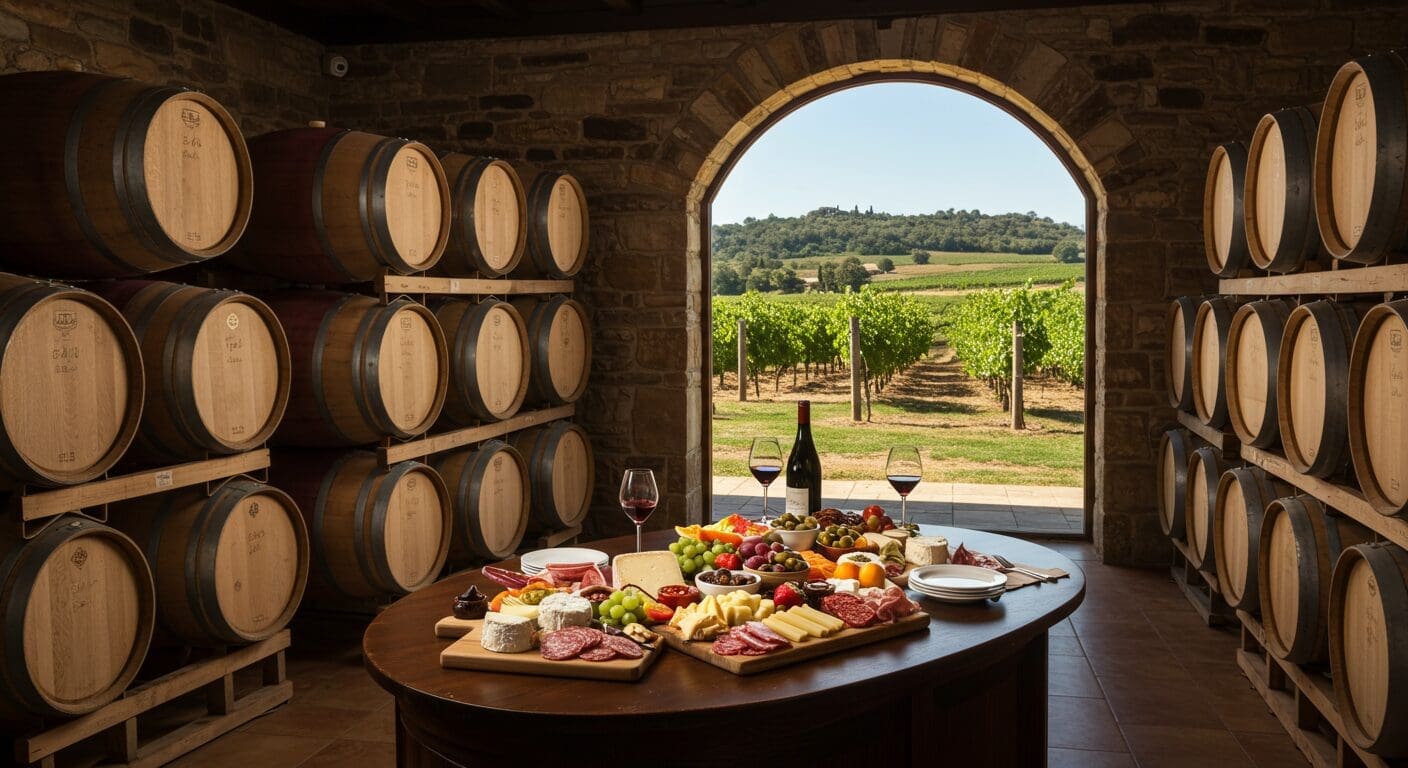
For the luxury traveller, the wine estates of the Limassol Hills offer experiences that go well beyond a tasting room with a leaflet. Several estates have invested significantly in both their viticulture and their visitor facilities. Ktima Vassiliades, Tsiakkas Winery, and ETKO – one of the island’s oldest wine companies – all offer estate visits with tastings paired to local food. Vouni Panayia Winery, at an elevation that makes the drive an experience in itself, produces restrained, mineral-driven Xynisteri that repays attention. Zambartas Winery, run by a father-and-son team with serious international winemaking credentials, has become one of the most talked-about producers on the island – their blends demonstrate what Cyprus can achieve when indigenous varieties are treated with genuine ambition. Book ahead. These are working estates, not theme parks, and the welcome is warmer for it.
Food Markets: Where the Island Does Its Real Shopping
The municipal markets of Cyprus are not yet the kind of artfully curated food halls that have become the default destination for the Instagram-conscious traveller. They are, instead, actual markets – noisy, purposeful, slightly chaotic, and absolutely worth an hour of anyone’s morning. Limassol’s covered market, located near the old town, is the most rewarding for food lovers: butchers who will explain every cut with a seriousness bordering on philosophy, stalls draped with dried herbs and strings of carob, cheese vendors who will cut halloumi to order and press a sample into your hand without being asked. Nicosia’s Laïki Yitonia area and the capital’s central market offer similar pleasures, with the added advantage of being surrounded by enough coffee shops that a mid-market espresso is never more than thirty seconds away.
Village markets – particularly the Saturday morning markets in larger Troodos villages during summer – tend to be smaller but often more interesting for the quality of produce: seasonal vegetables grown on small family plots, local honey that tastes of thyme and wild herbs, homemade preserves in unlabelled jars. The kind of shopping that reminds you why food culture matters in the first place.
Olive Oil: The Other Liquid Gold
Cyprus produces olive oil that, relative to its quality, remains criminally under-known outside the island. The indigenous olive variety – Ladolia, a small, intensely flavoured fruit grown primarily in the Paphos and Troodos regions – produces oil of real distinction: grassy, peppery, with a finish that lingers. Small producers across the Paphos district press oil in autumn using methods that have changed only marginally over several centuries, and visits to local mills during the October-November harvest season offer one of the more genuinely memorable food experiences available on the island.
Look for single-estate oils at the better delis and farm shops – particularly around Paphos and Larnaca – and resist the temptation to assume the most expensive bottle is the best. Some of the finest oils come in unremarkable packaging from producers who have never felt the need to hire a graphic designer. This is arguably their most admirable quality.
Cooking Classes and Culinary Experiences for Serious Food Lovers
For travellers who want to bring something home more useful than a jar of dried herbs, Cyprus has developed a thoughtful range of culinary experiences over recent years. Several operators based in Limassol and Nicosia offer market-to-table cooking classes that begin with an escorted visit to a local market – often with a Cypriot home cook or chef as guide – before moving to a kitchen to prepare a traditional meze spread. These sessions typically cover the fundamentals: how to achieve the right texture in tahini-based dips, the correct spicing for loukaniko, the art of judging when halloumi has crossed from pleasantly yielding to irreversibly squeaky. They are, by general consensus, far more entertaining than they sound on paper.
Village-based food experiences have also expanded considerably. Several agrotourism properties in the Troodos region and the Paphos wine villages offer hands-on sessions that encompass olive oil pressing, bread-baking in traditional wood-fired ovens, and cheese-making – often hosted by the families who have been doing these things for generations. The quality of these experiences varies, as it always does, but the best of them offer access to a way of life that feels both authentic and entirely unperformable.
For those who prefer their culinary education with a higher thread count, some luxury villa properties and boutique hotels have begun offering private chef experiences where visiting cooks – often with serious restaurant backgrounds – come to the property, shop the markets on your behalf, and produce dinners that draw on traditional Cypriot technique with a contemporary sensibility. This is, by some distance, the most civilised possible way to learn about a food culture.
The Best Food Experiences Money Can Buy in Cyprus
There are moments in Cyprus that no itinerary quite prepares you for. Sitting on a terrace above the vineyards at a Troodos estate at dusk, with a glass of aged Commandaria and a plate of village cheese, watching the light change over the hills – that is one of them. Eating freshly caught red mullet at a harbourside table in a small fishing village on the south coast, with nothing between you and the sea but a glass of cold Xynisteri – that is another. These experiences are available at almost any price point, which is one of Cyprus’s more endearing qualities.
For the more structured and extravagant end of the spectrum: a private wine estate dinner arranged through a specialist concierge, combining a tour of the vineyards, a vertical tasting of the estate’s best vintages, and a long meal prepared around the wines, is the kind of evening that rearranges your sense of what a good night out can look like. Truffle hunting is not a Cyprus tradition in the formal sense – the island lacks the northern Italian infrastructure – but wild mushroom foraging in the Troodos forests during autumn does exist as a guided experience through specialist operators, and it is worth pursuing for the combination of forest walking and the eventual scrambled eggs at the end of it.
A private carob mill visit in the Limassol district, paired with a tasting of carob-based products – syrup, flour, chocolate alternatives – offers a window into an ingredient that shaped the island’s economy for centuries and is now experiencing a quiet renaissance among chefs interested in its deep, bittersweet flavour. If you taste nothing else from the carob tree, try the syrup poured over fresh cheese. It is one of those combinations that seems unlikely and then seems inevitable.
A Note on Where to Eat
The finest dining in Cyprus tends not to announce itself very loudly. The restaurants that local food writers and chefs name as their favourites are often in villages you might drive through without stopping, in converted stone houses with handwritten menus and wine lists compiled by people who actually know what they are talking about. In Limassol, which has become the island’s most dynamic food city over the past decade, a cluster of serious restaurants has emerged that takes Cypriot ingredients and applies genuine culinary intelligence to them. The old town particularly rewards an evening’s exploration on foot, stopping where something smells interesting. It is not a foolproof method. But it works more often than it has any right to.
For a fuller picture of planning your time on the island – including the best regions, beaches, and cultural sites – our Cyprus Travel Guide covers the broader picture in similar depth.
Your Base: Luxury Villas with Kitchens Worth Using
Everything described in this guide tastes considerably better when you have somewhere worth returning to. A private villa with a serious kitchen and a terrace that catches the evening light gives you the option of bringing the market home – the halloumi from the cheese vendor, the herbs from the village stall, the bottle from the estate – and doing something worthwhile with them. It also gives you the freedom to eat on your own schedule, which, when the afternoon has extended itself pleasantly over a long meze lunch, is not a small thing.
Explore our collection of luxury villas in Cyprus and find the right base for an island that, culinarily speaking, has been quietly ahead of the conversation for several thousand years.