Devon Travel Guide: Where to Stay, Eat & Explore in Luxury
There are places in the United Kingdom that get away with things no other county could reasonably attempt. Devon is one of them. It has two completely different coastlines – the wild, Atlantic-battered drama of the north and the soft, estuary-laced warmth of the south – separated by the kind of moorland that makes you feel you’ve stepped into a Thomas Hardy novel, and not always the cheerful kind. It has surf beaches and sailing towns, Michelin-starred restaurants tucked inside 13th-century thatched pubs and organic farm kitchens where the vegetables were in the ground this morning. It has ancient woodland, cream teas (in the correct order: jam first, and don’t let anyone from Cornwall tell you otherwise), and a quality of evening light in summer that painters have been chasing for centuries. Most destinations do one thing well. Devon does everything at once, and somehow gets away with it.
Who is Devon for? Almost everyone, which sounds like a cop-out but is actually just accurate. Families seeking genuine privacy – the kind where children can tear across a garden and into a pool without negotiating a hotel lobby – find the county’s wealth of spacious country houses and coastal retreats genuinely transformative. Couples marking milestone occasions discover that Devon does romance without trying too hard: candlelit harbours, clifftop walks, world-class tasting menus. Groups of friends who’ve been vaguely promising each other a “proper trip” for the better part of a decade find that a large villa with a well-stocked kitchen and no neighbours within earshot tends to settle the matter beautifully. Remote workers increasingly cite Devon as a serious base – connectivity has improved dramatically, and it turns out that writing code or conducting a Zoom call is considerably more tolerable when there’s a view of Dartmoor out of the window. And wellness travellers, drawn by coastal air, cold-water swimming, and long trails with no one on them, have discovered that Devon delivers the kind of slow reset that a spa weekend in a city hotel simply cannot replicate.
Getting to Devon: Farther Than London, Closer Than You Think
Devon sits in the far southwest of England, and there’s no point pretending the journey from London is brief. The M5 motorway will take you there in three to four hours from the Midlands, somewhat longer from the capital – especially on a Friday afternoon in August, when the entirety of southeast England appears to have had the same idea simultaneously. That said, the train from London Paddington to Exeter St Davids takes around two hours on a good day, and Great Western Railway’s service continues on to Totnes, Newton Abbot, and Plymouth. If you’re arriving from further afield, Exeter Airport handles flights from Edinburgh, Glasgow, Manchester, Belfast, and a handful of European destinations, making it a genuinely useful hub. Plymouth also has a ferry connection to Roscoff and Santander for those coming from Spain or France.
Once in Devon, a car is essentially non-negotiable. The county is large, the lanes are narrow, the signage is optimistic, and public transport outside the main towns operates on terms that require patience and goodwill. Car hire is available at Exeter Airport and all major train stations. If you’re staying in a luxury villa – which, for this county, makes overwhelming sense – most properties are set in countryside or coastal locations that are simply not accessible any other way. Budget for the lanes, budget for the tractors, and enjoy the fact that getting lost in Devon is rarely as stressful as it sounds.
Where to Eat in Devon: Michelin Stars, Market Stalls, and Morning Vegetables
Fine Dining
Devon’s fine dining scene punches well above its weight, and has done for long enough that chefs from elsewhere have started paying attention. At the apex sits Lympstone Manor in Exmouth, where Michael Caines – one of the most quietly formidable chefs working in the UK today – has created something close to the definitive modern British dining experience. The manor house itself is handsome, the grounds run down to the Exe Estuary, and the food holds a Michelin star and four AA Rosettes with the ease of someone who has stopped thinking about the awards and is simply cooking. The tasting menu here is an event, not just a meal.
Over in Torquay, The Elephant has been doing something rather remarkable: holding its Michelin star for the better part of twenty years under chef Simon Hulstone, who has the rare ability to make technically precise food feel genuinely generous. The atmosphere is warm rather than starched, the menu is rooted in Devon’s extraordinary larder, and the whole experience has the confidence of a restaurant that knows exactly what it is and has no intention of changing.
Gidleigh Park, perched on the upper reaches of the River Teign at the edge of Dartmoor National Park near Chagford, offers something else entirely: the sensation of eating extremely well while surrounded by the kind of landscape that makes you briefly reconsider your life choices (in the best possible way). The kitchen garden supplies much of what lands on the plate, the setting is quietly magnificent, and the Michelin star feels almost beside the point.
Then there is the Masons Arms at Knowstone – a thatched, flower-draped 13th-century pub that has held a Michelin star for fifteen years and remains one of Devon’s most singular dining experiences. Classic French technique meets Devonshire ingredients, with views across Exmoor that are frankly not helping anyone concentrate on the menu. It is exactly the kind of place that sounds too good to be real until you’re sitting in it.
Where the Locals Eat
Devon’s casual dining culture is built on the county’s extraordinary natural larder, and locals are not shy about using it. Farmers’ markets operate regularly across the county – Totnes, Tavistock, and Exeter all run excellent ones – where you’ll find direct-from-farm cheeses, smoked fish, hand-raised pies, and vegetables that look the way vegetables are supposed to look. The harbour towns do fish and chips with the conviction of people who believe it matters, because here it genuinely does. Dartmouth, Salcombe, and Padstow-adjacent Appledore all have independent fish restaurants and seafood cafés that require no reservation and deliver considerable satisfaction.
Cream teas, of course, are practically a civic duty. Every village tearoom, pub garden, and farm café will provide them, and the quality is almost uniformly high. The scone should be warm. The clotted cream should be Devonshire. The jam first question requires no further discussion here.
Hidden Gems Worth Seeking Out
Riverford Field Kitchen, on the organic farm at Buckfastleigh, is the kind of place that becomes someone’s most enthusiastic travel recommendation the moment they’ve visited. The menu changes daily based on what’s been harvested that morning, the long communal table puts you next to strangers who become, briefly, excellent company, and the veg-forward platters have the confidence of a kitchen that has never once needed to apologise for not serving steak. It is also, in the best possible way, an entirely different kind of eating experience from the Michelin circuit – one that reminds you what seasonal cooking actually means.
Beyond Riverford, the estuary villages of the South Hams conceal several small restaurants and gastropubs that locals guard with proprietary affection. Explore the lanes around Kingsbridge and Torcross, follow the smell of woodsmoke, and trust your instincts.
The Lay of the Land: Two Coastlines, One Moor, and Rather a Lot Going On
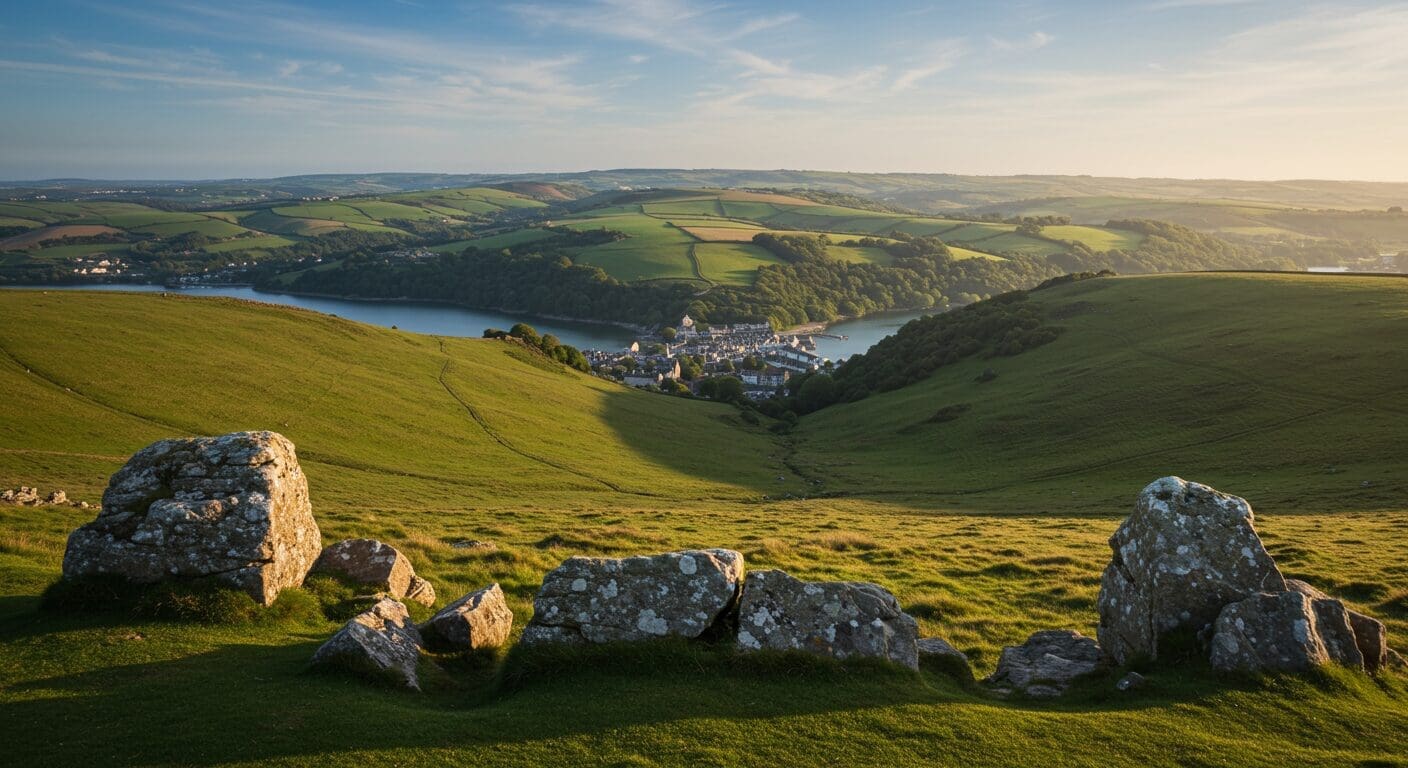
Understanding Devon geographically is the first step to actually using it properly. The county is bisected by Dartmoor National Park – 368 square miles of granite upland, ancient standing stones, wild ponies, and weather that changes its mind with alarming frequency. Dartmoor is the dramatic heart of Devon, the landscape that gives the county its particular character, and it deserves at least a full day, preferably two.
South Devon offers the county’s most celebrated coastal scenery: the South Devon Area of Outstanding Natural Beauty stretches from Dartmouth to Plymouth, taking in the Kingsbridge Estuary, the wide beaches of the South Hams, the sailing haven of Salcombe, and a series of coves and cliff paths that reward anyone willing to walk them. The towns here – Dartmouth with its castle and quayside, Totnes with its castle and independent spirit, Kingsbridge with its Saturday market – have genuine character and long histories.
North Devon is a different proposition altogether: wilder, less polished, and in many ways more interesting. The Atlantic coast here is raw and elemental, with vast sandy beaches backed by dunes at Saunton and Croyde, the curiously named Westward Ho! with its Victorian ambitions, and the cliffside village of Clovelly, where cars are banned and donkeys remain the primary mode of steep-lane transport. Exmoor straddles the North Devon border into Somerset, offering moorland, ancient oak woodland, red deer, and coastal paths of remarkable beauty.
Between the moor and the coasts, Devon’s interior is a working agricultural landscape of red-soiled fields, cider orchards, and market towns that have been quietly getting on with things since the Middle Ages. It repays slow exploration by car or bicycle, ideally without a fixed itinerary.
Things to Do in Devon: The Long Version
The challenge in Devon is not finding things to do. The challenge is deciding which things to sacrifice. A week here can be consumed entirely by beaches and still feel inadequate; add the moor, the estuary sailing, the restaurants, and the walking trails, and you begin to understand why so many visitors return annually with the helpless reliability of migrating birds.
The South West Coast Path – all 630 miles of it, Britain’s longest National Trail – passes through Devon in its entirety, and while walking the whole thing requires a level of commitment that goes beyond most holidays, the Devon sections offer some of the finest day-walking in England. The stretch between Salcombe and Hope Cove is particularly good: cliff-top paths, views to France on a clear day (approximately twice a decade), and several very welcome pubs along the route.
Sailing is taken seriously here, and has been for centuries. Dartmouth, Salcombe, and Exmouth are all well-served for yacht charter, sailing tuition, and the kind of day on the water that reminds you why landlocked living requires compensation. If sailing feels like too much commitment, river boat trips on the Dart between Dartmouth and Totnes are excellent and require only the ability to sit down.
Inland, Dartmoor offers guided pony trekking, wild swimming in the river pools below the tors, and some of the most rewarding hiking in the south of England. The high moor around Haytor and Hound Tor delivers proper drama; the wooded river valleys of the Teign and Dart deliver something quieter and, in their way, equally affecting.
For families, the combination of beaches, rock pools, coastal boat trips, and farm parks creates an itinerary that essentially writes itself. Older children with energy to spare will find paddleboarding, kayaking, and coasteering all available from multiple operators along both coasts.
Adventure on Devon’s Doorstep: Surf, Saddle, and Sea
North Devon holds one of the UK’s most significant surfing designations: the North Devon World Surfing Reserve, a stretch of coastline that encompasses Westward Ho!, Saunton Sands, Croyde, and Woolacombe. These are serious surf beaches. Croyde in particular has a reputation that draws experienced surfers from across the country, with consistent Atlantic swells and beach breaks that range from genuinely beginner-friendly to genuinely challenging. Multiple surf schools operate along the coast, and the standard of instruction is high – this is not a region where surfing is a novelty sideline.
Woolacombe is broader and generally kinder to beginners; Saunton Sands, three miles of almost deserted beach backed by dunes, offers space and consistency that is hard to match anywhere else in England. In summer, the surf culture here is lively without being overwhelming; in the shoulder seasons, you can have stretches of it almost to yourself.
Cycling in Devon divides into two distinct experiences. The Tarka Trail – named, with some literary optimism, after Henry Williamson’s famous otter – follows a 180-mile route through North Devon, including a long traffic-free section along a disused railway line from Braunton to Meeth. It is flat, beautiful, and accessible to all ages and fitness levels, passing through Barnstaple and along the tidal Taw and Torridge estuaries. Serious road cyclists and mountain bikers will find Dartmoor’s terrain considerably more demanding and considerably more rewarding.
Cold-water swimming has developed from niche pursuit to mild obsession across Devon, with designated spots on both coasts and in the Dartmoor river pools. The Outdoor Swimming Society maintains a useful guide to the best spots; local knowledge, as always, beats any guidebook.
Devon for Families: Space, Freedom, and the Considerable Advantage of a Private Garden
Devon does family holidays well. Genuinely well, not in the way that tourism boards describe every destination as family-friendly while meaning approximately nothing by it. The beaches are clean, the water is (relatively) warm in summer, the rock pools are extraordinary, and the mix of outdoor activities means that children of genuinely different ages can all find something that holds their attention. The county is also large enough that it never feels overwhelmed by its own popularity, even in August – which is no small thing.
The practical advantages of a luxury villa for families in Devon are substantial. Hotel rooms become complicated once children are involved; restaurants become negotiations; the logistics of getting everyone dressed and fed and out of a lobby multiply unpleasantly. A private villa – particularly one with a heated pool, a large garden, and a well-equipped kitchen – removes most of these complications at a stroke. Children have space to exist at full volume without consequence. Adults have space to actually relax, which is nominally the purpose of the holiday. Multigenerational groups – grandparents, parents, children, the occasional family friend who was invited somewhat optimistically – fit naturally into properties with multiple bedrooms, separate sitting rooms, and outdoor spaces large enough to provide everyone with the territorial distance they occasionally need.
The Devon countryside is particularly good for children who have begun to develop opinions about screens: give them a farm, a beach, a rockpool, and a surfboard and the opinions tend to dissolve rapidly. Several luxury villa properties in Devon are on working farms or adjacent to them, which adds an educational dimension that parents appreciate and children tolerate while enjoying it considerably more than they admit.
Devon’s Deep History: Moors, Myths, and Maritime Glory
Devon is old in the way that English counties are old – which is to say, extremely, and somewhat casually about it. The Bronze Age left its mark comprehensively on Dartmoor: over 5,000 recorded prehistoric monuments, including stone rows at Merrivale and Drizzlecombe that predate Stonehenge and still produce no satisfying explanation. The moor has been inhabited, farmed, and left largely alone in alternating phases for four thousand years, and the landscape shows it.
Exeter – Devon’s cathedral city and county town – was founded by the Romans, who called it Isca Dumnoniorum, built a bath house, and presumably found the weather challenging. The medieval city walls survive largely intact, as does the Norman cathedral, whose intricately carved West Front is one of the finest examples of Gothic ecclesiastical sculpture in England. The Quayside district, with its working canal (the oldest commercial ship canal in England, completed in 1566), has been revived as a lively arts and dining quarter without losing its historic character.
Dartmouth’s naval history runs through the town like a main vein – the Britannia Royal Naval College still trains officers on the hill above the town, and the castle guarding the estuary entrance has been doing its job since 1388. Plymouth, a short drive west, is where Francis Drake is alleged to have been playing bowls when the Spanish Armada arrived, which may or may not be true but is exactly the kind of story Plymouth tells well. The Mayflower Steps, from which the Pilgrim Fathers departed for the New World in 1620, are still there, somewhat modestly marked given the implications.
The arts have long found Devon congenial. Dartington Hall – the extraordinary 14th-century estate near Totnes that became a progressive arts centre in the 1920s – hosts an annual festival of music and ideas that draws serious performers and thinkers from across the world. The Totnes and South Hams area has a long association with artists and writers seeking landscape and light; the Tate St Ives is technically in Cornwall but is close enough to the Devon border to be considered part of the same southwest creative circuit.
Shopping in Devon: Artisan, Independent, and Occasionally Excellent
Devon’s shopping culture reflects its character: independent, agricultural, and considerably more interesting than a high street would suggest. Totnes is the county’s unofficial capital of independent retail – a market town with a pronounced alternative streak, an excellent Tuesday and Saturday market, and an eclectic collection of bookshops, vintage clothing dealers, independent food shops, and craft galleries that reward an afternoon’s wandering.
Dartmouth’s narrow streets hold jewellers working with Devon gold and silver, independent clothing boutiques, and several exceptionally good food shops stocking local cheeses, charcuterie, and preserves. Salcombe has shifted up-market considerably in recent years – the fashion boutiques here are genuinely good, and the town’s concentration of independent food and homeware shops reflects the tastes of its increasing population of second-home owners, which is either a good thing or a complicated one depending on your perspective.
What to bring home from Devon: Dartington Crystal, which has been made near Totnes since 1967 and remains genuinely beautiful; Devon clotted cream (in a sealed tin, aviation regulations permitting); local cider from one of the county’s many small producers; Beenleigh Blue or Ticklemore cheese from the South Hams dairy tradition; and, if you can find it, Sharpham wine from the vineyard near Totnes, which produces a Pinot Noir that surprises people.
Useful Things to Know Before You Go
Devon is part of England, so the currency is sterling, the language is English (with a West Country accent that varies considerably by area), and tipping at around 10-12.5% in restaurants is standard practice – though it is never obligatory and good restaurants don’t apply pressure. The tap water is perfectly fine.
The best time to visit depends considerably on what you’re hoping to do. June and September are the months that Devon regulars tend to favour: the weather is generally reasonable, the days are long, the roads are not yet at full August saturation, and the beaches have room on them. July and August are warmer and livelier, but busier – Salcombe and Croyde in particular reach concentrations of visitors in high summer that require patience. October is underrated: the moor turns amber and rust, the crowds evaporate, and the restaurants and hotels offer better rates with no reduction in quality.
Devon’s weather is famously variable, which is the polite way of saying it rains. The south coast is measurably warmer and drier than the north; Dartmoor creates its own microclimate and should be approached with layers regardless of the forecast. A waterproof jacket is not pessimism; it is experience.
Phone signal on the moor is patchy to nonexistent; download offline maps before setting out on any significant walk. Lanes are narrow, passing places are frequent, and reversing competence is effectively a local requirement for driving in rural Devon. Give way to tractors immediately and without debate; you will not win.
Why a Luxury Villa in Devon Changes Everything
There is a particular kind of Devon holiday that no hotel can deliver, however well appointed. It involves waking up to a view of the sea or the moor that belongs entirely to you, making coffee in a kitchen designed for people who actually cook, and spending a morning in a private heated pool before driving ten minutes to a Michelin-starred lunch. It involves the freedom to arrive late, leave early, and make whatever domestic arrangements suit the group without reference to check-in times or restaurant sittings. It involves, in short, a private villa – and Devon has some remarkable ones.
The county’s villa stock ranges from converted barns and Georgian farmhouses to clifftop properties with floor-to-ceiling glass and direct beach access. Many are genuinely large – six, eight, ten bedrooms, multiple reception rooms, grounds measured in acres – making them the natural choice for multigenerational family gatherings, group celebrations, or the kind of extended house party that hotels simply cannot accommodate. Private heated pools, home cinema rooms, games rooms, and dedicated home offices (with reliable connectivity, increasingly via Starlink in rural locations) have become standard features at the premium end.
For wellness-focused travellers, a well-chosen villa in Devon offers something that dedicated wellness resorts cannot: total freedom. The ability to arrange in-villa yoga or massage, to stock the kitchen with produce from Riverford or the local farmers’ market, to walk from the garden gate onto a coastal path or moorland trail, and to return to your own pool and your own silence. For remote workers, the same freedom applies in productivity rather than serenity: a private study, a fast connection, and a view that makes the working day considerably more bearable.
The villa experience also scales effortlessly in Devon. A couple celebrating an anniversary finds the same quality of property – and the same level of service, where concierge and daily housekeeping are available at premium properties – as a family of twelve managing school holidays. The common denominator is privacy, space, and the particular pleasure of feeling temporarily as though a very beautiful part of England belongs entirely to you.
Explore our full collection of luxury villas in Devon with private pool and find the property that fits your group, your itinerary, and your preferred version of the perfect Devon holiday.
More Devon Travel Guides
- Best Restaurants in Devon: Fine Dining, Local Gems & Where to Eat
- Devon Food & Wine Guide: Local Cuisine, Markets & Wine Estates
- Devon with Kids: The Ultimate Family Holiday Guide
- Best Time to Visit Devon: Month by Month Weather, Crowds & Tips
- Devon Luxury Itinerary: The Perfect 7-Day Guide
- Romantic Devon: The Ultimate Couples & Honeymoon Guide
What is the best time to visit Devon?
June and September offer the most reliable combination of good weather, manageable crowds, and competitive accommodation rates. July and August are the warmest months but bring peak visitor numbers, particularly to the popular coastal towns of Salcombe, Croyde, and Dartmouth. October is increasingly popular with those seeking autumn colour on Dartmoor and significantly quieter beaches. The south coast is consistently warmer and drier than the north, and the moor should be treated with meteorological respect at any time of year.
How do I get to Devon?
The most straightforward options are by car via the M5 motorway (approximately three to four hours from the Midlands, four to five from London), or by train from London Paddington to Exeter St Davids (around two hours on a fast service), with onward connections to Totnes, Newton Abbot, and Plymouth. Exeter Airport handles domestic flights from Edinburgh, Glasgow, Manchester, and Belfast, as well as a small number of European routes. Plymouth has a ferry connection to Roscoff in France and Santander in Spain. Once in Devon, a hire car is strongly recommended – the county’s rural character makes independent mobility essentially essential.
Is Devon good for families?
Devon is genuinely excellent for families. The combination of clean beaches, exceptional rock pools, surf schools, coasteering, farm parks, river trips, and moorland walking means children of different ages can all find activities that engage them. The county is also large enough to absorb summer visitor numbers without feeling overrun. Families staying in private luxury villas benefit from additional advantages: space for children to play without disturbing other guests, private pools, large gardens, and the freedom to eat, sleep, and operate on the family’s own schedule rather than the hotel’s.
Why rent a luxury villa in Devon?
A luxury villa in Devon offers a quality of experience that hotels – even excellent ones – cannot match for groups and families. The key advantages are privacy, space, and flexibility. A private heated pool, a fully equipped kitchen stocked with local produce, multiple living areas, and a generous garden create a base from which the whole of Devon becomes easily accessible. At the premium end, concierge services, daily housekeeping, and in-villa chef arrangements are available, delivering hotel-level service within a completely private setting. The staff-to-guest ratio at a well-serviced villa is often considerably more generous than any hotel.
Are there private villas in Devon suitable for large groups or multi-generational families?
Yes – Devon has some of the finest large-group villa accommodation in England. Properties sleeping eight, ten, twelve, or more guests are available across the county, ranging from converted Georgian manor houses and farmhouses to contemporary coastal properties. Many feature separate wings or annexes that give different family generations their own space while sharing communal areas, pools, and grounds. For very large groups or milestone celebrations, several properties can accommodate twenty or more guests and offer event catering, marquee arrangements, and dedicated event coordination.
Can I find a luxury villa in Devon with good internet for remote working?
Connectivity in Devon has improved substantially in recent years. Many luxury villa properties now offer fibre broadband or Starlink satellite internet, providing speeds entirely adequate for video conferencing, file transfers, and sustained remote work. Properties in more rural locations – particularly on Dartmoor or in the deep country lanes of the South Hams – should be verified for connectivity at the time of booking. The Excellence Luxury Villas team can advise on specific properties with confirmed high-speed internet for guests with remote working requirements.
What makes Devon a good destination for a wellness retreat?
Devon’s combination of coastal air, exceptional walking trails, cold-water swimming spots, and unhurried pace makes it naturally suited to wellness-focused travel. The South West Coast Path, Dartmoor’s moorland trails, and the estuary walks of the South Hams provide outdoor activity in landscapes of genuine restorative quality. Many luxury villas offer private pools, hot tubs, home gyms, and treatment rooms where in-villa massage and yoga can be arranged. The county’s organic food culture – exemplified by Riverford and the farmers’ markets at Totnes and Tavistock – supports guests seeking clean, seasonal, locally sourced eating. It is, without overstating it, a place that tends to slow people down in ways they hadn’t quite planned for.