Dordogne Food & Wine Guide: Local Cuisine, Markets & Wine Estates
It is mid-morning in Sarlat-la-Canéda, and a man in a flat cap is selling walnuts out of a wooden crate with the quiet authority of someone who has been doing this since before you were born. Beside him, a stall of confit duck legs glistens under the autumn light. Someone nearby is cutting into a wedge of cheese. A woman with a market basket the size of a small child is negotiating, in rapid French, over a jar of something black and intensely aromatic. You do not need to speak the language to understand what is happening. This is the Dordogne at its most elemental – a region that treats food not as a lifestyle accessory but as the organising principle of daily life. Come hungry. Stay longer than you planned.
The Soul of Périgord Cuisine
The Dordogne sits within the ancient region of Périgord, and its cuisine is one of France’s most distinctive – unapologetically rich, rooted in the land, and almost defiantly unfashionable in the best possible sense. There are no foam garnishes here. No deconstructed this or reimagined that. What you will find is food of extraordinary depth and generosity: slow-cooked, carefully preserved, built for the pleasures of a long table rather than an Instagram grid.
The foundation of Périgord cooking rests on four pillars: duck, foie gras, truffles, and walnuts. Around these ingredients, an entire culinary identity has been constructed over centuries. Duck is not merely a dish here – it is an obsession. Confit de canard, made by slow-cooking duck legs in their own fat until the meat collapses from the bone with the merest suggestion of a fork, appears on virtually every menu in the region. So does magret de canard – the breast of a duck fattened for foie gras production, grilled over wood fire and served, ideally, with a sauce made from local Bergerac wine or the region’s celebrated walnuts.
Foie gras deserves its own sentence. Perhaps its own paragraph. The Dordogne produces some of the finest in France, and the experience of eating it here – in a farmhouse kitchen, or in a village restaurant with checked tablecloths and a proprietress who seems faintly disappointed you didn’t order more – is categorically different from eating it anywhere else. The quality is extraordinary. The portions are, by most standards, alarming. This is not the place to exercise restraint.
Alongside the duck, the region’s vegetables and legumes deserve mention. The Sarladaise potato – sliced thin and cooked slowly in duck fat with garlic and parsley – is a dish of such uncomplicated genius that you will spend the flight home wondering why you don’t eat them every day. The answer, of course, involves duck fat, and the logistical challenges of sourcing it in a suburban kitchen. But that is a problem for later.
Truffles: The Black Diamond of Périgord
The Périgord noir truffle – Tuber melanosporum – is arguably the region’s most celebrated export, and for the serious food traveller, truffle season (roughly December through February, with November and March producing smaller quantities) represents one of the great pilgrimages of European gastronomy. The black truffle has an earthy, almost animalic intensity that transforms anything it touches: eggs, pasta, butter, simple roasted chicken. The Dordogne grows them primarily around the limestone-rich soils of the Périgord Noir, where oak and hazelnut trees form the symbiotic partnerships truffle fungi require.
Several estates and specialist operators in the region offer truffle hunting experiences – proper ones, with trained dogs rather than the theatrical version offered at certain tourist-facing operations. These mornings begin early, move quietly through woods that look ordinary to everyone except the dog, and tend to end with something significant being lifted from the earth with a small implement and held up to the light like a religious relic. Which, in Périgord, it essentially is.
The markets at Sarlat, Périgueux, and Sorges – where the Écomusée de la Truffe provides context for those who want to understand what they’re eating before they eat it – offer truffles for purchase during the season. Expect to spend considerably. Consider it an investment in one of the genuinely irreplaceable sensory experiences the food world has to offer.
Walnuts, Foie Gras & the Supporting Cast
The Dordogne Valley produces a remarkable proportion of France’s walnuts, and they infiltrate the local cuisine with quiet persistence. Walnut oil – cold-pressed, with a toasty, almost resinous richness – dresses salads and drizzles over cheese. Walnut wine (vin de noix), made by macerating green walnuts in local wine and eau de vie, is served as an apéritif with the matter-of-factness of something that has always existed and always should. There are walnut cakes, walnut liqueurs, and walnut-encrusted goat’s cheese that arrives at the table looking modest and tasting extraordinary.
The region also produces excellent goat’s cheeses, particularly around Rocamadour – technically just over the regional border into the Lot, but claimed by anyone who has eaten there – and a range of charcuterie that includes rillettes d’oie (goose rillettes), duck gizzard salads (salade de gésiers), and various preparations of pork that the French treat with the reverence other cultures reserve for sacred texts. Chestnut, mushroom, and game round out the autumn and winter larder, when the forests deliver bounty in parallel with the truffle grounds.
The Wines of Bergerac and Beyond
The Dordogne’s wine country centres on Bergerac – a region that has spent considerable energy in recent decades escaping Bordeaux’s long shadow, and has largely succeeded. The Bergerac AOC produces red, white, and rosé wines across a patchwork of sub-appellations, each with their own character. Pécharmant, to the northeast of Bergerac town, produces the region’s most serious reds – Merlot-dominant blends with structure and longevity that reward proper cellaring. Monbazillac, directly south of Bergerac, produces the region’s liquid treasure: a sweet botrytised white wine made primarily from Sémillon, Sauvignon Blanc, and Muscadelle, aged in the local mists that encourage the noble rot responsible for its extraordinary concentration.
Monbazillac pairs with foie gras in a combination so logical it feels inevitable – the sweetness of the wine against the richness of the foie gras creates a balance that winemakers and chefs have understood here for centuries. It is the kind of pairing that makes you question the necessity of any other food combination. Other notable appellations include Saussignac – a lesser-known sweet white with devoted followers – and Montravel, producing dry whites of genuine finesse from the westernmost reaches of the department.
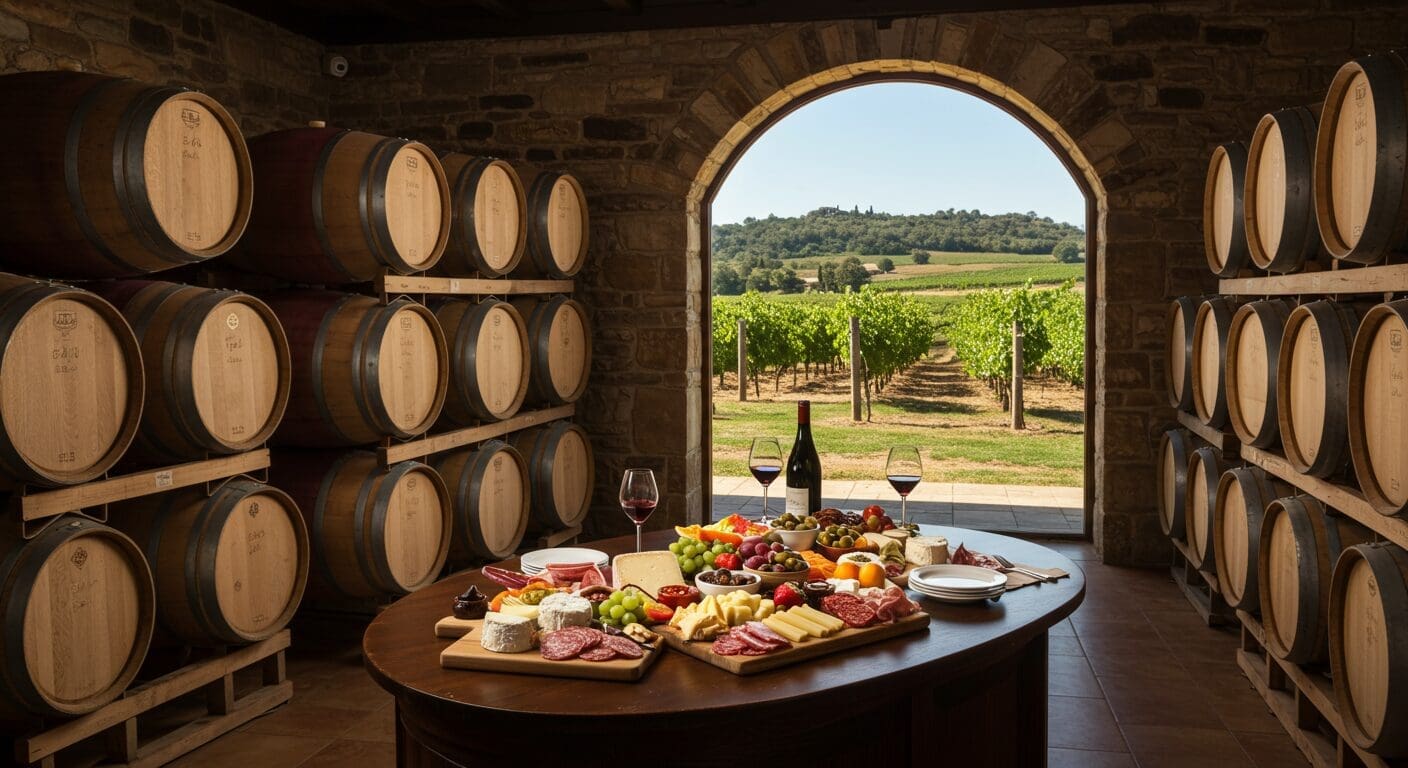
Several estates in the region open their doors to serious visitors. Château Monbazillac, the handsome sixteenth-century chateau that anchors the appellation of the same name, offers tastings with a grandeur appropriate to the surroundings. The Château de Tiregand in Pécharmant is regarded as one of the appellation’s benchmark producers, with a winemaking pedigree that stretches back generations. For a more intimate experience, smaller domaines – many of them family-run, many of them operating with minimal intervention and maximum dedication – can be visited by arrangement, often with tours of the cellars and vineyards that prove considerably more enlightening than the generic tasting room experience elsewhere.
The Markets: Where the Real Dordogne Reveals Itself
If you do one thing in the Dordogne food-wise – and you should clearly do considerably more than one thing – go to a market. Not as a tourist, which is unavoidable, but as a participant. Buy something. Carry it back to your villa. Eat it with impractical quantities of local bread and a glass of something cold.
Sarlat-la-Canéda holds the region’s most celebrated market, on Saturday mornings, with a Wednesday market providing a smaller but arguably more authentic alternative. The Saturday market transforms the medieval centre – already one of the most architecturally coherent towns in France – into something that feels genuinely cinematic. Producers arrive from across the region with foie gras, duck products, cheese, walnuts, seasonal vegetables, honey, wine, and armagnac sold with an honesty about its provenance that large-scale retail can never quite replicate.
Périgueux, the departmental capital, holds a significant Saturday market around the Place de la Clautre and the cathedral quarter. Bergerac’s market on Wednesday and Saturday mornings offers direct access to the wine country’s produce alongside the usual breadth of regional food. Smaller village markets – at Belvès, Domme, Montignac, and Beynac-et-Cazenac among others – operate on rotating days throughout the week and reward the unhurried traveller who turns up without a schedule and sees what appears.
Truffle markets, held during the season in Sarlat (Saturday mornings from December), Périgueux, and the village of Sainte-Alvère (Monday mornings), are extraordinary things to witness even if you are not buying. Serious buyers handle the truffles with the focus of jewellers inspecting diamonds, which is not entirely an inappropriate comparison given the prices involved.
Cooking Classes & Culinary Experiences
For travellers who want to bring the Dordogne home in some meaningful way beyond a jar of walnut oil, cooking classes have become an increasingly sophisticated offering in the region. Several chefs, both locally based and internationally connected, offer half-day or full-day classes structured around the regional larder – typically beginning with a market visit to source ingredients and ending at a table with rather more food on it than anyone strictly anticipated.
The most rewarding classes go beyond technique to explain the culture behind the cooking: why confit exists (preservation, before refrigeration – a logic that still produces delicious results), what makes a proper foie gras terrine different from an inferior one, how to tell whether the walnut oil you’re buying is genuinely cold-pressed or merely aspirational. This kind of contextual knowledge transforms the experience of eating in the region, and makes you considerably more annoying at dinner parties on your return. Worth it.
Some luxury villas in the region can arrange private chef experiences – either a resident chef for the duration of the stay, or a visiting chef who arrives for a single dinner with a menu built around what the market yielded that morning. This is, not to put too fine a point on it, one of the more civilised ways to spend an evening.
The Best Food Experiences Money Can Buy
The Dordogne is not a region of Michelin three-star temples, and this is, on reflection, entirely appropriate. What it offers instead is something arguably more valuable: access to extraordinary raw ingredients in a setting that knows exactly what to do with them. The highest-end food experiences here tend to be experiential rather than theatrical.
A private truffle hunt followed by a lunch prepared around the morning’s haul – eggs scrambled with black truffle, simple pasta with truffle butter, perhaps a truffle-perfumed roast chicken – represents a kind of perfection that no restaurant, however decorated, can quite replicate. Several specialist operators and estates offer this, particularly during peak season, and advance booking is essential.
A morning at a foie gras farm – not the industrial operations, but the smaller producers who raise their ducks on pasture – provides an understanding of the product that is both enlightening and, if you are the kind of person who eats foie gras without moral complication, deeply appetite-enhancing. The contrast with what you find in supermarkets elsewhere in the world is instructive.
For wine, a private tasting at a Pécharmant or Monbazillac estate – arranged through your villa concierge or a specialist operator – with a producer who speaks about their land with the fluency of someone who has spent a lifetime paying attention to it, is an experience of the kind that justifies travel entirely. Add a long lunch with the estate’s own wines and whatever the season is producing, and the afternoon becomes one of those memories that turns up unbidden on grey days at home, doing its quiet work.
For a complete picture of the region – its history, landscapes, and extraordinary prehistoric heritage – the Dordogne Travel Guide covers the destination in full. The food, after all, is part of a much larger story.
Staying Well: Where to Eat and How to Eat It
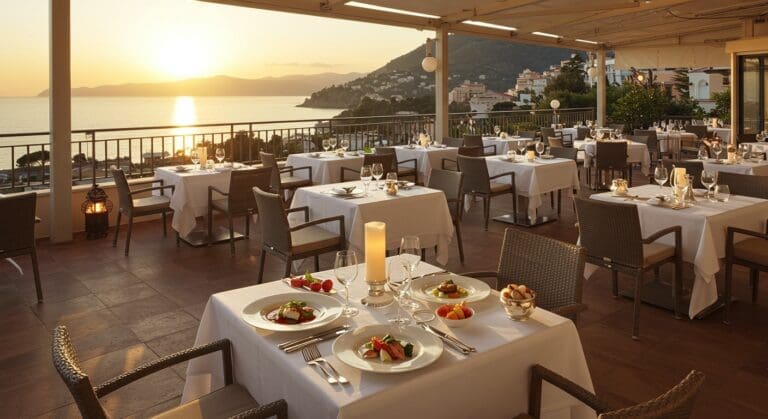
The Dordogne’s restaurant scene ranges from village auberges serving prix-fixe menus that would embarrass more ambitious establishments elsewhere, to more refined tables making serious use of the region’s larder. The best advice for the luxury traveller is perhaps counterintuitive: the most memorable meals are rarely the most expensive ones. A farmhouse lunch that begins with duck rillettes and ends somewhere around the cheese course, three glasses of Bergerac in, is not something that appears on any list, and is therefore worth seeking with considerable determination.
That said, the region does support a number of more polished restaurants in Sarlat, Périgueux, and Bergerac that handle the regional repertoire with genuine skill and appropriate attention to the wine list. The pattern in Dordogne is a long lunch culture rather than a destination-dining one – dinner tends to be quieter, more local, more about what remained after the day’s market. Adapt accordingly. Eat the long lunch. Accept what comes after.
The ideal base for exploring all of this – the markets, the estates, the truffle grounds, the farmhouse lunches, the walnut oil producers who will press oil to order if you ask nicely – is a private villa, with enough space to spread out the morning’s market haul, a kitchen for the evenings when you don’t want to go anywhere at all, and a terrace that faces the right direction at the right time of day. Fortunately, the region has these in considerable number.
Explore our collection of luxury villas in Dordogne and find the right base for your own version of this – unhurried, well-fed, and properly attended to.