
Romantic Gloucestershire: The Ultimate Couples & Honeymoon Guide
Romantic Gloucestershire: The Ultimate Couples & Honeymoon Guide
Here is the thing about Gloucestershire that nobody tells you: it does not try. While other destinations construct romance out of fairy lights and Instagram backdrops, this corner of England simply exists in its own ancient, unhurried beauty – and somehow that is infinitely more affecting. The Cotswold hills roll without apology. The rivers run cold and clear through cathedral towns. Honey-coloured stone villages glow at four in the afternoon as though they have been lit from within. If you are looking for a destination that makes romance feel earned rather than manufactured, that rewards couples who want to actually feel somewhere rather than merely photograph it, Gloucestershire is quietly, devastatingly good at this. It has been for about eight hundred years. It sees no reason to change.
Why Gloucestershire Is Exceptional for Couples
There is a particular kind of romantic destination that works not because it offers spectacle, but because it offers pace. Gloucestershire belongs firmly in that category. The county sits at the meeting point of several distinct landscapes – the limestone uplands of the Cotswolds, the broad flood plains of the Severn Vale, the ancient wildness of the Forest of Dean, and the cathedral city of Gloucester itself – which means that two people can spend a week here and experience something genuinely different every day without ever feeling like they are on a tour itinerary.
What couples consistently find here is a sense of proportion. The villages are the right size. The drives between them take twenty minutes rather than two hours. The restaurants are serious without being theatrical. The accommodation, particularly the private villa and country house market, reaches a quality that rivals anything in the more publicised parts of England – yet without the crowds that have, frankly, rather taken the edge off the Cotswolds’ most famous villages for anyone hoping for a quiet moment together.
The county also has a particular talent for the seasons. Spring brings drifts of blossom along the Winchcombe valleys. Summer evenings in the Slaughters – yes, they are really called that, and yes, you will fall for them despite the name – stretch on forever. Autumn turns the beech woods of the escarpment into something that feels almost unreasonably beautiful. Even winter, with log fires in old stone pubs and frost on the fields, has its advocates. Couples who return more than once tend to start timing their visits around a particular season. That is the kind of place this is.
The Most Romantic Settings in Gloucestershire
Bourton-on-the-Water gets all the attention and, as a result, all the coach parties. The genuinely romantic traveller learns quickly to look slightly to the side of the obvious. The villages of the Slaughters – Upper and Lower – offer the same Cotswold stone architecture in almost complete quiet, divided by the River Eye and connected by a footpath that takes about fifteen minutes to walk. It is, in the very best sense, a small thing. Small things are often the most romantic.
Painswick, known as the Queen of the Cotswolds by those who feel such titles are appropriate (and they are not wrong), sits on a ridge south of Cheltenham with views across the Severn Vale that on a clear day stretch to the Welsh hills. The churchyard here contains ninety-nine yew trees clipped into extraordinary forms – a fact that sounds like tourist board copy until you actually stand among them at dusk and feel something genuinely strange and wonderful happen to the light.
Tewkesbury, where the Avon meets the Severn, is consistently underestimated. Its Norman abbey is one of the finest in England. Its medieval streets are largely intact. And unlike so many Cotswold destinations, it has the quality of a place that real people actually live in – which, after a while, becomes rather more appealing than somewhere preserved entirely for visitors. Couples who find their way here tend to feel they have discovered something. They have.
The Forest of Dean, on the county’s western edge, operates on entirely different emotional frequencies. Ancient and slightly otherworldly, its deep green interior and the gorge of the Wye Valley provide the kind of landscape that makes people stop talking and simply look at each other. The Symonds Yat viewpoint, high above the river bend, is one of those places that reorganises your sense of scale in a way that only the very best landscapes manage.
Romantic Restaurants and Dining Experiences
Gloucestershire’s dining scene has matured considerably over the past decade, and for couples seeking a serious dinner – the kind where you linger over a second bottle and lose track of time – the options are genuinely excellent. The county sits at the heart of some of Britain’s finest agricultural land, which means that the produce arriving in restaurant kitchens here is, almost without exception, the real thing. Rare breed beef from the Cotswold hills. Gloucester Old Spot pork that has actually led a reasonable life. Asparagus from the Vale of Evesham in season. Chefs who care about provenance because provenance here is not a marketing concept – it is just what is available.
Cheltenham is the natural centre of gravity for serious dining, with a restaurant scene that punches well above its population size. The town’s Regency architecture and its culture of understatement – ambitious but never flashy – makes it a particularly good backdrop for a special anniversary or pre-theatre dinner. For couples staying in the countryside, the Cotswold gastropub – a species that has reached impressive levels of sophistication in this part of England – provides evenings that begin with a fireside drink and end rather later than intended. This is not a complaint.
Wine lists in the better Gloucestershire restaurants tend to be the work of people who actually know what they are doing. When you find a list organised by style rather than country, with proper notes that describe rather than name-drop, you have usually found somewhere worth returning to. Make a note of it. Bring someone you love. Order the tasting menu if there is one.
Couples Activities: Beyond the Country Walk
The walk is, of course, non-negotiable. The Cotswold Way runs ninety-nine miles from Chipping Campden to Bath, and stretches of it – particularly the escarpment section between Cheltenham and Painswick – offer the kind of views that justify the investment in proper walking shoes you have been putting off. But for couples who want to build a fuller itinerary, Gloucestershire offers considerably more than fresh air and good boots.
Sailing and watercraft on the Severn estuary and the inland waterways provides an unexpectedly dramatic option. The Gloucester-Sharpness Canal – the widest ship canal in Britain, which is not something you necessarily knew you needed – and the river navigations offer private boat hire for couples who want the water to themselves. The pace of canal travel is, it turns out, extremely well suited to the early days of a honeymoon.
Spa experiences in Gloucestershire have benefited from the county’s proliferation of high-quality country house hotels, several of which have developed serious wellness facilities. Couples treatments – the kind where you are in the same room and not just doing your own separate things in adjacent cubicles – are offered at a number of properties, and the setting of a Cotswold spa, with its stone walls and views over managed grounds, adds an architectural dimension that a city spa simply cannot replicate.
Wine tasting in the Cotswolds has become a legitimate activity rather than an afterthought. The English wine industry’s transformation over the past twenty years has been remarkable, and the limestone soils of this part of England have proved well-suited to sparkling wine production. Private vineyard tours and tastings – book ahead, these are not vast operations – make for an afternoon that combines genuine education with the pleasant side effects of sampling several glasses of something rather good. Couples who enjoy cooking classes will find excellent options in the area, typically based in farmhouses or country estates, working with local ingredients and led by instructors who have the useful quality of being interesting to listen to while you are trying to chop things.
For something more vigorous, the Wye Valley offers kayaking and paddleboarding in spectacular gorge scenery, while the Forest of Dean has developed an impressive reputation for mountain biking – though this is perhaps better suited to the more energetically inclined couple than the honeymoon pair seeking tranquility.
The Most Romantic Areas to Stay
Where you stay in Gloucestershire matters enormously, because the county contains multitudes. The northern Cotswolds – Chipping Campden, Broadway, the villages around Stow-on-the-Wold – offer the archetypal honey-stone experience with the best access to the wider Cotswolds area. This is where the private villa market is at its most refined, and where the combination of village life, serious countryside, and easy driving distances creates the most complete romantic experience.
The Cheltenham corridor – the town itself and the villages immediately south and west – suits couples who want cultural options alongside countryside. Cheltenham’s festivals, its racing calendar, its theatre and restaurant scene, mean that a week here need never feel like it is all about scenery. Some couples find this reassuring. The town is elegant, confident, and has the excellent quality of not appearing to want anything from you.
For the most dramatic and secluded experience, the Forest of Dean and Wye Valley rewards couples who are comfortable with genuine remoteness. Accommodation here is more likely to be a converted farmhouse or a property in deep woodland than a village cottage, and the sense of being genuinely away – from noise, from people, from the ambient hum of connectivity – is more complete. There are couples for whom this is exactly what a honeymoon should feel like. They are right.
Proposal-Worthy Spots in Gloucestershire
A proposal deserves a location that does some of the work. In Gloucestershire, several places are equal to the occasion – and the best of them have the useful quality of not feeling like proposal locations, which is to say they are simply beautiful places that happen to be perfectly suited to a significant moment.
The Cotswold escarpment above Cleeve Hill, the highest point in the Cotswolds at over three hundred metres, provides views on a clear day that extend across half of England. This is the kind of vista that recalibrates your sense of what is possible – which is, when you think about it, an appropriate frame of mind for what comes next.
Hidcote Manor Garden, managed by the National Trust, is a masterpiece of Arts and Crafts garden design – a sequence of outdoor rooms, each with its own character and planting scheme, that creates an atmosphere of extraordinary intimacy despite being a public garden. The famous red borders in late summer are particularly affecting. Timing a proposal to coincide with the right season is the sort of planning that is rarely mentioned but frequently decisive.
The riverbank at Tewkesbury, where the two rivers meet and the abbey towers over the water meadows, has a quality of permanence that lends gravity to significant moments. It is also – and this matters more than it should – genuinely quiet on a weekday morning. A proposal interrupted by a tour group is, broadly speaking, suboptimal.
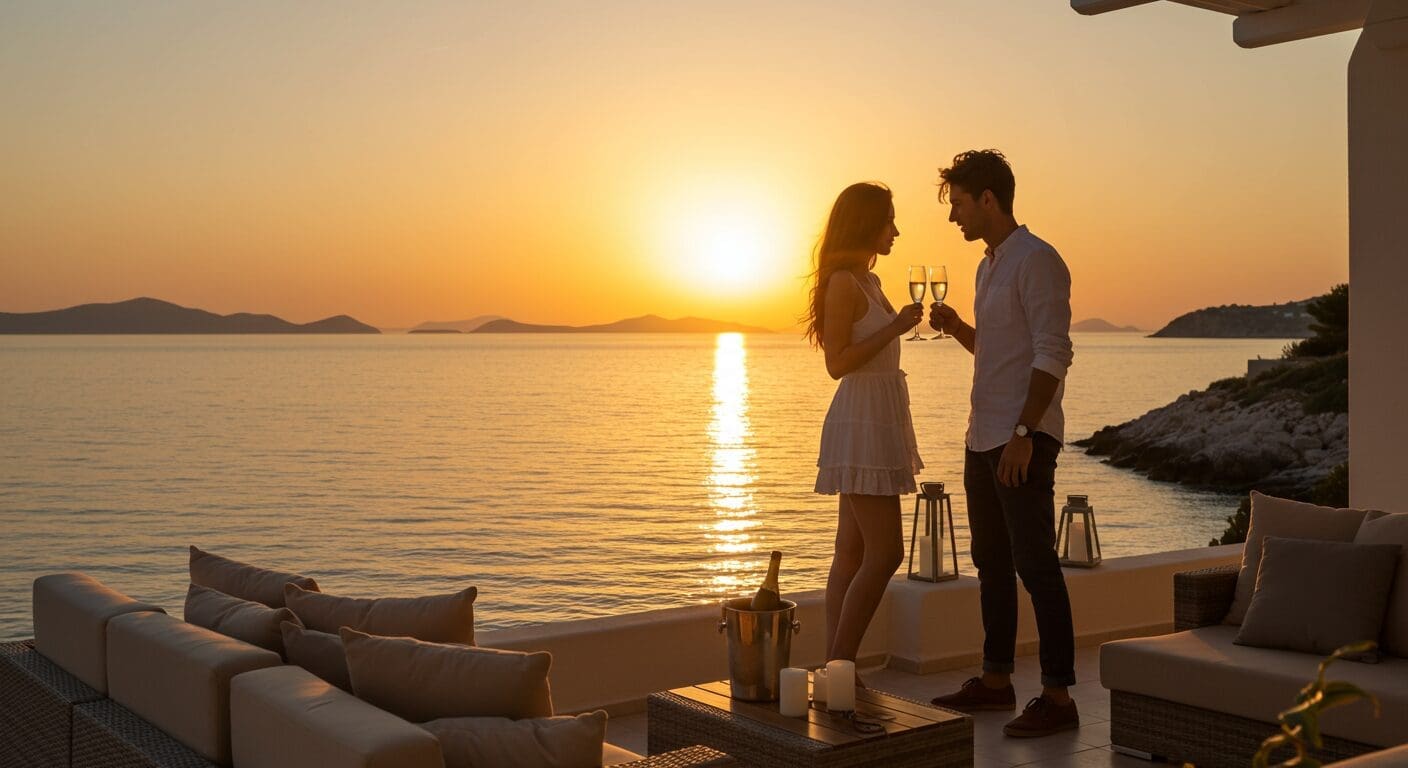
For something more private, a proposal from the terrace of a rented country house villa, with the Cotswold hills unfolding in the evening light and a glass of something properly cold in hand, has the advantage of being entirely your own. No other witnesses. No strangers. Just the two of you and the landscape. This should not be underestimated.
Anniversary Ideas and Special Occasions
The natural rhythm of Gloucestershire – slow, seasonal, rooted in the pleasures of food, landscape, and comfort – makes it particularly well suited to anniversary celebrations. For a significant milestone, the approach that works best is usually a private house or villa for at least three nights, with no fixed itinerary beyond a serious dinner reservation and perhaps one arranged activity. The rest can take care of itself, which in Gloucestershire means it will take care of itself rather well.
A first anniversary might be best spent returning to something experienced on a honeymoon – a particular walk, a favoured restaurant, the same stretch of canal in a different season. There is a real pleasure in return visits to places you first saw in a particular emotional state, finding what has changed and what has not. Gloucestershire rewards this kind of relationship. It is, after all, a county that has been visited for centuries without running out of things to offer.
For more landmark anniversaries, consider the combination of an outdoor experience – a private guided fly-fishing day on the Coln or Windrush, perhaps, or a morning’s hot air ballooning over the Cotswolds at dawn, which is the kind of thing that provides permanent conversational material – followed by a serious dinner at one of the county’s best restaurants and a night in a house of genuine quality. The ratio of effort to impact here is strongly in your favour.
Honeymoon Considerations for Gloucestershire
A Gloucestershire honeymoon works best when it is treated not as a series of organised experiences but as an extended permission to do nothing in particular in a beautiful place. This is a distinction worth making. The county offers more than enough to fill a fortnight – the restaurants, the gardens, the villages, the walking, the drives – but the best honeymooners tend to do about half of what they planned and spend the rest of the time sitting somewhere with a book they are not actually reading.
Practically speaking, a private villa or country house is the ideal honeymoon base. The privacy that comes with exclusive use of a property – having a garden entirely to yourselves, a kitchen stocked according to your preferences, the ability to eat breakfast at eleven without anyone’s approval – is qualitatively different from even the best hotel experience. On a honeymoon, this matters. You do not want to be managed. You want to be left alone in very comfortable circumstances, which is a service that Gloucestershire’s private rental market provides with considerable sophistication.
The county is accessible without being inconvenient. Driving from London takes under two hours. The Cotswolds are connected by genuinely enjoyable roads – the kind where the driving itself is part of the pleasure rather than something to be endured. For international honeymooners arriving via Heathrow, Gloucestershire combines well with a night in London at either end, providing a trip that covers two distinct experiences without feeling disjointed. Couples who combine a Gloucestershire villa stay with the wider Cotswolds circuit – taking in Burford, Bibury, and the northern villages – find that a ten-day honeymoon passes with the particular speed that indicates you have been entirely, genuinely happy. You will find a thorough grounding in what the county offers in our Gloucestershire Travel Guide, which covers the practical detail of getting here and getting around in full.
Your Romantic Base in Gloucestershire
Everything that makes Gloucestershire work for couples – the privacy, the pace, the quality of the landscape, the sense that you have arrived somewhere rather than merely passed through – is amplified when you have a private house to come home to. The right villa does not just provide accommodation. It provides context. A stone fireplace in February. A walled garden in July. A kitchen table where you can open something good and not have to be anywhere by nine. These are not small things.
For couples who want Gloucestershire at its best, a luxury private villa in Gloucestershire is the ultimate romantic base – the fixed point around which everything else can be arranged, changed, or happily abandoned in favour of staying put. It is, in the end, the kind of place a relationship remembers.
When is the best time of year for a romantic trip to Gloucestershire?
Gloucestershire has genuine appeal across all four seasons, which is not true of every destination. Late spring – May into early June – offers blossom, long evenings, and countryside at its most lush without the summer crowds. September and October bring exceptional light on the escarpment and autumn colour in the beech woods that is worth planning a trip around. Winter, particularly around Christmas, suits couples who want log fires, quiet villages, and the particular pleasure of having somewhere beautiful largely to themselves. High summer (July-August) is the busiest period – the most famous villages can feel congested – though a private villa base insulates you considerably from this.
Is Gloucestershire a good honeymoon destination for international travellers?
Very much so. Gloucestershire sits within easy reach of London – under two hours by road, with good rail connections to Cheltenham from London Paddington – which makes it straightforward to combine with a night or two in the capital for international travellers arriving at Heathrow or Gatwick. The county provides a very different experience from London: genuine countryside, small historic towns, and the kind of privacy that a city cannot offer. For couples who want the complete English experience – ancient churches, country house culture, proper landscapes, and serious food – Gloucestershire delivers this more authentically and more quietly than almost anywhere else in the country.
What is the most romantic village to stay in or visit in Gloucestershire?
This depends considerably on what you find romantic. For the classic Cotswold experience – honey-stone architecture, a river, a great pub – the villages of Upper and Lower Slaughter consistently deliver, with a quietness that the more famous Bourton-on-the-Water cannot match. Painswick, with its extraordinary churchyard yews and escarpment views, suits couples who want atmosphere over prettiness. Chipping Campden, at the northern end of the Cotswold Way, is architecturally remarkable and well-placed for exploring the wider northern Cotswolds. The honest answer is that the village matters less than the quality of where you are sleeping – which is where a well-chosen private villa, in or near any of these settlements, makes the most significant difference.