Best Restaurants in Haute-Savoie: Fine Dining, Local Gems & Where to Eat
There is a specific moment, somewhere around six in the evening in Haute-Savoie, when the mountain air carries something you cannot quite name. It is resinous and cold and faintly sweet – pine sap, wood smoke, and underneath it all, the suggestion of melted cheese. Not the aggressive, fondue-tourist version. Something quieter. More honest. It drifts down from the chalets above and settles in the village squares, and before you have even sat down at a table, you are already hungry in a way you are rarely hungry anywhere else. The mountains do that to you. They also, it turns out, have developed a restaurant scene that would embarrass cities three times their size.
Haute-Savoie is a department that rewards the curious eater. Yes, there are the expected Michelin stars – and there are rather a lot of them, concentrated in improbable places like ski resort villages where you might reasonably have expected nothing more sophisticated than a vin chaud and a croque-monsieur. But there is also the market in Annecy on a Tuesday morning, and the lakeside bistros that serve perch so fresh it seems implausible, and the mountain huts where the cheese is made on the premises and the welcome is unconditional. Knowing where to look – and what to order when you get there – makes all the difference.
This guide covers the full range: Michelin-starred dining that earns every one of its flowers, neighbourhood gems that Google Maps has yet to ruin, what to drink with your tartiflette, and the reservation intel that will save you considerable disappointment. Consider it the dining companion you wish you had packed.
The Fine Dining Scene: Michelin Stars in the Mountains
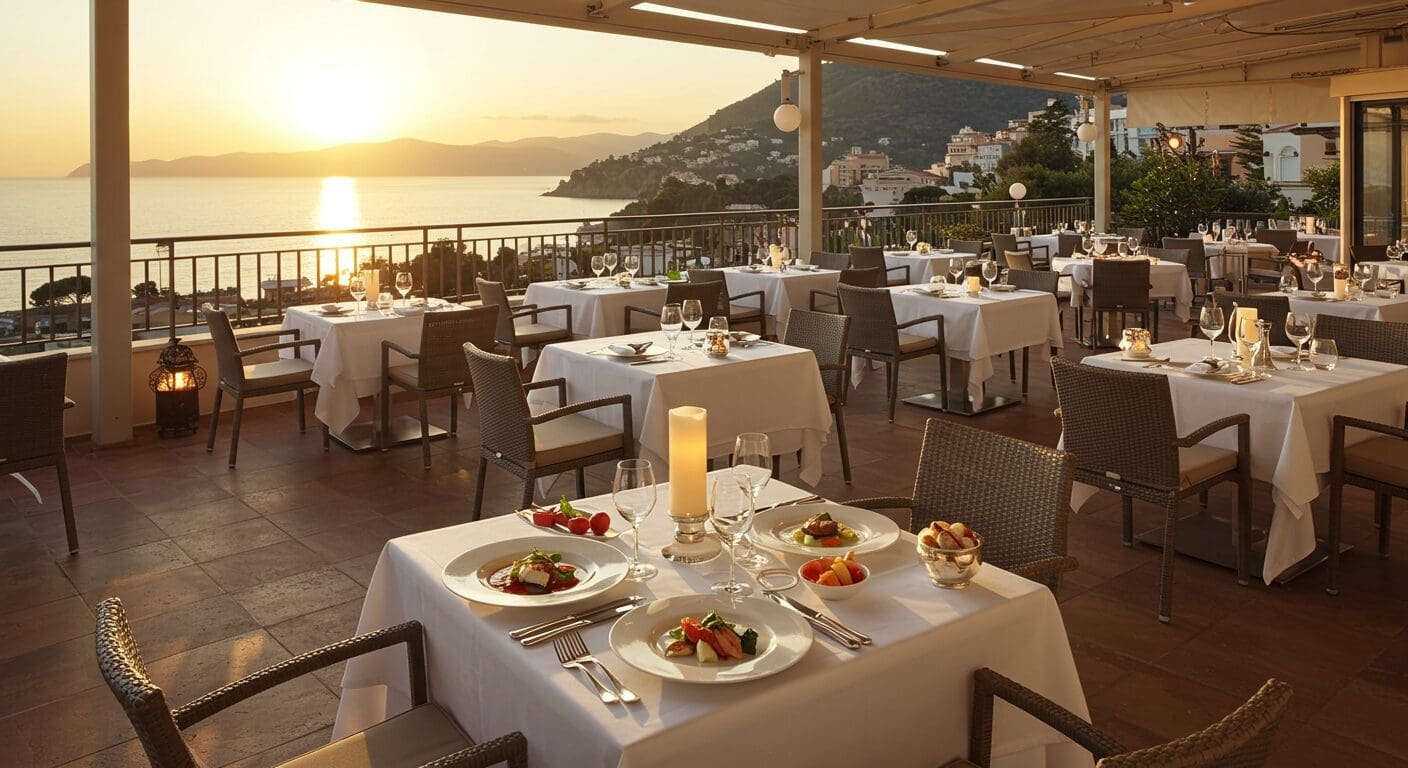
The concentration of Michelin-starred restaurants in Haute-Savoie is, when you think about it, slightly absurd. This is a largely rural mountain department. The cows outnumber the sommeliers by some margin. And yet the region holds more starred establishments than many European capitals, clustered around Megève and Annecy with the quiet confidence of somewhere that has nothing to prove.
At the very top of the mountain – literally and figuratively – sits Flocons de Sel in Megève. Emmanuel Renaut holds three Michelin stars and the title of Meilleur Ouvrier de France, which in culinary terms is roughly equivalent to being both a virtuoso and a craftsman simultaneously. His cooking is rooted entirely in the Alpine landscape – wild herbs foraged from the hillsides above the restaurant, local producers whose names Renaut knows personally, and a sensibility that insists the mountains are not a backdrop to the food but its actual subject. The restaurant completed a full renovation and reopened in December 2025, returning to service with its reputation not merely intact but sharpened. A meal here is genuinely moving in a way that makes the phrase “fine dining” feel insufficient. Book as far ahead as humanly possible. Then book further ahead than that.
Annecy has its own claim to the top table, and it comes in the form of Le Clos des Sens in Annecy-le-Vieux, which earned its third Michelin star in 2025. Chef Franck Derouet and his partner Thomas Lorival have built something genuinely distinctive here – a tasting menu philosophy anchored in plants and fish from the Alpine lakes, with produce sourced from their own garden or within a hundred kilometres. Not as a marketing exercise, but as a genuine creative constraint that produces food of extraordinary precision and freshness. The tasting menus come with food and wine pairing or, for those who prefer it, food and juice pairing – the non-alcoholic option being rather more sophisticated than that phrase usually implies. The vegetable preparations alone are worth the journey from wherever you happen to be.
Megève, for a village of its size, is doing something remarkable. It holds three Michelin-starred restaurants under one set of mountain ridges. Alongside Flocons de Sel, La Dame de Pic – Le 1920 at the Four Seasons Megève brings the formidable Anne-Sophie Pic – the world’s most decorated female chef by star count – to the Alps. Her approach at Le 1920 layers the flavours of Savoie against global references with a complexity that is as intellectual as it is pleasurable. The tasting menu begins at around €190 per person, which in the context of what arrives at the table is not unreasonable. The Four Seasons setting means the service is impeccable without being stiff – a balance that is harder to achieve than it looks.
Completing Megève’s triumvirate is La Table de l’Alpaga, part of the five-star L’Alpaga hotel. The cuisine here is refined Alpine – meaning it respects the traditions of the region without being enslaved to them, and the setting, within one of the Alps’ most considered wellness properties, gives the whole experience a particular kind of unhurried grace. Three starred restaurants in a single ski village. Megève has clearly decided to take food seriously, and the results speak for themselves.
Lakeside Excellence: Dining Around Annecy
Annecy is one of the most beautiful towns in France. It knows this, and has developed a certain patience with the coaches full of visitors who arrive to photograph it and then leave without eating anywhere interesting. The smart visitor does the opposite: spends less time photographing the lake and more time sitting beside it with a glass of something cold and a plate of lavaret – the delicate white fish that comes from the lake itself and appears on menus across the region in season.
Just outside Annecy, in the village of Veyrier-du-Lac, Restaurant Yoann Conte represents one of the most complete dining experiences the region offers. The chef’s eponymous restaurant has accumulated a Michelin star alongside three Toques Blanches from the Gault et Millau guide – the latter being, in certain circles, the harder accolade to earn. The cooking celebrates the flavours and produce of Savoie with a rigour that stops well short of rigidity, and the lakeside position gives every meal a quality of light and reflection that you will find yourself thinking about long afterwards. More than 688 TripAdvisor reviews suggests a clientele that keeps coming back, which is, when you strip away all the star ratings and awards, the only endorsement that truly counts.
The town of Annecy itself offers dining at every register. The old town – the canals, the flower-draped bridges, the cobbled alleys – is thick with restaurants of variable quality, and choosing blindly here is an act of optimism. The places worth seeking out tend to be slightly away from the main tourist circuit: the neighbourhood bistros near the covered market, the wine bars on the quieter streets, the fromageries that have added a few tables and a short menu because their cheese was too good not to cook with. Annecy rewards the visitor who is willing to walk a little further and resist the pavement terrace with the best view of the canal.
Local Gems and Hidden Tables
The best meals in Haute-Savoie are not always the most decorated ones. Alongside the Michelin firmament, the region has a dense network of mountain restaurants, village bistros and family-run ferme-auberges that represent a different kind of excellence – one measured in generosity, in directness of flavour, in the feeling that the person who cooked your meal also made the cheese and probably knows the farmer who raised the meat.
The ferme-auberge is a specifically French Alpine institution and one worth understanding. These are working farms that open their dining rooms to guests, typically for lunch, typically for a set menu that involves several courses of the farm’s own produce. Reservation is essential – these are not walk-in operations – and the experience is entirely unlike a restaurant in the conventional sense. You eat what is made that day, with whoever else happens to have booked, at a table that has probably been in the family for three generations. The food is direct and serious in the way that food always is when the cook and the producer are the same person.
In the ski villages, the mountain restaurants – the refuges and the mid-mountain chalets accessible by ski or on foot – deserve more serious attention than they typically receive. The best of them serve simple food with exceptional ingredients: a cheese plate assembled from things made within visual range of where you are sitting, cured meats from producers the chef has known for years, soups and stews that taste of real cold and real effort. They are not trying to be restaurants. That is precisely what makes them good.
Markets and Produce: Eating Like a Local
The Tuesday and Friday markets in Annecy are among the finest in the French Alps, and any visit to Haute-Savoie that does not include at least one market morning is leaving something significant on the table. The Tuesday market occupies the streets around the old town and runs into the afternoon; the Friday version, on the shores of the lake, is larger and more theatrical. Both reward early arrival and unhurried browsing.
What to look for: Reblochon from the Aravis valley, which in its raw-milk form is a different animal from anything you have encountered in a supermarket. Tome de Savoie – mild, nutty, versatile – sold in big rough rounds. Beaufort, which is the region’s grand fromage, an alpine cheese of such seriousness that it has its own appellation and its own dedicated cult following. Charcuterie of particular excellence: diots (pork sausages made for poaching in white wine), lonzo, and the dried mountain hams that concentrate flavour over months of altitude curing.
The fruit and vegetable stalls at these markets reflect an Alpine growing season that is shorter and more intense than the lowlands – the tomatoes taste more like tomatoes, the small mountain strawberries are brief and extraordinary, and the wild mushroom sellers in autumn bring chanterelles and cèpes down from the forests above the valley in quantities that make the whole market smell like October. This is not hyperbole. It really does smell like October.
What to Order: The Dishes That Define the Region
Any serious engagement with Haute-Savoie cuisine begins with the holy trinity of Savoyard comfort food: tartiflette, raclette, and fondue. These are not, despite their ubiquity, tourist inventions – they are genuine expressions of a mountain food culture built around dairy, potato, and the pragmatic genius of combining the two in ways that generate extraordinary warmth and satisfaction. A properly made tartiflette – with Reblochon au lait cru, lardons, onion, and just enough crème fraîche to bind it – is a different dish entirely from the canteen versions that have given it an undeserved reputation for heaviness.
Beyond the cheese dishes, look for omble chevalier – Arctic char from the mountain lakes, delicate and clean-flavoured, best served simply with brown butter. Lavaret from Lac d’Annecy, poached or grilled and dressed with little more than good oil and herbs. Diots au vin blanc – the local pork sausages poached slowly in Savoie white wine until they are tender and the broth around them has concentrated into something worth mopping up with bread. And in autumn, game from the forests above: venison, wild boar, hare, prepared in the long braises that mountain cooking does better than anywhere.
For dessert: tarte aux myrtilles made with the wild blueberries that grow above the treeline in summer, or – if you can find it – the génépi semifreddo that appears on better menus as an expression of the local alpine herb liqueur. Génépi itself deserves a mention: this is the region’s emblematic digestif, made from artemisia plants harvested at altitude, and it tastes unmistakably of the mountains – slightly medicinal, slightly sweet, entirely compelling. One glass after dinner is research. Two glasses is enthusiasm.
Wine and Local Drinks
Savoie wine is one of France’s best-kept open secrets, which is another way of saying that most of it is drunk close to where it is made and very little of it makes it to the export market. This is the local drinker’s advantage: in Haute-Savoie, you can drink Savoie wines at reasonable prices in the restaurants and bars where they were always meant to be consumed, rather than paying a premium for them abroad.
The whites are the stars. Jacquère is the dominant grape – light, mineral, and faintly floral, it cuts through cheese dishes with a precision that seems designed rather than accidental. Which it probably was – centuries of mountain cooking and mountain viticulture do not coexist without developing a relationship. Roussette de Savoie is a step up in weight and complexity, with a honeyed quality that makes it a natural companion for the fish dishes from the alpine lakes. Chignin-Bergeron, made from Roussanne grown on steep south-facing slopes above the Isère valley, produces wines of real depth and ageing potential – the kind of wine that makes you feel slightly smug for knowing about it.
The red wines from Savoie – Mondeuse in particular – are worth seeking out for their originality: dark-fruited, tannic, and peppery in a way that recalls Northern Rhône without quite being it. They are excellent with game and charcuterie. For aperitif, try a kir savoyard made with Mondeuse rather than the standard Burgundy convention, or simply a glass of something cold and local while you wait for the sun to drop behind the Aravis and the evening to turn properly cold and beautiful.
Reservation Tips and Practical Notes
The dining calendar in Haute-Savoie is governed by two seasons: winter (roughly mid-December to April) and summer (July to early September), with a shoulder in between when some restaurants close and others breathe. This is important because turning up in late October expecting Flocons de Sel to be open is the kind of plan that ends in disappointment and vending machine cheese. Check opening dates before you travel. Then check them again the week before.
For the three-starred restaurants – Flocons de Sel and Le Clos des Sens in particular – reservations should be made weeks in advance during peak season, and months in advance if you have a specific date in mind. Both restaurants have their own reservation systems; the Four Seasons Megève handles Le 1920 bookings through the hotel. Many of the best mid-mountain restaurants and ferme-auberges require reservation by phone – in French – which is either an inconvenience or an opportunity to practice, depending on your temperament.
For the market towns and village bistros, the general rule is: lunch is more forgiving than dinner, Sunday lunch is the most sociable and most copious meal of the week, and anywhere with a handwritten menu in the window is worth investigating. The places that print their menus on laminated cards and include photographs of the dishes are telling you something. Listen to them.
Staying in Haute-Savoie: The Villa Table
For those staying in a luxury villa in Haute-Savoie, the question of where to eat acquires an additional dimension. Many of the finest properties in the region can be arranged with a private chef – someone who knows the local producers, shops the market on Tuesday morning, and produces food that reflects the landscape outside your window rather than importing a generic luxury-hotel sensibility. A private chef in a Savoyard villa is not an indulgence in the decorative sense; it is a genuinely different way of experiencing a region whose food culture is as much about provenance and place as it is about technique. Breakfast becomes an occasion. Dinner becomes a conversation. The fondue, made from cheese sourced that morning, becomes something you think about for years afterwards.
The region’s combination of extraordinary restaurants and exceptional self-catered properties means that the best approach is usually a mixture: two or three evenings out at the starred tables, a market morning, and the rest of the time making use of your own kitchen, your chef, and the extraordinary raw materials that Haute-Savoie provides. For more on planning your time in the region, see our full Haute-Savoie Travel Guide.