Kalkan Travel Guide: Where to Stay, Eat & Explore in Luxury
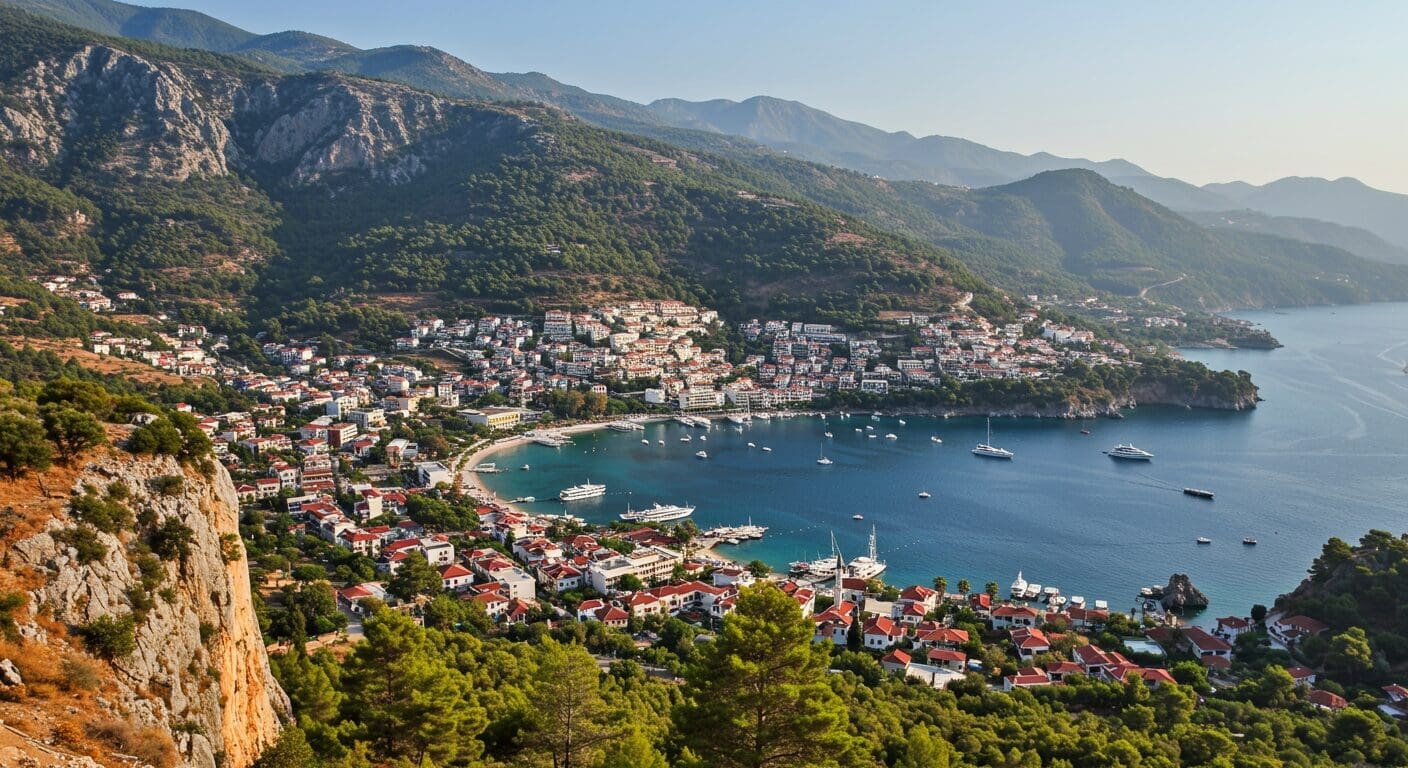
There is a particular kind of travel envy that Kalkan inspires – the sort where friends return from holiday slightly changed, slightly quieter, and frustratingly reluctant to share the details. It is not the biggest resort on the Turkish coast. It does not have a waterpark, a strip of neon clubs, or a beach you could lose a child on in thirty seconds. What it has instead is something rarer: the feeling that you arrived somewhere rather than simply landing somewhere. Perched on a hillside above a small natural harbour on Turkey’s Turquoise Coast, Kalkan is the kind of place where the light hits the water at an angle that makes you briefly question why you have spent the last decade going anywhere else. A luxury holiday in Kalkan is not about spectacle. It is about depth – the cumulative pleasure of excellent food, exceptional villas, clear warm water, and a town that still feels, improbably, like itself.
The travellers who fall hardest for Kalkan tend to be specific types, and it is worth naming them honestly. Couples marking milestone anniversaries or honeymoons find it close to perfect – intimate enough to feel romantic, polished enough to feel indulgent. Families seeking genuine privacy rather than a hotel corridor version of it discover that a hilltop villa with an infinity pool and no neighbouring sunbeds is, in fact, the entire point. Groups of friends who have graduated from sharing apartments in their twenties and now want something with a chef’s kitchen and a poolside table for ten find Kalkan accommodates them beautifully. Wellness-focused guests – the ones who want yoga at dawn, sea swims before breakfast, and a week without the particular anxiety of an open-plan office – find the pace here genuinely restorative rather than merely aspirational. And the growing number of remote workers who have discovered that the Mediterranean sun does not, in fact, impair productivity, will find that many luxury villas in Kalkan now come equipped with the kind of connectivity that makes Zoom calls possible even while the sea turns gold below the terrace. Kalkan is, in other words, rather good at being several things at once without being any of them badly.
Getting Here: The Logistics Are Easier Than You Think
Kalkan sits on Turkey’s southwestern coast, roughly equidistant between two international airports – Dalaman to the east and Antalya to the west. Dalaman is the closer of the two at around an hour and forty minutes by road, and serves a good range of direct flights from the United Kingdom throughout the summer season. Antalya handles more year-round traffic and is slightly further – expect two and a half to three hours depending on traffic – but the drive through the Taurus Mountains is, in itself, an argument for choosing that route at least once.
Private transfers from either airport are the sensible choice for a luxury trip, and they are easy to arrange through your villa company or independently. A private car to the door removes the particular adventure of Turkish dolmuş networks, which are charming and cheap and will absolutely get you somewhere eventually. Hire cars are available and useful if you plan to explore the wider region independently – the coastal roads are dramatic and worth driving, though they demand your full attention in a way that makes audiobooks impractical. Kalkan itself is small and largely walkable, though its hillside topography means you will almost certainly be taking taxis uphill after dinner. This is not a hardship. The taxis are inexpensive, always available, and driven with a confidence that suggests the hairpin bends hold no surprises.
Where to Eat: A Town That Takes Food Seriously
Fine Dining
For a town of its size, Kalkan has a dining scene that quietly overperforms. The rooftop terrace restaurant is practically the default architecture here – almost every serious kitchen in town has elevated itself, literally, to make the most of the views across the bay – and the quality of food on those terraces has followed suit.
Aubergine Restaurant is the one that regulars mention first, and with good reason. Its panoramic position above the harbour gives it one of the best views in town – that particular vantage point where the blue of the Mediterranean fills the frame like a painting someone had the good taste not to hang anything in front of. The menu moves between Mediterranean and Anatolian influences with genuine fluency, and the atmosphere is upscale without the stiffness that sometimes accompanies that word. It is the kind of place where you order more than you planned to.
Baharat Restaurant and Bar earns its position as one of Kalkan’s busiest tables through a combination of a vibrant terrace atmosphere and a kitchen that takes its centrepiece seriously. Its Chateaubriand is the dish people come back for, and the kind of thing you find yourself thinking about on the flight home. Popular with both visitors and people who actually live here, which is always the more useful endorsement.
For those for whom the perfect fillet steak is a near-spiritual matter, Sade Terrace Restaurant has achieved something approaching cult status. Perched on an intimate roof terrace, it is a smaller operation than some of its neighbours – which is precisely its appeal. The service is attentive without being managed, the atmosphere is well-suited to couples, and the fillet has the kind of reputation that travels ahead of the restaurant. Book early.
Where the Locals Eat
Not every meal in Kalkan needs to be a considered occasion. Kalamaki Restaurant occupies a rooftop position with sea and mountain views that are, by any measure, worth the table alone. But the food keeps pace – the moussaka is exceptional and frequently cited as a reason to return, and the kitchen blends Mediterranean and Turkish culinary traditions with the ease of somewhere that has been doing this for a long time rather than simply pivoting between menus. Vegetarian guests, often underserved in Turkish coastal resorts, will find genuine options here rather than the usual afterthought.
The harbour area rewards an early evening wander, when the boats are returning and the light is doing things to the water that no filter has yet successfully replicated. Small meyhanes and seafood spots line the waterfront, and sitting with a glass of local wine watching the gulets come in is as close as the Turkish coast gets to a shared civic ritual.
Hidden Gems Worth Seeking Out
Rose Restaurant sits slightly away from the main town cluster, and that short walk is what keeps it good. Positioned in a calmer, more residential setting, Rose focuses on the kind of authentic Turkish cooking that sometimes gets squeezed out of tourist-facing menus – proper kebabs, freshly made pides and lahmacun, excellent mezze and bread that arrives warm and homemade. It is considered better value than many of its more prominent neighbours and noticeably more honest in its cooking. Regulars tend to tell you about it the way people tell you about their favourite bookshop: with slight reluctance and the implicit understanding that you won’t tell everyone.
Kalkan also has a small but worthwhile wine bar scene. Turkish wines – particularly those from the Aegean and Anatolian regions – have quietly become excellent over the past decade, and several bars in town have caught up with that development. Local varietals like Öküzgözü and Boğazkere are worth exploring with something from the kitchen to anchor them.
The Landscape: What Makes This Stretch of Coast Distinctive
The Turquoise Coast earns its name honestly. The water here achieves a specific shade of blue-green that seems almost engineered – the result of depth, clarity and reflected limestone, rather than anyone’s marketing department. Kalkan sits near the eastern end of the Lycian Coast, a stretch of Turkish shoreline that runs roughly from Fethiye in the west to Antalya in the east, and which contains more startling scenery per kilometre than almost anywhere in the European Mediterranean world.
The town itself is built on steep hillsides above a small harbour – the old Greek and Ottoman quarter of whitewashed houses and bougainvillea tumbling over stone walls sits above a marina that operates at a level of activity suggesting everyone in the Aegean has, quite sensibly, decided to be here. The old town has managed to preserve its character to a degree that is frankly impressive given the development pressure on this coast. Narrow cobbled streets, wooden balconies, the smell of jasmine and coffee. The architecture has a Mediterranean logic to it – shade where you need shade, views where you need views.
Beyond the town, the Taurus Mountains provide a dramatic backdrop that lifts the landscape out of the merely coastal into something more complex. Forested ridges, ancient ruins scattered through the scrub, river gorges that drop to the sea. The Xanthos Valley to the north contains some of the most significant Lycian archaeological sites in Turkey. The sea itself is not uniform – coves and inlets punctuate the coastline in a way that rewards exploration by boat, and the area around Kaputaş Beach, a twenty-minute drive east, is the sort of image you have seen on screensavers and assumed was digitally enhanced. It is not.
Things to Do: From Ancient Ruins to Blue Water
The best activities in Kalkan tend to divide neatly between those that involve getting in or on the water, those that involve exploring a landscape thick with history, and those that simply involve sitting somewhere beautiful with a long lunch. The correct approach is to rotate between all three.
A gulet cruise along the coast is, without qualification, one of the finest things you can do here. The Turkish wooden sailing boats that depart Kalkan harbour daily are built for exactly this coastline – wide enough to be comfortable, small enough to access the coves and sea caves that larger vessels cannot reach. A full-day cruise typically takes in secluded swimming spots, lunch on deck, and the kind of afternoon that feels structurally opposed to productivity. Private gulet charters are available and particularly well-suited to families or groups who would prefer their swimming cove to themselves. Book in advance during July and August – the boats fill up, and with good reason.
On land, the Lycian Way long-distance walking trail passes near Kalkan and offers day hike options for those who want to earn their dinner. The trail is one of the great long-distance walks of the Mediterranean world – ancient, dramatic and spectacularly under-crowded compared to anything of equivalent quality in western Europe. Day trips to the ancient Lycian cities of Xanthos, Patara and Letoon are straightforward from Kalkan, either independently by hire car or through guided excursions. Patara also has a beach of considerable length – twelve kilometres of it, in fact – backed by dunes and largely undeveloped, which feels like a minor miracle on this coast.
The Saklikent Gorge, roughly an hour’s drive inland, is a particularly good half-day trip that rewards the effort disproportionately. A narrow canyon cut through white rock by snowmelt from the Taurus Mountains, it involves wading, clambering and the specific pleasure of being genuinely cold in a hot country. Children find it excellent. Adults find they had more fun than they expected to.
For the Adventurous: Water, Rock and Altitude
The sea around Kalkan is clear enough and deep enough to make scuba diving genuinely worthwhile. Several dive operators work out of the harbour offering trips for both certified divers and beginners. The underwater topography along this section of coast includes rock formations, sea caves and a visibility that makes diving here feel like looking through glass. Snorkelling from a gulet or directly off cove beaches is accessible without any preparation and delivers more than the usual Mediterranean snorkel – there are sea turtles on this coast, and encountering one while drifting through clear water is the kind of moment that recalibrates expectations of what a holiday can contain.
Kayaking along the coastline is available through local operators and works particularly well in the early morning before the wind picks up. Paddleboarding has colonised every Turkish resort marina in the last decade, Kalkan included, and whatever one might feel about its ubiquity, it does work remarkably well in calm, clear water with mountains behind you.
For those drawn to altitude rather than depth, the Taurus Mountains offer paragliding with qualified tandem instructors – the launch point near Fethiye at Ölüdeniz is the most famous in Turkey, and within easy day-trip range. Road cycling through the Xanthos Valley and surrounding hills has a dedicated following among guests who arrive with their own bikes, and the roads are quiet enough to make it viable. Mountain hiking routes from town connect to the wider Lycian Way network, and a local guide is worth engaging for anything more ambitious than an afternoon walk.
Kalkan with Children: Better Than You Might Expect
Kalkan does not market itself aggressively to families in the way that larger Turkish resorts do – there are no waterparks, no animation teams with matching t-shirts, no buffet restaurants stretching to a visible horizon. This is, for the right kind of family, its greatest asset.
Families seeking privacy rather than organised entertainment find that a private villa with an infinity pool in Kalkan is, in practical terms, much more functional than a hotel. Children swim when they want to, eat when they’re hungry, sleep in beds that belong to the holiday rather than a rotation. There is no timetable. The pool does not have width restrictions. Teenagers have somewhere to be without being anywhere stressful. Multi-generational groups – grandparents, parents and children across an age range that no hotel room configuration can gracefully accommodate – find that a well-staffed villa solves everything almost immediately.
The town itself is small and navigable with children, and the harbour is the kind of place where small people can watch boats for longer than anyone would predict. Boat trips are well-suited to families – most private gulet charters welcome children and the combination of swimming from the boat, lunch on deck and complete absence of screens tends to produce a holiday experience that children actually remember. The Saklikent Gorge is a reliable hit with older children who need something physical and slightly wet. The beaches nearby, including Kaputaş and Patara, are genuinely beautiful and not so remote as to feel inaccessible with a family in tow.
History and Culture: The Lycians Were Here First
Kalkan sits in a landscape that has been inhabited, fought over, traded through and generally occupied by remarkable civilisations for the better part of three thousand years. The Lycian people – a Bronze Age Anatolian civilisation with a culture distinct enough to merit sustained academic fascination – left behind ruins across this entire coastline that have still not all been properly excavated. Their rock tombs, carved directly into cliff faces, appear throughout the region with a frequency that makes them feel familiar and with a quality of workmanship that makes familiarity feel insufficient as a response.
Xanthos, a short drive from Kalkan, was the capital of the Lycian League and is now a UNESCO World Heritage Site. Its ruins are extensive and atmospheric in the particular way of sites that have genuinely important things to say without much interpretive infrastructure to say them. Letoon, nearby, was the religious centre of the same league, and the combination of the two sites makes for a full day of genuine historical substance. Patara, in addition to its extraordinary beach, was the birthplace of St Nicholas – the historical figure behind the Santa Claus tradition – and contains archaeological remains significant enough to have kept Turkish archaeologists occupied for decades.
The town of Kalkan itself carries traces of its Greek history – it was known as Kalamaki under Ottoman rule and had a substantial Greek Christian population until the population exchanges of the 1920s. The old town architecture reflects this layered past, and walking its upper streets is to move through several centuries of the eastern Mediterranean in comfortable proximity. Islam is the predominant religion and observed without fuss – the call to prayer is part of the acoustic landscape of any morning here, and mosques are open to respectful visitors. The Turkish bathing tradition continues in a hammam culture that has survived tourist adaptations with its dignity more or less intact.
Shopping: Small Town, Considered Choices
Kalkan is not a shopping destination in the way that Istanbul or Bodrum might lay claim to that description, and for most guests this is mildly irrelevant given the number of hours that tend to disappear around a villa pool. What it does have is a small, curated collection of independent shops in the old town that reward an afternoon of wandering without the pressure of a market’s insistence that you really do need another piece of ceramic.
Turkish textiles are worth taking seriously here. Handwoven kilims, cotton hammam towels in various weights and colours, and the kind of soft linen that the Mediterranean climate seems to produce naturally are all available in the better shops, and the quality differential between the genuinely handmade and the imported-and-marked-up is worth navigating with patience. Leather goods, hand-painted ceramics, and locally produced olive oil and its derivatives (soaps, balms, products of various descriptions) are the standard reliable options. Spice shops are the olfactory highlight of any morning wander – the good ones offer a proper conversation about what you’re looking at, which is half the point.
The weekly market in nearby Kaş – a twenty-minute drive east – is larger and more varied, and a good option for a morning excursion combined with lunch in that town’s harbour. Kaş has a slightly more developed boutique shopping scene than Kalkan and is worth the trip for those who want more time in a shop than Kalkan’s compact old town provides.
Practical Matters: What You Actually Need to Know
Turkey uses the Turkish Lira (TRY), and the exchange rate against sterling and euros has historically been favourable enough to make holidaying here feel generously priced, particularly for dining and local services. Credit cards are widely accepted in restaurants and shops, though cash remains useful for smaller transactions, market stalls, and the occasional taxi driver who has exhausted their belief in card machines.
The best time to visit Kalkan, for the combination of reliably hot weather, clear seas and a town operating at full capacity without August’s particular intensity, is May through June and September through October. July and August are peak season – the weather is at its most reliably fierce, every restaurant and boat trip is booked, and the town operates at a pace that some guests find energising and others find slightly less peaceful than advertised. Spring and early autumn give you the light, the warmth, the full sea temperature and a slightly more thoughtful crowd. November to March is quiet to the point of several restaurants closing, though the landscape has a quality in winter that rewards those who seek it.
Tipping is standard in restaurants – ten percent is conventional, slightly more for exceptional service. English is spoken to a functional level in most tourist-facing businesses, and Turkish attempts, however modest, are received with warm good humour rather than the polite wincing they might produce elsewhere. The country is generally safe for visitors. Turkish hospitality is the genuine article – the frequency with which strangers offer tea is not a commercial strategy.
Modest dress is appropriate around mosques and in more traditional areas inland. The town itself is relaxed, but covering shoulders and knees when entering religious sites is both respectful and genuinely expected. Pharmacies are well-stocked and pharmacists are often bilingual; Turkish healthcare is accessible and competent. Travel insurance is advisable as standard.
Why a Private Villa Makes Kalkan Make Sense
The hotel question in Kalkan is worth addressing directly: the town has some good boutique properties, but it does not have the kind of grand resort hotel infrastructure that other Turkish coastal destinations have built around themselves. This is, from a certain angle, one of Kalkan’s more endearing qualities – it has remained a place where the villa is not merely an option but is genuinely the primary accommodation logic. The hillside topography, the emphasis on privacy, the quality of the local villa stock, the culture of long stays – all of it points in the same direction.
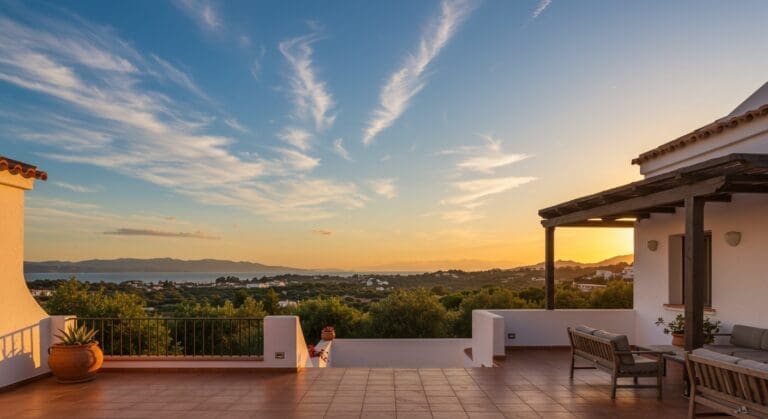
A private luxury villa in Kalkan offers something that no hotel room ratio can replicate: space calibrated to your group rather than a hospitality industry’s idea of it. An infinity pool that belongs entirely to you, which matters more than it should and exactly as much as you think it will. A kitchen for the morning when you want nothing more than strong coffee and the view. A terrace for the evening when you want to watch the sun take its time leaving. Staff options – private chefs, concierge services, villa management – that make the difference between a good holiday and one that requires no decisions you weren’t planning to enjoy making.
For families, the pool-and-privacy equation is essentially solved the moment you check in. For groups of friends, a large villa distributes the holiday across a set of shared spaces that hotels simply cannot provide without buying out an entire floor. For couples on a milestone trip, an infinity pool villa above the Turquoise Coast on a warm September evening is the kind of environment that does a significant amount of the romantic work entirely on its own. For remote workers, many Kalkan villas now offer reliable high-speed broadband – and some have Starlink – which means the view from your desk becomes, technically, a Mediterranean hillside. Whether this improves or impedes concentration is a question you will be pleased to investigate personally.
Wellness guests find that a private villa in Kalkan functions as a genuinely restorative environment in a way that wellness marketing often promises and rarely delivers. Swimming in your own pool before the day begins, hiking in the mountains before lunch, eating well, sleeping in silence. The pace here is not manufactured. It is structural.
Excellence Luxury Villas offers an extensive collection of properties across the region, from hillside retreats with private infinity pools to larger multi-bedroom villas suited to groups and extended families. Browse our full selection of luxury villas in Kalkan with private pool and find the one that makes the most sense for yours.
More Kalkan Travel Guides
- Best Restaurants in Kalkan: Fine Dining, Local Gems & Where to Eat
- Kalkan Food & Wine Guide: Local Cuisine, Markets & Wine Estates
- Kalkan with Kids: The Ultimate Family Holiday Guide
- Best Time to Visit Kalkan: Month by Month Weather, Crowds & Tips
- Kalkan Luxury Itinerary: The Perfect 7-Day Guide
- Romantic Kalkan: The Ultimate Couples & Honeymoon Guide
What is the best time to visit Kalkan?
May, June, September and October offer the most rewarding combination of reliable warmth, clear seas and a town that is fully operational without the intensity of peak August. The sea temperature in September is at its highest after months of summer heating, and the light in October is exceptional. July and August are the hottest and busiest months – everything is available, everything is booked, and the crowds are real. Spring and early autumn are the insider choice for good reason.
How do I get to Kalkan?
The two nearest international airports are Dalaman (approximately 1 hour 40 minutes by road) and Antalya (approximately 2.5 to 3 hours). Dalaman handles the majority of direct summer flights from the UK and is the more convenient option for most visitors. Antalya has more year-round flight options and a wider international catchment. Private transfers from either airport are recommended for a luxury trip and can be arranged through your villa company or independently. Hire cars are available at both airports for guests planning to explore the region independently.
Is Kalkan good for families?
Yes, particularly for families who value privacy and space over organised resort entertainment. Kalkan has no waterpark infrastructure and no animation teams – which is precisely what many families find so appealing about it. A private villa with an infinity pool provides a self-contained base from which the whole family can operate at its own pace. Boat trips are excellent for children of most ages, the Saklikent Gorge is a reliable hit with older kids, and the nearby beaches at Kaputaş and Patara are genuinely beautiful and accessible. Multi-generational family groups work especially well in larger villas with separate sleeping wings and shared outdoor spaces.
Why rent a luxury villa in Kalkan?
Kalkan’s architecture and character are built around the villa rather than the resort hotel, and the private villa experience here is genuinely superior to the hotel alternative for almost every traveller type. A private pool that belongs entirely to your group, space calibrated to the number of people you actually arrived with, a kitchen for the mornings you want to use it, and a terrace positioned to make the most of one of the most dramatic sea views on the Turkish coast. Staff options including private chefs and concierge services are available across many properties. The privacy is real, not a marketing concept.
Are there private villas in Kalkan suitable for large groups or multi-generational families?
Yes. The Kalkan villa market includes a strong selection of larger properties with multiple en-suite bedrooms, separate living wings and private pools suited to groups of eight, ten, twelve or more guests. Multi-generational families in particular benefit from villas with distinct bedroom configurations that give adults and children separate spaces while sharing outdoor and dining areas. Some larger properties come with additional staff options including private chefs, daily housekeeping and villa managers. Availability at the larger end fills quickly for July and August, so booking well in advance is advisable.
Can I find a luxury villa in Kalkan with good internet for remote working?
Increasingly, yes. Many of the better luxury villas in Kalkan now offer reliable high-speed broadband as standard, and a growing number have installed Starlink satellite connectivity, which delivers consistent speeds regardless of location on the hillside. It is worth specifying your connectivity requirements at the point of booking rather than hoping for the best on arrival. Most villa managers can confirm connection speeds in advance. Working from a hillside terrace above the Turquoise Coast with the Mediterranean visible below the screen is, empirically, a better working environment than an open-plan office. Whether this improves or impedes productivity is a matter for your own investigation.
What makes Kalkan a good destination for a wellness retreat?
The combination of physical environment, pace of life and private villa amenities makes Kalkan well-suited to genuinely restorative stays rather than the manufactured wellness that involves candles and a leaflet. The sea swimming is exceptional – warm, clear and accessible from boat or beach. The Lycian Way hiking routes provide serious outdoor exercise in a landscape of real quality. The food culture is Mediterranean in the best sense: fresh, olive-oil-based, varied and not unkind to the body. Many luxury villas come equipped with private pools, outdoor yoga terraces and gym spaces, and private yoga or fitness instruction can be arranged locally. The pace of the town itself – unhurried, unhustling – does a significant amount of the work before any formal wellness activity begins.