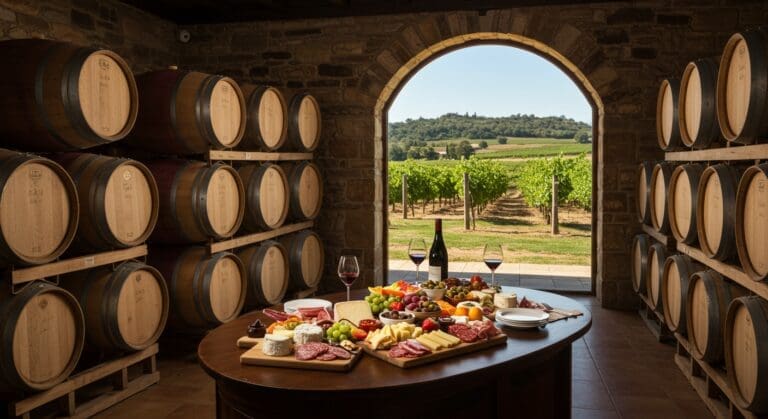
Kaş Food & Wine Guide: Local Cuisine, Markets & Wine Estates
There are places that feed you adequately, places that feed you well, and then there is Kaş – a small Lycian harbour town on Turkey’s southwest coast that manages, with very little fuss and absolutely no pretension, to do something most celebrated food destinations spend decades trying to manufacture: it makes you eat like a local without ever having to try. The ingredients arrive from the land behind it and the sea in front of it. The olive trees are ancient. The fishermen are actual fishermen. And the woman who has been making gözleme at the Friday market since before you were born has no interest in your food blog, which is frankly part of the charm. This is not a destination that performs its food culture for visitors. It simply has one.
The Foundation: Understanding Kaş Cuisine
Kaş sits within the broader culinary tradition of the Aegean and Mediterranean Turkish kitchen, but with a character distinctly its own. The region is Lycian territory – ancient, rugged, and historically isolated enough to preserve cooking habits that the more tourist-saturated stretches of the coast have quietly let slip. What this means in practice is that the food here is deeply ingredient-led. Not in the fashionable, menu-description sense of the word. In the sense that when the octopus is good, you eat octopus, and when the wild greens are coming up on the hillsides, someone’s grandmother is already doing something interesting with them.
The cuisine draws heavily on olive oil, fresh herbs, pulses, and the kind of vegetables that actually taste of something. Meze culture is alive and serious here – not the perfunctory bowl of hummus and some bread that passes for meze in certain tourist-facing establishments further up the coast. In Kaş, a proper meze spread can span twenty small dishes, each one a considered thing: braised wild greens with lemon, smoked aubergine, fried courgette flowers, octopus dressed in local olive oil and herbs, stuffed vine leaves that bear no resemblance to the tinned variety. Dinner, done properly, takes a while. Plan accordingly.
Signature Dishes You Should Know Before You Arrive
Lamb features prominently in the local cooking, often slow-cooked in a sealed clay pot – a method called güveç – with tomatoes, peppers, and whatever aromatics the cook feels are appropriate that day. It is not a dish that rushes. Neither should you. Sea bream and sea bass pulled from the waters around the bay are grilled simply over charcoal and served with little more than a wedge of lemon and a drizzle of the local olive oil. To add more would be to miss the point entirely.
Piyaz – a white bean salad with onion, tomato, parsley, sumac and a sharp vinaigrette – is a regional staple that sounds unremarkable and tastes extraordinary, which is a sentence that applies to a surprising number of things in Turkish cooking. Look also for kabak çiçeği dolması, courgette flowers stuffed with herbed rice and pine nuts, lightly fried or steamed depending on who is making them. And if you encounter a local version of tarhana soup – a fermented grain and vegetable broth, thick and slightly sour – do not let its humble appearance deter you. It has been warming people through Anatolian winters for centuries. It knows what it is doing.
The Friday Market: Where Kaş Actually Shops
The weekly Friday market in Kaş is not a tourist attraction, although tourists do, of course, attend it. It is a working market where local producers bring in vegetables, herbs, cheese, olives, honey, and dried goods. The distinction matters because it means the quality is genuine and the prices are honest – two things that do not always survive contact with the visitor economy.
Arrive early. The serious shoppers are there by eight. You will find vendors selling local goat’s cheese in various stages of age and saltiness, wild thyme honey from the surrounding hills, dried figs, fresh almonds still in their fuzzy green casings if the season is right, and enormous quantities of olive oil decanted into whatever containers the vendor had to hand. There are also household goods, fabric, and clothing stalls, which you can ignore unless you need a set of patterned tea towels, in which case this is your moment. The food section is the draw. Take a bag. Take two bags. You will buy more than you intended.
Olive Oil: The Liquid That Runs Through Everything
The olive groves around Kaş and the wider Antalya province are not incidental to the food culture here – they are its backbone. The region produces olive oil that is genuinely excellent: grassy, peppery, with a finish that lingers in a way that supermarket olive oil has entirely given up on. Local varieties include Memecik and Gemlik olives, pressed in small-scale operations that have been running for generations.
Visiting an olive oil producer in the Kaş hinterland is one of those experiences that converts the merely interested into the genuinely obsessed. If you are staying in a private villa – and the luxury villas in Kaş are well positioned for exactly this kind of excursion – your villa host or a local fixer can arrange a visit to a family press, particularly during the October to December harvest period when the air around the mills smells extraordinary. You will taste oils at different stages of processing, learn more about acidity levels than you expected to, and leave carrying bottles that will make your cooking at home feel quietly fraudulent for months afterwards.
Wine in Kaş: Better Than Anyone Outside Turkey Realises
Turkey has been producing wine for longer than almost anywhere else on earth. It tends not to shout about this, possibly out of modesty, possibly because the domestic market has kept producers occupied. Whatever the reason, the international wine world is only now catching up with what has been quietly happening in Anatolian vineyards – and the region around Kaş, set within the broader winemaking landscape of southwestern Turkey, offers some genuinely interesting drinking.
Indigenous grape varieties are where the real interest lies. Öküzgözü – which translates, memorably, as “ox eye” – produces reds that are full-bodied and spiced without heaviness. Boğazkere, another native red variety grown in the southeast and increasingly blended into wines available across the country, brings tannin and depth. For whites, Narince and Emir are worth seeking out: clean, mineral, and considerably more interesting than the phrase “Turkish white wine” might lead you to expect. The wine list at better restaurants in Kaş will include thoughtful selections from Anatolian producers. Trust the recommendations of whoever is serving you. This is not a region where the sommelier is guessing.
Wine Estates and Tasting Experiences
The most celebrated wine-producing regions of Turkey – Cappadocia, Bozcaada island, the Thrace region near the Greek border, and the Aegean hinterland around İzmir and Denizli – are within reach as day trips or overnight excursions for travellers based in Kaş. The Denizli region in particular, with estates including those working with the indigenous Çal Karası grape, is close enough to warrant a dedicated visit if wine is a genuine priority.
Closer to Kaş itself, the focus tends to be less on estate visits and more on exceptional wine service at the better restaurants and wine bars in town, where curated lists do serious justice to Turkish producers. Ask specifically for natural and small-production Turkish wines – there is a quiet revolution happening in that space, and the results are worth the conversation. Some restaurants work directly with specific producers and will talk about them at length if you express genuine interest. Expressing genuine interest at a good restaurant is always advisable. It tends to result in better food.
Cooking Classes and Culinary Experiences
Learning to cook in someone’s home is a different experience from a hotel demonstration class, and in Kaş, home-based cooking experiences are available through local food tourism operators and guides. A typical session might involve a morning at the market selecting ingredients, followed by several hours in a domestic kitchen learning to make meze from scratch – the aubergine preparations, the stuffed vine leaves, the slow-cooked lamb – and then sitting down to eat all of it, which is the correct ending to any cooking lesson.
More structured culinary programmes are also available through some of the boutique properties and villa concierge services in the area. These can range from a single afternoon session to multi-day deep dives into regional Turkish cuisine. If you are interested in booking something before you arrive, it is worth raising this with your villa management team early – the best local instructors and experiences get reserved quickly, particularly in the high summer months when everyone is competing for the same few excellent people.
Truffle Hunting in the Kaş Region
This is not, it must be said, the Périgord. But the scrubby oak hillsides of the Taurus mountain foothills behind Kaş do yield wild truffles – specifically the Asiatic black truffle, Tuber himalayense, and some rarer Mediterranean varieties – and seasonal truffle hunting excursions are available through specialist local guides. The season runs broadly from winter into early spring, which makes this a compelling reason to visit outside the summer rush.
Truffle hunters in this region typically work with dogs rather than pigs, which is both more practical on the steep terrain and considerably easier to transport. A morning in the forest with an experienced guide, followed by a lunch built around whatever was found, is the kind of experience that is very difficult to replicate anywhere else and costs a fraction of what an equivalent experience in southern France would set you back. The truffles themselves are milder in flavour than their Périgord counterparts, but shaved over a simple pasta or stirred into scrambled eggs at your villa, they are more than sufficient to justify the early start.
The Best Food Experiences Money Can Buy in Kaş
A private boat charter with a catered lunch on deck, the food prepared by a local chef using that morning’s market produce, somewhere between Kaş and the Greek island of Meis visible on the horizon – this is one of those experiences that is very hard to describe without sounding like a brochure. It is also genuinely extraordinary. The sea here is the colour of things that don’t have names in English. The food, eaten on the water with salt in the air, tastes better than it would anywhere on land. This is not a metaphor. There is actual science about it, probably.
A private meze dinner on the terrace of a well-positioned villa, staffed by a local chef and served as the sun drops behind the Greek islands, runs a close second. Working with a villa concierge to source a private chef for an evening is one of the more intelligent uses of a food budget in Kaş – you get the quality, the ingredients, and the intimacy of a private setting without the slight formality of even the best restaurant. It is, in short, the kind of meal people describe to their friends for years, which is the highest possible praise.
For the full picture on what to see, where to go, and how to navigate this part of the Turkish coast, the Kaş Travel Guide covers the broader destination in detail.
Find Your Base: Luxury Villas in Kaş
The best food experiences in Kaş are not confined to restaurants. They happen on private terraces with views across the bay, in villa kitchens where a local chef has arrived with a crate of market produce, or on chartered boats where lunch is whatever was interesting at the harbour that morning. To access all of this properly, you need the right base. Browse our collection of luxury villas in Kaş and find a property that positions you – with pool, kitchen, terrace, and access to the best of the region – exactly where you should be.