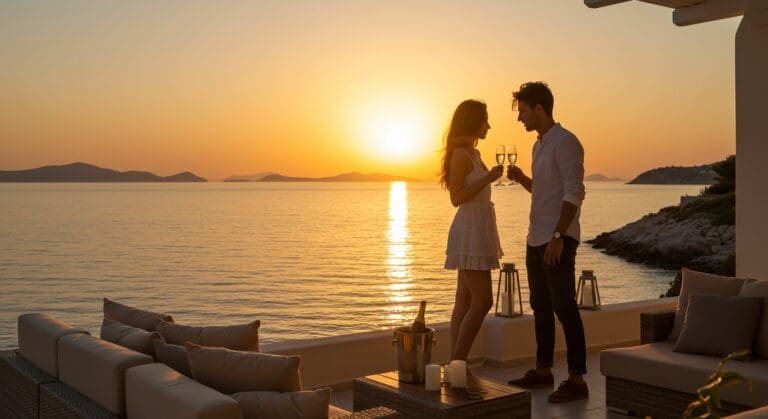
Kaş Travel Guide: Where to Stay, Eat & Explore in Luxury
Here is a confession that might reorder your assumptions about the Turkish coast: Kaş is not, technically, undiscovered. It has been beloved by a certain kind of knowing traveller for decades – the kind who distrusts superlatives and books their flights before anyone else has thought to Google the place. And yet it remains, against all odds and in defiance of the usual rules of coastal tourism, genuinely itself. No strip of identical sunbed concessions. No beachfront clubs playing music you’d rather not identify. Just limestone cliffs dropping into water so blue it looks legally edited, a small town that smells of jasmine and woodsmoke in equal measure, and the companionable feeling that you’ve arrived somewhere that hasn’t quite been ruined yet. That is, of course, precisely when you should visit.
So who is Kaş actually for? The honest answer is: almost everyone worth travelling with. Couples marking a milestone – a fortieth birthday, an anniversary that deserves more than a weekend in a European city – will find something here that feels earned rather than packaged. Families seeking genuine privacy, the kind that a private villa with a cliff-edge pool provides and a hotel simply never can, tend to return year after year with minor variations in the number of children. Groups of friends who have arrived at the age where they want exceptional food and a long table and a view that requires no commentary are very much in their element in Kaş. Wellness-focused travellers, who find their nervous systems genuinely restored by hiking, open-water swimming, and silence, will discover a landscape almost engineered for recovery. And if you are one of the growing number of remote workers conducting your professional life from the most beautiful places you can find, Kaş – with increasingly reliable connectivity and the kind of light that makes staring at a screen feel almost acceptable – rewards that particular modern gamble too.
The Journey In: How to Actually Get to One of Turkey’s Best-Kept Secrets
Kaş is situated on the Turquoise Coast in the Antalya province of southwestern Turkey, and getting there requires a small commitment – which is precisely why it retains its character. The nearest major airport is Dalaman, roughly two hours away by road and served by direct flights from the United Kingdom and across Europe during the summer season. Antalya Airport is the larger hub, around two and a half hours in the other direction, with considerably more flight options year-round including connections from the United States via Istanbul. Both routes are viable; Dalaman tends to mean a more straightforward transfer, while Antalya opens up the possibility of spending a night or two in the city before heading west along one of the world’s more persuasive coastal roads.
Private transfers are the right choice here, and not merely for comfort. The mountain road into Kaş – hairpin turns, limestone rock faces on one side and the Aegean glinting far below on the other – is a drive that deserves full attention, ideally from the passenger seat. Renting a car is sensible if you plan to explore the wider region independently, and the roads, once you have calibrated your expectations to Turkish driving customs (which are spirited), are perfectly manageable. Within Kaş itself, most of the Old Town is pleasantly walkable. Taxis and dolmuş minibuses connect the surrounding villages and beaches with cheerful frequency. The rhythm of getting around is slow in the best possible sense.
Where to Eat in Kaş: From Harbourside Tables to Hidden Grandmother’s Kitchens
Fine Dining
Kaş punches considerably above its weight at the dinner table, which is one of the reasons it attracts the travellers it does. L’Apéro Kaş is the clearest evidence of this. Opened by French chef Paul in a 150-year-old house that has the good sense to wear its age lightly, L’Apéro delivers a French-Mediterranean menu that feels entirely natural in this setting – Turkey and France having both devoted considerable cultural energy to the proposition that dinner is the most important event of the day. The lobster ravioli and sea bass carpaccio are the sort of dishes you mention to people back home, and the candlelit tables, set above the harbour on warm evenings, create an atmosphere that doesn’t need embellishing. A genuine luxury holiday in Kaş almost requires one dinner here. Book ahead.
Smiley’s Restaurant has been part of the Kaş landscape since 1987, which in coastal Turkey represents something approaching institution status. Housed in an ancient cistern and an adjacent 19th-century Ottoman house beside the yacht harbour, it attracts a loyal following of Turquoise Coast sailors and villa guests who have learned not to arrive without a reservation. The grilled octopus is the standard against which everything else is measured, the calamari is handled with the respect it deserves, and the menu is broad enough – seafood, kebabs, pide, vegetarian options, stone oven dishes – that groups with competing dietary preferences tend to arrive suspicious and leave rather pleased with each other. The friendly service, unhurried and genuinely warm, is worth mentioning separately.
Where the Locals Eat
The instinct to ask locals for restaurant recommendations is correct, and in Kaş that instinct leads consistently to one place: Yeşil Restaurant. It sits just outside the Old Town, unflashy in its presentation, operating on the reliable principle that if the food is good enough the room doesn’t need to try very hard. And the food is good. Genuinely, quietly, unpretentiously good – the kind that comes from a Turkish grandmother in the kitchen working from recipes that have never been written down because writing them down would somehow miss the point. Yeşil is also, relative to the more visible restaurants in the centre, refreshingly easy on the wallet, which is not something that diminishes it in any way.
For those evenings when the heat demands cold drinks and food that isn’t trying to be Turkish, Oburus Momus – set in a tree-shaded garden just back from the harbour – is the answer. It specialises in vegetarian and vegan dishes drawn from across Asia: nasi goreng, pad thai, falafel bowls, lentil burgers, beetroot carpaccio, vegan moussaka. It is equally good for afternoon cocktails or a glass of their homemade lemonade, and the outdoor setting under the trees has the kind of relaxed energy that makes it easy to lose an entire afternoon there. This is Kaş’s best vegan restaurant and, more broadly, one of the most genuinely laid-back spots in town.
Hidden Gems Worth Seeking Out
The name Müpptela means “addicted,” and it is an honest piece of branding. This ocakbaşı – a traditional Turkish grillhouse built around live fire cooking – sits at the edge of old Kaş in a sultry outdoor setting that comes into its own after dark, when the embers are glowing and the mezes have arrived and you have ordered a second round of something cold. The hot appetisers are excellent, the grilled meat and kebab selection gives you genuine decisions to make, and the service has the warmth that distinguishes a place that genuinely likes having people there. The kind of dinner you try to explain to someone who wasn’t at the table and can tell you’re not quite capturing it.
The Landscape Around Kaş: Where the Mountains Actually Meet the Sea
The geography of Kaş is one of its defining qualities, and it operates differently to most Mediterranean coastal destinations. This is not a flat, sandy shoreline gradually shading into hinterland. The Taurus Mountains come almost to the water’s edge here, creating a landscape of dramatic vertical contrast – limestone peaks above, deep blue water below, and the town itself occupying a small peninsula that juts into the sea with considerable confidence. The result is a visual drama that other parts of the Turkish coast, however attractive, simply cannot match.
The coastline is rocky and clear – the lack of significant sandy beaches is not a disadvantage but a filter, because it means the water is extraordinary. The clarity is the kind that makes snorkelling from rocks feel like a genuine wildlife encounter rather than a leisure activity. Across a short stretch of water lies the Greek island of Kastellorizo, close enough to see with the naked eye and reachable by a ferry that takes around fifteen minutes – a reminder that this part of the world has always been where cultures overlap rather than divide cleanly at borders. The sea itself is a shade of blue-green that travel photographers have been chasing for years, and in person it is precisely as good as the photographs suggest, which is not always the case.
The surrounding region rewards exploration. Kalkan, roughly twenty minutes along the coast road, is a whitewashed hillside town with a working harbour and excellent restaurants, different in character from Kaş but complementary. Patara Beach, one of the longest and most pristine stretches of sand on the entire Turquoise Coast, is close enough for a half-day trip. The Saklikent Gorge, inland and vast and cold in the way that mountain gorges always surprise you with, offers a completely different register of the landscape. Xanthos, the ancient Lycian city, adds history to the daytrip itinerary. The region around Kaş is, in short, a destination with genuine depth – not merely a place to sit by water and congratulate yourself, though that remains an entirely valid option.
Things to Do in Kaş: The Full Range From Active to Contemplative
The best things to do in Kaş tend to involve the water in some form, which should not surprise anyone who has seen it. Sea kayaking along the coast is one of the signature activities – guided kayak tours take you past ancient Lycian rock tombs carved directly into the cliff faces, through sea caves accessible only from the water, and across to the sunken city of Kekova, where the ruins of an ancient Lycian settlement are visible beneath the surface. This is, objectively, a remarkable thing to paddle past. The tours typically combine Kekova with the village of Üçağız and the castle of Kaleköy, and a full day on the water in this company tends to be the experience most guests mention first when asked what they’d do again.
Boat trips are the other essential, and Kaş is particularly well set up for them. Day charter boats depart from the harbour for circuits of the local coastline, stopping at swimming spots of extraordinary clarity, calling in at isolated coves accessible by no other means, and generally providing the occasion for the kind of collective contentment that a good group holiday is built around. Private charter is available and is worth the expenditure for anyone who values being able to choose their own pace and stops. The difference between a shared day boat and a private gulet is roughly the difference between a package holiday and a luxury villa – technically the same activity, experientially another category entirely.
On land, the Lycian Way passes through the region – one of the great long-distance walking trails, with sections ranging from an easy coastal amble to a committed mountain traverse. The Old Town of Kaş itself is small enough to cover on foot in an afternoon but offers enough in the way of independent shops, amphitheatres, and narrow streets to reward the kind of slow, unhurried walking that a good holiday allows.
Adventure From Above and Below: Diving, Paragliding and More
Kaş has a particular reputation among divers, and it is well earned. The combination of clear water, varied underwater topography, and several impressive wreck sites – including a Second World War aircraft wreck – makes it one of the better dive destinations on the Turkish coast. Multiple dive centres operate from the town, offering everything from beginner courses to advanced technical dives, and the visibility in peak season is the kind that makes you understand why people become divers in the first place. For anyone planning a luxury holiday in Kaş with scuba diving as a primary interest, the infrastructure here is both professional and well-established.
Paragliding from the cliffs above the town is another activity with a devoted following, offering the particular perspective of seeing the peninsula, the sea, and the island of Kastellorizo from above in a way that no photograph quite prepares you for. It is offered in tandem formation for those who wish to have the experience without the years of training, which is most people. The thermal conditions in this part of the coast are reliable, and the flight paths tend to take you over water and back along the cliffs, which is about as good as it gets in terms of aerial tourism. The landing back on the hillside above town tends to be followed by a long period of slightly stunned appreciation.
Hiking in the mountains directly above Kaş reveals a landscape of abandoned villages, ancient water cisterns, and views that make the effort feel entirely proportionate. Cycling is possible both on road and on some of the trail networks inland. For the genuinely committed, rock climbing on the limestone faces of the Taurus range is an option – Kaş has a small but dedicated climbing community and several established routes of varying difficulty.
Kaş With Children: Why Families Who Know Return Every Year
Families come to Kaş and tend to come back, which is always the most honest form of endorsement. The appeal is partly practical and partly something harder to quantify. The town is small and safe, which matters enormously when you have children who have acquired the habit of wandering. The water is calm and extraordinarily clear, which means that snorkelling from rocks – even for children old enough to have goggles but not yet old enough for official instruction – is a legitimate and genuinely exciting activity rather than a supervised exercise. Boat days provide the kind of concentrated family enjoyment that hotels with organised entertainment programmes attempt to simulate and never quite achieve.
The real advantage for families, though, is the private villa. It is not merely a preference but a genuinely different proposition. A villa with a private pool removes the daily negotiation of sun lounger territory. Separate spaces for adults and children mean that bedtime is not also everyone’s bedtime. A kitchen that actually functions means that the small dietary preferences and peculiarities of children – and there are always several – can be accommodated without the mild daily anxiety of restaurant menus and allergy conversations. Villa concierge services can organise private boat days, private guides for the Kekova sea kayak, and childcare if required. The Kaş travel guide for families, honestly rendered, begins and ends with the villa recommendation.
The sea caves accessible by kayak, the visible ruins beneath the water at Kekova, the boat trip to Kastellorizo – these are the kinds of experiences that children actually remember. Not a waterslide or a kids’ club, but the morning they looked down from a boat and saw a sunken city. Kaş is particularly good at providing those moments.
Layers of History: Lycians, Romans, Ottomans and the Town That Kept Them All
Kaş occupies what was once the ancient Lycian city of Antiphellos, and the evidence of this is present in a way that has been absorbed rather than museumified. A well-preserved Hellenistic theatre sits above the town – small, intact, and positioned with the kind of unselfconscious grandeur that suggests its architects were not thinking about future tourist appeal but simply building somewhere impressive to watch a performance. It is still used occasionally for concerts, which is the right instinct. Rock-hewn Lycian tombs are cut into the cliff faces around the town, visible from the water and from the streets above – the Dorian tomb in the centre of town is particularly striking, rising directly from the pavement as if it simply chose not to be buried.
The Lycian civilisation that produced these monuments was one of the more sophisticated of the ancient world, notable for a democratic federal system of governance that some historians have argued influenced the framers of the American constitution. They had a refined approach to death, to civic life, and to architecture. The evidence is scattered across this entire region of Turkey, from Xanthos to Myra to Patara, and a kaş travel guide that neglects the Lycian context is describing the scenery without explaining the story. A half-day exploring Xanthos, the Lycian capital designated a UNESCO World Heritage Site, provides the context that makes everything else make more sense.
The town itself has the layered character of a place that has been lived in continuously for a very long time. Ottoman-era houses with carved wooden details stand alongside newer buildings with no obvious awareness that this is architecturally significant. The Greek Orthodox church, converted to a mosque during the population exchanges of the early twentieth century, is a reminder of the complicated recent history of this part of the coast. The atmosphere is Turkish in the most relaxed and hospitable sense – warm without performance, confident in its own identity, entirely unbothered by the fact that considerable numbers of foreigners have been finding it charming for several decades.
Shopping in Kaş: Ceramics, Handmade Jewellery and the Art of Not Rushing
Kaş has developed, over the years, a genuinely distinctive shopping character – one that distinguishes it from the more touristic parts of the Turkish coast where the choice tends to be between carpets, evil eye keychains, and counterfeit sportswear. The town has attracted independent artists and craftspeople, and the result is a collection of small shops along the cobbled streets of the Old Town that rewards a slow afternoon’s wandering rather than a purposeful mission.
Hand-thrown ceramics, silver jewellery made by independent silversmiths, hand-woven textiles and kilims, locally produced olive oil and herbs – these are the things worth buying. The jewellery in particular is unusually good; there are several independent designers working in the town who produce pieces that feel specific to this part of the world rather than generically Turkish. Antiquities are legally protected and should not be purchased regardless of what is offered, but the range of genuinely well-made contemporary craft is sufficient that this is not a constraint that will disappoint anyone.
The Thursday market is worth attending for its produce as much as anything else – local tomatoes, fresh herbs, olives from local groves, pomegranates in autumn, and the general sensory experience of a working market that is doing its job rather than performing it for visitors. Saffron, dried figs, and the local variety of wild thyme make excellent and properly useful things to bring home – the kind of souvenirs that improve dinner rather than occupy shelf space.
Everything You Actually Need to Know Before You Land
The currency in Turkey is the Turkish Lira (TRY). At the time of writing, the Lira remains weak against both the Euro and the Pound, which makes Turkey exceptional value for visitors from Western Europe and from United Kingdom. Cash is useful in markets and smaller restaurants; cards are accepted almost everywhere in Kaş. ATMs are available in the town centre.
Tipping is customary and appreciated. A ten percent tip in restaurants is standard; rounding up taxi fares is the norm. Turkish is the language of daily life, but English is widely spoken in Kaş – more so than in many comparable Turkish towns, owing to the long history of international visitors and a local population that has calibrated itself accordingly. A few phrases of Turkish – teşekkürler (thank you), merhaba (hello) – are received with genuine warmth rather than the polite surprise they generate in places less accustomed to foreigners making the effort.
The best time to visit Kaş, for most visitors, is May to June or September to October. July and August bring peak heat – temperatures regularly above 35°C – and the highest concentration of visitors, though Kaş at its busiest is still considerably calmer than comparable resorts further east. The shoulder seasons offer more temperate weather for hiking and exploring, water still warm enough for comfortable swimming from late May through to October, and a quieter town that feels more like itself. April is genuinely lovely for those who prioritise landscape over swimming. Winter is mild and genuinely peaceful – Kaş does not shut down in the way that more seasonal resorts do, and there is a version of the town in November and December that has the quality of a place seen without its public face on.
Safety is not a significant concern for visitors. Kaş is a small, community-oriented town and the general atmosphere is relaxed and welcoming. Standard travel precautions apply. Dress modestly when visiting the mosque and any religious sites, which is both respectful and sensible. Sunscreen is not optional in summer; the light here is powerful and the combination of heat and clear water will catch you out on the first day if you are not attentive.
Why a Private Villa in Kaş Changes the Nature of the Holiday Entirely
There is a version of Kaş that you access from a hotel room, and a significantly better version that you access from a private villa with a pool that overlooks the sea. They are technically the same destination. In practice they are quite different experiences, and anyone who has done both will tell you this without hesitation.
The privacy argument is the obvious one, and it is compelling. The Turkish coast in summer is not a solitary experience in most hotels – there are people at breakfast, people at the pool, people in the corridors, and the minor background consciousness of being in a shared space that is impossible to entirely ignore however good the room is. A luxury villa in Kaş removes all of this. The pool is yours. The terrace is yours. The evening, the morning, the long afternoon – all yours. This is not a luxury preference but a qualitative difference in what the holiday actually feels like.
For families, the case has already been made in full. For groups of friends, the communal villa experience – the shared table, the long evenings, the collective decision-making about where to go and when to go and whether to go at all – is the social architecture that group holidays are actually built around, and a hotel provides none of it. For couples on milestone trips, the intimacy of a private villa with a chef available if desired and a concierge who knows which boat to charter and which table to reserve at L’Apéro – this is what a special occasion actually deserves.
The wellness argument is increasingly valid too. Many of the finest luxury villas in Kaş come equipped with outdoor yoga spaces, home gym facilities, hammam rooms, and infinity pools positioned to make morning swimming feel like a spiritual practice rather than exercise. The combination of clean air, extraordinary light, physical activity on the water or in the mountains, and the restorative quality of genuine solitude is a wellness package that no organised retreat can quite replicate – because it is self-directed, unhurried, and structurally private.
Remote workers should know that villa connectivity has improved substantially in recent years. High-speed fibre is increasingly standard in quality properties; in more remote villas, Starlink has changed the calculation entirely. Working from a terrace with the Aegean below you and a reliable connection to whatever you’re supposed to be doing above you is not as contradictory as it sounds. It is, in fact, rather easy to get used to.
Excellence Luxury Villas offers an exceptional selection of luxury holiday villas in Kaş – from intimate cliff-top retreats for two to expansive multi-generational properties with staff, private chefs, and the kind of views that make justifying the trip to other people surprisingly straightforward. Browse the collection and find the one that makes the right argument for itself.
More Kaş Travel Guides
- Best Restaurants in Kaş: Fine Dining, Local Gems & Where to Eat
- Kaş Food & Wine Guide: Local Cuisine, Markets & Wine Estates
- Kaş with Kids: The Ultimate Family Holiday Guide
- Best Time to Visit Kaş: Month by Month Weather, Crowds & Tips
- Kaş Luxury Itinerary: The Perfect 7-Day Guide
- Romantic Kaş: The Ultimate Couples & Honeymoon Guide
What is the best time to visit Kaş?
May to June and September to October offer the best balance of warm weather, swimmable sea temperatures, and manageable visitor numbers. July and August are peak season – very hot, livelier, and more expensive, but still considerably quieter than comparable resorts on the busier stretches of the Turkish coast. April is excellent for hiking and sightseeing. November through March is mild and atmospheric for those who prefer a destination without its tourist infrastructure fully deployed.
How do I get to Kaş?
The two nearest airports are Dalaman (approximately 2 hours by road, with direct seasonal flights from the UK and Europe) and Antalya (approximately 2.5 hours, with year-round international connections including via Istanbul from long-haul destinations). Private transfer is the most comfortable option and transforms the mountain road approach into an experience rather than a logistical step. Car hire is useful for independent exploration of the wider region.
Is Kaş good for families?
Yes – particularly for families who prefer an active, exploratory holiday over a resort-based one. The town is small and safe, the water is clear and calm enough for children to snorkel from rocks, and day trips to Kekova, boat days, and sea kayaking are genuinely memorable rather than merely organised. The private villa option significantly enhances the family experience – private pools, kitchen facilities, and separate spaces for adults and children make a material difference to how relaxed the holiday actually feels.
Why rent a luxury villa in Kaş?
A private villa provides privacy, space, and flexibility that hotels cannot replicate. For families, it means a private pool, kitchen facilities, and no shared spaces to negotiate. For groups and couples, it provides the communal or intimate environment that makes a special trip feel genuinely special. Many luxury villas in Kaş come with dedicated staff, private chef options, and concierge services that personalise the experience entirely. The staff-to-guest ratio in a well-staffed villa is simply incomparable to any hotel, however good.
Are there private villas in Kaş suitable for large groups or multi-generational families?
Yes. The villa market in Kaş includes properties ranging from two-bedroom retreats to large multi-bedroom estates designed specifically for groups and multi-generational families. The best properties offer separate wings or cottages for privacy within the group, multiple living spaces, private pools, outdoor dining areas for large numbers, and staff including housekeeping and chefs. The combination of communal spaces and private retreats within a single property is what makes villa travel work for larger groups in a way that a hotel booking simply cannot.
Can I find a luxury villa in Kaş with good internet for remote working?
Increasingly, yes. High-speed fibre broadband is standard in many quality villa properties in and around Kaş, and Starlink satellite connectivity has resolved the connectivity question in more remote cliff-top or hillside locations where cable infrastructure is limited. It is worth confirming connectivity specifications directly when booking if reliable internet is essential – but the honest answer is that working from a well-equipped Kaş villa with a sea view and a solid connection is an entirely viable proposition for most remote working requirements.
What makes Kaş a good destination for a wellness retreat?
Kaş offers the combination of physical landscape, pace of life, and amenities that genuine wellness requires. Hiking in the Taurus mountains, open-water swimming in exceptionally clear sea, sea kayaking, yoga on private terraces, and the quieter rhythm of a small town that has not been optimised for mass tourism all contribute to the restorative quality of the place. Many luxury villas in Kaş include private hammams, outdoor yoga decks, gym facilities, and infinity pools. Local spas offer traditional Turkish hammam treatments. The overall effect – clean air, physical activity, excellent food, and genuine quiet – is therapeutic in the most straightforward sense.