Lazio Travel Guide: Where to Stay, Eat & Explore in Luxury
There is a version of Italy that everyone thinks they know: the one on the poster, in the film, in the vague romantic fog of received opinion. Tuscany has its rolling hills and its influencers. The Amalfi Coast has its cliffs and its coach parties and its forty-euro plates of pasta. Sicily has the volcano. But Lazio – the region that contains, among other things, one of the greatest cities in human history – has something none of them quite manage: the uneasy, exhilarating feeling that you are somewhere that was already old when everywhere else was still being invented. The Romans didn’t just pass through Lazio. They built their roads here, buried their emperors here, consecrated their gods here. And then, when the empire eventually got around to collapsing, the vineyards and the hilltop towns and the thermal springs simply carried on. Lazio does not need to try. That, perhaps more than anything else, is its defining quality.
It is also, rather pleasingly, one of the most versatile regions in Europe for the kind of traveller who knows what they actually want from a holiday. Couples celebrating something significant – an anniversary, a significant birthday, the successful completion of a decade of marriage – find in Lazio a combination of romance and substance that few places match. Families seeking genuine privacy, away from the hotel lobby shuffle and the communal pool politics, discover a region where hilltop villas come with their own terraces and the children can run feral in the olive groves in a perfectly safe way. Groups of friends who have outgrown Airbnb and want something with a proper kitchen and a wine cellar within reach of world-class restaurants are extremely well served here. Wellness-focused travellers will find thermal waters, forested trails and a pace of life that makes you wonder what you were so stressed about. And those who need reliable connectivity to work remotely while pretending they are not working remotely will find, increasingly, that Lazio’s luxury villa market has caught up with that particular modern requirement rather impressively.
Getting to Lazio: Easier Than the History Books Make It Sound
The practical news is excellent. Rome Fiumicino – officially Leonardo da Vinci International Airport – is one of the best-connected airports in Europe, with direct flights arriving from across the continent and from North America, the Middle East, and beyond. If you are travelling from the United Kingdom, direct flights to Fiumicino run from London, Manchester, Edinburgh and several regional airports, with journey times hovering around two and a half hours. Ciampino, Rome’s secondary airport, handles a significant volume of low-cost carrier traffic and sits a little closer to the city – though transfers from both airports are well-organised, and a private car or minibus transfer to your villa is straightforward to arrange.
Once in the region, the question of getting around deserves a moment of honest counsel. If your plan involves Rome and Rome alone, the Metro and taxis serve admirably. But if you want to properly explore Lazio – the lakes, the hilltowns, the coast, the volcanic countryside – a hire car is not just convenient, it is transformative. The roads through the Castelli Romani, through the Pontine hills, along the Etruscan coast north of Rome: these are the kind of drives that remind you why people write songs about Italy. Roads that elsewhere in Europe would be an unremarkable B-road become something else entirely when they are flanked by umbrella pines and ruins. Trains connect Rome to the coastal towns and some inland destinations, but the real Lazio – the one between the guidebook chapters – rewards the kind of spontaneous detour that only a hire car allows.
Where to Eat in Lazio: From Three Michelin Stars to Standing Room Only
Fine Dining
The standard opening position on fine dining in Lazio is La Pergola, and it earns that position without argument. Rome’s only three-Michelin-starred restaurant sits atop the Rome Cavalieri Hotel on Monte Mario, and Chef Heinz Beck has held those stars with a consistency that makes other chefs quietly furious. The wine cellar contains over 53,000 bottles, which sounds like a boast until you realise it reflects not excess but genuine, almost scholarly dedication to the craft. The views over Rome from that height, at night, with a glass of something serious in hand – this is one of those experiences that earns the word “occasion.” Book weeks in advance. Several of them.
For something that feels less like a formal ceremony and more like a genuinely exciting meal, Imàgo at the Hotel Hassler occupies the top floor of one of Rome’s great addresses above the Spanish Steps. Chef Francesco Apreda does something quietly daring here: he folds Asian spices and flavours into the architecture of classic Italian cuisine without ever making either tradition feel compromised. The result is surprising, elegant, and rather wonderful. The views over Trinità dei Monti and the rooftops of central Rome provide what might be generously described as distraction from the food – though the food is more than capable of holding its own.
Pipero Roma on Corso Vittorio Emanuele II belongs in a slightly different conversation – one about what contemporary Italian cooking looks like when it is done with precision and without pretension. Chef Ciro Scamardella’s seasonal menu is the kind of cooking that rewards attention, and owner Alessandro Pipero’s expertise as maître and sommelier lends the whole experience a particular coherence. Their carbonara has been discussed in tones normally reserved for religious matters. The discussion is not unjustified.
Glass Hostaria in Trastevere – in what was, in a previous life, a carriage workshop, which is the kind of detail Rome offers with complete casualness – is helmed by Chef Cristina Bowerman, whose Michelin star has been reconfirmed for 2026. Her tasting menus, including a well-considered vegetarian option, use Lazio tradition as a point of departure rather than a destination. This is creative Italian cooking with real ideas behind it, in one of Rome’s most characterful neighbourhoods.
Where the Locals Eat
The wine bars of Trastevere and Testaccio operate on a different frequency to the fine dining circuit – louder, more argumentative, more likely to involve a proprietor with strong opinions about whether you have ordered correctly. This is not a criticism. The neighbourhood osterie around Testaccio market, Rome’s old slaughterhouse district, serve the kind of offal-forward Roman cooking that has been feeding this city for centuries. Cacio e pepe. Rigatoni alla gricia. Abbacchio. If you approach this food with openness and without an overcautious palate, Testaccio will reward you thoroughly.
Outside Rome, the Castelli Romani towns – Frascati, Marino, Castelgandolfo – are where Romans go to drink the local white wine and eat long lunches on weekends. Frascati DOC, the light, dry white produced from the volcanic soils of the Alban Hills, is at its best drunk in the town it comes from, at a table with a view, alongside a plate of fresh pasta. The gap between this experience and any attempt to replicate it at home is, regrettably, unbridgeable.
Hidden Gems Worth Seeking Out
Roscioli Salumeria con Cucina on Via dei Giubbonari is the kind of place that has been discovered so thoroughly by now that calling it hidden requires a certain creative relationship with geography. Featured by Michelin, the New York Times, Forbes, and Condé Nast Traveller, it occupies the intersection between delicatessen, wine shop, and restaurant in a way that makes you wonder why more places don’t try this arrangement. The Roman pastas are the thing to order; the cured meats and cheese selection is the thing to assemble alongside them. A reservation is essential. Turning up speculatively and hoping for the best is optimism bordering on delusion.
Beyond Rome, the less-visited towns of northern Lazio – Viterbo, Tarquinia, Civita di Bagnoregio – have small, serious trattorias serving the local cooking of their particular corner of the region, from the wild boar ragu of the Cimini hills to the lake fish of Bolsena. These are not places with websites or Instagram accounts. Ask whoever manages your villa. They will know.
The Shape of the Land: What Lazio Actually Looks Like Beyond the Forum
The mental image most people carry of Lazio begins and ends with Rome – the ochre and travertine of the historic centre, the dome of St Peter’s visible from improbable distances. This is reasonable, given that Rome is one of the great cities of human civilisation, but it does represent a fairly dramatic failure of peripheral vision.
Drive north from Rome and the land opens into something entirely unexpected: a volcanic plateau punctuated by crater lakes, Etruscan necropoles, and medieval walled towns that look as though they have not quite decided what century they belong in. Lake Bolsena is the largest volcanic lake in Europe – clear, swimmable, and startlingly tranquil. Lake Bracciano sits closer to Rome and closer to consciousness; the castle of the Orsini-Odescalchi broods magnificently over its shore. Viterbo’s medieval quarter preserves a papal palace and a tangle of dark stone streets that the tourist tide has not, by some miracle, entirely swallowed.
South and east, the landscape shifts again. The Pontine Marshes – drained by Mussolini in one of the few useful things achieved by that administration – give way to the Circeo promontory, where pine forests meet a rugged coastline and the Parco Nazionale del Circeo protects one of the most biodiverse corners of central Italy. The Lepini and Ausoni mountains provide a limestone backbone to the region’s southern reaches, riddled with gorges and tiny fortified villages that reward slow exploration.
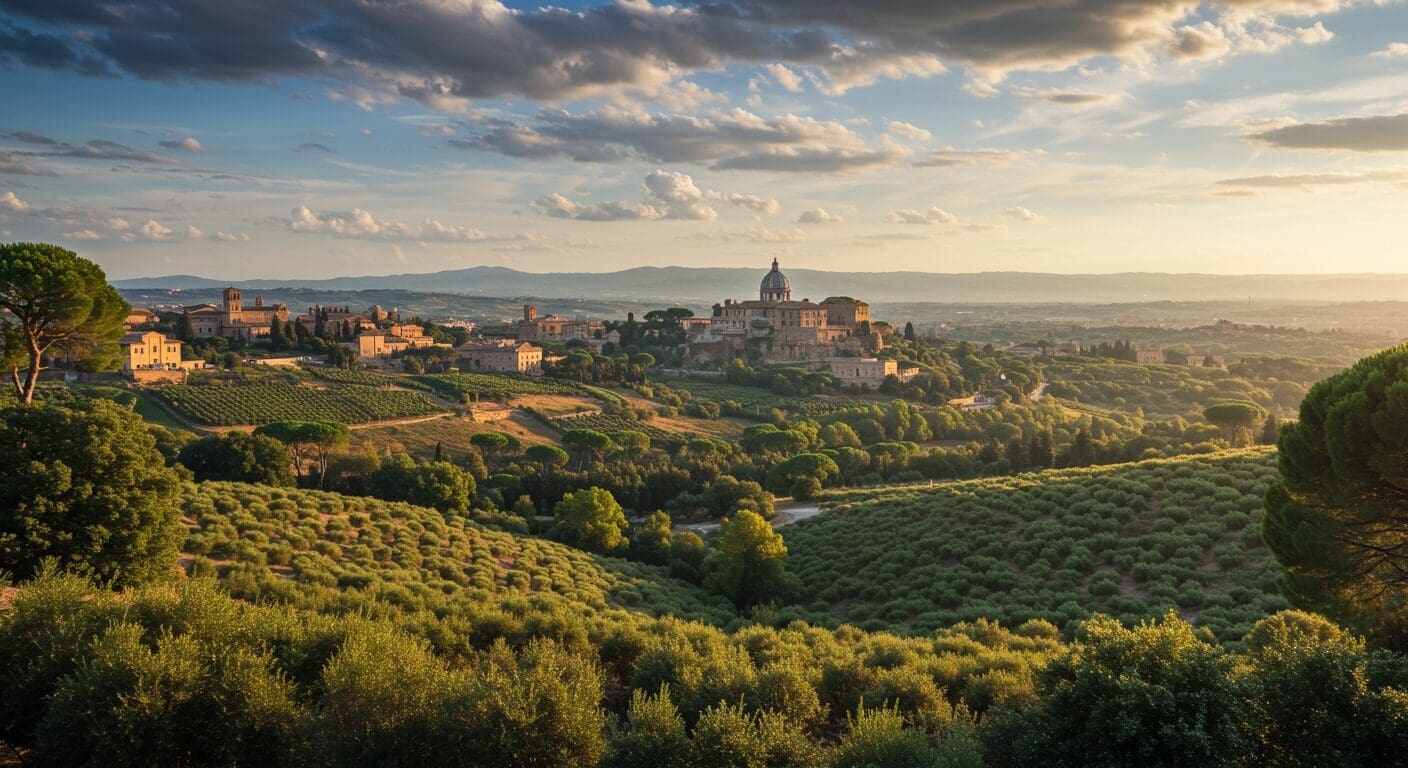
The Castelli Romani – the ring of hilltowns built on the rim of an extinct volcanic crater southeast of Rome – occupy their own particular category. This is where popes came to escape the Roman summer, where the aristocracy of the city maintained their country estates, and where, today, the Romans come on weekends to eat lunch in gardens and drink the local wine until the afternoon becomes unreasonably comfortable. The views from Rocca di Papa, from Grottaferrata, from the shores of Lake Albano, are of a landscape that has been lovingly inhabited for two and a half thousand years. It shows, in the best possible way.
Things to Do in Lazio: An Embarrassment of Options
The single greatest activity in Lazio, and the one most reliably underestimated by first-time visitors, is simply walking through Rome without a plan. Not the Colosseum-to-Vatican death march of the itinerary-heavy tourist, but the kind of aimless navigation through Trastevere and Pigneto and the Jewish Ghetto and the Campo de’ Fiori that produces unexpected piazzas, excellent coffee at unexpected bars, and the recurring discovery that almost every wall in central Rome is doing something architecturally interesting. This is a city that rewards curiosity more generously than almost anywhere on earth.
Beyond the city, the activities on offer cover a genuinely impressive range. Wine tourism in the Castelli Romani and the Cesanese DOC zone around Piglio offers cellar door tastings of a quality that the region’s relatively low international profile does not prepare you for. The Etruscan trail through Cerveteri, Tarquinia, and Vulci – some of the most significant and least-crowded Etruscan sites in Italy – provides the kind of serious archaeological experience that Pompeii used to offer before half the world discovered it simultaneously. The necropolis at Cerveteri, a vast Etruscan city of the dead where you can walk among tomb mounds in near-solitude, is one of the genuinely remarkable experiences available to the Lazio traveller, and the fact that relatively few people make the detour there is entirely their loss.
Day trips from a Lazio villa base deliver well. Orvieto, across the border in Umbria, is a forty-minute drive from northern Lazio and contains a cathedral facade that constitutes one of the more extraordinary things human beings have produced. Pompeii and Naples are accessible from southern Lazio for those prepared to invest in an early start. And Rome itself, of course, never exhausts itself – you could spend a fortnight there and leave with a list.
Adventure and the Outdoors: Lazio’s Less Advertised Character
The region does not, it should be said, market itself aggressively as an adventure sports destination. This is not because the options are absent – it is because Lazio, much like a person of genuine substance, doesn’t feel the need to shout.
The Parco Nazionale del Circeo on the Tyrrhenian coast offers some of the best hiking and cycling in central Italy, with trails through Mediterranean macchia, past brackish lagoons, and along coastal headlands with views that justify the effort straightforwardly. The Monti Lepini provide serious hiking terrain in the region’s interior – limestone ridges, gorges, and the occasional abandoned medieval village – with the particular pleasure of encountering almost no other hikers in the process. Cyclists of the road variety find the Castelli Romani roads demanding and rewarding in equal measure; the gradients are real, the scenery is absurd, and the espresso at the summit is entirely earned.
Water-based activity centres on the Tyrrhenian coast and the volcanic lakes. Kitesurfing and windsurfing operate from the beach at Sabaudia, where the combination of reliable wind and a long sandy coastline creates conditions that attract serious practitioners from across Europe. Lake Bolsena and Lake Bracciano offer sailing, kayaking, and open-water swimming in conditions that are calmer and warmer than the open sea. Diving operators on the Circeo coast run excursions to underwater cliffs and caves that the region’s clean, clear water makes genuinely rewarding. Horse riding through the Maremma countryside of northern Lazio – across land that has barely changed since the Renaissance landscape painters used it as reference material – is available through a number of established operators and constitutes one of the more viscerally satisfying ways to experience this particular corner of Italy.
Lazio With Children: The Holiday That Actually Works for Everyone
The honest assessment of travelling to Rome with children under ten is this: some of it will be magnificent, and some of it will involve explaining to a seven-year-old why they have to look at another column. This is true of all great ancient cities, and it is manageable – especially when you have a base that is not a hotel room. The private villa with a pool changes the calculus of family travel in Lazio so fundamentally that it barely deserves calling the same holiday.
When the children have reached their daily quota of historical significance and need to be horizontal in a pool for two hours while adults drink wine nearby, a villa makes this possible without negotiation or compromise. The private outdoor space, the kitchen for early suppers and reliable pasta nights, the absence of other guests’ opinions about how loudly your children are celebrating life – these are not luxuries in the abstract sense. They are the specific things that make a family holiday genuinely restorative for the adults as well as exciting for the children.
Lazio specifically delivers well for families beyond the villa gates. The volcanic lakes are safe for swimming and shallow at the edges. The Etruscan tombs at Cerveteri – dark stone chambers with relief carvings of beds, household items, the entire domestic apparatus of a vanished civilisation – have a quality of spookiness that children find deeply satisfying. The gladiatorial history of Rome, frankly, sells itself. Ostia Antica, the abandoned Roman port town south of Rome, is the kind of experience that turns children into accidental archaeologists – two thousand years of streets, shops, apartment buildings and bathhouses to wander through, with almost none of the crowds of the Colosseum. It is one of the great family days out in Europe, and it is consistently underused.
History and Culture: Where Civilisation Comes to Look at Itself
To say that Lazio is historically significant is a bit like saying the Pacific is damp. This is a region where the layers of human settlement go so deep that archaeologists working on Roman sites routinely find Etruscan material underneath, and Etruscan sites occasionally reveal Bronze Age material below that. The Palatine Hill in Rome has been continuously inhabited for approximately three thousand years. The mind, if it dwells on this too long, begins to do something uncomfortable.
Rome itself requires no real advocacy here – the Forum, the Colosseum, the Pantheon (still, after two thousand years, operating as a building), the Vatican Museums with the Sistine Chapel, the Baroque exuberance of Bernini’s piazzas and fountains, the early Christian catacombs beneath the Appian Way. This is a city in which genuine world masterpieces arrive without warning around corners you were simply using to get somewhere else.
But beyond Rome: the Etruscan necropolis at Tarquinia contains painted tombs of extraordinary sophistication – vivid scenes of banquets, hunting, athletic games, painted by a civilisation that Rome itself acknowledged as culturally superior in its origins. The medieval town of Viterbo, with its thirteenth-century papal palace and loggia, is one of the finest and least-visited medieval urban ensembles in Italy. Civita di Bagnoregio – the dying city, as Italians call it, perched on an eroding tufa pinnacle accessible only by footbridge – is one of those places that provokes in the visitor an emotion somewhere between wonder and mild existential anxiety. It is vanishing, slowly but certainly, into the ravine below. In the meantime, it is extraordinary.
Lazio’s festival calendar rewards those who time their visits deliberately. The wine harvest festivals of the Castelli Romani towns in September are raucous, local, and very well-lubricated. The Infiorata at Genzano – a carpet of flower petals laid along the main street in June – is one of those Italian traditions that proves, once again, that this country applies to temporary public art the same level of seriousness it applies to everything else that matters.
Shopping in Lazio: Beyond the Roman Souvenir
The Roman souvenir industry – gladiator helmets, Colosseum snow globes, leather goods of ambiguous provenance sold by persuasive strangers – deserves exactly as much of your attention and budget as you feel appropriate, which is to say, very little. The actual shopping in Lazio is considerably more rewarding.
The Via Condotti and its surrounding streets in central Rome house the flagship boutiques of most of the significant Italian fashion houses, alongside jewellers, shoemakers, and tailors of serious standing. This is not a place for browsing idly, but for purchases made with deliberate intent. More interesting, perhaps, are the vintage and antique markets: Porta Portese in Trastevere on Sunday mornings is one of the great European flea markets – chaotic, enormous, and capable of producing, if you approach it early enough and with sufficient patience, genuinely extraordinary things.
Food shopping in Lazio rewards attention proportionally. The Testaccio market in Rome is the serious cook’s market of choice: vegetables, fish, meat, cheese, and pasta in quantities and qualities that make the supermarket experience seem like a mild personal failing. Roscioli Salumeria’s retail counter – the deli component of the operation rather than the restaurant – is a masterclass in Italian charcuterie and cheese, the kind of place you visit for a particular purpose and leave forty minutes later having reconsidered several of your life choices in a positive direction.
Regional produce to bring home: bottarga from the Circeo coast, Castelli Romani olive oil (the volcanic soils produce something particularly aromatic), Frascati and Cesanese DOC wines, and the dried pasta from Gragnano – technically Campanian but universally available in Lazio’s serious food shops. Ceramics from Civita Castellana and hand-woven textiles from the mountain towns of the Ciociaria complete a shopping list that has nothing to do with snow globes and everything to do with actually remembering where you were.
Useful Things to Know Before You Go (Without Being Tedious About It)
Currency is the euro. Payment by card is increasingly accepted across Lazio, including in smaller towns, though carrying some cash remains advisable for markets, small bars, and the kind of mountain trattoria that has been operating without a card reader since before card readers existed and sees no compelling reason to change now.
Italian is the language, and while English is spoken in Rome’s tourist districts with reasonable fluency, it becomes notably less reliable outside the capital. A few phrases in Italian – buongiorno, per favore, un caffè, mi scusi – are not just practically useful but socially important in a region that maintains fairly firm views on the minimal social courtesies.
Tipping operates on different conventions to the United Kingdom or the United States. In Italy, tipping is appreciated but not structurally required in the way American service culture assumes. Rounding up the bill or leaving five to ten percent at restaurants is perfectly appropriate; the coperto (cover charge) is not a tip but a standard table charge that will appear on the bill regardless. Do not tip the cover charge as though it were a gratuity request. This is a source of unnecessary confusion for visitors from both sides of the Atlantic.
Safety across Lazio is generally excellent, though Rome’s busy tourist sites require the standard urban alertness around pickpockets. The region has no particular safety issues beyond those of any major European city.
The best time to visit depends considerably on what you want from the experience. Late April, May, June, and September are the months that most luxury villas in Lazio fill up quickly, for good reason – the temperatures are benign, the light is extraordinary, and the summer crowds are either yet to arrive or recently departed. July and August bring serious heat to Rome (40 degrees is not unusual) and considerable tourist pressure, though the coast and the volcanic lakes become genuinely appealing in this period. October and November deliver beautiful light, empty streets, and the wine harvest – a combination that makes for one of the most satisfying times of year in the region. Winter in Rome is mild by northern European standards and considerably less dramatic than the high season tourist industry implies.
Luxury Villas in Lazio: Why the Private Villa Wins Every Time
The hotel in Rome is a magnificent thing. There are hotels in this city with histories that predate most nations. There are hotels with rooftop bars so beautiful that photographs of them circulate as aspirational content across social media with a kind of resigned inevitability. Nobody is suggesting you should never stay in a Roman hotel. But for a family of any size, a group of friends, a couple who want to arrive home from dinner to somewhere that is genuinely, exclusively theirs, or a remote worker who needs a functioning workspace that isn’t a hotel desk beside a minibar – the private luxury villa in Lazio makes an argument that is difficult to refute once you have experienced it.
The privacy is the first and most fundamental thing. A luxury villa in Lazio – whether it sits in the Castelli Romani hills with a view over Lake Albano, on a working wine estate in the Frascati hills, in the volcanic countryside north of Rome, or on the Circeo coast with a terrace that catches the Tyrrhenian breeze – is yours, entirely. The pool is yours. The garden is yours. The kitchen, stocked from the morning market on your behalf if you wish it to be, is yours. There is no lobby, no 6am breakfast competition, no encounter with strangers’ holiday opinions at the poolside. This is not a small luxury. For many travellers, it is the difference between a holiday that rests you and one that requires another holiday to recover from.
Lazio’s villa portfolio runs from intimate properties for two – perhaps a restored stone farmhouse in the Sabine hills, or a converted wine estate apartment with a private terrace and views that seem almost unreasonably generous – through to substantial villas capable of housing three generations in genuine comfort, with private pools, staff, chef services, and the kind of space that allows various factions of a family or group to occupy it simultaneously without any of them actually encountering the others more than strictly necessary. For remote workers, the more contemporary villa properties increasingly offer Starlink connectivity or high-speed fibre alongside proper dedicated work spaces – the technology has arrived, and the view across the Roman campagna while taking a call is, objectively speaking, an upgrade on the open-plan office.
Wellness-focused guests find in the private villa a particular advantage: the ability to set the rhythm of the day entirely according to their own requirements. Morning yoga on a private terrace. A long pool swim before breakfast. An afternoon at the thermal baths of Viterbo – the natural hot springs that have been used for therapeutic purposes since the Etruscan period – followed by a return to a villa that offers its own sense of sanctuary. Lazio is extraordinarily well-suited to the kind of restorative, intentional travel that the word “wellness” is attempting to describe before it disappears under the weight of its own overuse.
A luxury holiday in Lazio, experienced from a private villa with the right support, the right location, and the right amount of space, is something that continues to improve in retrospect – the kind of trip that people describe in terms that make others slightly envious and immediately start planning their own version. The villa is where that version begins.
Browse our collection of luxury holiday villas in Lazio and find the property that makes the region entirely, properly yours.
More Lazio Travel Guides
- Best Restaurants in Lazio: Fine Dining, Local Gems & Where to Eat
- Lazio Food & Wine Guide: Local Cuisine, Markets & Wine Estates
- Lazio with Kids: The Ultimate Family Holiday Guide
- Best Time to Visit Lazio: Month by Month Weather, Crowds & Tips
- Lazio Luxury Itinerary: The Perfect 7-Day Guide
- Romantic Lazio: The Ultimate Couples & Honeymoon Guide
What is the best time to visit Lazio?
Late spring (late April to June) and early autumn (September to October) are the optimal windows for visiting Lazio. Temperatures are comfortable for both city exploration and outdoor activity, the light is exceptional, and the summer crowds have not yet materialised or have recently departed. July and August bring intense heat to Rome – regularly exceeding 35 to 40 degrees Celsius – though this is also when the volcanic lakes and the Circeo coast come into their own. October is particularly rewarding: the wine harvest is underway in the Castelli Romani, the air is clear, and Rome becomes, briefly, closer to the city its residents actually live in.
How do I get to Lazio?
The primary gateway is Rome Fiumicino Airport (Leonardo da Vinci International), one of the best-connected airports in Europe, with direct flights from across the continent and from North America, the Gulf, and beyond. Travellers from the United Kingdom have direct services from London Heathrow, Gatwick, Stansted, Manchester, and several regional airports, with flight times of around two to two and a half hours. Rome Ciampino handles lower-cost carriers and is slightly closer to the city centre. From either airport, private transfers to villas anywhere in Lazio can be pre-arranged. A hire car is strongly recommended for exploring the region beyond Rome itself.
Is Lazio good for families?
Exceptionally so, provided you approach it with appropriate expectations and the right accommodation. Rome with children is manageable and often revelatory – gladiatorial history, spooky catacombs, and Ostia Antica as a living archaeological playground are all genuinely child-engaging. The volcanic lakes are safe for swimming, the Etruscan tombs at Cerveteri satisfy a particular appetite for the macabre, and the countryside around Rome offers space and freedom in quantities that city-based travel cannot. The private villa with pool is transformative for family travel here: it provides a reliable base, outdoor space, and the ability to feed children at whatever hour they require without restaurant negotiations. Multi-generational families are exceptionally well served by Lazio’s larger villa properties.
Why rent a luxury villa in Lazio?
The private villa offers what no hotel in Lazio can match: complete exclusivity of space. Your pool, your garden, your kitchen, your terrace – occupied only by your party, on your schedule. For families, this removes the daily friction of hotel logistics; for couples, it creates a genuinely private retreat; for groups, it provides a shared base with enough space that the group’s separate needs never compete. The staff-to-guest ratio at a well-serviced luxury villa – with options including private chef, daily housekeeping, concierge, and driver – consistently exceeds what even five-star hotels deliver at equivalent spend. Add the settings available – hilltop wine estates, volcanic lake shores, countryside farmhouses within forty minutes of Rome – and the case for the villa becomes straightforward.
Are there private villas in Lazio suitable for large groups or multi-generational families?
Yes, and in considerable variety. Lazio’s luxury villa portfolio includes substantial properties with eight, ten, or twelve or more bedrooms, private pools large enough for genuine use rather than symbolic paddling, separate wings or guest annexes that allow different generations to share a property without sharing every waking moment, and grounds extensive enough to contain multiple outdoor dining areas, games spaces, and private terraces. Properties of this scale typically come with the option of full staff services: house manager, chef, housekeeping, and concierge. For milestone celebrations – significant birthdays, anniversary gatherings, family reunions – these larger villas represent a category of experience that hotels simply cannot replicate.