
Lisbon Food & Wine Guide: Local Cuisine, Markets & Wine Estates
Lisbon Food & Wine Guide: Local Cuisine, Markets & Wine Estates
Come to Lisbon in October and you will understand, viscerally, what the word saudade actually means. The light goes amber in the late afternoon, the miradouros fill with people who aren’t in any particular hurry, and the smell of charcoal-grilled sardines drifts through the Alfama like something from a long-ago summer. The city has cooled just enough to make walking its famous hills feel like pleasure rather than punishment, the tourists have thinned to a civilised number, and the restaurant terraces are still open. It is, in other words, a very good time to eat and drink your way through one of Europe’s most underrated food cities – and to begin to understand why Lisbon’s food culture feels less like a trend and more like a quiet truth that was always there, waiting to be discovered.
For more on planning your visit, our Lisbon Travel Guide covers everything from neighbourhoods to transport to the best times to arrive.
The Soul of the Cuisine: What Lisbon Actually Eats
Portuguese food is not complicated. This is a compliment. While the rest of Europe was busy deconstructing and reimagining its culinary heritage, Portugal largely continued making things the way it always had – with exceptional raw ingredients, minimal fuss, and a confidence that needs no validation. The backbone of Lisbon’s table is the Atlantic: fish arrive here with a freshness that makes you feel personally deceived by every other fish you have ever eaten.
Bacalhau – salted cod – is the cultural touchstone. Legend insists there are 365 ways to prepare it, one for each day of the year, and locals will debate the merits of bacalhau à brás (shredded, scrambled with eggs and potato crisps) versus bacalhau com natas (baked under a cream and potato gratin) with the seriousness usually reserved for matters of state. Both deserve your full attention. So does the arroz de lingueirão – razor clam rice – which arrives in a deep ceramic pot, slightly soupy, deeply savoury, and finished with olive oil that smells faintly of green almonds.
Pork appears in many forms: the slow-braised presa ibérica, the crisp-skinned leitão (roast suckling pig, more associated with Bairrada but very much present on Lisbon menus), and the magnificent bifanas – pork sandwiches in white rolls, doused in garlic and wine, eaten standing up at a counter. Do not make the mistake of regarding them as a snack. A good bifana is a complete experience. Lisbon also does offal with affection rather than apology: tripas, favas, and chouriço flame-cooked at the table in a special ceramic dish called a caçoila. High-low contrasts are not a menu concept here. They are just dinner.
Pastéis, Bread, and the Art of the Portuguese Breakfast
Any serious food and wine guide to Lisbon must confront the pastel de nata immediately and without delay. These custard tarts – flaky, slightly charred around the edges, warm from the oven, dusted with cinnamon and icing sugar – exist at a level of pastry excellence that is genuinely difficult to contextualise. The original recipe comes from the Pastéis de Belém bakery near the Jerónimos Monastery, where monks developed it in the early nineteenth century to sustain themselves. It worked. The queue outside remains, at most hours, a minor spectacle of devotion.
Beyond the tart, Portuguese bread culture is serious and regional: corn-dense broa from the north, the light and crisp papo-secos used for bifanas, and the soft, slightly sweet pão de Deus studded with coconut. Breakfast in Lisbon is a small, precise ritual: an espresso (a bica), a pastel, a newspaper if you’re lucky enough to read Portuguese. The locals complete this in seven minutes. Visitors tend to linger considerably longer, and nobody seems to mind.
Lisbon’s Wine Scene: From the Vine to the Glass
Portugal produces wine of remarkable quality and still manages to sell most of it at prices that feel almost anachronistic given what you’d pay for equivalents from France or Italy. The wines around Lisbon specifically – produced under the Lisboa DOC designation, a large and varied region running north and south of the capital – have come of age in recent years, and the best of them are now finding their way onto international lists with something approaching swagger.
Arinto is the white grape to know: bright acidity, citrus and mineral character, an affinity with seafood that feels almost preordained. Grown along the coast, particularly in Bucelas (a small, ancient sub-region just north of the city), it produces whites of genuine elegance. Fernão Pires, another native white, is rounder and floral, and shows beautifully in the Alenquer sub-region. For reds, look to Castelão – sometimes called Periquita – which delivers dark fruit and structure with a wild edge that suits the landscape it comes from.
And then there is Setúbal, just south of the Tagus, where the Moscatel de Setúbal – a fortified dessert wine of extraordinary complexity – has been produced for centuries. Amber, perfumed, with notes of orange peel and dried apricot, it is the kind of wine that makes you understand why people used to go to quite considerable lengths for wine. Worth visiting for itself, the peninsula also produces serious, age-worthy reds from the Arrábida hills.
Wine Estates and Quintas to Visit Near Lisbon
The great advantage of Lisbon as a luxury base is the proximity of genuinely world-class wine country – most of it within forty minutes to an hour by car. Day trips to wine estates are not an afterthought here; they are the point.
In the Setúbal Peninsula, the José Maria da Fonseca winery – one of Portugal’s oldest – offers beautifully curated visits through its historic cellars in Azeitão, with tastings of the legendary Moscatel that have been ageing there since the nineteenth century. The experience is part wine education, part time travel. To the north, the Quinta de Pancas in Alenquer is worth the drive for its estate wines alone, while the Colares sub-region on the Sintra coast produces wines from ungrafted vines growing in sand – one of the viticultural world’s genuine curiosities, and an argument for taking the scenic route back.
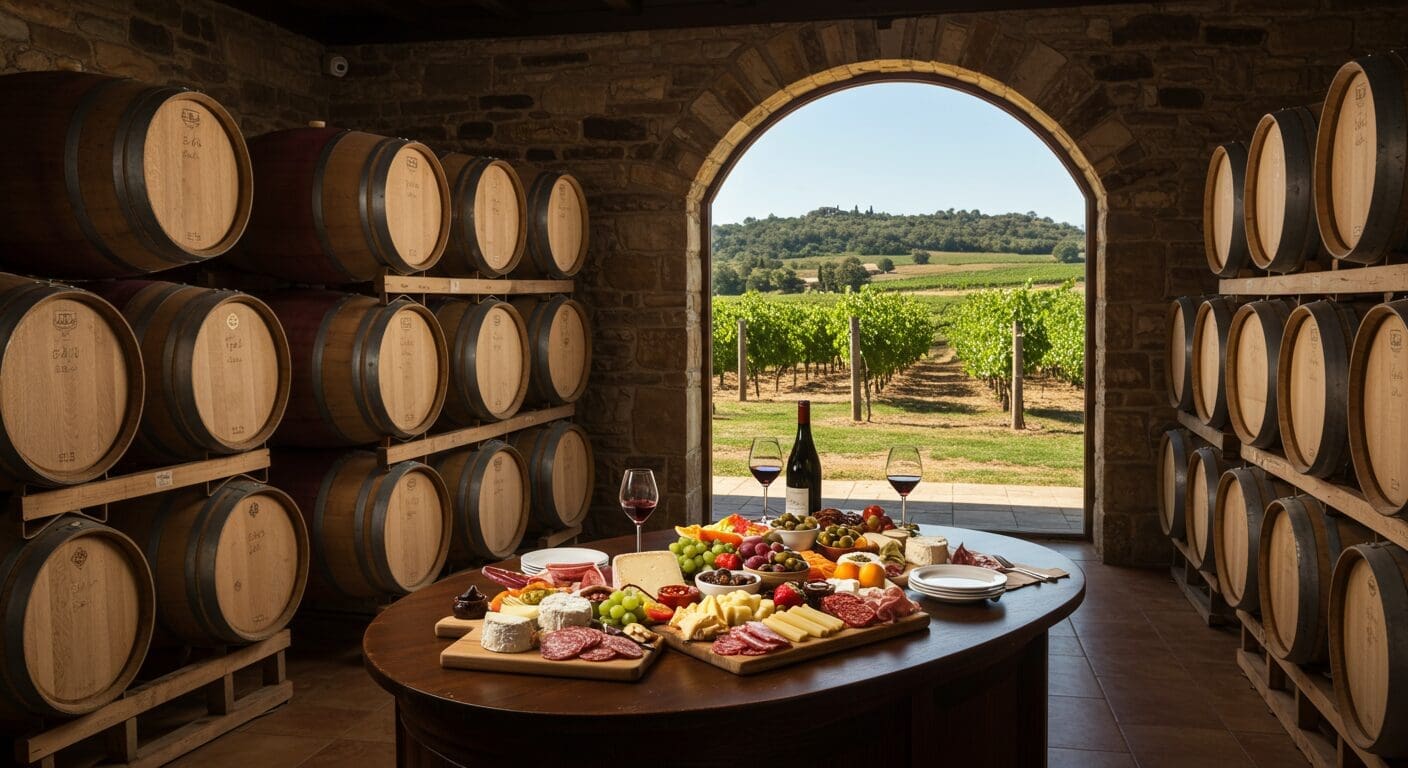
For something more intimate, several quintas in the Torres Vedras area offer private tastings and cellar tours, often paired with regional charcuterie and local cheeses. At the right estate, at the right time of afternoon, with the right wine in your glass and the Atlantic breeze coming in from the west, it is difficult to believe that anywhere else in the world is currently doing quite as well as you are. (It isn’t.)
The Best Food Markets in Lisbon
Lisbon’s market scene rewards the early riser and punishes the leisurely. Get to the Mercado da Ribeira – the historic iron-frame market hall at Cais do Sodré – before ten in the morning and you will find the working market: vegetables piled high with actual soil still on them, whole fish on ice, butchers discussing the merits of particular cuts with the week’s regular customers. By lunchtime, the Time Out Market section at the rear has come to life, a curated food hall showcasing some of the city’s better chefs and producers in one buzzing space. It is very good. It is also very popular, and the queue for certain counters at peak Saturday lunchtime suggests that the concept has not gone unnoticed.
For a more neighbourhood-scaled experience, the Mercado de Campo de Ourique in the residential district of the same name is a beautifully restored covered market with excellent cheese, charcuterie, and wine stalls, surrounded by local restaurants that fill at lunchtime with exactly the kind of well-dressed Lisboetas who eat very well without making any particular fuss about it. The Feira da Ladra flea market in Alfama, held on Tuesdays and Saturdays, is primarily antiques and bric-a-brac, but the food stalls around its edges – olives, smoked fish, fresh fruit – are worth navigating for the theatrical atmosphere alone.
Olive Oil and the Liquid Gold of the Alentejo
Lisbon sits at the gateway to the Alentejo, one of the world’s great olive oil regions, and the finest Portuguese extra virgin olive oils deserve considerably more attention than they typically receive. The country’s production is dominated by a handful of native cultivars – Galega, Cobrançosa, Cordovil, Picual – and the best single-estate oils have the kind of grassy, peppery, genuinely complex character that would command three times the price if they came from Tuscany. They do not come from Tuscany. This is your advantage.
Several producers in the Alentejo offer estate visits and tasting experiences, including tours of the groves and presses during harvest season (typically November through January). The Herdade do Esporão, better known for its wines, also produces olive oil of exceptional quality and runs beautifully designed estate experiences that combine both. Bringing a bottle home is one of the better decisions you will make on any trip to Portugal.
Cooking Classes and Culinary Experiences
The most rewarding culinary experiences in Lisbon tend to be the ones that begin at a market. Several cooking schools and private chefs offer market-to-table classes that start in the morning at one of the city’s food markets, selecting ingredients with a degree of ceremony that makes you feel like a provisioner of some consequence, before retiring to a kitchen to turn them into something recognisably Portuguese. Bacalhau à brás, cataplana seafood stew, arroz de pato (duck rice, one of the great overlooked dishes of the world) – all appear on programmes depending on season and mood.
Private dining experiences, where a Lisbon chef cooks in your villa kitchen for a small group, have become increasingly sought after among visitors who want the food without the table-by-the-toilet lottery of booking high-demand restaurants. Several chefs and personal chef services operate in the city and can be arranged through your villa concierge, combining market shopping, wine pairing, and a menu built around what looked best that morning. It is, by most measures, the finest way to eat in Lisbon.
For those with serious oenological ambitions, private wine tasting sessions led by a sommelier – either in a wine bar setting or at a quinta – can be arranged with relative ease. These typically cover the Lisboa DOC in context, with comparative tastings against the Douro or Alentejo, and are the kind of two-hour investment that pays dividends every time you subsequently read a Portuguese wine list.
The Best Food Experiences Money Can Buy in Lisbon
At the top of the market, Lisbon now has a constellation of restaurants operating at the level you’d expect from a European capital that has spent the last decade quietly building a serious dining scene. Chef José Avillez has become the public face of modern Portuguese fine dining, with his Belcanto restaurant having held two Michelin stars while remaining recognisably, affectionately Portuguese rather than stateless in the way some fine dining can feel. The tasting menu is a considered journey through Portuguese culinary history, reinterpreted with considerable skill and a lightness of hand that stops it ever becoming ponderous.
For a more elemental luxury, hire a private boat from the Tagus marina and have a catered lunch on the water – the city receding in golden afternoon light, a chilled bottle of Bucelas white, plates of cold shellfish and local cheese. The Tagus is wide here, almost sea-like, and the experience sits somewhere between meal and memory. Which is, after all, what the best eating tends to do.
Wine estate dinners at private quintas – long tables, candlelight, the producer’s full range over seven courses – are available on request for groups and represent perhaps the most complete expression of what the Lisboa region has become: confident, deeply rooted, and quietly rather pleased with itself.
Plan Your Stay: Luxury Villas in Lisbon
Eating and drinking this well deserves a base that matches the ambition. The right villa – a converted palácio in the Chiado, a contemporary house above the Tagus in Belém, a whitewashed retreat on the Setúbal Peninsula – changes everything. It gives you a kitchen for the things you bring back from the market, a terrace for the evening wine, a concierge who knows which quinta has just opened its cellar to private visits. It gives you, in short, Lisbon at its most unhurried.
Browse our collection of luxury villas in Lisbon and find the setting your appetite deserves.
What is the best time of year to visit Lisbon for food and wine experiences?
October through November is arguably the finest time: the harvest season is underway in the wine estates around the city, olive pressing has begun in the Alentejo, and the city’s restaurants are at their most focused. Spring (March to May) runs a close second, with market produce at its freshest and restaurant terraces fully operational without the summer crowds. July and August are the warmest months but also the busiest, and some of the smaller, more personal wine estates temporarily reduce their visiting hours.
Which wines from the Lisbon region are most worth seeking out?
The Lisboa DOC is a broad designation encompassing several distinct sub-regions. For whites, the Arinto-based wines of Bucelas offer exceptional quality at reasonable price points – precise, mineral, and built for seafood. The Moscatel de Setúbal, from the peninsula south of the Tagus, is one of Portugal’s great fortified wines and an essential tasting. For reds, explore the Castelão-based wines of the Palmela and Setúbal areas, and look for producers working with older vine material in the Alenquer and Torres Vedras sub-regions. Portuguese wines in general represent some of the best quality-to-price ratios currently available in Europe.
Can I arrange a private cooking class or chef experience through my villa?
Yes, and it is one of the more worthwhile things you can organise in advance. Most luxury villa concierge services in Lisbon can arrange private chef visits, market-to-table cooking experiences, and wine pairing dinners either in the villa or at a local estate. It is worth specifying your interests – seafood cookery, a focus on traditional Portuguese dishes, a particular wine region – so that the experience can be tailored accordingly. Booking a few weeks ahead, particularly in spring and autumn, ensures the best availability.