Los Angeles Travel Guide: Best Restaurants, Culture & Luxury Villas
There are cities that reward you for knowing them, and cities that reward you simply for showing up. Los Angeles is neither, and both, depending entirely on your mood and your postcode. What it has that nowhere else quite manages is this: the audacious, slightly deranged belief that the life you want – the one with the perfect weather, the right table, the view from the canyon at dusk – is available to you, right now, today, if you just know where to look. Paris has grandeur. New York has urgency. Los Angeles has possibility – delivered with a side of avocado toast and approximately forty-five minutes of traffic to get there.
It is a city that works differently for different people, and that is perhaps the point. Families looking for genuine privacy – a walled compound with a pool, space for three generations, zero chance of bumping into the other hotel guests at breakfast – find it here in ways that London or New York simply cannot match. Couples on milestone trips find a city that stages romance effortlessly: clifftop dinners, golden-hour drives on Mulholland, wine lists that read like novels. Groups of friends discover that LA operates at exactly the right decibel level – loud enough to be exhilarating, sprawling enough that you never feel crowded. Remote workers, increasingly drawn to luxury holiday rentals with serious connectivity and home-office aesthetics, find that a Bel Air villa with fibre broadband and a pool is an entirely rational way to spend a working month. And wellness-focused travellers – the ones booking sound baths and infrared saunas and cold plunges before breakfast – find that Los Angeles invented the lifestyle they were already living. It is, in this sense, the most obliging city on earth.
Getting to Los Angeles: Easier Than the 405 Makes It Look
Los Angeles International Airport – LAX – is the main gateway, and with good reason: it handles flights from virtually every major city on earth, with direct services from London, across Europe, Asia, Australia and beyond. The flight from London takes around eleven hours. From New York, roughly six. From Sydney, brace yourself. LAX is not a small airport, and arriving there can feel mildly chaotic – particularly in the Tom Bradley International Terminal, which has seen improvements but remains a place where patience is genuinely useful. The new automated people mover and consolidated rental car facility have helped, and the ongoing modernisation programme means the experience is gradually becoming less of an endurance test.
For those who prefer a quieter arrival, Hollywood Burbank Airport (BUR) serves the north side of the city with considerably less drama – ideal if you’re heading to the Hills or the Valley. Long Beach Airport (LGB) is a hidden asset for the south and east of the metropolitan area: small, fast, and about as far from the LAX experience as it is possible to get while still landing in Greater Los Angeles.
Once you’ve arrived, the question of getting around is the question that defines the Los Angeles experience. The city is vast – about 500 square miles of it – and while the Metro system has improved substantially, the honest answer is that most visitors rent a car, or hire one with a driver. For luxury villa stays in the Hills or the Canyons, a car is not optional; it is the only sensible approach. Rideshares are plentiful and reliable for shorter trips within denser neighbourhoods. Budget extra time for everything. The traffic is real. It is not an urban myth. It is just Los Angeles.
The Table You Actually Want: Eating in Los Angeles
Fine Dining
The fine dining conversation in Los Angeles has changed significantly over the past decade, and in 2025 it reaches a landmark moment. Providence, on Melrose Avenue, has for years been the quiet giant of LA dining – not flashy, not especially fashionable in the Instagram sense, just relentlessly, impeccably good. Chef-owner Michael Cimarusti finally received his third Michelin star in 2025, making Providence one of the most decorated restaurants on the West Coast. The focus is the sea: Santa Barbara spot prawns, steelhead trout from Washington’s Quinault River, Japanese golden eye snapper. The menus are tasting, the service is thoughtful without being starched, and the wine programme is serious. Co-owner Donato Poto has spent two decades building the kind of room where guests feel welcome rather than assessed, which – in this city – is its own kind of achievement.
For something architecturally different, Holbox operates out of Mercado La Paloma in South Central – a Michelin-starred restaurant inside a community market, which tells you something important about Los Angeles. Chef Gilberto Cetina, a James Beard Award semifinalist, named his restaurant after an island off the Yucatán Peninsula and cooks with an intensity that has earned him over 1,000 five-star reviews. Michelin called it “a distinctively Angelino phenomenon,” and they are not wrong: this is a place where distinction lives somewhere outside the usual coordinates of fine dining real estate.
Where the Locals Eat
Anajak Thai in Sherman Oaks has been The Infatuation’s highest-rated restaurant in the city since 2021, which is the kind of sustained approval that money cannot simply manufacture. It’s a decades-old Thai spot that has been transformed into something national in scope – sharp creativity meeting deep family tradition, a wine list of unusual and sometimes revelatory finds, and a room that feels genuinely alive. Getting a reservation requires planning. Do the planning. The combination of exquisitely made Thai food and a wine list that ranges from natural producers to prestige Burgundy is the sort of thing you describe to people when you get home and watch them not quite believe you.
The food truck and market scene remains one of the great democratic pleasures of a luxury holiday in Los Angeles. Grand Central Market, on Broadway in Downtown, is an essential stop – Korean stalls, Mexican tortas, Thai curries, craft coffee and artisan ice cream operating cheek by jowl under a historic vaulted ceiling. Smorgasburg LA at the Row DTLA brings an outdoor food market every Sunday that draws serious eaters. The San Gabriel Valley is its own universe of Chinese, Taiwanese, Korean and Vietnamese cooking, largely undiscovered by tourists and better for it.
Hidden Gems Worth Seeking Out
Pizzeria Sei is a spartan storefront on Pico Boulevard that has somehow managed to make the best pizza in Los Angeles by making Tokyo-style Neapolitan pies – a concept that sounds like it shouldn’t work until the moment you taste one. Pizzaiolo William Joo uses San Marzano DOP tomatoes and produces thin, blistered rounds with a crust that has a mochi-like chew entirely unlike anything from Naples or New York. They sometimes sell out before the evening service ends, which is either a logistical warning or a useful measure of how good they are. Probably both.
Yang’s Kitchen in the San Gabriel Valley is serving farm-to-table Chinese-inspired dinners that manage to be inventive without being precious, nostalgic without being backward-looking. The fried chicken wings are a reliable way to understand what the kitchen does best: Asian-inflected comfort cooking that reveals more complexity with every mouthful. It is exactly the kind of restaurant Los Angeles does better than anywhere else – genuinely original, deeply rooted, no dress code required.
Neighbourhoods: How to Read a City That Refuses to Have a Centre
Los Angeles has no single centre, which confuses first-time visitors and delights everyone else. It is better understood as a loose federation of very different cities, each with its own character, its own food, its own approximate income bracket, and its own relationship to the concept of traffic.
West Hollywood is where the energy concentrates on the Sunset Strip – restaurants, rooftop bars, music venues, boutiques. It is dense, walkable by LA standards, and has the kind of nightlife infrastructure that requires no introduction. Beverly Hills delivers exactly what the myth promises: Rodeo Drive, manicured streets, hotels of a certain grandeur, and a quietness in the residential areas that feels almost European. The retail is extraordinary. The people-watching is quietly extraordinary.
Malibu is a state of mind as much as a neighbourhood – twenty-one miles of Pacific coastline, ranch properties set back from the road, seafood shacks that have been serving the same loyal clientele for thirty years. Nobu Malibu remains the unofficial headquarters of the film industry’s informal social life. The beaches here – Zuma, El Matador, Point Dume – are genuinely wild in places, which catches some visitors off guard.
Silver Lake and Los Feliz occupy the east side of the city in a zone that is part architectural history (extraordinary concentration of modernist houses from the mid-twentieth century), part serious restaurant destination, part the kind of neighbourhood where the record shops are still good. Venice offers the boardwalk theatre of street performers, bodybuilders and general civic expressionism that you came to see, but the residential canals just inland are tranquil in a way that surprises most people. Brentwood and Pacific Palisades remain among the most sought-after residential postcodes in the city – wide streets, mature trees, high property values, and an almost suburban calm that belies their proximity to the ocean.
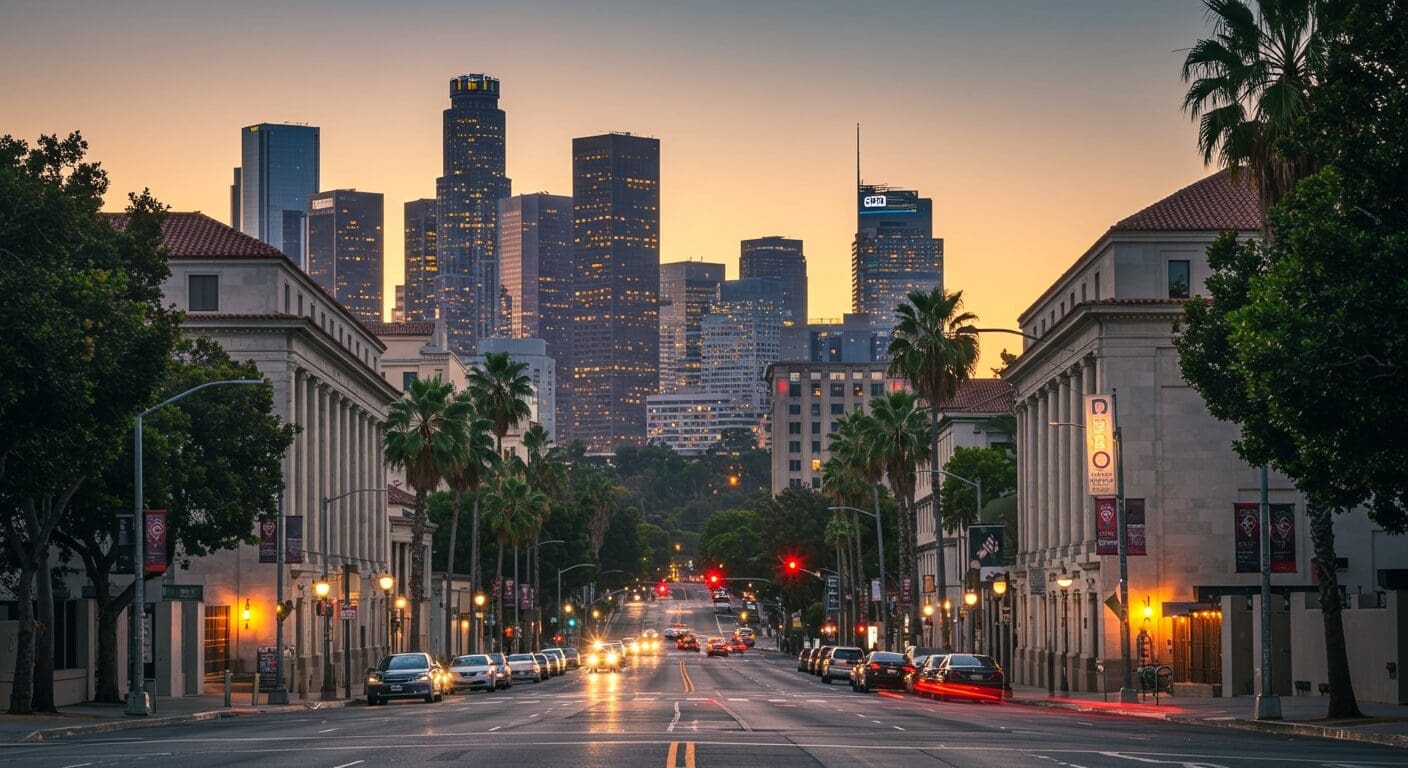
Downtown Los Angeles has transformed considerably since the early 2000s – the Arts District, Little Tokyo, the Broad and Grand Avenue cultural corridor all add up to a version of the city that bears almost no relation to the Downtown of thirty years ago. It rewards an afternoon considerably more than its reputation might suggest.
What to Do in Los Angeles: Beyond the Obvious
The Getty Center above Brentwood is one of the finest art museums in the United States – a Richard Meier building that sits in the Santa Monica Mountains with views across the city and the Pacific. The permanent collection is serious: Rembrandt, Monet, Van Gogh, Cézanne. But the architecture and the gardens and the light are reasons enough to visit even before you consider the art inside. Arrive early.
The Los Angeles County Museum of Art (LACMA) on the Miracle Mile houses the largest art collection in the western United States, and the campus – currently undergoing an ambitious redevelopment designed by Peter Zumthor – is itself a study in what a civic institution can aspire to. The Urban Light installation of vintage street lamps at the entrance has become one of the most photographed images in the city, which is slightly unfair on everything inside.
The Broad in Downtown is newer, sharper and currently home to one of the most important collections of contemporary and post-war art in America – Koons, Basquiat, Cindy Sherman, Jeff Koons’ Tulips – in a building by Diller Scofidio + Renfro that manages the trick of being architecturally distinctive without being obnoxious.
The Hollywood Bowl on summer evenings remains one of the great outdoor concert experiences available to a traveller anywhere. The amphitheatre dates to 1922, the sightlines are excellent, and the tradition of bringing your own picnic and bottle of wine to a Los Angeles Philharmonic performance is one of those rituals that makes you understand why people who live here stay.
A drive along Mulholland Drive at dusk – when the city below starts to light up and the Santa Monica Bay catches the last of the sun – is free, takes about forty-five minutes, and is one of the most affecting experiences Los Angeles offers. The road winds along the spine of the Santa Monica Mountains between the 101 and the 405, with the city on one side and the Valley on the other. It requires only a car and a reasonable sense of direction.
Into the Wild: Adventure and the Outdoors
The thing that surprises people about Los Angeles as an adventure destination is the sheer proximity of wilderness to the city. You can be in serious backcountry within an hour of most postcode areas, which recalibrates the whole idea of what a luxury holiday in Los Angeles can look like.
Griffith Park is 4,310 acres of hiking trails, horse trails, and open chaparral sitting directly above Hollywood and Los Feliz. The trails to the summit of Mount Hollywood are accessible to most fitness levels and reward with panoramic views of the basin, the Pacific, and on clear days, Catalina Island. The park is also home to the Griffith Observatory, one of LA’s most beloved landmarks – an Art Deco building opened in 1935 that has appeared in La La Land and Rebel Without a Cause, and whose position on the south slope of Mount Hollywood offers arguably the finest view of the city available without a helicopter. It is a national leader in public astronomy, runs regular free public telescope viewings, and is worth the visit regardless of whether the sky is clear.
The Santa Monica Mountains National Recreation Area stretches from Griffith Park to Point Mugu, containing over 500 miles of trails through oak woodland, chaparral and coastal sage scrub. The combination of Pacific views, canyon hiking, and mountain biking makes it one of the best urban wilderness areas in the world – a phrase that sounds like hyperbole and isn’t.
Surfing is serious on the beaches from Malibu south through Santa Monica, Venice and the South Bay. Beginner-friendly breaks at Malibu’s First Point and Venice have been producing surfers for decades. Further south, the waves at El Porto and Manhattan Beach are more demanding. Lessons are available at every level. Equipment rental is straightforward. The water, for most of the year, requires a wetsuit – the Pacific here is colder than the brochures tend to admit.
Road cycling along the Marvin Braude Bike Trail – the thirty-two-mile coastal path running from Pacific Palisades to Torrance – provides an entirely different perspective on the city’s relationship with its coastline. Electric bike rentals have made it accessible to visitors of all fitness levels, and the flat, traffic-free route past Venice Beach, Santa Monica Pier and Marina del Rey is one of the more pleasurable ways to spend a morning.
Day trips to Catalina Island – ninety minutes by ferry from San Pedro or Long Beach – deliver snorkelling, kayaking, diving, and an island atmosphere that sits somewhere between the Mediterranean and something much more specifically Californian. The glass-bottom boat tours over the kelp forests are not as embarrassing as they sound.
Los Angeles with Children: Big City, Surprisingly Large Backyard
Los Angeles works exceptionally well for families, provided expectations are correctly calibrated around one central truth: space is the luxury here, and the city has it in abundance. The scale that can feel overwhelming to solo travellers is a genuine asset when you have children to contain and activities to coordinate.
The obvious anchors – Universal Studios Hollywood, Disneyland in neighbouring Anaheim, the Natural History Museum, the La Brea Tar Pits – are famous for good reason. The Tar Pits in particular have a way of stopping children mid-sentence: genuine Ice Age fossils being extracted from pools of black asphalt in the middle of Wilshire Boulevard is the kind of thing that requires no additional explanation to a ten-year-old. The California Science Center, home to the Space Shuttle Endeavour, handles science education with a directness that puts most institutions to shame.
The beach is, naturally, a constant. Santa Monica and its pier offer the classic Los Angeles family afternoon – a Ferris wheel, street food, Pacific paddling and the Palisades above. Zuma Beach in Malibu is cleaner, quieter and more suited to younger children. For families staying in private villas, the combination of an in-house pool, a private garden, and proximity to nature rather than crowds transforms the entire logistics of a family holiday. No packing the beach bag, negotiating hotel elevators, or arguing about sun loungers. The children swim; the adults read in peace. Los Angeles with children, from a private villa, is as close to a genuinely relaxed family holiday as the city offers.
History, Culture and the Architecture of Aspiration
Los Angeles is a younger city than it thinks it is, and older than most visitors expect. The area was inhabited for thousands of years by the Tongva people before Spanish missionaries established the Pueblo de Los Ángeles in 1781. The Mission San Fernando Rey de España and Mission San Gabriel Arcángel survive from this period – adobe buildings in the California mission style that offer a quieter, more contemplative version of the city’s history than the Hollywood narrative usually allows.
The architectural story of twentieth-century Los Angeles is one of the great unsung design narratives. The Case Study Houses programme, which ran from 1945 to 1966, produced some of the most influential domestic architecture in the world – Pierre Koenig’s Case Study House #22, photographed by Julius Shulman against the Los Angeles night skyline, remains one of the defining images of postwar optimism. The Silver Lake area contains a remarkable concentration of Neutra, Schindler and Ain houses. The Bradbury Building in Downtown – an 1893 atrium building of ornate ironwork and glazed skylights – has appeared in more films than most actors.
The film industry’s cultural footprint is unavoidable and occasionally worth embracing. The Academy Museum of Motion Pictures, which opened in 2021 next to LACMA, is the most serious attempt yet to contextualise cinema’s history and impact in the city that invented the form. The permanent collection covers costume, technology, story, and industry with genuine rigour. The temporary exhibitions have been consistently strong.
The performing arts scene is anchored by the Los Angeles Philharmonic at Walt Disney Concert Hall – Frank Gehry’s landmark building on Grand Avenue whose stainless steel facade remains, twenty years after opening, one of the most photographed buildings in America. The programming under successive music directors has been ambitious and occasionally revelatory. A ticket to the Philharmonic on a clear Los Angeles evening, with dinner at one of the Grand Avenue restaurants before, constitutes a cultural evening that few cities in the world can equal.
Shopping in Los Angeles: Where the Industry Buys Its Clothes
Los Angeles has no single shopping district in the European sense – instead, it has a series of distinct retail personalities spread across the city, each catering to a different version of the Los Angeles dream.
Rodeo Drive in Beverly Hills delivers the full international luxury experience: Chanel, Hermès, Cartier, Saint Laurent, Gucci – all present, all correct, all operating at price points that require no comment. The architecture of the street, particularly the Via Rodeo two-level cobblestone plaza, is more interesting than it gets credit for.
Melrose Avenue is where the fashion gets interesting – a stretch of independent boutiques, vintage stores, streetwear labels, and designer consignments that has been setting trends for four decades. The Rex Orange County era of vintage finds is well and truly over, but the vintage infrastructure in this city remains extraordinary: Wasteland, It’s a Wrap (selling actual wardrobe pieces from film and television productions), and dozens of independent shops make Los Angeles one of the finest cities in the world for pre-owned fashion.
The Abbot Kinney Boulevard in Venice offers the most self-consciously curated shopping experience in the city – independent design, sustainable fashion, gallery spaces and excellent coffee within a walkable mile. The first Friday of every month brings a food truck event that extends the evening well into something more festive.
For food to take home, the Brentwood Country Mart and the various weekend farmers’ markets – the Santa Monica Farmers’ Market on Wednesdays and Saturdays being the largest and most celebrated – offer California produce at its finest. Chefs from across the city shop here. It is not a performance. It is genuinely how the best restaurants source.
Practical Los Angeles: The Things No One Tells You Until You Need Them
The best time to visit Los Angeles is broadly September through November, when the summer heat has eased, the marine layer has retreated, and the city operates in a kind of golden-weather equilibrium. June and July bring the “June Gloom” – a morning marine layer that can keep coastal areas grey until early afternoon. January and February are the rainy months, though “rainy” by Los Angeles standards means approximately forty-eight hours of light precipitation followed by weeks of clear skies.
The currency is the US dollar. Tipping is not optional and not negotiable: 20% is standard at restaurants, 18% at the lower end of the scale. Rideshares and taxis expect a tip. Spa services expect a tip. Hotel housekeeping expects a tip daily. This is Los Angeles. The tipping culture is embedded and should be budgeted for accordingly.
Safety varies enormously by neighbourhood. The areas most visitors and luxury villa renters occupy – Bel Air, Brentwood, Pacific Palisades, the Hollywood Hills, Malibu, Santa Monica – are safe and well-maintained. Downtown requires the same awareness you’d apply to any major city centre after dark. Leaving visible valuables in parked cars is inadvisable anywhere in the city.
Driving requires a US licence (or an international driving permit) and a relatively relaxed relationship with freeway merging. The 405 southbound on a Friday afternoon is a meditation on impermanence. The 10 west at 8am on a Tuesday is a reminder that the internal combustion engine was perhaps not entirely thought through. Use Google Maps, trust the real-time routing, and allow twenty minutes more than you think you need for everything.
The time zone is Pacific Standard Time (PST), UTC-8 in winter and UTC-7 in summer. The dress code, across most of the city, is smart casual at best and considerably more casual everywhere else. You will not feel underdressed in expensive restaurants if you arrive in well-cut clothes rather than a jacket and tie. You will not feel overdressed at the beach regardless. Los Angeles is remarkably forgiving in this respect.
Why a Private Luxury Villa in Los Angeles Is Simply the Better Option
There is a version of Los Angeles that involves a hotel room with a view of another hotel, a pool shared with a hundred other guests, and a lobby that operates as a permanent social performance. It is a version that works for some people. It is not the version this guide is recommending.
The case for luxury villas in Los Angeles begins with space and ends with privacy, and everything in between is a considerable list. The Hills – Bel Air, Holmby Hills, Coldwater Canyon, Laurel Canyon, Brentwood – contain some of the finest private residential architecture in the world, much of it available for rental at a standard that has no equivalent in the hotel sector. A five-bedroom villa in Bel Air with a pool, a home cinema, a chef’s kitchen, a covered terrace and grounds that screen it entirely from the road is not a compromise version of the Los Angeles luxury experience. It is the definitive version.
For families, the arithmetic is straightforward: private pool means no 10am sun lounger ritual, no sharing the shallow end with strangers, no navigating hotel restaurants with tired children. The villa operates on your schedule. If the children want breakfast at 7 and the adults prefer 10, both can happen simultaneously without negotiation. Space for three generations to coexist without proximity becomes a primary amenity rather than an afterthought.
Groups of friends on milestone trips – significant birthdays, reunions, celebrations – find that a villa with multiple bedrooms, a serious outdoor entertaining space, and a pool becomes the event itself rather than just a base. The ability to hire a private chef, arrange in-villa yoga or massage, stock the fridge through a luxury provisioning service, and receive a dedicated concierge means that the gap between hotel service and private villa service has largely closed – and in several important respects, the villa has won.
Remote workers who have discovered that a luxury Los Angeles villa rental for a month costs less than they’d expect, provides fibre broadband as standard (and Starlink at more remote properties), and delivers a working environment that makes the nine-to-five feel like a structural choice rather than an obligation – these guests tend not to go back to the office hotel model. The home office with a pool view, the lunch break that involves actual sunshine, the end-of-day swim: these are not small things.
Wellness guests find that the villa format is the most coherent expression of the Los Angeles wellness philosophy. A private pool for morning laps, a garden for outdoor yoga, proximity to hiking trails, and the option to bring in private practitioners – nutritionists, personal trainers, breathwork facilitators, massage therapists – on a schedule that suits rather than a spa menu that doesn’t. Los Angeles invented the wellness lifestyle. The villa is where it actually lives.
Excellence Luxury Villas offers a curated collection of private luxury rentals in Los Angeles across Bel Air, Malibu, the Hollywood Hills, Santa Monica and beyond – each property selected for the standard of its accommodation, its amenities, and the quality of experience it delivers. Whether you are planning a family escape, a group celebration, a remote working month or a wellness retreat, the collection covers the full range of what this city, at its best, can offer.
More Los Angeles Travel Guides
- Best Restaurants in Los Angeles: Fine Dining, Local Gems & Where to Eat
- Los Angeles Food & Wine Guide: Local Cuisine, Markets & Wine Estates
- Los Angeles with Kids: The Ultimate Family Holiday Guide
- Best Time to Visit Los Angeles: Month by Month Weather, Crowds & Tips
- Los Angeles Luxury Itinerary: The Perfect 7-Day Guide
- Romantic Los Angeles: The Ultimate Couples & Honeymoon Guide
What is the best time to visit Los Angeles?
September through November is widely considered the ideal window – the summer heat has softened, the June marine layer has gone, and the city settles into a reliably warm, clear-skied rhythm. October in particular offers near-perfect conditions: warm enough for outdoor dining and beach afternoons, cool enough for hiking. Winter (January to February) brings occasional rain but also far fewer crowds, lower villa rates, and the peculiar pleasure of having the hiking trails largely to yourself. Summer is busiest and hottest inland, though coastal areas benefit from Pacific breezes that keep temperatures tolerable.
How do I get to Los Angeles?
Los Angeles International Airport (LAX) is the primary international gateway, with direct flights from London, Paris, Amsterdam, Frankfurt, Tokyo, Sydney and most major global hubs. Flight time from London is approximately ten to eleven hours. For a quieter arrival on the north side of the city – useful if you’re heading to Burbank, Studio City or the Hollywood Hills – Hollywood Burbank Airport (BUR) is a considerably more relaxed experience. Long Beach Airport (LGB) is excellent for the south and east of the metro area. Once landed, private car transfers to your villa are the most efficient option; rideshares are available but add unpredictability during peak hours.
Is Los Angeles good for families?
Genuinely excellent, provided you approach it correctly. The scale of the city that can feel overwhelming for a solo traveller becomes an asset with children: there is no shortage of things to do, no single neighbourhood becomes exhausting, and the outdoor lifestyle means that energy is rarely a problem to burn off. Disneyland, Universal Studios, the Natural History Museum, the La Brea Tar Pits, the beach, Griffith Park – the family infrastructure is substantial. The real advantage, however, comes with a private villa rental: a pool the children have to themselves, a garden, a kitchen for early breakfasts, and a base that operates entirely on your schedule rather than a hotel’s.
Why rent a luxury villa in Los Angeles?
Privacy, space and the ratio of staff to guests are the three things a private luxury villa delivers that no hotel in Los Angeles can replicate at the same level. A villa in Bel Air or the Hollywood Hills gives you a walled compound, a private pool, a chef’s kitchen, grounds that mean you never share a sun lounger with a stranger, and the freedom to operate on your own schedule entirely. For families and groups, the cost per person often compares favourably with equivalent hotel rooms once you factor in the amenities. For couples on milestone trips, the intimacy and seclusion are simply incomparable. Dedicated concierge services, private chef options and bespoke experiences can all be arranged through your villa management team.
Are there private villas in Los Angeles suitable for large groups or multi-generational families?
Yes – and this is one of Los Angeles’s genuine strengths as a villa destination. The residential architecture of the Hills and Malibu in particular runs to large compound-style properties: six, seven, eight bedrooms across a single estate, with multiple living areas, separate guest wings, staff quarters, and outdoor entertaining spaces designed for significant gatherings. Multi-generational families find that the ability to give grandparents a quiet wing, children a pool area, and adults a separate terrace transforms the group holiday dynamic entirely. Properties with dedicated guest cottages or pool houses add an additional layer of privacy within the group. Our collection includes properties scaled for groups of up to twenty or more.
Can I find a luxury villa in Los Angeles with good internet for remote working?
Reliably, yes. High-speed fibre broadband is standard across virtually all luxury villa properties in Los Angeles – the city’s infrastructure is excellent and the demand from the entertainment, tech and creative industries means connectivity is treated seriously. Properties in more remote canyon locations or the Malibu hills may additionally offer Starlink for satellite backup, ensuring consistent speeds regardless of location. Many villas include dedicated home-office spaces or quiet studies separate from the main living areas, which matters considerably when you are on calls across multiple time zones. The combination of reliable connectivity, private outdoor space, and a pool within reach of the desk is, many guests report, genuinely difficult to leave.
What makes Los Angeles a good destination for a wellness retreat?
Los Angeles has been the global centre of wellness culture for long enough that it is no longer a trend – it is simply the infrastructure of the city. Year-round sunshine, access to serious hiking within twenty minutes of most villa locations, a Pacific coastline for cold-water swimming and surfing, and a wellness industry that encompasses everything from Pilates to sound healing to infrared saunas means the options are genuinely serious. From a private villa, the wellness experience becomes entirely personal: bring in a private yoga instructor at dawn, book a massage therapist