Loulé Food & Wine Guide: Local Cuisine, Markets & Wine Estates
What does it actually taste like, the Algarve? Not the Algarve of grilled sardines on a seafront terrace with a view of the marina – though there is nothing wrong with that – but the real one. The interior one. The one that has been quietly feeding itself rather well for centuries without any particular interest in being discovered. The answer, as it turns out, is somewhere between the sea and the hills: briny, earthy, occasionally smoky, and almost always accompanied by something good poured into a glass. Loulé, sitting at the geographic and gastronomic heart of the Algarve, is where you begin to understand this.
The Flavours of the Interior: Understanding Loulé’s Cuisine
Loulé is not a coastal town, which matters more than most visitors initially realise. While the beaches of Quinta do Lago and Vale do Garrão are close enough to reach before lunch, the town itself sits inland, shaped by the Serra do Caldeirão to the north and the fertile lowlands to the south. This geography produces a cuisine that is fundamentally dual in character: it borrows the seafood traditions of the coast while remaining deeply rooted in the hunting, foraging and livestock culture of the hills.
The result is a table that can offer you both cataplana – the copper-pot seafood stew that is perhaps Portugal’s most theatrical dish – and slow-braised wild boar in the same afternoon, depending on which direction your appetite is pointing. Pork is used in ways that would alarm a dietary consultant: cured into presunto (the local air-dried ham), rendered into lard for pastry, ground into chouriço that finds its way into everything from soups to rice dishes. Chicken piri-piri, sometimes treated as a tourist shortcut, is genuinely excellent here when made properly, with the bird rested overnight in a marinade that has actual intention behind it.
The carob tree is perhaps Loulé’s most emblematic ingredient – long before chocolate arrived in Europe, carob was being ground into flour, pressed into syrup and traded across the Mediterranean. Today it appears in local sweets and breads, a quiet reminder that this region was doing farm-to-table centuries before the phrase existed.
The Municipal Market: Loulé’s Most Essential Food Experience
Loulé’s market building – a Moorish Revival structure with terracotta tiles and horseshoe arches that looks as though it was designed by someone who had read too much about Granada – houses one of the most serious food markets in the Algarve. It operates every morning from Tuesday to Sunday, but Saturday is when the surrounding farmers and producers join the permanent stallholders to turn the whole thing into something considerably more alive.
Arrive before ten o’clock if you want the best of it. The permanent stalls inside sell dried figs, almonds, local honey in varieties that range from lavender to arbutus berry, handmade cheeses, smoked sausages, and fresh herbs in quantities suggesting that the region’s cooking relies, quite correctly, on using a lot of them. The Saturday outdoor market extends into the surrounding streets and brings in vegetables still carrying the soil they were grown in, which is either charming or inconvenient depending on your luggage situation.
The market is also where you begin to understand olive oil here. Multiple producers sell their oil directly, and the variation between them is considerable – from grassy and peppery to softer, more buttery expressions depending on the cultivar and harvest timing. Tasting them side by side, poured onto small pieces of bread by a stallholder with evident pride in the difference, is one of those food experiences that costs almost nothing and stays with you significantly longer than things that cost a great deal more.
Olive Oil, Almonds & Carob: The Producers Worth Seeking Out
The land around Loulé has been producing olive oil for millennia, and while Alentejo tends to get more international attention for its groves, the Algarve interior produces oils of genuine character and complexity. The hilly terrain north of Loulé, particularly around the villages of Alte, Salir and Querença, supports traditional olive cultivation using varieties including Maçanilha Algarvia – a local cultivar that produces a delicate oil with pronounced fruitiness and a gentle finish.
Several quintas (rural estates) in the municipality allow visits by appointment, where you can walk the groves, see the pressing facilities and taste the oils with the producer present to explain what you’re tasting and why. These are not formal tourist operations – they are working farms that happen to be willing to share what they do with people who are genuinely curious about it. The distinction shows in the experience.
Almonds and figs are equally fundamental to this landscape. Driving north from Loulé in late January or February, when the almond trees flower white against bare hillsides, is one of those experiences that tends to produce the kind of silence that means something. The almonds themselves end up in Loulé’s most famous confection: Dom Rodrigos, a baroque little sweet made from egg yolks, sugar and ground almond wrapped in silver foil, which is the correct thing to buy as a gift and also entirely acceptable to eat in the car immediately.
Truffle Hunting in the Algarve Interior
Few people arrive in the Algarve expecting to go truffle hunting. This is, it turns out, their loss. The cork oak and holm oak forests of the Serra do Caldeirão, which begins effectively in Loulé’s northern reaches and extends up through the municipality, support a quiet but genuine tradition of black truffle foraging – and increasingly, a small number of operators offer guided hunts that pair a trained dog (the real expert in this enterprise), an experienced guide and a forest walk with a lunch or dinner built around whatever has been found.
The season runs roughly from December through March, and the experience is significantly more absorbing than you might expect. There is something about watching a dog work – nose down, systematically quartering ground, then suddenly arrested by a point of intense interest six inches below the surface – that holds attention in a way that is difficult to explain and easy to become mildly obsessed with. The truffles themselves are not the magnificent Périgord specimens of French reputation, but they are fragrant, genuine and considerably more interesting for having been found by a small enthusiastic animal rather than a supermarket.
Wine Estates & the Algarve Wine Region
The Algarve has four recognised wine sub-regions – Lagos, Portimão, Lagoa and Tavira – and while Loulé sits technically within the Tavira denomination, the estates worth visiting draw from across the wider region, several within easy reach of the town. Algarve wine was, for much of the twentieth century, exactly the sort of thing that polite wine writers described as “improving.” It has, in fact, improved. Rather substantially.
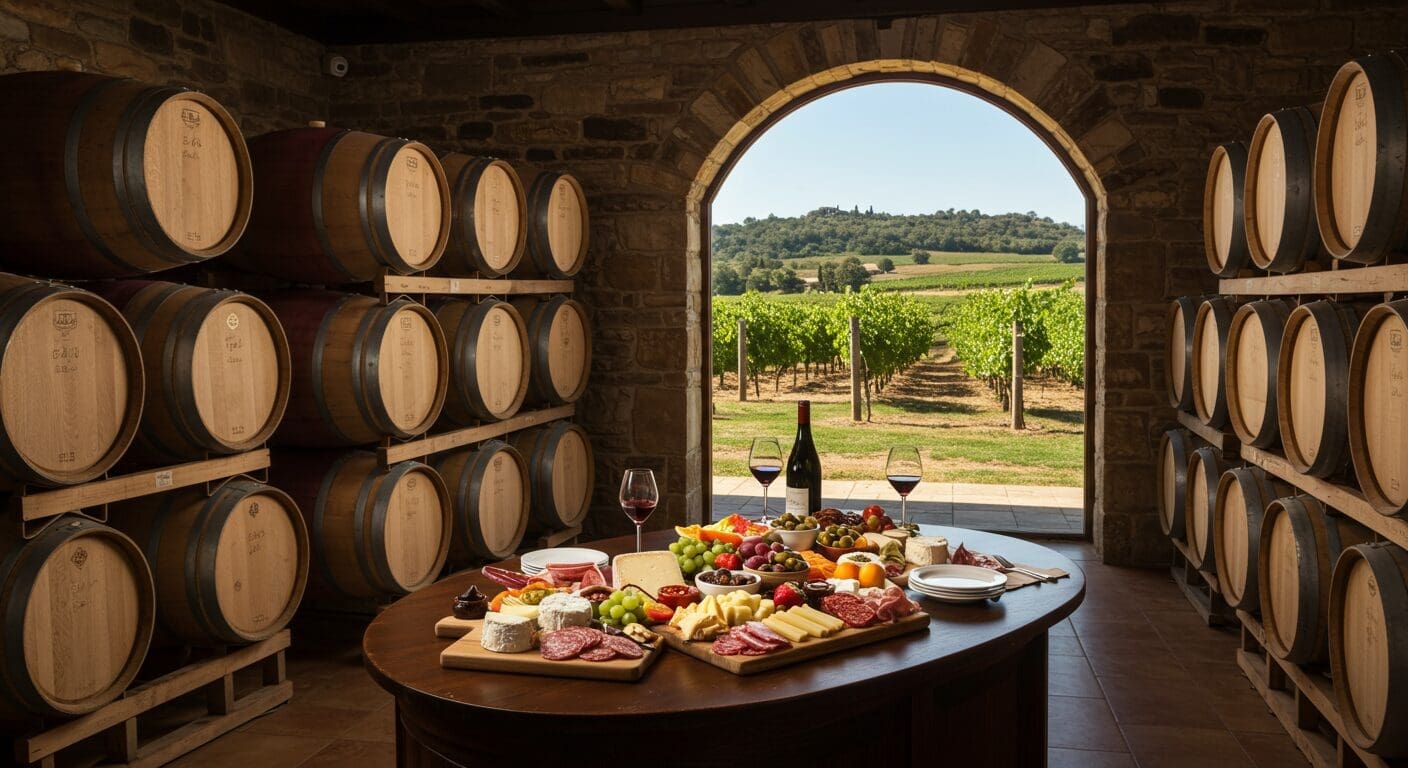
Quinta dos Vales, north of Lagoa and accessible from Loulé in around thirty minutes, is the estate that probably does most to demonstrate what the Algarve is capable of when proper attention is paid to viticulture and winemaking. The estate produces across a wide range, from accessible everyday wines to more serious barrel-aged expressions using indigenous varieties including Negra Mole and Castelão alongside international grapes. Visits include cellar tours and structured tastings, and can be arranged to include lunch among the vines – which is, frankly, the correct format for wine tasting.
Adega do Cantor – the winery associated with Sir Cliff Richard, which produces respectable wines under the Vida Nova label and is located near Guia, northwest of Loulé – has become something of a pilgrimage destination for a certain kind of visitor. The wines are genuinely good. Whether the Sir Cliff connection adds to the experience or introduces an element of mild surrealism is largely a matter of personal disposition.
For something smaller and more intimate, the Algarve has a growing number of boutique producers who receive visitors by appointment rather than operating formal tasting rooms. Several of these are located in the hills north of Loulé, working with older vine material and producing wines in quantities too small for significant export. Finding them requires a little research – or a good concierge.
Cooking Classes & Culinary Experiences
The appetite for learning to cook Portuguese food properly – cataplana assembled with the right sequence, pastel de nata pastry worked until it is paper-thin, the aromatics for açorda (the bread-based soup-stew that is one of Portugal’s most underrated dishes) added in the right order – has generated a small but quality-focused set of cooking experiences in and around Loulé.
Several operators offer market-to-table experiences that begin at the Saturday market, where you select ingredients with the chef-guide, before moving to a kitchen – sometimes the chef’s own home, sometimes a dedicated facility on a rural property – to cook and then eat the results. This format works exceptionally well in Loulé because the market genuinely delivers the quality of produce that makes the exercise worthwhile rather than illustrative.
More ambitious culinary programmes are available through some of the larger quintas in the area, where multi-day experiences might combine olive oil production, wine tasting, a truffle hunt and cooking sessions into something that functions less as a holiday activity and more as an education in what this particular corner of Portugal actually produces and how it thinks about food. These experiences can be fully customised for private groups – which, for a party staying in a luxury villa, is the natural format.
Cataplana, Caldeirada & the Dishes You Should Order
A working list of what to eat in and around Loulé, in no particular order of priority because they are all important:
Cataplana de marisco – The copper-hinged clam-shaped vessel that gives this dish its name seals in a seafood broth of clams, prawns, chouriço, tomato, white wine and onion, cooking everything in its own steam until the flavours have collapsed into each other in the best possible way. It is both theatre and substance, which is a combination that rarely disappoints.
Caldeirada – The fish stew that predates cataplana as a concept, layered with whatever the day’s catch provided, potatoes, tomatoes and saffron. Simpler in presentation, deeper in flavour. The version made with monkfish and bream together is particularly worth pursuing.
Frango piri-piri – Properly made, with a bird that has had time in a real marinade and heat applied with patience rather than speed. The piri-piri pepper arrived in Portugal from its African colonies and never left. This is entirely to everyone’s benefit.
Favas com chouriço – Broad beans cooked with smoked sausage and a quantity of good olive oil. Described as a side dish in most contexts. Functions, in practice, as a reason for visiting in spring when the beans are young.
Dom Rodrigos – As noted above. Buy them. Eat them. Accept that you will want more.
The Best Food Experiences Worth Spending on
For travellers to whom the best version of something is the point of the exercise, Loulé and its surroundings offer several food and wine experiences that justify significant investment – whether in time, money or both.
A private cataplana dinner prepared in your villa by a local chef is an experience that consistently outperforms restaurant dining for groups. The chef shops at the market in the morning, arrives at the villa in the late afternoon, and produces a succession of dishes that unfold over an evening spent entirely on your own terms. The wines can be matched by the same chef or pre-selected with the help of a local wine specialist. This is, without qualification, one of the finest ways to spend an evening in the Algarve.
A full-day private food and wine itinerary – market in the morning, olive oil quinta before lunch, wine estate in the afternoon with a cellar tour and vertical tasting, dinner at a serious restaurant – can be arranged through specialist operators and covers the full range of what this region produces in a single day. It requires a driver, comfortable shoes and a willingness to eat considerably more than usual. All of these are easily managed.
For those with particular interest in the agricultural traditions of the region, a private visit to a working quinta north of Loulé – where you might see presunto curing in the traditional manner, taste cheeses made from the property’s own animals and walk the land with someone who has farmed it for generations – offers a connection to place that no restaurant, however excellent, can replicate.
For more on what the wider region has to offer beyond the table, our Loulé Travel Guide covers everything from the historic old town to the golf courses of the Golden Triangle in the same spirit of informed enthusiasm.
Plan Your Stay
Loulé’s food culture – serious, rooted, generous and quietly proud of itself – is best experienced slowly. A week is the minimum that does it justice. Two weeks is better. The kind of holiday where the rhythm of the market and the rhythm of the table begin to set the pace of the days is, in this writer’s experience, the kind of holiday people talk about for years afterwards.
Browse our collection of luxury villas in Loulé and find the property with the kitchen, the terrace and the space to make all of this possible on your own terms. The cataplana can be arranged. The truffle hunter knows a very good dog. And the Saturday market starts at eight.
What is the best time of year to visit Loulé for food and wine experiences?
Spring (March to May) and autumn (September to November) are the most rewarding seasons for food-focused visitors. Spring brings young broad beans, fresh almonds and the tail end of truffle season, while autumn coincides with the olive and grape harvests – a time when many estates welcome visitors to participate in the picking and pressing. The Saturday market operates year-round and is worthwhile in every season, but it is at its most abundant in the transitional months when both warm-weather and cooler-weather produce overlap.
Can I arrange a private chef in a Loulé villa for an authentic local dining experience?
Yes, and it is one of the most highly recommended ways to experience Loulé’s cuisine. Private chefs who specialise in Algarvian cooking can be arranged through villa management companies or specialist concierge services in the area. The best experiences typically involve the chef visiting the local market in the morning to select ingredients before arriving at the villa to cook in the afternoon. This format works particularly well for groups of six or more, where the cost per person becomes very reasonable relative to the quality and intimacy of the experience.
Are Algarve wines worth seeking out, or should I stick to wines from other Portuguese regions?
Algarve wines have improved dramatically over the past two decades and are absolutely worth exploring with an open mind. The region’s best producers – working with indigenous varieties like Negra Mole, Castelão and Aragonez as well as international grapes – are producing wines of genuine character and increasing critical recognition. Whites and rosés tend to be the most immediately approachable, particularly given the climate, but the better red expressions from quality estates age with real interest. Visiting a local estate and tasting with the producer is the ideal introduction, and several are within comfortable reach of Loulé.