Madeira Travel Guide: Where to Stay, Eat & Explore in Luxury
The coffee arrives before you’ve quite decided you wanted it, which on Madeira is less a presumption than a small act of telepathy. You’re sitting on a terrace somewhere above Funchal, the Atlantic spread out below you like something that’s been polished overnight, and the air has that particular quality – warm but not heavy, carrying something floral that you can’t quite identify and will spend the rest of the week trying to. The bougainvillea is doing what bougainvillea does best, which is making every other plant look like it’s not really trying. Somewhere below, a levada trickles through ancient laurel forest. A whale is probably breaching just off the coast, which is the kind of thing that happens here with cheerful frequency. You have nowhere to be. This, it turns out, is entirely the point.
Madeira is one of those rare places that manages to be genuinely different things to genuinely different people, without feeling like it’s trying. Couples who’ve been together long enough to want a milestone trip that doesn’t require a spreadsheet will find it here: romance without the performance of it, beauty without the crowds. Families seeking actual privacy – a private villa, a pool entirely their own, mornings without negotiating the breakfast queue – find Madeira remarkably well suited to the task. It draws wellness-focused travellers who want sea air, forest walks and the quiet satisfaction of a life lived at a slower pace, even temporarily. Remote workers have discovered it too, and for good reason: reliable connectivity, a favourable time zone for Europe-based teams and mornings that make the 9am call considerably more bearable. And then there are the groups of friends who simply want somewhere that rewards both activity and inertia in equal measure. Madeira accommodates all of them, usually simultaneously, and without making any of them feel they’ve chosen the wrong destination.
Getting to Madeira: Further Than You Think, Closer Than You’d Expect
Madeira sits in the Atlantic some 1,000 kilometres southwest of Lisbon and about 520 kilometres off the African coast, which sounds remote until you realise that direct flights from London take roughly three hours and fifteen minutes – shorter than many domestic journeys, and significantly more enjoyable than the M25. Madeira’s main airport, Cristiano Ronaldo International (named, with some regional pride, after the island’s most famous son), is located just east of Funchal near Santa Cruz. It is memorably perched on the edge of a cliff with a runway that extends over the sea on enormous concrete pillars. Landing is, let’s say, an experience. Most passengers applaud. Some of them have been applauding internally since approach.
Direct routes connect Madeira to London Gatwick, London Heathrow, Manchester, and numerous other United Kingdom airports, as well as major European hubs. TAP Air Portugal runs frequent connections via Lisbon. From the airport to Funchal is a straightforward 30-minute drive, and a private transfer – the sensible choice after a flight, even a short one – can be arranged in advance with your villa concierge. Once on the island, a hire car opens up the interior dramatically. The roads are good, the tunnels through the volcanic rock genuinely impressive in their engineering, and the local drivers have a confidence in narrow lanes that takes a day or two to admire from a safe distance.
Where to Eat: From Two Michelin Stars to a Terrace Full of Locals
Fine Dining
Madeira has quietly become one of the most interesting culinary destinations in the Atlantic, and the Michelin Guide has taken notice. The benchmark is Il Gallo d’Oro at The Cliff Bay in Funchal, which holds two Michelin stars – as well as a Green Star for sustainability – under Chef Benoît Sinthon. The island’s first starred restaurant when it received its initial recognition in 2009, it was elevated to two stars in 2017 and has maintained that distinction with the kind of quiet authority that doesn’t need to talk about it. The cooking is refined, inventive and deeply rooted in the Atlantic world around it; the tasting menu is an argument, elegantly made, that Madeira deserves to be taken seriously as a gastronomic destination.
At William Restaurant inside Reid’s Palace – a Belmond Hotel, and one of the great grand dames of European luxury hospitality – Chef José Diogo Costa has sustained a Michelin star for eight consecutive years, no small thing. The views over Funchal Bay are the kind that make you briefly forget you were midway through something excellent on the plate. The combination is, frankly, unfair in the best possible way. More recently, Desarma at Hotel The Views Baía earned its first Michelin star in 2024 under Chef Octávio Freitas, with an open kitchen, a focus on local ingredients and contemporary cooking that is deeply, recognisably Madeiran without being stuck in it. Three Michelin-starred restaurants on one island of this size is not something you stumble into accidentally. The island has clearly decided something.
Where the Locals Eat
The locals are, understandably, rather protective of Casal da Penha in Funchal, a small family-run restaurant that wears its Michelin Bib Gourmand with the confidence of somewhere that never needed it to know how good it was. The father runs the kitchen; the upstairs terrace is draped in flowers; the black scabbard fish with banana arrives as both a surprise and, immediately after, a revelation. Black scabbard fish – espada – is the signature of the Madeiran table, hauled up from deep water and served with a combination of banana that sounds like a joke until you eat it. Order it here and you will not require an explanation.
For seafood in an atmosphere that comes close to the real working soul of the island, head to Vila do Peixe in Câmara de Lobos – one of Madeira’s most atmospheric fishing villages, the kind that still earns that description. The restaurant draws on the daily catch with the simplicity that only comes from confidence in the raw material. Sit outside if you can. Watch the fishing boats. Order the limpets if they’re on. They will be.
Hidden Gems Worth Seeking Out
The markets of Funchal – the Mercado dos Lavradores in particular – reward an early morning visit before the tour groups arrive and the photographers congregate around the passion fruits. The fish market downstairs is a spectacle of serious intent: the espada laid out in long black rows, the fishmongers with the unhurried authority of people who know exactly what they have. Pick up poncha – the local spirit made from aguardente, honey and lemon – at a local café rather than a tourist bar and the price drops considerably. The experience improves proportionally. The village of Santana and the north coast generally offer simpler, cheaper and frequently more rewarding meals than anything in central Funchal; the drive alone justifies the detour, and lunch at a small local restaurant with a terrace over the Atlantic and nobody else from your hotel within five kilometres is quietly one of the best things Madeira offers.
The Shape of the Island: A Landscape That Earns Its Drama
Madeira is a volcanic island roughly 57 kilometres long and 22 kilometres wide, and it packs into that modest geography a topographic ambition that seems slightly excessive for the area available. The interior rises to nearly 1,900 metres at Pico Ruivo, Madeira’s highest peak, and the landscape shifts with a speed that feels almost theatrical: from subtropical coastline to dense laurel forest (Laurisilva, a UNESCO World Heritage Site, and a remnant of the forests that covered southern Europe millions of years ago) to open moorland and vertiginous cliff faces, all within the span of a short drive.
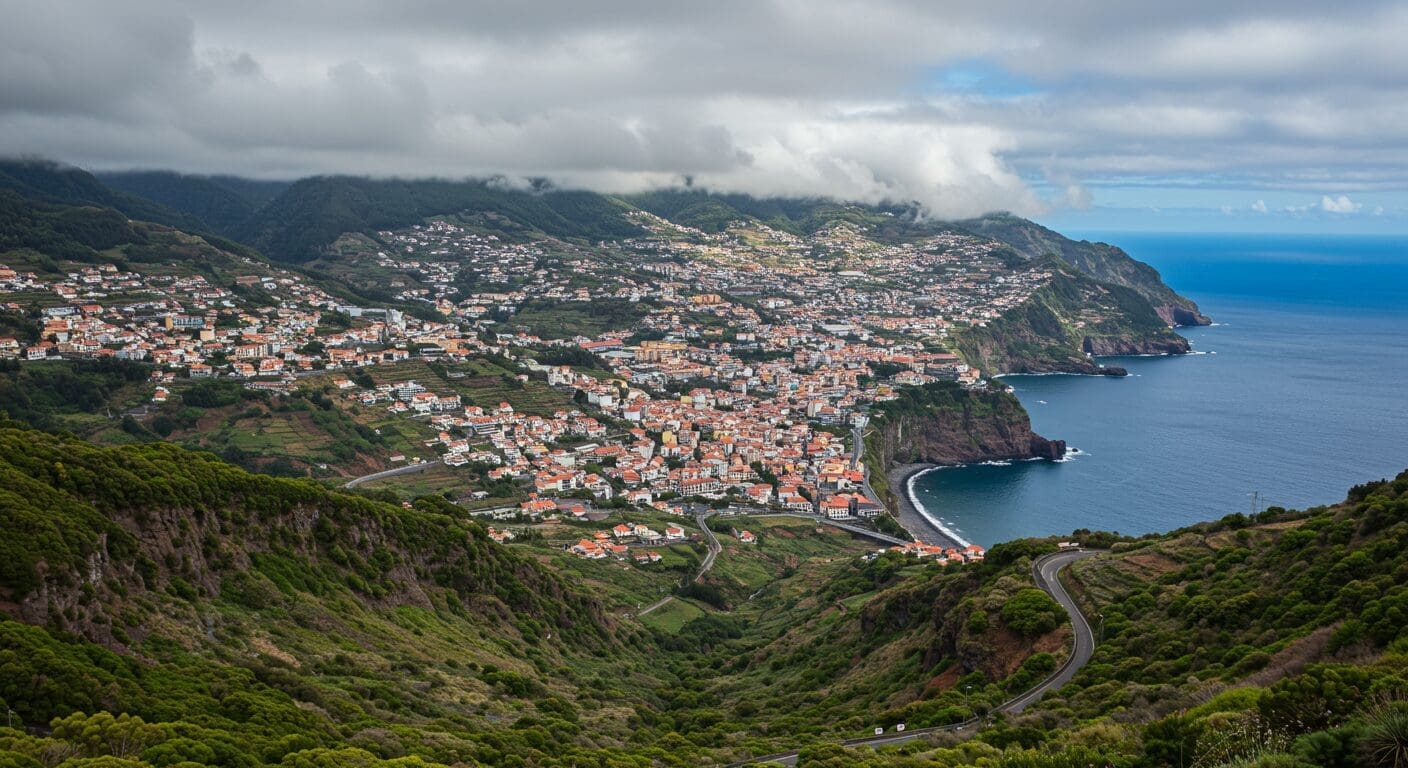
Funchal, the capital, occupies a natural amphitheatre on the south coast and is considerably more sophisticated than its setting might initially suggest – all terracotta rooftops, excellent restaurants and a waterfront that has been intelligently developed without losing its character. The east of the island around Santa Cruz is flatter and more accessible, where the airport and many holiday properties sit. The west – Ponta do Sol, Calheta, Paúl do Mar – is quieter, less visited and rewards the traveller willing to make the journey. The north coast is where Madeira gets properly wild: Porto Moniz, with its natural rock pools carved out by lava flows, is the kind of thing the island seems to have arranged specifically to make Instagram feel inadequate. The interior, explored along the levada paths, is something else entirely – a world of dripping moss and filtered green light that has been here, essentially unchanged, for millennia. Most visitors see the coast. The ones who go up into the mountains tend to go quiet about it for a moment when they come back.
What to Do: A Destination That Doesn’t Let You Run Out of Ideas
The levada walks are the essential activity, and the numbers confirm it: over 1,300 kilometres of irrigation channels cross the island, and the paths that run alongside them constitute one of the great walking networks in the world – not in the dramatic alpine sense, but in the specifically Madeiran sense of levelled, mostly accessible paths that lead through extraordinary landscape with the reassuring sound of running water throughout. The Levada das 25 Fontes (25 Fountains) is the headline route, ending at a pool fed by 25 individual streams that cascade down a moss-covered rock face. It is the kind of place that makes people who don’t normally hike suddenly consider hiking more seriously.
The Monte Toboggan is either a genuinely thrilling piece of living history or a charming tourist peculiarity, depending on your disposition – probably both. The wicker sled rides have been operating since the 19th century, when they were the fastest way down from Monte to Funchal, guided by carreiros in white linen suits and straw hats. They still are, essentially. Two carreiros push and steer each sled down steep cobbled streets, controlling speed with rubber-soled boots, and the whole thing is simultaneously more exhilarating and more graceful than it has any right to be. The historical weight and the absurdity of it sit comfortably together, which is very Madeiran.
Whale watching is serious business here: the waters around Madeira are among the richest cetacean habitats in the Atlantic, with sperm whales resident year-round and numerous migratory species passing through. Half-day boat trips from Funchal marina use rigid inflatable boats that get properly close. Seeing a sperm whale surface twenty metres away, exhale, and slide back under the Atlantic is not something the brain quite knows what to do with. It files it somewhere different from ordinary memories.
Getting Vertical and Getting Wet: Madeira’s Adventure Credentials
For an island this size, the range of serious outdoor pursuits available is remarkable. Canyoning is one of the signature experiences – descending through the volcanic ravines and waterfalls of the interior, which sounds alarming and is, in controlled measure, magnificent. The island’s geology has created a network of natural slides, pools and drops that operators run with professional guidance and proper equipment. It requires no prior experience. It does require a tolerance for cold water, which the Atlantic delivers without apology.
Mountain biking has grown significantly as a pursuit here, with trails ranging from coastal routes to demanding descents from the high peaks that would satisfy even experienced riders. Surfing is possible, particularly on the north and west coasts around Jardim do Mar and Paul do Mar, which have long been known in surfing communities as waves of genuine quality in the right conditions. The deep-water sea cliffs along the south coast attract experienced divers and free divers; visibility is exceptional, and the marine life in protected areas is quietly outstanding. Road cycling on the quieter mountain roads is popular among those who enjoy earning their views the hard way. The island also has a growing paragliding scene – taking off from the high ridges above Funchal and landing near the coast, with the whole of the southern coastline visible in between.
Madeira with Children: Surprisingly, and Genuinely, Excellent
Madeira is one of those destinations that doesn’t feel specifically designed for families but turns out to work extremely well for them, which is often the best outcome. The island is safe, compact and broadly gentle in its pace, which matters when you’re negotiating with people under ten about itineraries. The natural rock pools at Porto Moniz are a particular triumph – shallow enough for young children, dramatic enough to hold the attention of teenagers, and set in a landscape that does the work of keeping everyone interested without requiring a queue or a ticket.
The Monte cable car, the toboggan ride, whale watching, the markets – these are, without exception, activities that work better with children in tow than without them. Seeing a whale for the first time at any age is one thing; seeing it through the eyes of an eight-year-old is considerably more interesting. Private villa rentals represent the obvious solution to the perennial family holiday logistics problem: a private pool means no competition for sunbeds, no awkward poolside dynamics, children swimming until they choose to stop rather than until you’ve exhausted the hotel pool’s opening hours. Separate bedrooms mean adults can have evenings. It is a transformative thing and one that hotels, despite their best efforts, cannot quite replicate.
History, Flowers and the Strange Fact About Madeiran Embroidery
Madeira was uninhabited when Portuguese sailors arrived in the 1420s – a blank slate of laurel forest and volcanic rock that the Portuguese proceeded to transform, over the following centuries, into one of the most productive agricultural territories in the Atlantic world. Sugar was first; the sweetness of Madeiran sugar made it extraordinarily valuable, and trade routes through Funchal made it one of the most cosmopolitan ports in the known world for a time. Then came Madeira wine, the fortified wine that became a global phenomenon partly because it travelled so well – the heat and motion of long sea voyages, it turned out, improved it considerably. The wine, aged in barrels that sometimes spend months in warm rooms to replicate the effect, has a complexity and longevity unlike almost anything else; a properly aged Madeira can outlive everyone in the room without difficulty.
Madeiran embroidery – Bordado Madeira – is a UNESCO-recognised craft that has been practised on the island for centuries. The work is genuinely extraordinary: dense, precise, made by hand in homes across the island by women who have inherited the technique across generations. The strange fact is the stamp: every piece of certified Madeiran embroidery is authenticated with an official lead seal to confirm its origin, which tells you something about how seriously the island takes the tradition and how vigorously it has been copied elsewhere. The Church of Nossa Senhora do Monte, above Funchal, is the spiritual heart of the island – an 18th-century Baroque structure reached by a long staircase of 74 steps and the departure point, historically, of those famous toboggans. The views from the terrace are the kind that make the climb immediately worthwhile, regardless of what you do next.
What to Buy: The Things Worth Bringing Home
The obvious answer is wine, and it is the correct one. A well-chosen bottle of Madeira wine – from one of the island’s historic wine lodges like Blandy’s or Henriques & Henriques, where you can taste before you commit – is the gift that actually travels, literally and metaphorically. The variety is wider than most people expect: from the dryer Sercial to the richest Malmsey, with a full spectrum in between. A ten-year-old Madeira bought at the source costs a fraction of what it commands in Spain or elsewhere in Europe, and the narrative around it at a dinner party is an entirely free bonus.
Madeira embroidery is the other serious purchase – the real thing, authenticated and purchased from certified producers. It is not cheap, because the labour involved is not quick, but a genuine piece of Bordado Madeira is an object that will last several lifetimes, which changes the calculus considerably. The Mercado dos Lavradores is the place for local produce: the passion fruits, the exotic jams, the small bottles of poncha mix. The shops along Funchal’s Rua Dr. Fernão Ornelas offer local handicrafts, wicker work and wickerware – the Monte toboggan’s raw material, essentially, repurposed into objects that travel considerably more sedately. Funchal also has a small but worthwhile collection of independent boutiques for those who want something more contemporary alongside the traditional.
The Practical Things That Are Actually Worth Knowing
Madeira uses the euro and operates in Western European Time (GMT in winter, GMT+1 in summer), which makes it conveniently aligned with the United Kingdom for those working remotely. Portuguese is the official language; English is spoken widely in Funchal and in most hospitality contexts, less so in the north and interior, where a few words of Portuguese and a willingness to point at menus are your most useful tools. Tipping is appreciated but not mandatory – 10% in restaurants that have earned it is standard, rounding up taxi fares is considered polite.
The best time to visit depends, as with most things, on what you want from it. Madeira’s climate is famously mild year-round – the island markets itself as the Island of Eternal Spring, which is only slightly hyperbolic. Summers are warm and dry on the south coast; winters are cooler with more rain, particularly in the north. The flower festivals in April and May are spectacular, filling Funchal with colour and crowds simultaneously. September and October offer warm weather, quieter conditions and, for whale watchers, the best cetacean diversity of the year. December and January bring New Year celebrations that are genuinely worth planning around – Funchal’s fireworks display is one of the largest in the world, visible from the whole bay and from any villa terrace fortunate enough to face south.
Why a Private Villa Changes Everything About a Madeira Holiday
There is a version of Madeira that happens in hotels – good hotels, some of them extraordinary hotels – and then there is the version that happens in a private luxury villa, and the two experiences are related in the way that a concert recording is related to being in the room. Both are valid. Only one of them is the room.
A private villa in Madeira means a pool with nobody else in it, which sounds like a small thing until your first morning when the mist is still lifting off the Atlantic and you swim in silence with nothing but ocean in front of you. It means a kitchen, which on an island this culinarily rich means mornings at the market buying passion fruits and espada and spending the afternoon doing something with them, or having a private chef arrive and doing that something considerably better. It means a terrace of your own, evening drinks without a bar tab, space for children to exhaust themselves independently of the adults’ need for quiet. For groups of friends or multi-generational families – grandparents, parents, teenagers, the family dog who has somehow made it onto the booking – a villa with multiple bedrooms and common spaces allows everyone to be together and apart in the proportions they actually want, which is the secret to a holiday that everyone remembers warmly.
Remote workers will find that many of the island’s premium villa properties now offer fast, reliable broadband – in some cases Starlink – alongside the kind of workspace arrangements that make a morning of calls genuinely manageable before the afternoon belongs entirely to the levada or the Atlantic. The time zone keeps European working hours intact; the setting makes everything feel disproportionately civilised. Wellness-focused guests find in Madeira’s villas what spas charge considerable sums to approximate: clean air, natural beauty, a pool for daily swimming, space for yoga, the particular quietness of a place that isn’t trying to be anything other than what it is.
Excellence Luxury Villas offers a curated collection of private villa rentals in Madeira – from intimate retreats for couples to grand properties sleeping twelve or more, most with private pools, many with concierge services, all chosen for the particular quality that makes a place worth coming back to. Which, on Madeira, most people find they are already planning before they’ve left.
More Madeira Travel Guides
- Best Restaurants in Madeira: Fine Dining, Local Gems & Where to Eat
- Madeira Food & Wine Guide: Local Cuisine, Markets & Wine Estates
- Madeira with Kids: The Ultimate Family Holiday Guide
- Best Time to Visit Madeira: Month by Month Weather, Crowds & Tips
- Madeira Luxury Itinerary: The Perfect 7-Day Guide
- Romantic Madeira: The Ultimate Couples & Honeymoon Guide
What is the best time to visit Madeira?
Madeira’s climate is mild throughout the year, which makes it a genuinely year-round destination rather than a seasonal one. The south coast enjoys warm, dry summers between June and September, while the north is wetter and cooler year-round. Spring – particularly April and May – brings the famous flower festivals and extraordinary colour across the island. September and October offer warm temperatures, reduced crowds and the best variety of whale and dolphin species in the surrounding waters. December is worth serious consideration: Funchal’s New Year fireworks display is among the largest in the world and transforms the whole bay into something memorable. If you are hiking levadas, spring and autumn offer the most comfortable conditions; if swimming is the priority, June through September is warmest on the south coast.
How do I get to Madeira?
Madeira is served by Cristiano Ronaldo International Airport, located near Santa Cruz on the island’s east coast, approximately 30 minutes from Funchal by road. Direct flights operate from London Gatwick, London Heathrow, Manchester and several other UK airports, with journey times of around three hours and fifteen minutes. TAP Air Portugal offers frequent connections via Lisbon for those travelling from elsewhere. Several European carriers also operate direct routes from major continental hubs. A private airport transfer to your villa is the most straightforward arrival option and can typically be arranged through your villa concierge in advance. Porto Santo, a smaller island nearby, has its own airport and is accessible by short flight or ferry from Madeira.
Is Madeira good for families?
Yes, genuinely and specifically – not just in the vague way that most destinations claim to be family-friendly. The island is safe, compact and varied enough to hold the attention of children and adults simultaneously. Natural highlights like the rock pools at Porto Moniz, the Monte toboggan ride, whale watching excursions and the levada walks all work well across a range of ages. The absence of a significant beach culture (Madeira has black volcanic rock rather than sandy beaches, with some sand beaches at Calheta and Prainha) is worth noting – families who want a classic beach holiday may find this a limitation, though the island compensates with almost everything else. Private villa rental transforms the family experience: a pool of your own, flexible meal times and separate sleeping spaces remove the friction points that hotel stays introduce, and children consistently report Madeira as one of the more memorable island holidays they have taken.
Why rent a luxury villa in Madeira?
The honest answer is space, privacy and the particular quality of mornings. A private luxury villa gives you a pool that is yours alone, a terrace from which to watch the sun rise over the Atlantic without negotiating with other guests, and the freedom to structure your day entirely around what you want rather than hotel timetables. For couples, this means genuine seclusion; for families, it means children can swim and run freely while adults have their own quiet corners; for groups, it means living together without being on top of one another. Many of Madeira’s premium villas also come with access to concierge services, private chefs and housekeeping, which raises the staff-to-guest ratio considerably above what any hotel can offer. The overall experience is simply more personal, more flexible and – once you have done it – rather difficult to go back from.
Are there private villas in Madeira suitable for large groups or multi-generational families?
Yes. Madeira’s villa inventory includes properties sleeping anywhere from two to twelve or more guests, with configurations that suit multi-generational travel well – separate bedroom wings, multiple bathrooms, large communal living and dining spaces, and private pools that can accommodate everyone at once. Some larger properties include additional staff quarters, home cinema rooms and games areas that make them genuinely self-contained for extended stays. The key advantage for multi-generational groups is the ability to be together when you want and separate when you need to be, which hotel rooms simply cannot provide. Excellence Luxury Villas can advise on specific properties suited to larger bookings, including those with ground-floor bedrooms for guests with reduced mobility.
Can I find a luxury villa in Madeira with good internet for remote working?
Increasingly, yes. Madeira has actively positioned itself as a destination for remote workers – Funchal even launched a dedicated digital nomad village programme in 2021 – and the island’s broadband infrastructure has improved considerably as a result. Many premium villa properties now offer high-speed fibre connections, and some of the more recently renovated properties have Starlink installations providing fast, reliable connectivity even in more rural locations. When booking through Excellence Luxury Villas, connectivity requirements can be specified as part of the search criteria. Madeira’s time zone (GMT in winter, GMT+1 in summer) aligns well with European working hours, making morning calls straightforward and leaving afternoons entirely available for the island. It is, by some margin, a more civilised backdrop for a working week than most offices.
What makes Madeira a good destination for a wellness retreat?
Madeira offers a particular combination that purpose-built wellness resorts spend considerable sums trying to manufacture: clean Atlantic air, extraordinary natural landscapes, a pace of life that slows you down whether you intend it to or not, and an outdoor activity portfolio that supports both the energetic and the restorative. The levada walks provide daily movement in genuinely therapeutic settings – ancient laurel forest, running water, filtered green light. The ocean is accessible for swimming, sailing and dolphin watching. Several hotels operate serious spa facilities open to non-guests, and private villa rentals with pools, outdoor spaces and in some cases private gym or yoga areas allow guests to create an entirely personal wellness routine. The food, based around fresh fish, local vegetables and the island’s extraordinary fruit, does the rest. It is a destination that makes healthy choices feel effortless rather than effortful, which is considerably rarer than it sounds.