Best Restaurants in Marrakesh-Safi: Fine Dining, Local Gems & Where to Eat
Here is something nobody tells you before you arrive in Marrakesh: the food will surprise you more than the architecture. And the architecture will try very hard to surprise you. You’ll walk through a plain door in a featureless medina wall, duck through a low corridor, and emerge into a courtyard of such excessive beauty that you briefly forget what you were looking for. Then the food arrives, and you forget the courtyard. This is the rhythm of eating well in Marrakesh-Safi – a region that has been feeding travellers, traders and wanderers for a thousand years and has, quietly and without any need for your validation, become one of the most interesting food destinations in Africa. The tagines alone justify the flight. The rooftop terraces seal the deal.
What follows is a guide to the best restaurants in Marrakesh-Safi – from the grand palace dining rooms that date back decades to the modern rooftop kitchens reinventing what Moroccan food can be. Whether you are planning a long lunch in the medina or a meditative dinner in a candlelit riad, consider this your table of contents.
The Fine Dining Scene in Marrakesh-Safi
Marrakesh does not yet have Michelin stars – the guide does not cover Morocco – but make no mistake, this is not a city that needs outside validation. The fine dining scene here operates on its own ancient logic: extraordinary settings, elaborate multi-course feasts, and a hospitality tradition that makes French service look slightly perfunctory by comparison.
The jewel in the crown is Dar Yacout, and it has been the jewel in the crown for long enough that pointing it out feels almost unnecessary – except that it still earns it, which is the only thing that matters. Set inside a vast riad designed by the late American interiors legend Bill Willis, this is palace dining in the most literal sense. The architecture alone would justify an evening: hand-painted tiles, carved plaster ceilings, candlelight doing its very best work on all of it. But Dar Yacout’s real claim on your attention is the diffa – the traditional Moroccan feast format, presented as a fixed-price multi-course procession of dishes that unfolds at a pace somewhere between ceremonial and indulgent. It was one of the first restaurants in the medina to offer this format, and decades on, the glamour is entirely intact. Book well ahead. Dress accordingly.
La Maison Arabe sits just five minutes’ walk from the organised chaos of Djemaa El Fna, which is close enough to feel connected to the city’s pulse and far enough to feel like a genuine escape from it. Historically significant – this was home to the first restaurants in Marrakesh to open their doors to non-residents – it remains one of the most consistently praised addresses in the medina for elegant Moroccan cooking. The setting is a classic luxury riad-hotel, which means inner courtyards, fountains, low lighting, and the kind of quiet that cities like Marrakesh shouldn’t technically be capable of producing. The flavours are authentic, deeply spiced, and presented with real care. It’s the sort of dinner that makes you cancel whatever you had planned for the following morning.
Moroccan Fine Dining Institutions You Should Know
Le Foundouk occupies the northeast corner of the medina, which is already a good start – the northeast medina has a slightly quieter, more considered atmosphere than the frenetic souks near the main square. The restaurant itself is set across several levels of a beautifully restored building, and the table you want is on the upper floor, overlooking the patio below, where the evening light pools in a way that makes everyone look like they’re in a film they didn’t realise they were starring in.
The experience begins before the menu arrives – waiters bring orange blossom water to cleanse your hands, a gesture so graceful and considered that it sets the entire tone for what follows. Menus arrive rolled like old scrolls. The food is refined Moroccan cooking: technically accomplished, beautifully balanced, and rooted in tradition without being enslaved to it. Nearby, the Maison de la Photographie is worth an afternoon visit before dinner – a genuinely wonderful collection of historical Moroccan photography, and a sharp reminder that this city has been photogenic for considerably longer than Instagram has existed.
Folk Marrakech leans hard into tradition and makes it look effortless. The interiors draw directly from Moroccan craft heritage – jewel-toned furnishings, classic lanterns, potted cacti, the kind of considered aesthetic that takes real effort to make look uncontrived. The menu focuses on mezze and tagines, executed with confidence and served with warmth. The 3-course Yalla menu at 370 dirhams per person is excellent value by any standard, and the portions are described by almost everyone who orders it as “ample” – which, in a city where generosity at the table is essentially a social obligation, is saying something.
Modern Moroccan: Where Tradition Gets a Refresh
Not every meal in Marrakesh needs to be a ceremony. Sometimes you want something lighter, brighter, more spontaneous – and that is precisely where Nomad Restaurant comes in.
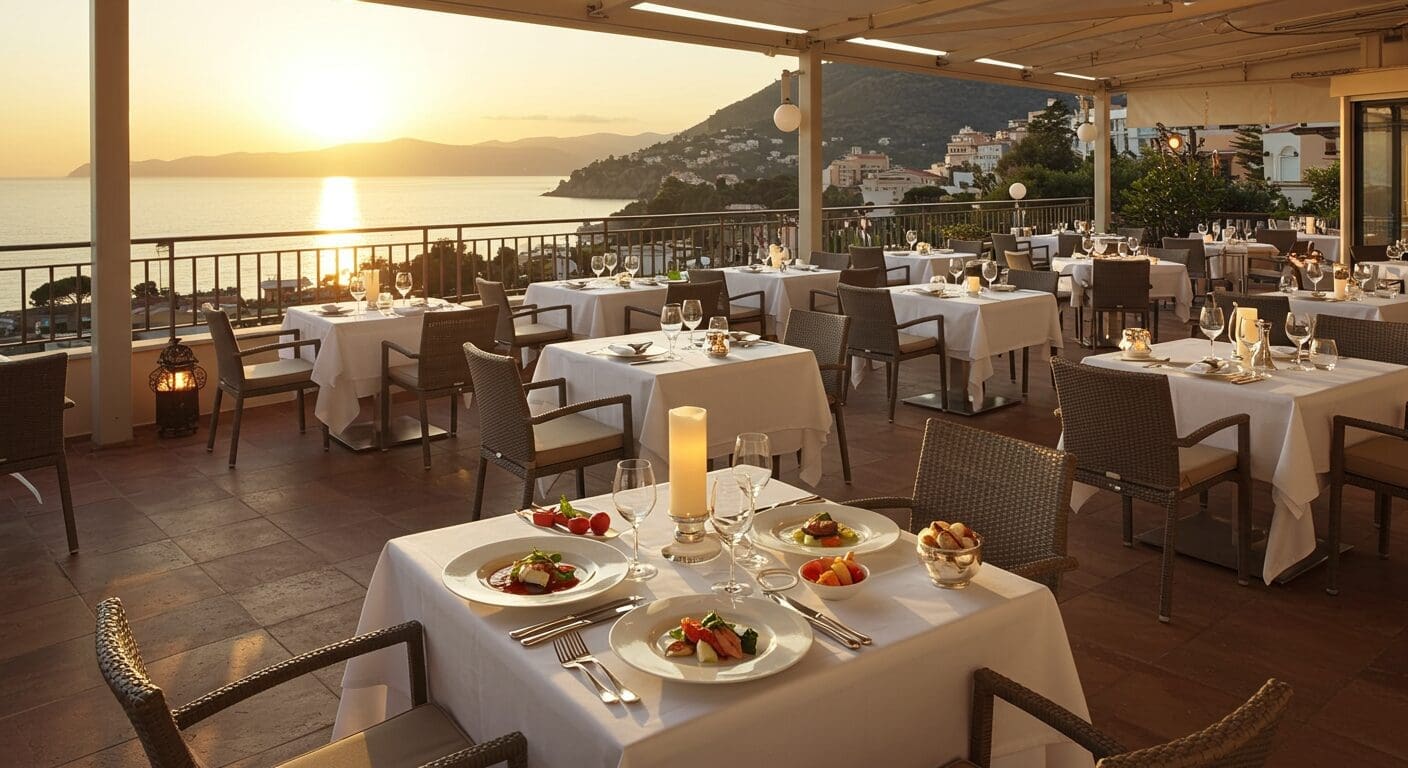
Perched on a rooftop terrace above the Rahba Lakdima spice square – known to most visitors as Place des Épices – Nomad has built one of the most genuinely deserved reputations in the medina. The candlelit tables, the view over the square below, the friendly and unpretentious service: all of it works. But what really distinguishes Nomad is the cooking. This is modern Moroccan food – confident, inventive, and not remotely interested in playing it safe. Traditional dishes arrive in new forms: the spiced lamb burger is the kind of thing you order once and then talk about for slightly too long; the courgette and feta fritters are sharper and more interesting than they have any right to be; and the famous orange cake has acquired a small but passionate following of its own, which feels entirely justified. For travellers who love Moroccan flavours but want something beyond the standard tagine-and-couscous circuit, Nomad is where you go first.
The location is, incidentally, excellent for people-watching. The spice square below conducts its own parallel theatre throughout the evening, and watching it from a rooftop with a glass of something cold is one of those uncomplicated pleasures that Marrakesh excels at providing.
Food Markets and Street Food: The Other Education
Any honest guide to the best restaurants in Marrakesh-Safi has to include the food markets, because ignoring them in favour of restaurant lists alone would be like visiting Paris and skipping the boulangeries. Technically possible. Genuinely a shame.
Jemaa el-Fnaa – the great central square of Marrakesh, established in the 11th century as a meeting point for traders, travellers and whoever else happened to be passing through – is the obvious starting point. During the day it’s all fresh orange juice, henna artists and snake charmers doing their particular brand of performative mysticism. When the sun goes down, the square transforms into something closer to a medieval fair: rows of food stalls emerge seemingly from nowhere, smoke rising from grills, the smell of cumin and charred meat hanging in the air, acrobats and musicians and storytellers all competing for your attention simultaneously. Navigating it for the first time feels mildly overwhelming. Navigating it for the second time feels like coming home. You should eat here at least once – the grilled meats, the harira soup, the kefta skewers – even if your instinct is to retreat to somewhere with a proper wine list. Some experiences require you to surrender a little comfort.
Beyond the square, the souks and covered markets reward early morning exploration. The spice stalls alone are worth the visit for the colours and the smell, even if you have no practical intention of cooking anything. The dried fruit sellers, the olive merchants, the bread baked fresh in communal ovens – this is the everyday food culture of a city that has never particularly needed to dress itself up for tourists.
What to Order: The Dishes That Define the Region
You will encounter tagine everywhere, which is as it should be. The slow-cooked clay pot dishes of Morocco are one of the great cooking techniques of the world – lamb with preserved lemon and olives, chicken with saffron and ginger, beef with prunes and almonds – and the best versions are not found in the most expensive restaurants but in the places where the recipe has been made the same way for several generations without anyone seeing a reason to change it. Order one. Eat it properly, with bread, not a fork.
Couscous is traditionally a Friday dish, which means visiting on a Friday carries a particular reward. Pastilla – the extraordinary pigeon (or sometimes chicken) pie encased in paper-thin warqa pastry, dusted with cinnamon and sugar – is one of those dishes that sounds unlikely and tastes extraordinary. Harira soup, thick with tomatoes, lentils and chickpeas, is what you eat when you’re cold or hungry or simply want to feel better about the world. Mechoui – whole slow-roasted lamb, carved at the table – is the occasion dish, and it occasions rather a lot.
Wine, Drinks and What to Sip
Morocco is a Muslim-majority country, and alcohol is handled differently here than in European destinations – not unavailable, but not ubiquitous either. The fine dining restaurants and luxury riads generally have wine lists, and Morocco produces its own wines from the Meknes and Casablanca regions that are considerably better than their international profile would suggest. The Syrah-based reds are worth exploring. The rosés are easy and often excellent.
Beyond wine, the drinks to know are mint tea – sweet, theatrical in its pouring, and offered everywhere as an act of hospitality that it would be rude to refuse – and fresh-pressed orange juice, which in Marrakesh is made from the local Moroccan oranges and costs roughly nothing and tastes like the Platonic ideal of what orange juice is supposed to be. Avocado and almond milk smoothies appear frequently at juice bars and deserve more attention than they typically get from visitors who are busy photographing their tagines.
Reservation Tips and Practical Advice
For restaurants like Dar Yacout and Le Foundouk, reservations are not optional – they are the thing that separates a memorable dinner from a disappointed walk back through the medina. Book ahead, particularly during peak season (March-May and September-November), and confirm the day before. Many of the medina’s finer restaurants are inside riads without any visible signage on the street, which means that even with a reservation you may spend a few minutes standing in a narrow alley being mildly confused. This is normal. Persist.
Nomad and Folk both accommodate walk-ins more readily, though neither is immune to a full terrace on a warm evening. Arriving at 7pm rather than 8:30pm is the simplest form of insurance. Dress codes are relaxed by Western fine dining standards, but some effort is appreciated – particularly at the more formal palace restaurants, where showing up in shorts would feel genuinely odd.
Tipping is customary and appreciated: 10-15% is standard practice at sit-down restaurants. At the medina food stalls and market stands, prices are usually fixed and tipping is not expected, though rounding up is always received warmly.
For the Complete Experience: Staying in a Luxury Villa
Eating your way through Marrakesh is best done with a proper base – somewhere you can return to after dinner, contemplate your choices, and plan tomorrow’s meals with appropriate seriousness. Staying in a luxury villa in Marrakesh-Safi gives you exactly that, with the added option of a private chef who can bring the whole experience home – market visits, traditional recipes, the kind of cooking that doesn’t appear on any restaurant menu because it belongs to a family, not an establishment. It is, arguably, the single most underrated way to eat in Morocco.
For more on planning your time in the region – from the medina to the Atlas foothills to the Atlantic coast – the full Marrakesh-Safi Travel Guide covers everything you need to know before you arrive.