Metropolitan City of Florence Food & Wine Guide: Local Cuisine, Markets & Wine Estates
It begins, as the best days here always do, with the particular quality of morning light that Florence seems to have patented. You are sitting outside a bar no larger than a generous wardrobe, holding a cornetto that is still warm from wherever warm cornetti come from, and your cappuccino is better than almost anything you have had in the past twelve months. You haven’t done anything yet. You haven’t been to the Uffizi or crossed the Ponte Vecchio or said the right things about Brunelleschi’s dome. You are simply sitting in a city that has been feeding people extraordinarily well for seven centuries, and it already feels like a privilege. This is the particular genius of the Metropolitan City of Florence: the food and wine are not a backdrop to the culture. They are the culture. Everything else is decoration.
The Soul of Florentine Cuisine
Tuscan cooking operates on a philosophy that sounds simple until you try to replicate it at home: take the finest raw ingredients, do as little as possible to them, and resist every urge toward flourish or embellishment. This is a cuisine that emerged from both the grand tables of the Medici and the resourceful kitchens of the peasantry, and it wears both influences without apology. The result is food that is simultaneously rustic and refined – a tension that Florence itself manages rather well.
Bread is the foundation of everything, which would be unremarkable anywhere else except that Florentine bread is made without salt. This baffles visitors, delights locals, and makes perfect sense once you understand that it was designed to carry other flavours – the salt of a cured meat, the funk of a rich bean stew, the sharpness of a good olive oil. The bread is not the point. What goes on top of it very much is.
The defining dishes of this territory reward patience and an open mind. Ribollita – a thick, twice-cooked soup of cavolo nero, cannellini beans, and stale bread – sounds like the kind of thing you eat when the supplies are running low. In the right hands, it is one of the most deeply satisfying things a bowl can contain. Pappa al pomodoro is similarly elemental: bread and tomatoes, slowly transformed into something that bears very little resemblance to either. And then there is bistecca alla Fiorentina, the T-bone steak from Chianina cattle that the city has elevated to something approaching civic identity. It is served rare. Not medium-rare. Rare. Asking for it any other way is, in Florence, an act of considerable social courage.
Markets: Where the City Feeds Itself
To understand how Florence eats, you need to spend a morning in its markets – not photographing them for social media (though that will happen regardless), but actually moving through them, touching things, asking questions, and occasionally being given a slice of something by a vendor who has decided you look hungry.
The Mercato Centrale, spread across two floors in San Lorenzo, is the grandest of these. The ground floor is a working food market of serious intent: butchers with hanging pheasants and slabs of lardo, fishmongers surrounded by ice and glistening silver, cheese vendors operating with the focused calm of people who know exactly what they have. There are truffle sellers here too, their wares displayed with the reverence usually reserved for jewellery. The upper floor has evolved into a gourmet food hall – excellent for grazing, good for wine, convenient for those who want the atmosphere without committing to a full shop.
Outside the city centre, the Mercato di Sant’Ambrogio is smaller, rougher around the edges, and considerably less interested in your tourist experience. It is, for this reason, rather wonderful. The vendors are feeding the neighbourhood, not performing for cameras, and the prices reflect this refreshing attitude. Come early, come hungry, and bring cash.
For those staying in the wider metropolitan province – in the hills above Fiesole, perhaps, or in a villa somewhere between Florence and Greve – the weekly markets of smaller towns are worth building a morning around. These are places where the local olive oil producer sets up next to the woman who makes her own ricotta, and where the concept of food miles is so compressed as to be almost theoretical.
The Wines of the Florentine Territory
The Metropolitan City of Florence sits at the heart of one of the world’s most important wine landscapes. Chianti Classico – the real thing, with its black rooster emblem, not its many pale imitations – is produced in the hills running south from Florence toward Siena, and the best examples of it are wines of genuine complexity and age-worthiness. The Sangiovese grape, which dominates here, produces something that can be bracingly tannic in youth and hauntingly beautiful with a decade of bottle age. It also pairs with bistecca alla Fiorentina in a way that suggests the wine and the steak might have been designed in collaboration.
Beyond Chianti Classico, the territory encompasses Chianti Rufina to the northeast – a cooler, higher appellation that produces wines of notable elegance – and the scattered vineyards of the Colli Fiorentini, the Florentine hills whose wines are less famous but whose best producers are worth seeking out. There are also Super Tuscans here: wines that stepped outside the appellation rules in the 1970s and 1980s to include international varieties, and which now command prices that require a moment of quiet reflection before opening.
White wine has traditionally played second fiddle in this red-dominated territory, but Vernaccia di San Gimignano – from the famous hill town to the southwest – offers a crisp, dry alternative of real character. And if you are drinking aperitivo in the early evening, a glass of something local and cold is the civilised choice. The Florentines have been doing this for a very long time. Trust their instincts.
Wine Estates Worth a Serious Detour
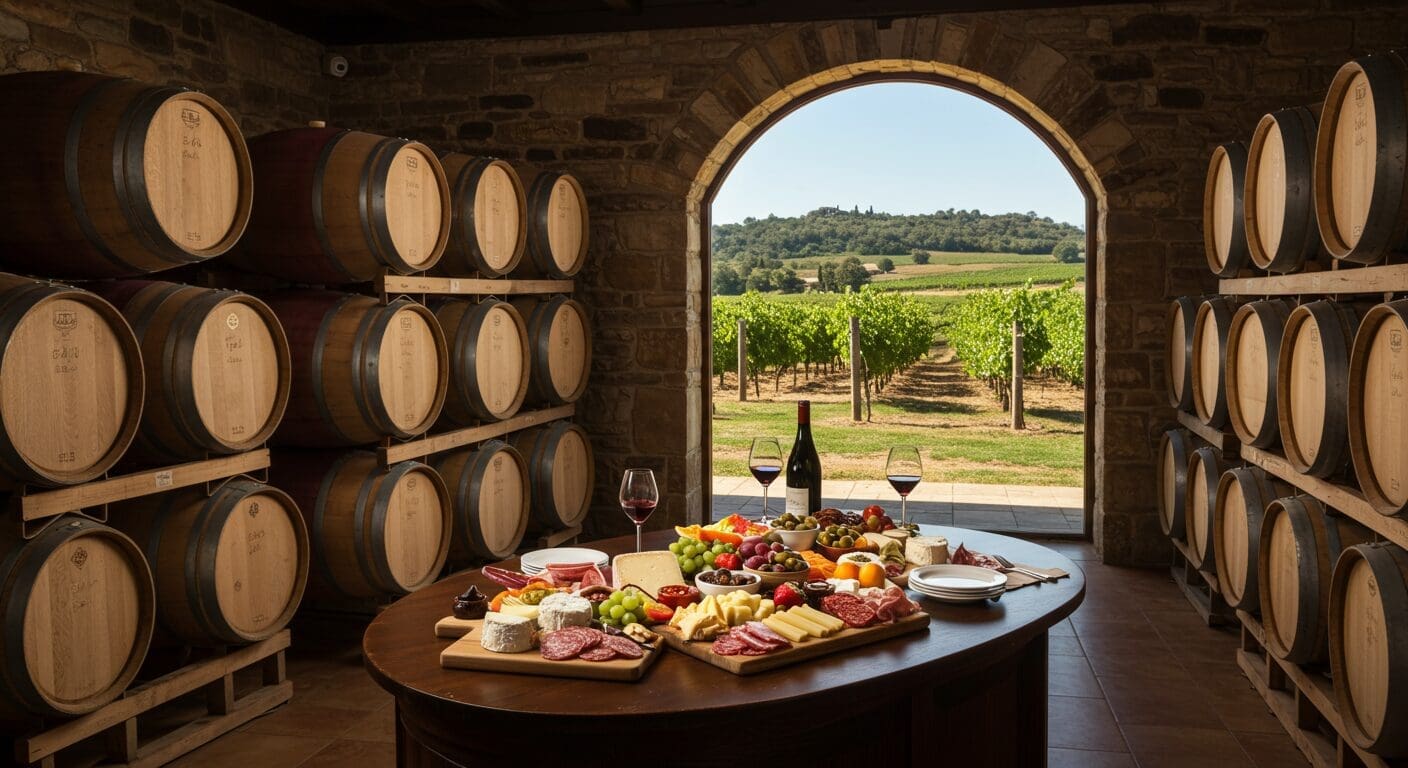
One of the genuine pleasures available to those staying in this territory – particularly those in villas with cars and no particular schedule – is the wine estate visit. The Chianti Classico zone is riddled with them, from grand historic properties with cellars that smell of the fourteenth century to smaller boutique producers who will pour you six different vintages in a converted barn and talk for two hours about the specific drainage properties of their galestro soil. Both experiences are valid. Both, in their way, are educational.
The estates around Greve in Chianti, Panzano, Radda, and Gaiole represent the classic circuit, and the quality on offer is consistently high. Look for estates that grow their own olives alongside their vines – the relationship between wine and olive oil in this landscape is intimate and old, and producers who take both seriously tend to take everything seriously. Many estates offer structured tastings with food pairings, and some have on-site restaurants or agriturismo accommodation that allow for considerably longer stays than the initial plan suggested.
For a more curated approach, working with a specialist wine guide or sommelier – something that a good villa concierge can arrange – transforms what might otherwise be a pleasant but slightly random afternoon into something genuinely illuminating. There is a meaningful difference between tasting well and understanding what you are tasting, and in the Chianti Classico zone, the latter is worth pursuing.
Truffles, Olive Oil and the Ingredients That Define the Territory
The truffle market in Tuscany operates with a discretion that borders on the clandestine. The best hunters – those with the dogs that have been trained since puppyhood, and the family knowledge of which patches of oak woodland to visit on which October mornings – do not advertise. They sell to the same restaurants and the same private clients they have always sold to, and they regard curious tourists with the careful neutrality of people who have learned not to give too much away.
This does not mean truffle hunting is inaccessible to visitors – quite the contrary. A number of operations in the Florentine hills and the wider Tuscan countryside offer guided experiences that are genuinely excellent rather than theatrical. You will walk with a trained dog through woodland that smells of autumn and possibility, and if you are lucky and the conditions are right, you will find something. What happens to that something afterward – whether it is shaved over eggs in a farmhouse kitchen or folded into pasta with good butter – is the part that stays with you.
Olive oil deserves equal reverence. The oils produced in the Florentine hills – particularly around Fiesole, Impruneta, and the slopes above the Arno valley – are among the finest in Italy. They are intensely green when fresh, peppery in a way that catches at the back of the throat, and emphatically not the thing you should be using to fry eggs. They are finishing oils, dressing oils, the thing you drizzle over ribollita or pour onto bread still warm from the oven. Visiting a producer during the olive harvest in October and November, when the mills are running and the air smells of crushed fruit, is one of those experiences that permanently recalibrates your understanding of what olive oil can be.
Cooking Classes and Culinary Experiences Worth the Investment
There is a category of cooking class that exists primarily to give visitors photographs of themselves wearing aprons and holding pasta. These are perfectly pleasant and not what we are talking about here. The experiences worth seeking out in the Florentine territory are those that teach you something genuinely transferable – techniques, principles, the logic behind why Tuscan cooking works the way it does.
The best classes happen in private villas, in farmhouse kitchens on the outskirts of the city, or in the hands of chefs who run serious restaurants and teach on the side with the focused rigour of people who actually care whether you understand the difference between soffritto and the thing most people make when they think they’re making soffritto. Market-to-table formats – where the class begins with a guided shop at Mercato Centrale or Sant’Ambrogio before moving to a kitchen – are particularly valuable, because understanding what to buy is at least as important as knowing what to do with it.
Private dining experiences in working wine estates or historic villas represent the highest tier of culinary experience available in this territory. Some of these are arranged through connections that villa concierges maintain with discretion; others require advance planning and, occasionally, the willingness to spend money that would alarm a reasonable person. The meals that result from such planning are typically unreasonable in the best possible sense.
What to Eat, Drink and Seek Out: A Practical Shortlist
For the traveller who wants direction without excessive hand-holding: eat bistecca alla Fiorentina at least once, cooked rare, with nothing on the side except white beans in olive oil and possibly a glass of Chianti Classico Riserva of at least ten years’ age. Eat ribollita in winter, when the cavolo nero is at its darkest. Try lampredotto – the tripe sandwich that Florentines eat at street stalls with the cheerful confidence of people who know something you don’t. It is worth overcoming whatever hesitation you may have about what lampredotto actually is. The hesitation dissolves quickly.
Drink the local wines by the producer rather than the appellation name. Ask questions. Accept recommendations. Buy a bottle of the estate’s olive oil when you leave a winery, because you will not find it at home and you will regret not having more of it approximately three weeks after returning. Visit at least one market before nine in the morning. Have your cappuccino standing at the bar, as tradition demands, and resist the urge to take it to a table. Some things are done in a particular way for reasons that do not need explaining.
For a broader view of everything this extraordinary territory offers beyond its food and wine, the Metropolitan City of Florence Travel Guide covers the full scope of what to see, where to go, and how to approach one of Europe’s most rewarding destinations.
Staying Well: The Villa Advantage
The experience of eating and drinking well in the Florentine territory is fundamentally changed by where you are based. A luxury villa with a private kitchen and a terrace looking out over olive groves and vineyards is not merely a place to sleep – it is a different relationship with the food and landscape entirely. You can bring produce back from the morning market and cook it yourself. You can receive an olive oil producer who delivers to the door. You can open a bottle of Chianti Classico at ten in the morning because you are in a private garden and that is your own affair.
The privacy, space, and kitchen facilities that a well-chosen villa provides make the food and wine of this region intimate in a way that hotel dining, however excellent, cannot replicate. This is particularly true for groups – families, friends gathering for a week in Tuscany – where the table becomes the centre of the experience rather than a daily logistical decision.
If this sounds like the right way to approach one of the world’s great food and wine territories, explore the collection of luxury villas in Metropolitan City of Florence and find the base from which your best possible version of this trip begins.