Palm Springs Travel Guide: Where to Stay, Eat & Explore in Luxury
First-time visitors to Palm Springs make the same mistake: they think they’re coming for the weather. They pack their SPF 50 and their sunglasses and they fly in with vague notions of a desert escape, as though warmth alone were a personality. What they discover, usually somewhere between their second poolside Negroni and their first encounter with a 1960s Alexander house sitting improbably perfect against a backdrop of craggy mountains and impossible blue sky, is that Palm Springs is not really about the weather at all. It’s about a very particular, very American idea of what life could look like if you stripped it back to its essentials: space, light, architecture, silence, and a martini at the right hour. The weather is simply the setting. It took Hollywood’s Golden Age elite to figure this out first, which perhaps explains why the place still carries, decades later, that faint whiff of knowing glamour – the kind that doesn’t need to announce itself.
It’s also, and this matters for planning purposes, one of the more unusually versatile destinations in the United States. Couples come here for milestone anniversaries and honeymoons, drawn by the romance of long warm evenings and total seclusion. Families discover that a private villa with its own pool solves approximately ninety percent of the logistical headaches that holidays with children traditionally involve. Groups of friends – the sort planning a significant birthday or a long-overdue reunion – find that Palm Springs’ combination of excellent restaurants, walkable neighbourhoods and reliably spectacular weather makes it near-impossible to have a bad time. Remote workers have quietly colonised it too, laptops open beside pools, taking calls against a backdrop that their video conference colleagues clearly find unsettling in the best possible way. And then there are the wellness devotees: people who come specifically to hike before sunrise, to sweat properly, to eat well, to sleep deeply in dry desert air. Palm Springs accommodates all of them without breaking a sweat. Which, given the temperature, is impressive.
Getting to the Desert: Arrivals, Transfers and How to Actually Get Around
Palm Springs is well served by its own airport – Palm Springs International (PSP) – which sits so close to the city that landing feels less like arriving at an airport and more like touching down in someone’s very glamorous back garden. Direct flights connect from Los Angeles, San Francisco, Seattle, Denver, Dallas and a growing number of major US hubs, making it genuinely easy to reach from most of the country. From the East Coast, connections through LAX or Phoenix Sky Harbor work smoothly. International visitors typically route through Los Angeles (a two-hour drive east along the I-10) or Las Vegas (a little under four hours west), both of which offer extensive international connections.
Once you land, the honest advice is this: rent a car. Palm Springs is not a city built for those who prefer not to drive. It is a city built for people who want to arrive at exactly where they want to be, at exactly the time they choose, without negotiating with anyone. The layout is logical, parking is not the existential crisis it is in most American cities, and the distances between the various neighbourhoods – Downtown, the Uptown Design District, the Movie Colony, the South End – are manageable. A car also means the broader Coachella Valley opens up to you: Joshua Tree National Park to the east, the high-altitude cool of Idyllwild to the west, the date groves and farm stands of the surrounding desert. For those arriving in style, private car transfers from LAX or PSP to your villa are the obvious choice, and most luxury villa concierge services can arrange this without you having to think twice about it.
Where to Eat in Palm Springs: From Old Hollywood Steak Houses to the Queue Outside Rooster and the Pig
Fine Dining
The standard assumption about American desert towns and their culinary ambitions is best left at the city limits. Palm Springs punches considerably above its weight, and has done so for decades. The flagship experience, the one that earns its reputation, is Copley’s on Palm Canyon – set within the former Cary Grant estate on North Palm Canyon Drive, and carrying the weight of that history with pleasing lightness. Chef Mark Van Laanen’s approach is locally anchored: ingredients sourced from farms within a hundred miles, a menu that moves with the seasons, and dishes that manage to be both elevated and genuinely satisfying rather than merely architectural. The setting does a great deal of the work – dining in the garden here, with mountain views above the flowering bougainvillea and the particular quality of desert dusk light settling over everything, is the sort of evening you describe to people afterwards with perhaps slightly more enthusiasm than they were anticipating.
Mr. Lyons, downtown, occupies a different register entirely. Less nostalgic throwback, more perfectly preserved relic – it has existed in some form since the 1940s, was lavishly renovated in 2015, and now occupies its position as the desert’s pre-eminent destination for a serious martini and a serious steak with the quiet authority of an institution that knows exactly what it is. The room has that low-lit warmth that only old American restaurants fully achieve. Order the martini first. Decide everything else second.
Where the Locals Eat
Birba, directly across from Copley’s in the Uptown Design District, is where you go when you want excellent Italian-influenced food and an outdoor fire pit and the sense that you’ve stumbled into something rather than been directed towards it. The wood-fired pizzas are the obvious draw – thin, blistered, made with produce sourced from small local farms – and the patio is the kind of setting that makes you reconsider your plans for the rest of the evening. Stay longer. Order another round. The cocktails are good.
For something more quietly remarkable, Rooster and the Pig on South Indian Canyon Drive is a family-run Vietnamese restaurant that has developed, entirely through the quality of its food, the kind of loyal following that results in a queue forming before the 5pm opening. The tea leaf salad is exceptional. The turmeric cod is the sort of thing you’ll still be thinking about on the plane home. They bring you a complimentary cup of congee when you sit down, which is either charming or alarming depending on your prior experience of American restaurant hospitality. It is charming.
Hidden Gems Worth Seeking Out
Sandfish is the kind of place that requires a slightly elevated commitment level – the dining room is small, reservations are critical, and you will probably still wait. It is, by general consensus, the finest sushi in Palm Springs, and the creative maki rolls justify every minute of the queue. The Venue (spicy tuna and cucumber topped with salmon, spicy aioli, teriyaki and tobiko) and the Experiment (snow crab, mango and avocado topped with tuna, cilantro, jalapeño and yuzu aioli) are the two rolls that built the reputation. Try both. This is not a moment for dietary conservatism.
The Lay of the Land: Understanding Palm Springs and the Coachella Valley
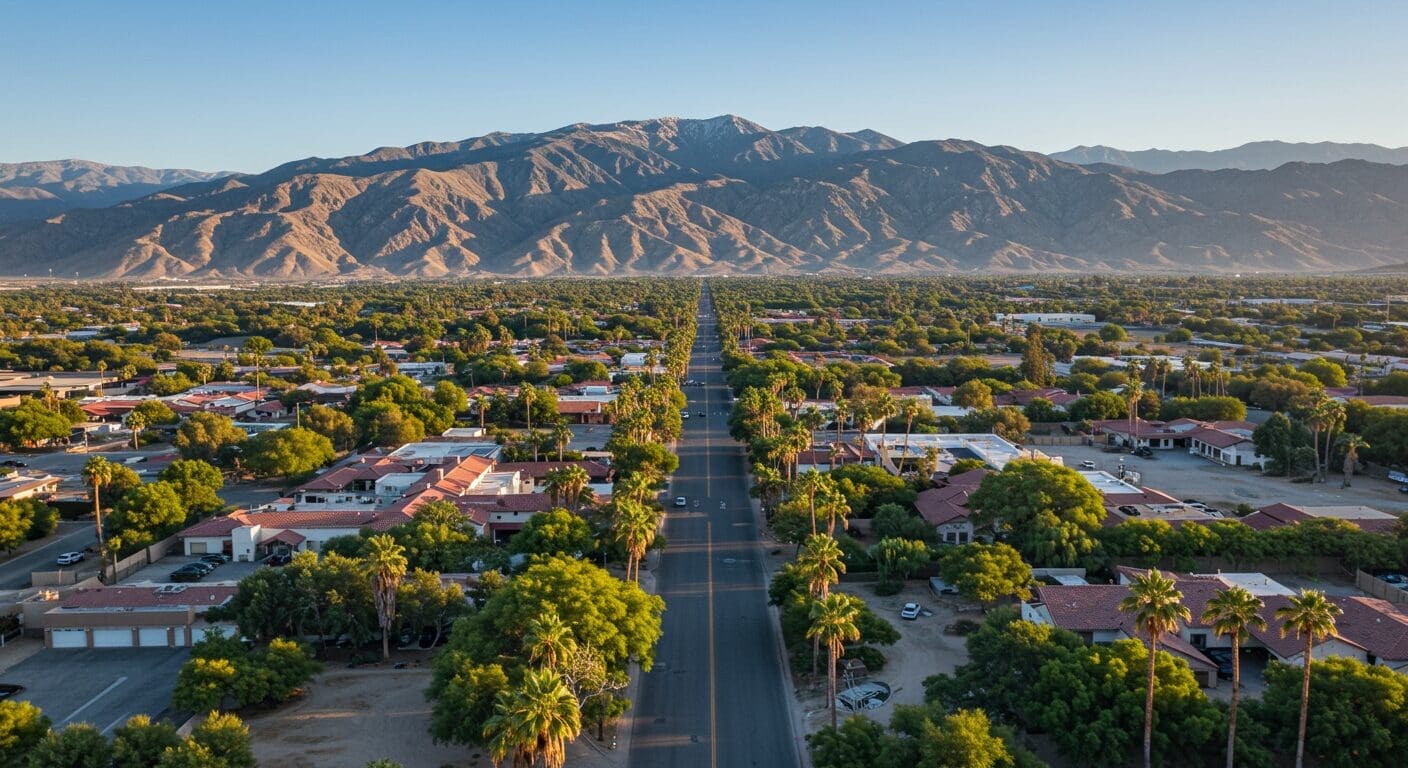
Palm Springs sits in the Coachella Valley, pressed against the eastern flank of the San Jacinto Mountains, with the Santa Rosa range to the south and the Little San Bernardino Mountains forming the northern edge of Joshua Tree. The geography is dramatic in a way that photographs only partially capture – the mountains rise almost vertically from the desert floor, and the contrast between the arid flatness of the valley and the sheer rock faces above it is the kind of thing that catches you mid-conversation and briefly silences you.
The city itself is small and navigable. Downtown Palm Springs is the commercial and social heart, with Palm Canyon Drive running its length and connecting the main restaurant and retail strip to the Uptown Design District, which is where the mid-century modern architecture becomes most concentrated and most photographed. The Movie Colony neighbourhood, to the east of downtown, is the area where Hollywood’s elite historically built their winter retreats – Frank Sinatra, Bob Hope, Liberace, Dean Martin, and yes, Cary Grant – and the residential streets here are a near-uninterrupted lesson in post-war American domestic architecture done with serious money and remarkable confidence.
Beyond the city limits, the valley opens up considerably. Rancho Mirage, Palm Desert, Indian Wells and La Quinta form a loosely connected chain of communities to the southeast, each with its own character and its own considerable stock of luxury villas. To the east, the low-slung desert gives way to the extraordinary landscape of Joshua Tree National Park, where the iconic trees – which are neither trees nor Joshua anything, technically speaking – populate a boulder-strewn moonscape that has inspired everyone from U2 to contemporary landscape photographers. It deserves more than a glance from the car window.
What to Do in Palm Springs: The Definitive Edit of the Actually Worth-Doing
The Palm Springs Aerial Tramway is the obvious start point, and it earns its obviousness. The largest rotating tram car in the world lifts you from the desert floor at around 2,600 feet to the edge of the San Jacinto Wilderness at 8,516 feet in just under ten minutes – a journey that takes you through five distinct vegetation zones and delivers you into a pine forest that feels, in the context of the desert below, genuinely surreal. It is typically 25 to 30 degrees cooler at the top. In summer, this is not a trivial consideration. There are over 50 miles of trails in the wilderness above, ranging from a gentle wander to a full-day summit push. The Peaks Restaurant at the top station opens for dinner service on Fridays and Saturdays, and watching the valley lights come on below as the sun drops is one of those experiences that justifies the trip on its own terms.
The Indian Canyons – Tahquitz, Murray, Andreas and Palm Canyon itself – are worth an entire morning. These oases at the base of the San Jacinto Mountains have been home to the Agua Caliente Band of the Cahuilla people for centuries, and the landscape is extraordinary: towering Washingtonia palms lining stream-carved canyons, ancient rock art on the canyon walls, and the particular quality of light in the early morning that makes professional photographers sit down quietly and work in silence. Palm Canyon, the most visited, is one of the largest natural palm oases in the world. Bring water. Go early. Take your time.
For something more architectural, the Palm Springs Art Museum, designed by E. Stewart Williams and opened in 1976, is a genuine cultural institution with a strong permanent collection spanning modern and contemporary art, architecture and design, and Native American art. The Architecture and Design Center, an annex run by the same organisation, occupies the Agnes Pelton House and focuses specifically on the mid-century modern tradition that defines the city’s visual identity. Both are worth several hours of unhurried attention.
The Coachella and Stagecoach festivals have made Palm Springs the launch pad for an increasingly well-established music and arts season every spring, and Modernism Week every February has become one of the most authoritative annual gatherings of mid-century modern architecture enthusiasts on the planet – which sounds like a niche audience until you see how many people turn up.
Getting Properly Physical: Hiking, Cycling, Hot Air Balloons and Everything in Between
The hiking here is serious, and those who treat it casually occasionally have to be retrieved by helicopter. The trails around Palm Springs range from gentle canyon walks accessible to most fitness levels to the full summit of San Jacinto Peak at 10,834 feet – a genuinely demanding undertaking that rewards the effort with views that extend, on clear days, to the Pacific Ocean. The Museum Trail, which climbs from the heart of downtown to a ridge with city and valley views, is a favourite for those who want a proper early morning workout without committing to an all-day expedition. Carry more water than you think you need. This is universal desert advice.
Cycling has become increasingly serious infrastructure in the Coachella Valley, with bike paths connecting communities across the desert floor and a growing culture of early morning road cycling taking advantage of the flat terrain and cooler temperatures before 9am. Several operators offer road and e-bike rentals, and guided rides into the surrounding landscape – date palm groves, desert wash areas, the edges of Joshua Tree – are available for those who prefer company and someone who knows where the shade is.
Hot air ballooning over the Coachella Valley at dawn is one of those experiences that sits in the category of “things you should do once and remember for years.” The stillness of a desert morning from several hundred feet above the valley floor, with the mountains lit pink and the palms casting long shadows across the sand, is genuinely beautiful in a way that resists useful description. Most operators depart very early and include breakfast afterwards, which feels earned.
Rock climbing, off-road jeep tours into the desert backcountry, golf on courses that have been drawing serious players since the mid-20th century – the activity menu is broad, and the year-round sunshine means almost none of it is subject to the seasonal restrictions that govern destinations with less cooperative climates.
Palm Springs with Children: Why This Works Better Than You Might Think
Palm Springs is not, on first impression, an obvious family destination. It has the energy of a place that likes its pools private, its cocktail hours respected and its design heritage appreciated. All of this is true. It is also, in practice, an excellent place to take children – partly because the outdoor life here is inherently engaging for younger travellers, and partly because a private luxury villa with its own pool and generous outdoor space solves, at a stroke, most of the logistical friction that makes family travel exhausting.
Children who are bored of the pool can be taken to the aerial tramway – universally popular with those aged five to seventy-five – or to Joshua Tree, which has the quality of a landscape from another planet and tends to produce in children an awed quiet that parents find rather refreshing. The Living Desert Zoo and Gardens in Palm Desert is a proper, well-designed wildlife and botanical attraction that focuses on desert ecosystems from around the world; it is genuinely interesting rather than merely sufficient, and the behind-the-scenes animal encounters available to older children and teenagers are well run.
The practical advantage of villa life for families cannot be overstated: flexible meal times, a kitchen for feeding picky eaters without a restaurant negotiation, a pool that operates at the pace of the family rather than a hotel schedule, and enough space that adults and children are not required to be in the same room at the same hours. This is, in the experience of every parent who has tried both approaches, the difference between a holiday and a holiday.
Mid-Century Modern and More: The Culture and History of Palm Springs
Palm Springs was, for most of the 19th century, essentially nothing – a seasonal stop on the Southern Pacific Railroad route, notable mainly for its hot springs and the surrounding Cahuilla land that had sustained indigenous life for at least a thousand years prior. The Agua Caliente Band of the Cahuilla people hold, still, the remarkable distinction of owning alternating sections of land in a checkerboard pattern across the city itself – a consequence of 19th-century federal land grants that created one of the more unusual land ownership arrangements in American urban history.
The city’s modern character was largely invented during the 1930s, 40s and 50s, when Hollywood’s studio system operated a rule requiring stars to stay within two hours of Los Angeles during filming. Palm Springs sat just inside that radius, which is why the entire entertainment industry appears to have built weekend houses here. The architecture they commissioned – from Albert Frey, Richard Neutra, William Cody, Donald Wexler, John Lautner and a dozen other practitioners of California modernism – constitutes what is now understood to be one of the greatest concentrations of mid-century modern residential architecture in the world. The houses are not merely historically significant. They are genuinely beautiful, and many of them are still in private hands, which is why Modernism Week’s annual tours sell out months in advance.
The art scene is more substantial than the city’s size would predict. The Palm Springs Art Museum holds a serious permanent collection and mounts consistently interesting travelling exhibitions. The local gallery scene, concentrated in the Uptown Design District, spans contemporary painting, sculpture, photography and – inevitably and appropriately – architectural photography. The city also has a deeply embedded LGBTQ+ cultural history, having been a haven since at least the 1960s; this history is part of the city’s identity in ways that are celebrated rather than merely acknowledged.
Shopping in the Desert: Modernist Treasures, Local Crafts and the Uptown Edit
The Uptown Design District is where serious shopping happens in Palm Springs. The street that runs along North Palm Canyon Drive above Alejo Road contains an unusually dense concentration of antique dealers, mid-century modern furniture galleries, independent boutiques, design shops and art galleries. If you arrive with an interest in vintage furniture and leave without a significant piece of 1950s California modernism that raises difficult logistical questions about international shipping, you have more self-control than most.
The Cahuilla cultural traditions – particularly basketry, pottery and beadwork – are represented in several specialist galleries and at the Agua Caliente Cultural Museum, which is worth visiting for the cultural context as much as the craft objects themselves. These are not souvenirs in any trivial sense; they are the continuation of an art tradition with deep historical roots, and the quality reflects that seriousness.
The date farms of the Coachella Valley produce Medjool and Deglet Noor dates that are, and this sounds like a small claim until you actually taste them, genuinely remarkable. Shield’s Date Garden in Indio has been operating since 1924 and sells dates, date products and a date shake that is either transcendent or bewildering depending on your relationship with the fruit. They also show a film about the sex life of date palms. Palm Springs is, in this respect as in many others, full of surprises.
Before You Go: The Practical Intelligence That Actually Matters
The best time to visit Palm Springs is, with reasonable confidence, October through April, when temperatures sit between a very comfortable 15 and 30 degrees Celsius and outdoor life is not just possible but genuinely pleasant at all hours. November through February is the peak season – expect higher villa and hotel rates and, during events like Modernism Week and the Coachella Valley Music and Arts Festival weekends, near-total accommodation saturation. Book early for spring visits. Seriously. Summer – June through September – sees temperatures regularly exceeding 40 degrees Celsius, which is genuinely extreme and not for the heat-averse. That said, summer rates drop dramatically, the pools become rather more purposeful, and those who acclimatise to desert heat find a certain austere pleasure in having the whole place more or less to themselves.
The currency is the US Dollar. Tipping is not optional here in any meaningful cultural sense – 20 percent is the baseline for restaurant service, and less than this will be noticed. The language is English, though Spanish is widely spoken throughout the Coachella Valley and some knowledge of it is more useful than purely conversational.
Safety in Palm Springs is not a significant concern by American city standards. The city is small, relatively affluent and well-policed. Standard travel common sense applies. The more relevant practical risk is the sun, which at desert altitude and latitude is considerably more effective than most visitors from northern Europe or the UK anticipate. Apply sunscreen liberally. Wear a hat. Carry water everywhere. Hydrate in a way that your GP would approve of. The medical infrastructure in the valley is good, but sunstroke is far more easily prevented than treated.
Palm Springs operates on Pacific Time, the same timezone as Los Angeles and the West Coast. International visitors should note that the driving distances within California are frequently larger than a European sensibility prepares you for. The distance from Palm Springs to San Francisco, for context, is roughly the same as London to Edinburgh – except that it’s motorway the entire way and you should allow seven hours minimum.
Why a Luxury Villa in Palm Springs Is Simply the Right Way to Do This
There is a hotel argument for Palm Springs. Several of its historic properties – the Parker, the Saguaro, the Avalon – are genuinely good. But the hotel argument is harder to make convincingly once you understand what the alternative looks like, and the alternative here is the thing Palm Springs was essentially designed for: a private house with its own pool, its own outdoor space, its own kitchen and its own particular quality of silence, set against the mountain backdrop that makes every view from every window a minor aesthetic event.
The villa inventory in Palm Springs is exceptional in quality precisely because the city’s architectural heritage means that the houses themselves are worth renting as objects – not just as a room count and a pool, but as a genuine encounter with mid-century California modernism in the form of somewhere you actually sleep and eat and live for a week. Many of the finest luxury villas here are Albert Frey-inspired or genuinely historic examples of the Desert Modernist style: wide overhangs, walls of glass, indoor-outdoor flow, pools that seem to extend directly into the mountain view. Staying in one of these houses is a different category of experience from staying in a hotel room of equivalent price. The space alone – a private villa for a family or group offers a volume of living area that no hotel suite approaches – changes the quality of the holiday completely.
For couples on milestone trips, the privacy is the point: no shared pool schedules, no breakfast crowds, no encountering strangers before coffee. For families, the kitchen and flexible mealtimes and pool-on-demand arrangement converts a potentially logistically complex trip into something genuinely relaxed. For groups of friends, a villa with multiple bedrooms, an outdoor dining terrace and a serious pool is simply better than six separate hotel rooms by every measurable metric. For remote workers – and Palm Springs’ reliable sunshine and high-end connectivity infrastructure make it an increasingly popular base for serious work-and-travel arrangements – a private villa with fast WiFi, a dedicated desk space and a pool to dive into between calls is a working arrangement that requires considerable willpower to leave.
The wellness dimension deserves particular mention. Several of the finest luxury villas in Palm Springs come equipped with private gyms, hot tubs, outdoor yoga terraces and, in some cases, options for in-villa massage and spa treatments. Combined with the hiking trails, the aerial tramway, the early morning desert air and the outstanding quality of the local food scene – which trends, particularly at the casual end, towards fresh, locally sourced and generously vegetable-forward – a week in a well-chosen Palm Springs villa is one of the more effective wellness retreats available without flying to Bali.
Browse our full collection of luxury holiday villas in Palm Springs and find the property that fits your group, your dates and your idea of what a perfect week in the desert should actually look like.
More Palm Springs Travel Guides
- Best Restaurants in Palm Springs: Fine Dining, Local Gems & Where to Eat
- Palm Springs Food & Wine Guide: Local Cuisine, Markets & Wine Estates
- Palm Springs with Kids: The Ultimate Family Holiday Guide
- Best Time to Visit Palm Springs: Month by Month Weather, Crowds & Tips
- Palm Springs Luxury Itinerary: The Perfect 7-Day Guide
- Romantic Palm Springs: The Ultimate Couples & Honeymoon Guide
What is the best time to visit Palm Springs?
October through April is the sweet spot – temperatures are comfortable for outdoor activity, the skies are reliably clear, and the full range of restaurants, bars and cultural events is operating. November through February is peak season, with corresponding pressure on accommodation availability and pricing. Spring, particularly March and April, combines excellent weather with the energy of festival season. Summer is extreme – regularly above 40 degrees Celsius – and best approached by those who genuinely enjoy heat and are prepared to structure their days around it, with significant savings on villa rates as compensation.
How do I get to Palm Springs?
Palm Springs International Airport (PSP) serves direct flights from many major US cities including Los Angeles, San Francisco, Seattle, Denver, Dallas and Phoenix. International visitors typically connect through Los Angeles International Airport (LAX), approximately two hours west by road, or Las Vegas (LAS), approximately four hours north. Renting a car is strongly recommended – Palm Springs is a driving city, and having your own vehicle opens up the wider Coachella Valley, Joshua Tree National Park and the mountain communities to the west. Private car transfers from any of the regional airports can be arranged through most luxury villa concierge services.
Is Palm Springs good for families?
Yes, more than its glamorous reputation might suggest. The outdoor activities – hiking the Indian Canyons, riding the aerial tramway, exploring Joshua Tree – are genuinely engaging for children, and the Living Desert Zoo and Gardens in Palm Desert is a high-quality attraction for younger visitors. The practical case for Palm Springs with children is significantly strengthened by staying in a private villa rather than a hotel: a private pool, a full kitchen, flexible mealtimes and enough space for adults and children to occasionally be in different rooms all make a material difference to the quality of the experience.
Why rent a luxury villa in Palm Springs?
Privacy, space and the architecture. Palm Springs’ villa stock is extraordinary precisely because the city’s mid-century modern heritage means that many of the finest private houses are genuine design objects – pools that look directly into mountain views, walls of glass, indoor-outdoor living spaces that were designed specifically for the desert light. A private villa gives couples total seclusion, gives families a kitchen and pool on their own terms, and gives groups the communal space that hotel rooms simply cannot provide. Staff-to-guest ratios in villa settings – particularly with concierge and housekeeping services included – routinely exceed what even the best hotels can offer at equivalent price points.
Are there private villas in Palm Springs suitable for large groups or multi-generational families?
The villa market in Palm Springs accommodates large groups very well. Properties ranging from four to eight or more bedrooms are available, many with multiple living areas, outdoor dining terraces, fire pits, private pools and – in some cases – separate guest wings or casitas that give different generations of a family meaningful independence while sharing the main villa space. Several properties also include games rooms, home cinemas and outdoor entertaining areas designed specifically for group use. Concierge services, private chefs and in-villa catering are available at the higher end of the market and can be arranged through most luxury villa specialists.
Can I find a luxury villa in Palm Springs with good internet for remote working?
Palm Springs is well connected by American standards, and the majority of luxury villas in the area offer high-speed broadband sufficient for video conferencing and remote working without interruption. The Coachella Valley’s infrastructure has improved considerably in recent years, and fibre connectivity is available in most developed residential areas of Palm Springs and the surrounding communities. Some properties in more remote locations are now served by Starlink satellite internet. When enquiring about a villa for remote working purposes, it is worth confirming download speeds and upload capacity specifically, as requirements for video calls differ from general browsing.
What makes Palm Springs a good destination for a wellness retreat?
Several things converge here that are genuinely useful for wellness. The dry desert air is easier to breathe than humid climates and the UV light – while requiring respect – has a documented effect on mood and sleep quality. The hiking in the Indian Canyons and San Jacinto Wilderness provides serious physical activity in a landscape that is difficult to find depressing. The local food scene trends towards fresh, locally sourced and vegetable-forward at the casual end. And a well-chosen luxury villa adds private gym facilities, hot tubs, outdoor yoga space and the option of in-villa massage and spa treatments – meaning the retreat infrastructure can be brought directly to your accommodation. The overall pace of Palm Springs, quieter and more deliberate than Los Angeles, does the rest.