Phuket Travel Guide: Best Beaches, Restaurants & Luxury Villas
Here is something the glossy magazines rarely admit: the west coast of Phuket faces the Andaman Sea, which means sunsets here are genuinely spectacular – not the kind of spectacular that travel writers deploy out of habit, but the kind where you find yourself standing on your villa terrace holding a glass of something cold, not saying anything, because there is actually nothing useful to add. Most first-time visitors book a hotel on Patong Beach because it is the name they recognise. That is, in the politest possible terms, a tactical error. The island is large, enormously varied, and rewards those who look past the neon-lit kilometre of Bangla Road to find the clifftop coves, the quiet northern beaches, and the Sino-Portuguese shophouses of Phuket Town, which is one of Southeast Asia’s most architecturally underrated streets and has roughly zero beach umbrellas for sale.
Phuket is, somewhat uniquely, a destination that works for almost everyone – provided they choose the right corner of it. Families seeking genuine privacy, with young children who need a pool on tap and parents who need not to think about logistics for a week, find the villa-dense hillsides of Surin and Natai almost custom-built for them. Couples marking a milestone – an anniversary, a honeymoon, the end of a particularly gruelling year – gravitate toward the northern tip near Naithon Beach, where the pace is slow enough to actually feel like rest. Groups of friends who have been meaning to do a proper trip for three years and finally managed it tend to congregate around Kamala, where the beach clubs are excellent and nobody judges anyone for ordering a second round before noon. Remote workers who have discovered that a villa in Phuket with fibre broadband and an infinity pool is, in fact, a perfectly reasonable office, are a growing and entirely sensible constituency. And wellness-focused travellers who want Thai massage, clean food, morning yoga, and early nights have found that Phuket’s quieter northern stretches offer all of that without requiring them to become a different person.
Getting Here Without Losing Half a Day to Bad Decisions
Phuket International Airport sits on the northern tip of the island, which is convenient if you are staying in the north and slightly less so if you are heading to Rawai or Nai Harn in the south. Either way, you will clear Thai immigration, collect your bags, and step into humidity that introduces itself like a warm, enthusiastic handshake. Direct flights connect Phuket to Bangkok (roughly an hour on Thai Airways, Bangkok Airways, or the budget carriers), Singapore, Kuala Lumpur, Hong Kong, and a growing list of European hubs – Finnair, Lufthansa, and British Airways among them. From London, expect a journey of eleven to thirteen hours depending on routing.
Once through arrivals, the question of how to get to your villa matters more than you might think. The airport’s metered taxis are legitimate and relatively affordable, but for a luxury holiday in Phuket, a pre-arranged private transfer is worth every baht – your driver will be waiting with your name on a sign, the car will be air-conditioned to something approaching Arctic, and you will not spend your first forty minutes in Thailand negotiating a price outside the terminal in thirty-three-degree heat. Most villa concierge services arrange transfers as a matter of course.
Getting around the island itself requires some planning. Phuket is not a walking destination – it is hilly, sprawling, and the roads have a creative relationship with lane discipline. Hiring a driver for the duration, particularly for a group or family, is genuinely sensible and not expensive by international standards. Grab, the regional ride-hailing app, works well in the more populated areas. Renting a scooter is an option that some travellers enjoy and others come to regret in the emergency room. The choice, as ever, is yours.
Where Phuket Earns Its Place at the Serious Food Table
Fine Dining
Thailand has long been taken seriously as a food destination in the street-food sense. What is less well understood outside the island is that Phuket has quietly assembled one of the most credible fine dining scenes in Southeast Asia – anchored by Michelin recognition and led by chefs who have thought seriously about what it means to cook in this particular place.
The standard-bearer is PRU, at Trisara Resort on Naithon Beach – the first and still the only Michelin-starred restaurant in Phuket. The name stands for Plant, Raise, Understand, which tells you something about how chef Jimmy Ophorst approaches his kitchen: with an on-site farm supplying much of what arrives on the plate, and multi-course tasting menus that change with the seasons rather than the marketing calendar. The setting is oceanfront and the cooking is modern Thai at its most considered. It is, predictably, not cheap. It is, unpredictably, worth it.
At Kamala Beach, JAMPA at the InterContinental Phuket Resort holds a MICHELIN Green Star – the guide’s designation for restaurants leading on sustainability – and earns it through a genuine commitment to zero-waste cooking and live-fire technique. The four-course lunch and seven-course dinner experiences have the kind of coherence that comes from a kitchen that has actually worked out what it wants to say. Also worth your attention: Tambu at Avista Hideaway Patong Resort, perched on a rooftop terrace inspired – impressively, if you think about it – by the palatial tents of the Mughal Emperors. Chef Saurabh Sachdeva, Iron Chef Thailand winner, produces a seven-course tasting menu over open flame that won Asia’s Best New Restaurant in 2024 and found its place in the Michelin Guide 2025. And Nitan, whose name translates as “determination,” takes its seasonal menu from an owner-operated farm in Surat Thani and the freshest available local seafood – the kind of commitment to provenance that has seen it earn consistent Michelin Guide recognition.
Where the Locals Eat
Away from the Michelin circuit, Phuket’s street food and market scene is the kind that makes you slightly resentful of your own country’s approach to lunch. The night markets at Naka Weekend Market and the Sunday Walking Street in Phuket Town are both excellent – the latter running along Thalang Road through the old Sino-Portuguese quarter, where you can eat your way through miang kham, massaman curry, rotee with banana and condensed milk, and pad Thai that bears no resemblance to the version that arrives in a foil container in most cities in Europe.
Phuket Town itself repays serious culinary attention. The local specialty is Hokkien-influenced cuisine – dishes like mee hokkien (thick yellow noodles in a rich pork broth) and oh tao (oyster omelette) that reflect the island’s Chinese immigrant heritage as much as its Thai identity. Find a plastic stool, order without full certainty about what you have asked for, and proceed with confidence. This almost always works out well.
For beach club dining with genuine quality, Café del Mar at Kamala Beach has arrived at Phuket with all the conviction of its Ibiza original – now ranked #45 in DJ Mag’s Top 100 Clubs worldwide. By day it is Mediterranean-inflected poolside food and sunbeds. By evening, it becomes something more animated. The food is considerably better than it needs to be given the setting, which is either a compliment to the kitchen or an indictment of most beach club kitchens worldwide.
Hidden Gems Worth Seeking Out
The genuinely unmissable discovery, if you only make one during your trip, is ROYD in Phuket Old Town. Twelve seats. That is not a typo – the restaurant accommodates twelve guests, full stop. Chef Suwijak (Mond) offers a six-course or nine-course dinner that draws on Southern Thai tradition while pushing it somewhere new, with seafood given the attention it deserves and flavours that are vivid enough to rearrange your opinions about what fine dining can be. Recognised by the MICHELIN Guide since 2024, it is the kind of place that requires advance planning, patience, and the willingness to eat at a table so small that you will absolutely know what your neighbours ordered. Which is fine, because you should probably order the same thing.
The Beach Question: Which Coast, Which Cove, and Whether Patong Is Really Worth It
Phuket has somewhere in the region of thirty named beaches, which is simultaneously too many to visit in a single trip and a reasonable argument for coming back. The honest answer to “which beach?” depends almost entirely on what you want from it.
Patong is the island’s most famous beach and, depending on your constitution, either a vivid cultural experience or an argument for staying at your villa. The sand is long and genuinely attractive. The beachfront is aggressively commercial. It is excellent for people-watching, fine for swimming, and ideal if you want to be near restaurants, bars, and the general energy of a place that is trying very hard to make sure you are never bored. It is less ideal if what you actually wanted was to lie down somewhere quiet and think about nothing.
For the latter, head north. Naithon Beach – near Trisara and the PRU restaurant mentioned above – is long, largely uncrowded, and has the kind of undeveloped quality that feels increasingly rare on an island that has been thoroughly discovered. Nai Thon’s neighbour, Layan Beach, is even quieter. Surin Beach has a sophisticated character – the beach is beautiful, the offshore snorkelling is decent, and the establishments immediately behind the sand cater to a clientele who are not there for cheap buckets of mixed spirits.
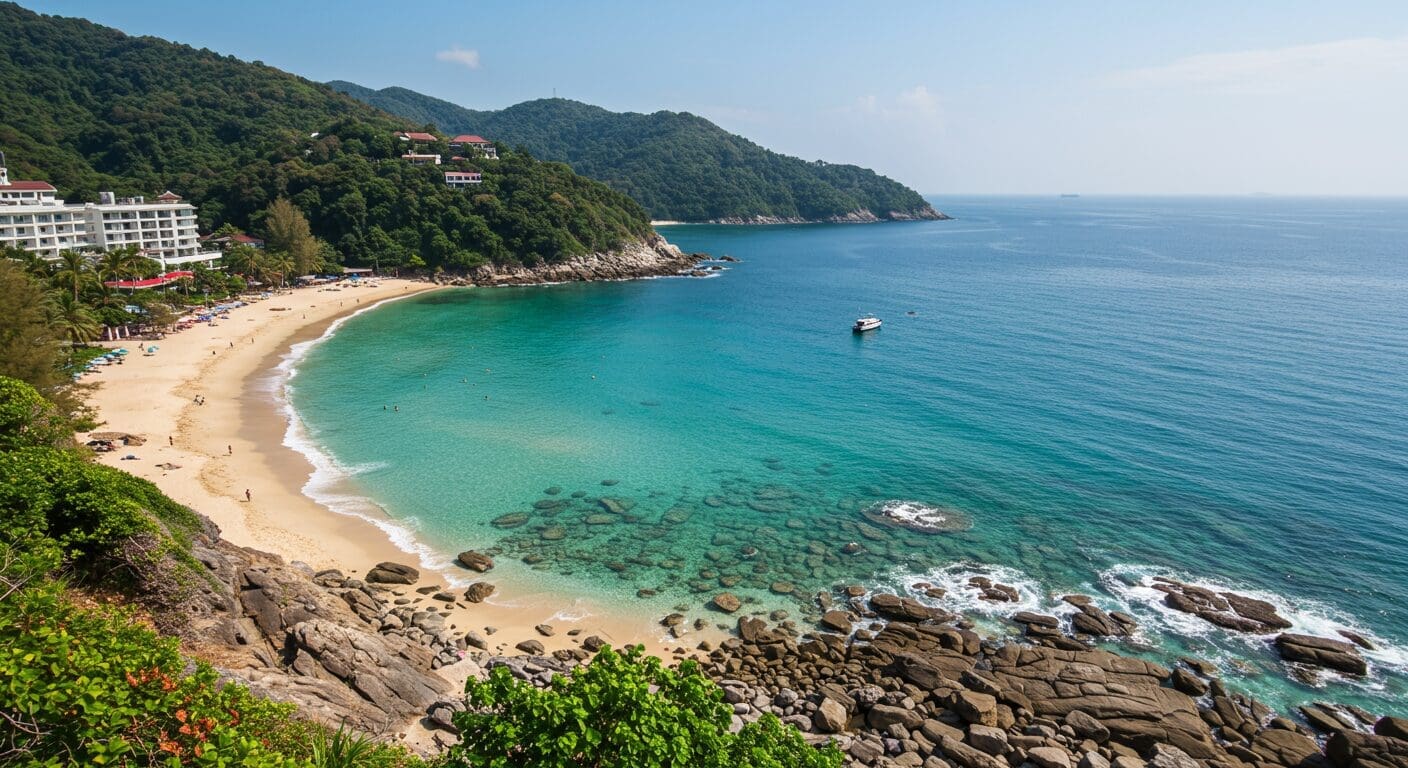
Kamala is worth lingering on: the bay is broad and calm, the village behind it has retained something of its original character, and it is home to Café del Mar’s Phuket outpost. Kata and Karon beaches, south of Patong, offer slightly more room to breathe than their famous neighbour and attract a noticeably more family-oriented crowd. At the southern tip, Nai Harn is regularly cited by those who know Phuket well as one of the island’s finest beaches – a broad crescent of deep-green water backed by low hills, with a yacht club and a monastery that seem to coexist without difficulty.
For something more private still, the Phi Phi Islands and Phang Nga Bay are accessible by day trip or private boat charter, and their limestone karsts rising vertically from turquoise water are one of those sights that photographs cannot adequately prepare you for.
Things to Do in Phuket That Are Not Simply Lying by the Pool (Although That Is Also Valid)
A luxury holiday in Phuket rewards activity in proportion to your appetite for it. The island offers a range of experiences that runs from extremely energetic to purely contemplative, and the best weeks tend to find a balance between the two.
Elephant sanctuaries represent one of Phuket’s most worthwhile experiences, provided you choose the right one. Ethical sanctuaries in the hills – where elephants are rescued rather than performing – offer genuine encounters that are among the most memorable things you will do in Thailand. The Elephant Jungle Sanctuary and Phuket Elephant Care are both reputable operations that do not use riding or performance. Worth researching before booking.
Phang Nga Bay by sea kayak is a legitimate highlight. The bay’s dramatic limestone karsts, some containing hidden lagoons accessible only by paddling through sea caves at low tide, constitute one of Southeast Asia’s most extraordinary natural environments. Private guided tours are available and preferable to the large group alternatives if you want the caves at their least populated. James Bond Island (Khao Phing Kan) is technically in Phang Nga Bay and is technically famous and is technically fine. It is also extremely crowded. A note for the files.
Phuket Old Town demands at least a morning. The Sino-Portuguese architecture along Thalang Road, Dibuk Road, and Soi Romanee is genuinely beautiful – the kind of shophouse facades in yellow and mint and rose that the Instagram algorithm was seemingly designed to reward, though they existed long before Instagram had any opinions about it. The museums are small and informative. The coffee shops occupy century-old buildings and serve excellent filter coffee. The overall effect is of a town that has retained its identity despite everything the island around it has become.
For those interested in Thai culture at depth, the Wat Chalong temple complex is the island’s most important Buddhist site – large, active, and genuinely worth visiting rather than simply photographing from the entrance. Dress respectfully, which means covered shoulders and knees. This information is widely available and widely ignored.
Adventure on the Water and in the Hills: What Phuket Offers Those Who Cannot Sit Still
Phuket’s position in the Andaman Sea places it within reach of some of the finest diving in the world. The Similan Islands, a protected archipelago accessible by liveaboard or day trip (seasonal – roughly November to May), offer visibility and marine life that attract serious divers from across the globe: leopard sharks, manta rays, whale sharks on occasion, and reef systems that have recovered well under the archipelago’s marine park protections. Closer to Phuket itself, Racha Yai and Racha Noi offer excellent conditions for both beginner and experienced divers, with reliable visibility and a solid selection of reputable dive schools operating PADI certification courses for those who have been meaning to get qualified since approximately 2019.
Snorkelling off the southern beaches and around the Phi Phi Islands is accessible without certification and frequently spectacular – the shallow reefs at Freedom Beach and around Koh Dok Mai reward even a basic mask and fins. For something more kinetic above the water, kitesurfing has established a foothold at certain beaches during the windy months, and stand-up paddleboarding is available at virtually every beach on the island, with varying degrees of instruction offered.
The interior of Phuket is much less visited than its coastline and considerably more interesting than most visitors realise. Jungle trekking in the hills around the Bang Pae waterfall or through the Khao Phra Thaeo National Park – the island’s last remaining virgin rainforest – offers a complete change of register from the beach. Zip-lining through the forest canopy is available and is the kind of activity that sounds mildly alarming until you are actually doing it, at which point it is entirely excellent. Road cyclists and mountain bikers have also quietly discovered that Phuket’s hillier terrain offers challenging and beautiful routes, particularly in the north, well before the heat becomes an argument against moving at all.
Phuket with Children: Why a Villa Changes Everything
The case for Phuket as a family destination is strong and largely made by the private villa. The honest truth about travelling with children to a beach destination is that the variables causing most parental stress – shared pools crowded with strangers, hotel dining rooms that require everyone to be presentable at fixed hours, the delicate algebra of naptime and room configurations – largely evaporate when you have a property of your own. A private villa in Phuket with a gated garden, a pool that your children can treat as their personal domain from seven in the morning, and a kitchen in which someone can make pasta at nine-thirty pm when the four-year-old has changed their mind about dinner: this is family travel operating at a different order of magnitude from anything a hotel can provide.
Beyond the accommodation question, Phuket has genuine child-specific appeal. Elephant sanctuaries, already mentioned, are a formative experience for children who engage with them properly. The beaches of Kata, Karon, and the calmer northern bays are safe and manageable for young swimmers. Cooking classes designed for families – most based around a market visit followed by a hands-on Thai cooking session – are both entertaining and educational in the way that activities which do not describe themselves as educational tend to be. Phuket Fantasea, a cultural theme park near Kamala Beach, is aimed squarely at families and delivers an evening of considerable theatrical ambition. It is not subtle. Children find this to be a point in its favour.
Multi-generational groups – grandparents, parents, and children sharing a villa large enough to accommodate everyone without overlap becoming friction – find Phuket particularly suited to the exercise, in part because the activities on offer genuinely span age groups, and in part because a well-staffed villa with a chef, a manager, and a private pool resolves most logistical challenges before they become conversations.
Phuket’s Layers: The History and Culture That Most Visitors Only Glimpse
Phuket’s history is considerably more layered than the island’s contemporary reputation suggests. The wealth that built the Sino-Portuguese shophouses of Phuket Town – many of which still stand along Thalang and Dibuk Roads – came from tin mining and the Hokkien Chinese merchants who arrived during the eighteenth and nineteenth centuries to work and eventually dominate the industry. The hybrid architecture they produced, a meeting of southern Chinese vernacular with Portuguese colonial influence filtered through the Malay Peninsula, is genuinely distinctive and has been recognised as such: Phuket Town is now working toward UNESCO World Heritage status, which it deserves and will presumably receive before the buildings fall down.
The Thai-Hua Museum on Krabi Road tells this story well – the history of Chinese immigration, the evolution of Phuket’s specific cultural identity, and the social fabric that produced the island’s most characterful quarter. The Phuket Trickeye Museum is a different kind of cultural institution and is aimed at a different kind of visitor. Both exist. Both have long queues on Sundays.
The Vegetarian Festival, held in October during the ninth lunar month, is one of Thailand’s most intense and photogenic religious events – a Taoist celebration brought to Phuket by Chinese immigrants that involves processions, firewalking, and acts of ritual devotion that are genuinely not suitable for the squeamish. It is also completely fascinating and absolutely worth arranging your trip around if the dates align. The festival transforms Phuket Town’s streets for nine days, and the seriousness with which it is observed by local participants is a useful corrective to the assumption that Phuket is primarily a place where people eat pad Thai and watch the sunset.
Songkran, the Thai New Year water festival in April, is celebrated with particular enthusiasm in Phuket – if you are here during mid-April, you will get wet, and the appropriate response to this is joy rather than irritation.
Shopping in Phuket: From Night Markets to Something You Actually Want to Carry Home
Phuket is not a shopping destination in the way that Bangkok is a shopping destination – there is no equivalent to the MBK Centre or the Chatuchak Weekend Market. What it does have, in useful abundance, is the kind of market browsing and local craft shopping that makes for genuinely pleasant afternoon hours and occasionally produces something worth bringing home.
The Sunday Walking Street market in Phuket Old Town is the best single shopping event on the island – the entire length of Thalang Road closes to traffic from approximately five in the evening, and the result is a mile of street food, handmade goods, vintage clothing, local art, and the kind of batik and silk work that represents genuine craft rather than factory production. Arrive early. The mango sticky rice vendor near the temple end is not operating in unlimited supply.
Naka Weekend Market, near Central Festival on the east coast, is larger, more mixed, and excellent for the kind of rummaging that produces unexpected finds alongside unremarkable tourist goods. It operates on Friday, Saturday, and Sunday evenings and has the cheerful density of a market that is there primarily for locals rather than visitors.
For something more curated, the Boat Lagoon and Royal Phuket Marina areas have small boutiques offering Thai jewellery, silk, spa products, and handmade homeware. The island produces excellent cashew nuts – dry-roasted and flavoured with various local spices – which are widely available, travel well, and are an entirely honest souvenir. Thai silk, lacquerware, and hand-painted ceramics in the southern Thai style are all worth seeking out in the Old Town’s gallery and craft shops. What to avoid: the counterfeit goods market, which exists and is obvious and carries risks that outweigh the savings on a fake designer bag.
The Practical Stuff: What You Actually Need to Know Before You Land
Thailand operates on the Thai Baht (THB). The exchange rate against most western currencies makes Phuket feel extraordinarily good value for a luxury destination – the labour costs, the food, the local services are all priced at a fraction of what equivalent quality would command in Europe or the Caribbean. International credit cards are widely accepted at resorts, restaurants, and larger establishments, but cash remains necessary at markets and smaller vendors. ATMs are plentiful; be aware that Thai ATMs charge a fixed foreign transaction fee per withdrawal, so withdrawing larger amounts less frequently is the financially rational move.
The official language is Thai, which is tonal, complex, and entirely unrealistic to acquire before a single holiday. English is spoken at all tourist-facing businesses and at most restaurants, though in markets and local establishments, pointing and smiling continues to serve the travelling public remarkably well. A few words of Thai – sawadee kha/krap for hello, khop khun for thank you – are received warmly and cost nothing in terms of preparation.
Tipping is not as culturally embedded in Thailand as in, say, the United States, but it is appreciated. In restaurants, rounding up the bill or leaving a modest cash tip is customary. At spas, fifty to a hundred baht per therapist is standard. Drivers and villa staff benefit from end-of-stay tips that reflect the quality and duration of service – your villa manager will generally provide guidance if asked.
The best time to visit Phuket is broadly November through April – the dry season on the Andaman coast, with reliable sunshine, lower humidity, and calm seas that make diving and island-hopping viable. May through October brings the southwest monsoon: heavier rainfall, rougher seas, and significantly lower hotel and villa rates. The rain in the wet season tends to arrive in dramatic afternoon downpours rather than sustained grey drizzle – mornings are often fine, the sea is warmer, and the island is noticeably quieter. Many experienced Phuket visitors consider the shoulder months of May and October to be quietly excellent.
A note on etiquette that saves embarrassment: remove shoes before entering temples, private homes, and many traditional restaurants. Dress modestly at religious sites. Public displays of frustration or anger are culturally counterproductive in Thailand – the concept of losing face operates in both directions, and the visitor who shouts at a tuk-tuk driver or argues loudly at a resort desk achieves precisely nothing except making everyone involved uncomfortable. Things move at their own pace here. This is, on reflection, part of the point.
Why a Private Villa in Phuket Is Not a Luxury – It Is Just Good Sense
There is a reasonable case to be made that the private villa has done more to improve the luxury holiday in Phuket than any number of hotel refurbishments. The island’s villa stock is among the most impressive in Asia: hillside properties with infinity pools that seem to pour into the Andaman Sea below, beachfront compounds with direct sand access, jungle retreats in the hills above Kathu with open-air living pavilions and the sounds of the forest instead of the sounds of the hotel corridor. The range is genuine and the quality, at the premium end, is extremely high.
The case for a villa over a hotel is at its strongest in Phuket for several converging reasons. Space is the first one. A luxury villa gives you – whether you are a couple, a family, or a group of eight friends who finally made the trip happen – room to move, room to breathe, and room to exist in different modes simultaneously. The parents can have a glass of wine on the terrace after the children are asleep without navigating hotel corridors. The friends who want to lie by the pool until two in the afternoon can do so while the friends who want to take a longtail boat to a snorkelling spot do exactly that. Nobody is waiting for anyone in a lobby.
Privacy is the second reason, and it compounds with the first. A gated villa with a private pool means that the pool is yours. The terrace is yours. The sunrise is, effectively, yours. For couples on a honeymoon or a significant anniversary, this is not a small thing. For families with young children, it is close to essential.
Staffing transforms the experience further. Most premium Phuket villas come with a villa manager, often a chef, housekeeping, and concierge services that take the decision-making load off your week entirely. Your chef will cook breakfast each morning using whatever you have asked for, and will cook dinner if you prefer to stay in rather than go out. Your villa manager will arrange the private boat to Phang Nga Bay, book the ROYD dinner table well in advance, organise the airport transfer, and generally operate as a knowledgeable local contact with a specific interest in making your trip work.
For remote workers who have decided – correctly – that a high-speed internet connection in a villa in Phuket is a perfectly legitimate working environment, the infrastructure has improved substantially. Premium villa rentals routinely offer fibre broadband and, increasingly, Starlink backup. The time zone is practical for communication with Asia and the Middle East, and not entirely catastrophic for European mornings if you are willing to work slightly adjusted hours.
Wellness is the final argument. Phuket’s villa properties frequently include outdoor gyms, yoga terraces, treatment rooms, and the kind of physical space that makes it genuinely possible to arrive stressed and leave different. Thai massage in your own villa garden, practiced by a therapist your manager has pre-arranged, is a specific pleasure that hotel wellness centres approximate but do not quite match. Combined with the pace of the island at its quieter northern end, the clean food from a private chef, and the simple arithmetic of an infinity pool and the Andaman Sea visible from your bed, the wellness case essentially makes itself.
Excellence Luxury Villas offers an exceptional collection of private pool villa rentals in Phuket, across every corner of the island and every scale of holiday – from intimate retreats for two to multi-bedroom compounds for extended families and groups. Browse the collection and find the version of Phuket that actually fits your trip.
More Phuket Travel Guides
- Best Restaurants in Phuket: Fine Dining, Local Gems & Where to Eat
- Best Beaches in Phuket: Hidden Coves, Beach Clubs & Coastal Secrets
- Phuket with Kids: The Ultimate Family Holiday Guide
- Best Time to Visit Phuket: Month by Month Weather, Crowds & Tips
- Phuket Luxury Itinerary: The Perfect 7-Day Guide
- Romantic Phuket: The Ultimate Couples & Honeymoon Guide
What is the best time to visit Phuket?
November through April is the dry season on the Andaman coast and generally considered the prime window – reliable sunshine, calm seas, and the best conditions for diving and island excursions. December and January are peak months with higher prices and more visitors. February and March offer an excellent balance of good weather without the peak-season crowds. May through October is the wet season: afternoon downpours are common, the sea can be rougher, and some dive sites close. However, rates are considerably lower, mornings are often fine, and the island is noticeably quieter. The shoulder months of May and October are particularly good value for those who can be flexible.
How do I get to Phuket?
Phuket International Airport (HKT) is the main point of arrival and is well connected regionally and internationally. Direct or one-stop flights operate from London, Frankfurt, Helsinki, Singapore, Kuala Lumpur, Hong Kong, and multiple Chinese cities. From Bangkok, domestic flights take approximately one hour and depart frequently from both Suvarnabhumi and Don Mueang airports. From the airport, private transfers are strongly recommended for luxury villa arrivals – your villa manager or concierge can arrange this in advance. The drive from the airport to southern beaches such as Nai Harn can take up to an hour in traffic; northern beaches like Naithon are considerably closer.
Is Phuket good for families?
Very much so, with the right approach to accommodation. The island offers child-friendly beaches with calm, manageable waters particularly in the north and south, ethical elephant sanctuaries, cooking classes, and cultural experiences that genuinely engage children. The single best decision a family can make is choosing a private villa over a hotel – a gated property with a private pool eliminates most of the logistical friction of travelling with children, and the option of a private chef means mealtimes never become a negotiation. Multi-bedroom villas also work well for multi-generational groups where different family members have different schedules and different ideas about what constitutes a good day.
Why rent a luxury villa in Phuket?
A private villa in Phuket offers a fundamentally different holiday experience from a hotel – more space, more privacy, and a level of personalisation that hotels cannot match at any price point. Your private pool is yours alone. Your villa chef cooks breakfast each morning and dinner whenever you prefer. Your villa manager arranges transfers, restaurant reservations, boat charters, and everything else that would otherwise require planning. For couples, the privacy is unmatched. For families, the combination of gated outdoor space and flexible mealtimes makes the trip genuinely relaxing rather than administratively intensive. For groups, having a shared home base rather than adjacent hotel rooms changes the entire social dynamic of the holiday.
Are there private villas in Phuket suitable for large groups or multi-generational families?
Yes – Phuket has one of the most impressive large-villa inventories in Asia. Properties sleeping eight, ten, twelve, or more guests are available across the island, many designed specifically with multi-generational groups in mind: separate bedroom wings for privacy, multiple living areas so different generations can coexist without collision, large private pools, outdoor dining pavilions, and on-site staff including a villa manager, chef, and housekeeping. Some properties include separate staff quarters, games rooms, home cinema facilities, and dedicated children’s play areas. For groups travelling together, the cost per head of a large villa often compares favourably to booking multiple hotel rooms of equivalent quality.
Can I find a luxury villa in Phuket with good internet for remote working?
Yes, and increasingly well. Premium villa rentals in Phuket routinely include high-speed fibre broadband as standard, and a growing number of properties now offer Starlink satellite internet as a backup or primary connection, particularly in hillside or more remote locations where standard broadband infrastructure is variable. When enquiring about a villa, it is worth specifically asking about upload speeds as well as download speeds if you are working with video calls or large file transfers. Phuket’s time zone (GMT+7) works well for those communicating with Asian and Middle Eastern clients, and is manageable for early-morning European meetings for those willing to adjust their schedule slightly.