Romantic Province of Siena: The Ultimate Couples & Honeymoon Guide
Romantic Province of Siena: The Ultimate Couples & Honeymoon Guide
Here is a confession: the Province of Siena will make you feel slightly embarrassed by how easily it works on you. You know you are being seduced. The rolling hills, the amber light, the wine that costs less than a London sandwich – you can see the whole operation clearly, and yet you fall for it entirely. There is no resistance. Couples who come here intending a cultured, balanced itinerary of art and gastronomy tend to spend most of their time simply sitting somewhere beautiful, saying very little, and meaning a great deal. Which is, when you think about it, a fairly precise definition of romance. This is not the Amalfi Coast with its performance and its crowds. The romantic Province of Siena operates quietly, confidently, and without needing to try very hard at all.
Why the Province of Siena Is Exceptional for Couples
There are destinations that are romantic in the way a Valentine’s card is romantic – obvious, a little forced, and somehow less moving than intended. The Province of Siena is romantic in the way a very good novel is: layered, unhurried, and better the second time around. It rewards couples who slow down.
The province covers a vast sweep of southern Tuscany, taking in the great medieval city of Siena itself, the vine-quilted hills of Chianti, the lunar white landscape of the Crete Senesi, the thermal springs of Bagno Vignoni, the fortified hill towns of the Val d’Orcia, and the ancient abbeys that sit in the middle of everything as though they have always been there. Which they have. The scale and variety means that two people with entirely different ideas of a perfect day – one wanting a long hike through cypress-lined roads, the other wanting a four-course lunch and a nap – can both be satisfied. Often by the same afternoon.
What sets this corner of Tuscany apart for couples is the quality of solitude. Even in high summer, it is possible to find a hillside, a courtyard, a terrace above a vineyard where you are entirely alone with each other and the view. That kind of privacy, combined with extraordinary food, extraordinary wine, and landscapes that appear to have been art-directed for precisely this purpose, creates the conditions for genuine connection. Or, at minimum, a very good photograph.
The Most Romantic Settings in the Province
The Val d’Orcia is the headline act and deservedly so. A UNESCO World Heritage landscape of almost theatrical beauty, it delivers the classic Tuscan view – the lone farmhouse on a hill, the avenue of cypresses, the soft ridgeline against a peach sky – in such concentrated form that it can feel briefly unreal. The town of Pienza, perched above the valley, is worth an entire afternoon: its Renaissance streets are unhurried, its sheep’s milk cheese is extraordinary, and the view from the town walls at dusk is the kind of thing couples tend to remember for the rest of their lives.
Montalcino, home of Brunello, sits on its high ridge with a quiet authority that suits couples rather better than tour groups. The Fortezza at sunset, with the Val d’Orcia spread below and a glass of something exceptional in hand, sets a bar that is frankly difficult to lower for the rest of the evening.
The Crete Senesi, south of Siena, deserves its own mention. This is a stranger, more elemental landscape – pale clay hills, deep ravines, an almost lunar emptiness – and it has a particular effect on people. It is meditative rather than dramatic. Couples who drive through it in the early morning often report feeling something they struggle to name. The Italians call the general territory “the soul of Tuscany.” They are not wrong.
And then there is Bagno Vignoni. A village built around a thermal pool in the central piazza – instead of a fountain, a steaming Renaissance basin fed by volcanic springs. It is one of the most quietly extraordinary places in all of Italy, and if you have not heard of it, this is your education.
Best Restaurants for a Special Dinner
The Province of Siena contains some of the finest restaurants in Italy, and a number of them happen to occupy rooms or terraces of considerable romantic power. The emphasis here is on Tuscan fine dining – the kind built on exceptional local ingredients, long relationships with producers, and a wine list that doubles as a love letter to the surrounding landscape.
In the Val d’Orcia and around Montalcino, you will find restaurants attached to estates and agriturismi that serve their own wine, their own olive oil, and produce that has not travelled more than a few kilometres to reach your plate. This is not a marketing pitch; it is simply how things work here. The best of these places will not rush you. A dinner can last three hours without anyone feeling impatient, which is itself a gift.
In Siena city, the restaurant scene operates at a different register – more formal in places, with a handful of establishments in medieval palazzi where the dining room alone is reason enough to book. Look for restaurants with a serious commitment to Sienese tradition: pici with wild boar, ribollita, the local salumi, and desserts built around saffron, almonds, and candied citrus. Pair everything with Chianti Classico or a Vernaccia di San Gimignano if you are heading north, and you will not have a bad evening. You will not, in fact, have anything other than an extremely good one.
For the most elevated experience, consider booking in advance at one of the Michelin-recognised restaurants in the province – several exist within striking distance of the Val d’Orcia and Montalcino – and building an entire evening around the occasion: late reservation, aperitivo at sunset beforehand, a slow drive home under the stars.
Couples Activities: Beyond the View
The Province of Siena is not a destination that requires you to fill every hour. But for couples who like to do things together, the options are considerable and genuinely well-suited to the romantic register.
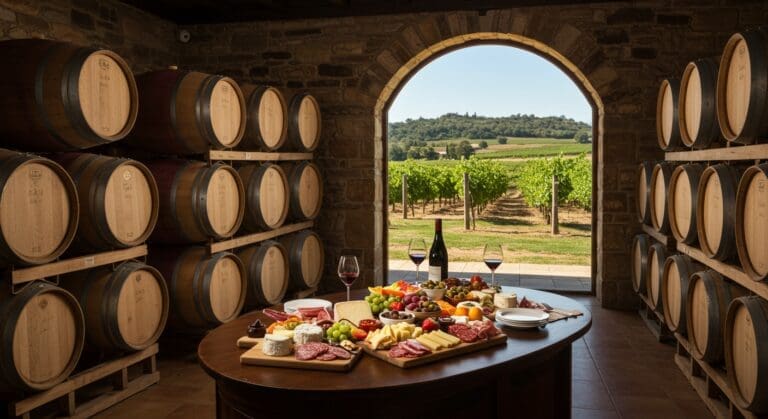
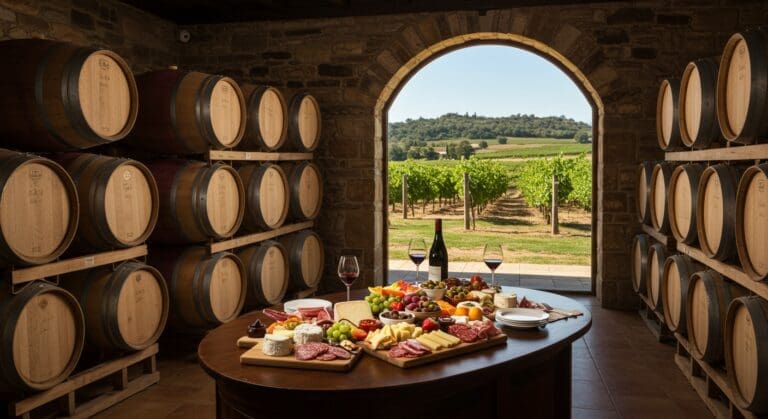
Wine tasting and cellar visits are the obvious starting point, and in a region that produces Brunello di Montalcino, Chianti Classico, Morellino di Scansano, and Vino Nobile di Montepulciano, obvious is entirely justified. Many of the great estates offer private tastings – just the two of you, a knowledgeable host, and several bottles of things that retail at prices you will pretend not to notice. Some estates include a cellar tour through ancient barrels and vaulted stonework. It is atmospheric in the extreme.
Cooking classes are an excellent shared activity with the advantage of being delicious by the end. Look for classes taught in private villa kitchens or in small farmhouse settings, ideally with a market visit beforehand to source the ingredients. Learning to make fresh pasta together turns out to be both genuinely useful and surprisingly good for a relationship. There is something about flour on your hands and mild competitive instinct that brings people together.
Thermal bathing at the natural hot springs of Bagno Vignoni and the nearby Bagni San Filippo – where warm waters flow over white calcite formations in the forest – is one of the more otherworldly experiences the province offers. Bagni San Filippo in particular, with its cascading white terraces and free public pools accessible year-round, has the quality of a secret. Keep it one.
Horseback riding through the Val d’Orcia and the Maremma in the south is another option of considerable romance – particularly at dawn or in the late afternoon when the light does what it does. Several stables offer guided rides for all abilities, including private excursions for couples who would rather not share their landscape with strangers.
Cycling along the white gravel roads – the strade bianche – that thread between the vineyards and olive groves is best described as either “idyllic” or “more challenging than it looks on the map,” depending on the gradient. For flatter terrain, the Val d’Orcia and the area around Pienza are gentler propositions. Electric bikes have rescued several romantic cycling plans.
Spa and wellness offerings across the province range from luxury hotel spas with mineral-rich thermal pools to smaller, more intimate wellness retreats tucked into the countryside. For couples, look specifically for experiences that include private thermal baths, couples massage treatments, and the particular pleasure of doing very little in very beautiful surroundings for an extended period.
The Most Romantic Areas to Stay
Where you stay in the Province of Siena shapes everything else, and the landscape here is varied enough that the choice of base matters considerably.
The Val d’Orcia is the first choice for couples who want to be at the heart of the iconic Tuscan scenery. The countryside around Pienza, Montalcino, and San Quirico d’Orcia is thick with private villas, converted farmhouses, and estate properties set in vineyards and olive groves. This is where the postcards come from, and the reality is better than the postcards.
The Chianti Classico zone – running roughly between Siena and Florence – offers a wilder, more forested landscape punctuated by castle estates, medieval villages, and some of the most celebrated wine properties in Italy. It suits couples who want dramatic countryside with excellent gastronomy and a more established sense of luxury infrastructure.
The Crete Senesi rewards couples looking for true seclusion. Properties here are fewer and further between, and the landscape is stark and beautiful rather than conventionally lush. It is a choice for people who genuinely want to be alone with each other and find that prospect exciting rather than alarming.
The area around Bagno Vignoni and Castiglione d’Orcia combines thermal wellness with spectacular position and a deeply local character that the more visited corners of the province occasionally surrender under summer pressure.
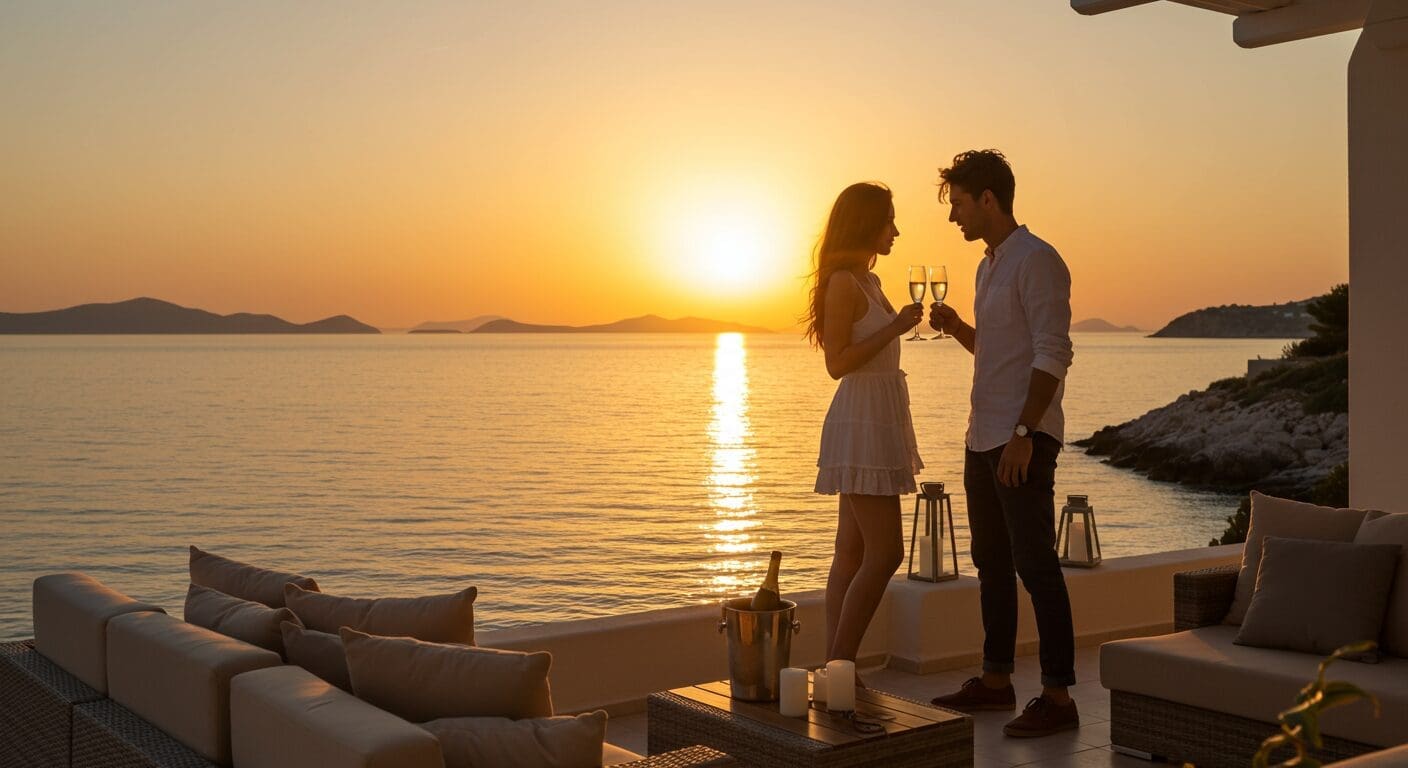
For honeymoons and significant anniversaries, staying in a private luxury villa rather than a hotel changes the entire dynamic. There is no shared dining room, no lobby, no crowd of other couples having their own special occasion. There is only your terrace, your pool, your kitchen, and the Tuscan countryside arranged beyond it for your exclusive consideration.
Proposal-Worthy Spots
The Province of Siena presents the practical difficulty of too many good options. You will need to narrow it down.
The view from the town walls of Pienza at dusk – looking out over the Val d’Orcia with the light turning everything amber and then gold and then something for which English lacks a specific word – is a strong candidate. It is public enough to feel significant, private enough to feel intimate. The timing is everything: late afternoon in spring or autumn, when the crowds have thinned and the valley is settling into evening.
A private wine tasting at one of the great Brunello estates, arranged with a little advance planning to include a particular moment on the estate’s terrace or in the vineyard itself, is another approach – intimate, personal, and involving a very good bottle of wine immediately afterward, which is sensible forward planning.
The hot spring pools at Bagni San Filippo, particularly in the early morning before other visitors arrive, have a quality that borders on the surreal – white mineral formations, steam rising through the forest, warm water in cool air. It is the kind of setting that makes grand gestures feel entirely natural.
For something more elevated, the Torre del Mangia in Siena city offers one of the great views over a medieval Italian city. The climb is 400 steps, which means anyone proposing at the top has the additional argument of considerable commitment. It counts for something.
Anniversary Ideas and Honeymoon Considerations
For anniversaries, the Province of Siena rewards the return visit. Couples who spent a honeymoon here will find that the landscape holds a kind of memory – the same view looks different ten years later, which is partly the quality of the light and partly something to do with the people looking at it. Return trips to the Val d’Orcia have a specific emotional weight that few destinations can match.
For milestone anniversaries, consider building an itinerary around a cooking class or wine experience that you can claim as “yours” – a specific estate, a specific dish, a specific bottle from the year you married. The province’s extraordinary range of Brunello vintages makes this pleasingly achievable.
For honeymooners, the practical considerations are worth addressing clearly. The best time to visit is May, June, September, and October – warm but not oppressive, busy but not overwhelming. July and August are hot and increasingly crowded in the more popular towns. The countryside, however, remains manageable even in peak summer, particularly if you are based in a private villa with a pool, where the world’s traffic problem is largely someone else’s concern.
A honeymoon in the Province of Siena benefits from a mixture of structure and surrender. Book the two or three things that genuinely require advance reservation – the Michelin dinner, the private cellar tasting, the spa afternoon. Leave the rest loose. Some of the best days will be the ones with no plan beyond a direction and an appetite.
For a complete overview of the region’s highlights, history, and practical travel information, the Province of Siena Travel Guide is the ideal companion to your romantic planning.
Your Romantic Base: The Case for a Private Villa
There is a version of a romantic holiday in Tuscany that takes place entirely in hotel lobbies, shared terraces, and dining rooms full of other couples having what appears to be a slightly better time than you. A private villa removes this particular anxiety from the equation entirely.
A luxury private villa in Province of Siena is the ultimate romantic base – and not merely for the obvious reasons of space, privacy, and the pool that is yours alone. It is also about pace. In a villa, you set the rhythm of the day. Breakfast at nine or at noon. A long lunch at the table under the pergola. An afternoon that has no particular obligation attached to it. An evening that begins with an aperitivo on the terrace and ends whenever it ends. This is not available in a hotel, regardless of its star rating.
The villas available through Excellence Luxury Villas across the province range from intimate retreats for two in the Val d’Orcia to grand estate properties in the Chianti hills with wine cellars and infinity pools and views that will, at some point, cause you to put down whatever you are doing and simply look for a while. They are staffed with discretion, provisioned with thought, and positioned in the landscape with the kind of care that suggests someone understood exactly what a couple coming here actually needs.
Which is, in the end, very little – and everything.
When is the best time of year for a romantic trip to the Province of Siena?
May, June, September, and October offer the ideal balance for couples – warm temperatures, long evenings, and landscapes at their most vivid without the full intensity of summer crowds. Spring brings the countryside into bloom and the light has a particular softness in the mornings. Autumn delivers the harvest season, with vendemmia activity across the vineyards, truffle hunting in the woods, and a golden quality to the afternoons that is hard to overstate. July and August are hot and popular, but couples staying in a private villa with a pool will find the heat entirely manageable and the long summer days their own reward.
What are the most romantic towns in the Province of Siena for couples to visit?
Pienza is consistently the first answer – a small, perfectly formed Renaissance town perched above the Val d’Orcia with exceptional food, minimal crowds in the early morning, and a view from its town walls that is genuinely difficult to leave. Montalcino rewards couples who appreciate wine and altitude in equal measure. Bagno Vignoni is one of the most quietly extraordinary villages in Italy, built around a thermal piazza that has been drawing visitors since Roman times. For something larger and culturally weightier, Siena city itself – with its medieval streets, its great Piazza del Campo, and its cathedral – offers an entirely different kind of romance: urban, layered, and inexhaustibly interesting.
Is the Province of Siena a good choice for a honeymoon, and how does it compare to other Italian destinations?
The Province of Siena is an exceptional honeymoon destination and compares very well to the more celebrated romantic alternatives. Unlike the Amalfi Coast, it is not defined by crowds, traffic, and the occasional vertical walk. Unlike Venice, it does not require any management of expectations about what a city surrounded by water actually smells like in August. What Siena province offers instead is space, quiet, extraordinary gastronomy, and a landscape of such consistent beauty that it begins to feel personal – as though it exists specifically for the two of you. Combined with the privacy of a luxury villa, it delivers the conditions for a honeymoon that feels genuinely exclusive rather than merely expensive.