
Best Restaurants in Rhodes: Fine Dining, Local Gems & Where to Eat
Late afternoon in Rhodes smells like oregano and diesel and something frying in olive oil – a combination that shouldn’t work as well as it does. The light goes amber around six, the fishing boats knock against the harbour walls, and somewhere in the Old Town a kitchen is already coaxing garlic into butter. This is when Rhodes makes its case. Not at the Acropolis in the blazing midday heat, not on the beach at noon with a thousand other people doing the same thing, but in the quiet hour before dinner, when the island shifts register entirely and reminds you why people have been coming here since before anyone thought to write a travel guide about it. The food, it turns out, is a very good reason.
Rhodes sits at a crossroads that has been useful to traders, crusaders, Ottomans, and Italians across several millennia, and every one of them left something behind in the kitchen. The result is a cuisine that is recognisably Greek but with layers – spices that hint at the Middle East, pasta dishes that betray the Italian occupation, and an obsession with fresh seafood that requires no historical explanation whatsoever. Knowing where to eat on this island is, frankly, the most useful thing you can do before you arrive. This guide will tell you exactly that.
The Fine Dining Scene: Rhodes at Its Most Considered
Rhodes does not currently hold a Michelin star – a situation that surprises anyone who has eaten seriously on the island and would not surprise anyone who has navigated Greek bureaucracy. What it does have is a small, serious fine dining scene that punches considerably above its weight and would hold its own in most European capitals.
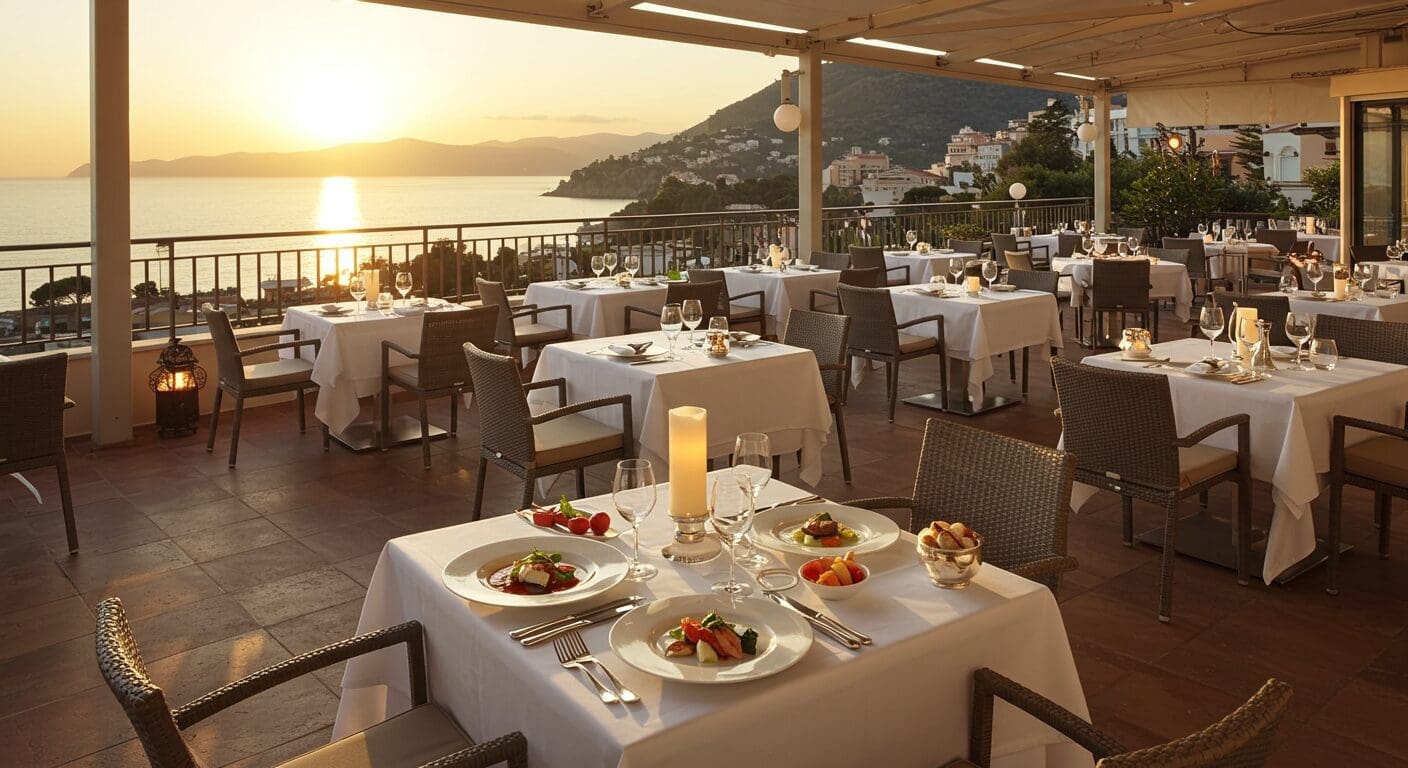
The standout in this category is the Noble Gourmet Restaurant at the Elysium Resort and Spa on the island’s northeast coast. Executive Chef George Troumouchis and head chef Spyros Kougios have built a tasting menu around authentic Rhodian flavours handled with precision and intent. The pitaroudi pie with crab and mushrooms is the sort of dish that stops conversation – not because it’s theatrical, but because it is simply very, very good. The lamb kapama with marinated eggplants is another: a slow-cooked, deeply savoury thing that manages to feel both rustic and refined. The restaurant has twice won Toque d’Or awards and is ranked among the top 25 restaurants in Greece. If you’re staying at a luxury property on the island’s northeast coast, making a reservation here should be among your first acts. The atmosphere is elegant without being stiff, which is exactly the balance that defines genuinely good hospitality.
For fine dining with a different kind of pedigree, the name you need is Mavrikos in Lindos – which we’ll return to in detail shortly, because it deserves a section of its own.
Mavrikos, Lindos: The One That Started the Conversation
There is no credible guide to the best restaurants in Rhodes that does not begin – or at least end – with Mavrikos. Established in 1933 and currently run by brothers Dimitris and Michalis Mavrikos, this restaurant in the whitewashed village of Lindos, some 55 kilometres from Rhodes Town, is not merely well-reviewed. It is an institution. The New York Times has mentioned it. Serious food people make the drive specifically for it. Greeks, who are not easily impressed by their own cuisine being done well, nod approvingly when you bring it up.
What makes Mavrikos extraordinary isn’t nostalgia, though ninety-plus years of family ownership certainly gives it a particular gravity. It’s the cooking itself: traditional Greek cuisine handled with genuine respect for seasonality and local produce, in an era when those words have become somewhat overused. The menu changes with what’s available and what’s good. The seafood preparations are clean and confident. The sauces speak. The brothers have maintained a standard that most restaurants would struggle to hold for a decade, let alone across generations. Lindos is worth the journey on its own merits – the Acropolis, the village, the views – but Mavrikos is the reason you should book a table there before you book anything else.
Local Tavernas and Hidden Gems: Where Rhodes Eats
Away from the resort zones and the medieval walls, Rhodes has a parallel dining life that most visitors never quite locate. This is where the island rewards patience and a willingness to drive somewhere that doesn’t have a sign in four languages.
Taverna Paraga in Apollona Village is a case in point. The restaurant is run by Chef Yiannis Efthymiou – a large, bearded man with the energy of someone who has been feeding people well for a long time and intends to keep doing so. The dining space is open-air, lined with long communal tables built for the kind of meals that run long into the evening. The food is old-school Rhodian: slow-cooked meats, vegetables from the garden, bread that arrives still warm. It’s honest cooking, generously priced, and the sort of experience that reminds you why you bothered to leave the villa terrace in the first place. The staff speak good English, which is useful, but the menu largely communicates for itself.
In the Old Town, Mama Sofia occupies a particular niche: a family-run restaurant with a genuinely rustic atmosphere and a menu that reads like a greatest-hits of Greek home cooking. Moussaka, souvlaki, slow-braised lamb – all executed with the kind of care that suggests someone’s grandmother was consulted at some point in the development process. The staff are warm and speak excellent English, and the menu accommodates gluten-free and vegetarian requirements without the mild resentment you sometimes encounter elsewhere. It is almost always busy. Book ahead. This is not a suggestion.
Seafood: Where to Eat When the Island Has Just Unloaded the Catch
On an island surrounded by the Aegean and the Mediterranean, ordering seafood is less a choice than an obligation. Rhodes takes its fish seriously – the harbours around the island are working ones, and the distance between ocean and plate is shorter here than almost anywhere in Greece.
Hatzikelis in Rhodes Town is the name that comes up repeatedly in this context, and with good reason. It is a world-class seafood restaurant in the plainest sense of the phrase: frequented by celebrity clientele, consistently praised across multiple platforms and guides, and producing dishes that use classic Greek flavour combinations to handle outstanding produce. The mussels in tomato sauce with feta are a study in what happens when good ingredients are left to do most of the work. The shrimps in ouzo sauce are the kind of dish that converts people who thought they didn’t really care about ouzo. If you are serious about seafood, Hatzikelis is non-negotiable.
Beyond the headline restaurants, any fishing harbour on the island – Kamiros Skala, Mandraki – will have small tavernas serving whatever came in that morning. The menus tend to be short. The grilled fish tends to be exceptional. The wine tends to be from a carafe. Nobody is complaining.
Beach Clubs and Casual Dining: Eating Well Horizontally
Rhodes has a well-developed beach club scene, particularly along the northern and eastern coasts, where the more sophisticated resort infrastructure concentrates. The better ones – typically attached to the larger luxury properties or operating independently on the more organised beaches – offer serious food alongside the expected loungers and cocktails. Fresh fish, mezze spreads, cold Assyrtiko, the sound of the sea. There are worse ways to spend an afternoon.
The thing to know about beach dining on Rhodes is that quality varies considerably. The establishments directly serving the package-hotel beaches are not, as a general rule, where you want to be eating. The beach clubs worth seeking out tend to be slightly removed from the main tourist concentrations – on quieter stretches of coastline, or in the calmer bays around Lindos and the island’s eastern shore. The food at these spots is simple by design: grilled octopus still warm from the kitchen, a Greek salad that has not been refrigerated into submission, a glass of something cold and local. Nothing complicated. Everything correct.
Food Markets and Where to Shop Like a Local
Rhodes Town’s central market area, near the port and spreading through parts of the New Town, is the best place on the island to understand what the kitchen here actually runs on. Stalls sell locally grown herbs, honey from Rhodian bees (particularly good – the thyme variety is worth buying in quantities that will raise eyebrows at airport security), olives cured in ways that vary from village to village, and a range of local cheeses that never quite make it to export markets.
The Old Town itself has a more tourist-facing version of this, with spice shops and deli-style producers along the main commercial streets. These are not without merit – the quality of the dried herbs and the local capers is genuinely high – but the serious shopping is better done in the municipal market area, where the people buying things are planning to cook them rather than carry them home in decorative packaging. Both have their place. One is more photogenic. The other is more useful.
If you’re staying in a villa with kitchen access, the market trip is not optional. It is, in fact, the point.
What to Order: The Dishes Rhodes Does Best
A few things you should eat before you leave. Pitaroudia – chickpea fritters spiced with cumin and mint – are a Rhodian speciality that you won’t find in quite this form anywhere else in Greece. Order them wherever they appear. Moussaka exists everywhere in Greece, but the version on Rhodes – often richer, sometimes with additional spicing – has a particular character. Fresh grilled fish, ordered whole and simply dressed with olive oil and lemon, is self-explanatory. Fava from Santorini appears on many menus here and pairs excellently with most of the above.
For meat, the slow-cooked preparations are where Rhodes excels: lamb dishes braised low and slow with local wine and aromatics, kleftiko if you can find it done properly, and the kind of offal dishes that reward adventurousness and punish timidity. Pasteli – sesame honey bars – appear everywhere as a snack or sweet. They are better than they sound. Most things here are.
Wine, Ouzo and What to Drink
Rhodes has its own wine-producing tradition, centred primarily around the CAIR cooperative, which has been producing wines on the island since 1928. The sparkling wine – a method traditionelle produced from the local Athiri grape – is a curiosity worth trying, if only because discovering that Rhodes makes sparkling wine is the kind of information that makes you a more interesting dinner companion. The Athiri grape also produces dry whites with good acidity that pair well with seafood. They are not Burgundy. They are not trying to be.
Ouzo is the aperitif of record in this part of Greece, and it should be treated accordingly: consumed cold, with ice, and accompanied by small plates rather than swallowed neat as a dare. The local ouzo produced on Rhodes has a slightly sweeter profile than the Lesbos varieties that dominate export markets. It is worth trying on its own terms. Tsipouro – a grape spirit, rougher and more immediate than ouzo – appears on some menus and is an excellent end to a long dinner, provided you are not driving and have no particular commitments in the morning.
Reservation Tips: The Practical Business of Eating Well
Rhodes in high season – roughly June through September – is busy in ways that the word “busy” doesn’t quite capture. The better restaurants fill up. Mavrikos in Lindos requires advance booking, often weeks ahead in July and August. Noble Gourmet at the Elysium operates on a tasting menu format where places are limited by design. Mama Sofia in the Old Town runs out of tables for walk-ins before most people have finished thinking about dinner. The lesson is consistent: book before you arrive, not after you’ve settled in and found yourself hungry.
Outside the peak months – May, early June, October – the island relaxes considerably. Some restaurants reduce their hours or close certain days, but the trade-off is the ability to eat where you want, when you want, without a reservation made in a previous season. For visitors with flexibility, these shoulder months are, frankly, the best time to eat on Rhodes. The produce is still excellent, the kitchens are less pressured, and the whole experience feels more like dining and less like logistics.
One further practical note: dress codes at the fine dining establishments are smart casual at minimum. The beach clubs are the beach clubs. The tavernas don’t care what you’re wearing. Use judgement accordingly.
A Final Word on Eating Well in Rhodes
What Rhodes offers the serious eater is not a single scene but a range of them – fine dining that competes with any island in the Aegean, family tavernas running on recipes that predate living memory, seafood that travels approximately nowhere before it reaches your plate, and a market culture that makes cooking in a villa feel like a genuine pleasure rather than a compromise. The island has been feeding people for longer than most countries have existed. It has developed opinions about how this should be done.
The best way to experience all of this, naturally, is to have a base that allows you to range freely across the island – eat in Lindos one evening, the Old Town the next, find your way to Apollona for lunch, come back to a terrace with a carafe of local wine and the evening light doing its thing across the water. A luxury villa in Rhodes provides exactly this kind of freedom, and many of the finest properties come with private chef options – meaning that the local market visit you did on a Tuesday morning becomes a dinner worth talking about on a Wednesday night. For a deeper dive into everything else the island offers, the full Rhodes Travel Guide is the place to start.
What are the best restaurants in Rhodes for a special occasion dinner?
For a genuinely memorable dinner, Mavrikos in Lindos is the island’s most celebrated restaurant – a family-run institution since 1933 with a menu built around the finest local and seasonal produce. Noble Gourmet Restaurant at the Elysium Resort and Spa is another outstanding choice, offering a refined tasting menu of Rhodian cuisine that has earned multiple Toque d’Or awards. Both require advance reservations, particularly in high season, so book as early as possible.
What local dishes should I try when eating in Rhodes?
Pitaroudia – Rhodes’s own chickpea fritters seasoned with cumin and mint – are essential, as is fresh grilled fish ordered whole and simply dressed. Slow-cooked lamb dishes, moussaka prepared in the Rhodian style, and seafood preparations such as mussels with feta or shrimps in ouzo sauce (particularly good at Hatzikelis in Rhodes Town) are all worth prioritising. For something sweet, pasteli – sesame and honey bars – appear throughout the island and are one of its most distinctive local treats.
Do I need to book restaurants in advance in Rhodes?
In high season (June to September), yes – and the earlier the better for the top tables. Mavrikos in Lindos and the Noble Gourmet Restaurant can fill up weeks in advance during peak months. Even well-regarded local restaurants such as Mama Sofia in the Old Town are consistently busy and strongly recommend booking ahead. Outside of peak season, the island is considerably more relaxed about walk-ins, though calling ahead is still advisable for the island’s most sought-after restaurants.