Riverside County Travel Guide: Where to Stay, Eat & Explore in Luxury
Most American destinations sell themselves on one big idea. New York has the skyline. Miami has the beach. Los Angeles has the industry of pretending to be something else. Riverside County sells itself on everything at once – and means it. Within a single county in Southern California’s United States interior, you can hike through Joshua Tree’s alien rock formations at dawn, be back at a private pool with a glass of local Temecula wine by noon, and eat dinner at a Gilded Age hotel that Theodore Roosevelt once called home. That is not a brochure promise. That is Tuesday. For the discerning traveller who has done the obvious choices and wants something that rewards genuine curiosity, Riverside County is the answer California has been hiding in plain sight.
This is a destination with serious range – and that range attracts serious travellers. Families who want privacy and space rather than hotel corridors and adjacent strangers find exactly that here, particularly in the sprawling villa properties that come with their own pools, gardens, and the blessed absence of other people’s children. Couples marking milestone birthdays or anniversaries are drawn by the combination of wine country romance and desert grandeur – the kind of landscape that makes people go quiet in a good way. Groups of friends who want to actually be together rather than booked into separate rooms across two floors of a Marriott thrive in the communal luxury a large villa provides. Remote workers who have discovered that reliable connectivity and a mountain view are not mutually exclusive increasingly treat Riverside County as a long-stay base. And wellness-focused guests who want something more rigorous than a spa menu and a yoga mat find genuine outdoor challenge here, combined with the comfort to recover from it properly. Very few destinations genuinely serve all of these people equally well. Riverside County, rather quietly, does.
Getting There: Closer Than You Think, and Worth Every Mile of the Drive
The nearest major airport is Ontario International Airport (ONT), which sits just over the county line and offers a refreshingly un-Angeleno experience of actually finding a taxi without existential suffering. From ONT, most parts of western Riverside County – Riverside city, Temecula, the wine country – are 30 to 45 minutes by car. Los Angeles International Airport (LAX) is around 60 to 90 minutes in manageable traffic, though “manageable Los Angeles traffic” is doing a lot of work in that sentence. San Diego International Airport (SAN) is a clean 90-minute drive north to Temecula, which makes it a perfectly sensible choice if you’re combining a Riverside County stay with time in San Diego. Palm Springs International (PSP) is the gateway for the eastern desert reaches – Joshua Tree, Coachella Valley, Palm Desert – and is a genuinely pleasant small airport where the luggage actually arrives at roughly the same time you do.
Within the county, a car is not optional – it is essential. Riverside County covers over 7,000 square miles. Public transport exists with the optimism of a philosophy it cannot quite support. Hire a good car, ideally something with legroom and a working air conditioning system, and use it. The drives between Temecula’s rolling wine hills and the sudden severity of the Joshua Tree landscape are themselves worth the tank of fuel. Private transfers from airports can be arranged easily, and for groups arriving at a villa together, a single people carrier is often the most civilised solution.
Where to Eat: A County That Takes the Table Seriously
Fine Dining
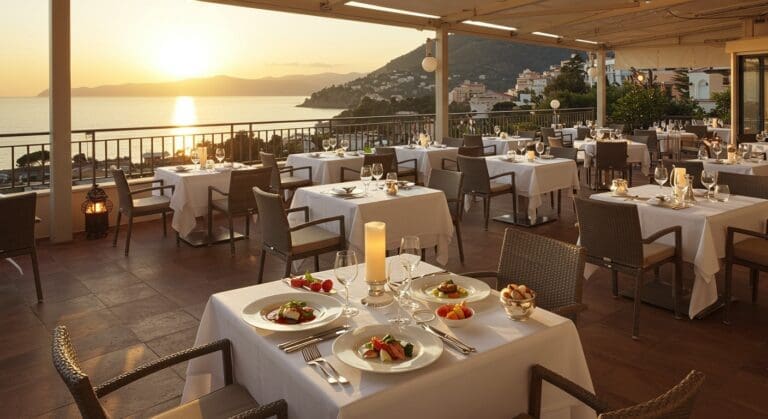
Duane’s Prime Steaks and Seafood, inside the Mission Inn Hotel on Mission Inn Avenue in Riverside, is the kind of place that earns its reputation without reminding you of it at every turn. Open since 1993 and consistently ranked among the finest restaurants in the county, it has the warm amber tones and rich furnishings that suggest confidence rather than effort. The centrepiece is a painting – “Charge Up San Juan Hill” – one of the largest canvases at the Mission Inn and rather extraordinary company for a ribeye. The steaks are serious. The seafood is taken equally seriously. If you eat here once, you will understand why it still holds a 4.3-star rating across hundreds of reviews after more than three decades in business. That kind of longevity in the restaurant world is not luck.
Mario’s Place is another Riverside institution that has made seasonal Italian its calling card, backed by an extensive wine list that their staff navigate with genuine knowledge rather than the usual performance of it. Long an OpenTable favourite, it is the kind of restaurant that attracts regulars who book the same table with the same quiet certainty every few weeks. The menu honours fresh ingredients without making a theatrical production of the fact.
Where the Locals Eat
Le Chat Noir on 9th Street in Riverside is where you go when you want French food done with genuine heart rather than Michelin-adjacent solemnity. The menu is rooted in southern French cuisine – the kind of food that assumes you are there to eat rather than to curate an experience – and the service has been singled out repeatedly across review platforms as genuinely exquisite. The wine list is extensive and well-chosen. It appears at the top of best-of lists across TripAdvisor, Wanderlog, and regional food guides with the frequency of something that has simply decided to be excellent and stuck with it.
The Salted Pig on Main Street in downtown Riverside has made farm-to-table cooking feel like what it should be: pleasurable rather than principled. The space blends rustic warmth with modern touches in a way that actually works, and the menu changes with the seasons in ways that give you a genuine reason to return rather than a marketing one. It handles both casual Tuesday evenings and special gatherings with equal ease, which is rarer than it sounds.
Hidden Gems Worth Seeking Out
Market Broiler Riverside has been voted the number one seafood restaurant in the area for more than twenty consecutive years – an achievement that should make any serious fish eater pay attention. The format is polished-casual: a working fresh fish market at the front where you can see exactly what is being served that evening, award-winning chefs behind the pass, and a menu that extends to 100% Premium Angus steaks and roasted chicken for those in the group who have complicated feelings about the sea. The pricing sits in the moderate range for a full-service restaurant, which is either reassuring or suspicious depending on your prior dining experiences. It is reassuring. Temecula’s wine country, meanwhile, has its own clutch of winery restaurants where long lunches conducted with local Syrah are treated as both option and obligation.
The Landscape: One County, Approximately Four Different Planets
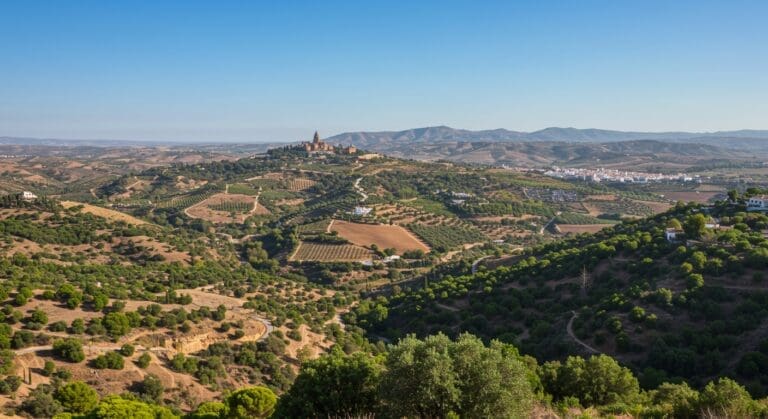
Riverside County stretches from the edges of the greater Los Angeles basin eastward through wine country, into desert, and finally out to the Colorado River border with Arizona. The geographical ambition is remarkable. In the west, Temecula sits in a green valley of rolling hills planted with over forty wineries – warm days, cool nights, and a microclimate that produces Cabernet Franc, Viognier, and Syrah of real quality. It resembles nothing so much as a small Californian version of a southern French wine region, which is presumably why Le Chat Noir has found such a comfortable home there.
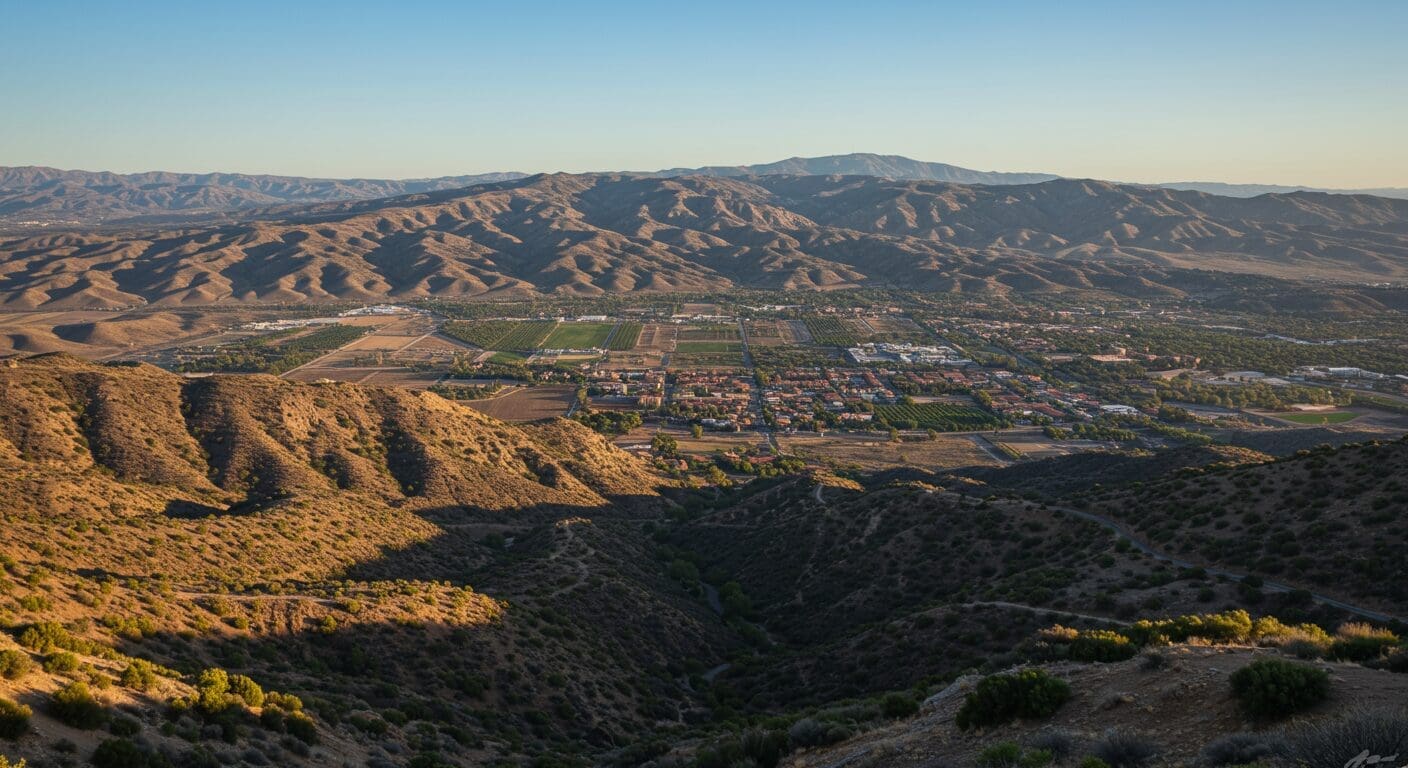
Moving east, the landscape shifts dramatically. Palm Springs and the Coachella Valley announce the desert with sudden, unambiguous authority: the Santa Rosa Mountains rise sharply above the valley floor, the light changes quality entirely, and the architecture – those extraordinary mid-century modernist houses – seems to have been designed specifically to frame the mountains and sky rather than hide from them. Further east still, Joshua Tree sits at the convergence of the Mojave and Sonoran deserts, where the rocks are so improbably large and the trees so genuinely strange that first-time visitors often stand in silence for a moment before they can form a sentence. The San Jacinto Mountains provide alpine elevation and pine forests that feel entirely incongruous with the desert floor visible below. Riverside County does not so much have a landscape as a collection of landscapes that have agreed to share a postcode.
Things to Do: The Deliberately Incomplete List
The activities in Riverside County spread across enough categories to cause pleasant indecision. In Temecula, wine tasting is the dominant leisure activity – structured tastings, private barrel tours, hot air balloon flights over the vineyards at dawn that provide an aerial perspective on just how much wine this valley produces. Old Town Temecula offers antique shopping and the kind of weekend farmers’ market that sells things you actually want to eat rather than artisanal candles. The Pechanga Resort and Casino is the largest resort casino in California and offers a scale of entertainment programming – concerts, comedy, boxing – that routinely draws visitors from across the state.
In Palm Springs, the Aerial Tramway carries passengers from the desert floor to the top of Mount San Jacinto in under fifteen minutes, depositing them in an alpine environment that sits at 8,516 feet above sea level. The temperature difference between top and bottom can be thirty degrees. Bring a layer. The Palm Springs Art Museum is genuinely excellent – not in a dutiful cultural-box-ticking way, but in a this-is-actually-worth-two-hours way – with strong collections in Western and Native American art alongside contemporary work. Architecture tours of the mid-century modernist districts are a legitimate half-day activity for anyone with even passing interest in design.
Joshua Tree National Park is the county’s crown jewel for sheer singular experience. Sunrise and sunset here are events rather than times of day. The rock formations at Skull Rock, Arch Rock, and Hidden Valley have a quality that photographs cannot quite capture – which is not something one says often, given how many photographs of Joshua Tree exist.
Adventure and the Outdoors: Where the Serious Exercise Happens
Mount Rubidoux Park in Riverside city is a local landmark that delivers proper hiking with city views – a series of trails winding up a rocky hill topped with a peace tower and a cross, offering a panoramic perspective over the Santa Ana River valley. It is manageable for most fitness levels and delivers considerably more than it initially promises. The summit views on a clear morning are genuinely arresting.
In Joshua Tree, rock climbing is not a niche pursuit – it is practically the point. The park contains over eight thousand documented climbing routes across its granite formations, ranging from beginner bouldering to technically demanding multi-pitch climbs that require both skill and commitment. Guide services operate out of the gateway towns of Joshua Tree and Twentynine Palms, and a half-day introduction to climbing here is an experience that tends to create converts. Mountain biking trails thread through the desert landscape for those who prefer wheels to boots. The PCT – Pacific Crest Trail – passes through the county, offering long-distance hikers a stretch of genuine wilderness walking.
The Santa Rosa and San Jacinto Mountains National Monument protects over 280,000 acres of high desert terrain, with trails that rise sharply from the valley floor into pine and fir forest. Cyclists have discovered that the roads around Temecula’s wine country offer excellent riding: rolling hills, relatively quiet roads, and the unusual incentive of a winery at the end. Hot air ballooning above the Temecula Valley at dawn is the kind of activity that sounds like a cliché right up until you are actually doing it, at which point it becomes the thing you tell people about for months.
Riverside County with Children: Space, Freedom, and No Hotel Corridors
Families find Riverside County genuinely accommodating rather than merely tolerant of their presence. The question is usually less “what is there to do with children” and more “how do we fit it all in.” Joshua Tree offers the kind of landscape that children engage with instinctively – rocks to climb, strange trees to investigate, stars visible at night in a way urban children almost never see. The Palm Springs Aerial Tramway is reliably thrilling for children who have never experienced the concept of boarding a rotating cable car and arriving in the snow wearing desert clothes. The children’s museum in Riverside is well-regarded regionally.
The particular advantage of a private villa rental for families in Riverside County is hard to overstate. A villa with its own pool means children can swim without the politics of shared resort facilities. Multiple bedrooms mean adults can actually speak to each other at dinner. Private outdoor space means the energy levels of children under twelve – which are, let us say, considerable – can be discharged safely without inconveniencing other guests. A well-chosen luxury villa property in this county can genuinely feel like having the whole of Southern California to yourselves, which is exactly the point.
History and Culture: More Depth Than the Desert Suggests
Riverside’s Mission Inn Hotel and Spa is one of the most architecturally extraordinary buildings in California – a Spanish Mission Revival structure that began as a small boarding house in 1876 and grew, under the ambitious stewardship of Frank Miller, into a labyrinthine complex of towers, atriums, courtyards, and chapels that covers an entire city block. Every American president from Benjamin Harrison to Richard Nixon stayed here. It was declared a National Historic Landmark in 1977. Walking through it for the first time, the instinctive response is to wonder how a building this elaborate ended up in Riverside rather than somewhere that would have made more architectural fuss about having it. Guided tours are available and are worth every minute.
The California Citrus State Historic Park, also in Riverside, tells a story that shaped the entire American West: the navel orange industry that transformed Southern California in the late nineteenth century and made Riverside one of the wealthiest cities per capita in the United States. The restored groves and period packing houses are more engaging than they sound. The Riverside Metropolitan Museum covers regional history with a collection that includes Serrano, Cahuilla, and other Indigenous cultural material of genuine significance.
Palm Springs has its own distinct cultural identity rooted in mid-century Hollywood glamour – the retreat of choice for Sinatra, Cary Grant, Elvis, and the architectural clientele of Albert Frey and Richard Neutra. The annual Modernism Week in February draws design enthusiasts from across the country and beyond. Native American heritage is represented most powerfully through the Agua Caliente Band of Cahuilla Indians, whose ancestral territory encompasses much of the Coachella Valley and whose cultural museum in Palm Springs tells that story with care and authority.
Shopping: What to Buy and Where to Find It
Temecula’s Old Town is the most rewarding shopping district in the county for visitors seeking something with local character. Antique stores occupy the majority of the historic storefronts – serious antique stores, not the type that sells painted driftwood with inspirational quotes on it – alongside boutiques carrying local jewellery, art, and the kind of homeware that you genuinely would not find at home. The weekly Certified Farmers Market in Old Town is an excellent Saturday morning activity even if you do not buy anything, which you will.
Palm Springs has its own distinct retail character: vintage furniture and mid-century design pieces are the local speciality, and the number of shops dedicated to authentic period pieces from the 1950s and 1960s is remarkable. If you arrived on a commercial flight with limited luggage allowance and are now looking at a Charles and Ray Eames chair in a Palm Springs antique shop, the calculus becomes interesting. The various winery tasting rooms throughout Temecula Valley sell their own bottles, and bringing home several cases of local Syrah or Viognier is both a practical souvenir and an excellent decision.
The Desert Hills Premium Outlets near Cabazon, just west of Palm Springs, is one of the largest outlet centres in the American West and attracts shoppers from Los Angeles on a scale that suggests it has become a destination in its own right. If designer goods at reduced prices are on the agenda, this is where to come.
Practical Things Worth Knowing Before You Go
The currency is the US dollar, and Riverside County is card-friendly in all but the most remote outdoor settings. Carry a small amount of cash for farmers’ markets and the occasional food truck. Tipping is standard: 18 to 20% at sit-down restaurants, a dollar or two per drink at bars, $5 to $10 per day for housekeeping staff if you are in a hotel. At private villa rentals, tipping any provided staff appropriately is both courteous and appreciated.
The best time to visit depends rather heavily on what you intend to do. The desert areas – Joshua Tree, Palm Springs, the Coachella Valley – are ideal from October through April, when temperatures are warm and manageable. Summer in the desert is a serious business: 110°F (43°C) is not uncommon in July and August, and while a private pool becomes the most important room in the house, outdoor activity requires genuine caution and early starts. Temecula wine country has a more forgiving summer, and the harvest season from August through October is the most atmospheric time to visit. Spring in Joshua Tree – roughly March through May – produces wildflower blooms that can be extraordinary in good rainfall years.
The dominant language is English, with Spanish widely spoken across the county. Safety is not a significant concern in the tourist-oriented areas; standard urban awareness applies in downtown Riverside as in any city. The air quality can occasionally be affected by wildfires, which are a feature of Southern California life rather than an unusual event – monitoring local conditions during fire season (typically late summer through autumn) is simply good sense. Sunscreen is not optional anywhere in this county at any time of year.
Why a Private Villa Changes Everything Here
The case for renting a luxury villa in Riverside County rather than booking hotel rooms is straightforward once you understand what the county actually is. It is a place defined by space – geological, architectural, atmospheric. The desert does not do intimacy. The wine country does not do corridor queues. The mountains do not do lobby bars. A private villa fits the landscape in a way that a hotel, however well-appointed, simply cannot.
For families, the villa proposition is essentially: your own pool, your own kitchen, your own schedule, your own peace. No one is going to take your sun lounger while you go to breakfast. No children you have not met are going to spend three hours in the pool during the exact window your children wanted to use it. The space that a well-chosen villa provides – multiple bedrooms, generous outdoor areas, a proper kitchen – makes a week feel genuinely different from a week in two interconnected hotel rooms. Couples on anniversary trips or milestone birthdays find a different kind of privacy: meals eaten at your own table, mornings that go at whatever pace you choose, and the genuine luxury of not seeing another guest for an entire day unless you specifically choose to.
Groups of friends benefit most obviously from the economy of scale – the cost per person of a large villa with a private pool, when divided among eight or ten people, often compares favourably with hotel rooms that offer a fraction of the communal space. But the financial argument is almost secondary to the social one: a group of friends actually together in a shared house, around a shared table and pool, is a fundamentally different experience from the same group booked into adjacent rooms who occasionally pass each other in the lift.
Remote workers have discovered that Riverside County villas – particularly in the wine country and Palm Springs areas – increasingly come with high-speed connectivity as standard. The combination of reliable internet, a dedicated workspace, and surroundings that make the end of the working day feel like a genuine transition to something better is increasingly what people mean when they talk about working remotely with intention rather than just working from somewhere that happens not to be an office.
Wellness guests will find that the county’s landscape does a great deal of the work before any formal retreat programming begins. Hiking from your villa’s door, sunrise in the desert, evening swims in a private pool: these are not amenities listed in a brochure. They are the actual texture of a day here. The best luxury villa properties in the county come with gym facilities, outdoor dining areas designed for evening use, and concierge services that can arrange everything from private chef dinners to guided desert hikes.
Excellence Luxury Villas holds over 27,000 properties worldwide, and Riverside County represents some of the most compelling options in the entire United States portfolio: desert compounds with mountain views, wine country estates with vineyard outlooks, mid-century Palm Springs properties with pools that seem designed specifically to hold a glass of something cold. Browse the full collection of luxury villas in Riverside County with private pool and find the property that makes this destination properly yours.
More Riverside County Travel Guides
- Best Restaurants in Riverside County: Fine Dining, Local Gems & Where to Eat
- Riverside County Food & Wine Guide: Local Cuisine, Markets & Wine Estates
- Riverside County with Kids: The Ultimate Family Holiday Guide
- Best Time to Visit Riverside County: Month by Month Weather, Crowds & Tips
- Riverside County Luxury Itinerary: The Perfect 7-Day Guide
- Romantic Riverside County: The Ultimate Couples & Honeymoon Guide
What is the best time to visit Riverside County?
It depends on where in the county you are headed. For the desert areas – Palm Springs, Coachella Valley, and Joshua Tree – October through April is the sweet spot: warm, clear days and cool evenings. Summer temperatures in the desert regularly exceed 110°F (43°C), which makes outdoor activity challenging, though private pools become exceptionally useful. Temecula wine country is pleasant year-round and is especially atmospheric during harvest season from August through October. Spring in Joshua Tree, roughly March through May, can produce remarkable wildflower blooms in good rainfall years. If the Coachella music festival or Palm Springs Modernism Week are on your agenda, plan around those specific weeks in February and April respectively and book well in advance.
How do I get to Riverside County?
The most convenient airport for western Riverside County – including Riverside city and Temecula – is Ontario International Airport (ONT), roughly 30 to 45 minutes by car. Los Angeles International (LAX) is 60 to 90 minutes depending on traffic, and San Diego International (SAN) works well for Temecula, sitting about 90 minutes south. For Palm Springs and the eastern desert areas, Palm Springs International Airport (PSP) is a small, efficient airport that handles direct flights from several major US cities. A hire car is strongly recommended once you arrive – Riverside County covers over 7,000 square miles and is not designed for public transport. Private airport transfers can be arranged for groups arriving at a villa together.
Is Riverside County good for families?
Genuinely yes. The combination of outdoor landscapes – Joshua Tree’s climbable rock formations, the Palm Springs Aerial Tramway, the hiking trails of the San Jacinto Mountains – gives children activities that are both engaging and memorable rather than theme-park predictable. Temecula’s Old Town and wine country offer a gentler pace. The strongest argument for families, however, is the private villa: a property with its own pool, outdoor space, and multiple bedrooms gives children freedom and adults sanity in equal measure. A private villa also allows families to eat together, sleep to their own schedule, and generally operate as a functioning unit rather than guests in someone else’s building.
Why rent a luxury villa in Riverside County?
A private villa fits Riverside County in a way that hotels fundamentally do not. The county is defined by space and landscape – the desert, the wine country, the mountains – and a villa property lets you inhabit that landscape directly rather than observe it through a hotel window. The practical advantages are significant: a private pool, a full kitchen, multiple bedrooms, and communal outdoor areas that belong entirely to your group. The staff-to-guest ratio at a serviced villa is dramatically higher than at any hotel. Concierge services can arrange private chef dinners, guided hikes, wine country tours, and transfers. For families, couples, and groups who want to be genuinely together rather than co-located, a luxury villa is not an alternative to the hotel experience – it is a different and better category of travel.
Are there private villas in Riverside County suitable for large groups or multi-generational families?
Yes, and this is one of the county’s particular strengths as a villa destination. Properties range from intimate two-bedroom retreats to large estate-style compounds sleeping twelve or more, with separate wings, multiple living areas, and private pools that make large-group living feel spacious rather than chaotic. Multi-generational families find that a villa with defined private spaces – grandparents in one wing, younger families in another, shared outdoor areas for everyone – is a far more functional arrangement than a block booking of hotel rooms. Many larger villa properties in the Palm Springs and Temecula areas come with staffed options, including housekeeping and private chef services, which further ease the logistics of group travel.
Can I find a luxury villa in Riverside County with good internet for remote working?
Increasingly yes. High-speed broadband is standard at most premium villa properties in the Palm Springs, Temecula, and Riverside city areas. More remote desert-adjacent properties sometimes supplement fixed-line connections with Starlink satellite internet, which delivers reliable speeds even in areas without traditional infrastructure. When booking, it is worth confirming upload and download speeds if video conferencing is a daily requirement – any reputable villa rental company should be able to provide this information. Many villa properties also have dedicated desk or study spaces, which makes the practical reality of working remotely considerably more comfortable than a laptop balanced on a poolside table, however appealing that sounds in theory.
What makes Riverside County a good destination for a wellness retreat?
The landscape does considerable work before any formal wellness programming begins. The desert environment of Palm Springs and Joshua Tree – the clean dry air, the extreme quiet, the quality of light – produces a physiological decompression that most urban environments cannot replicate. Hiking in the San Jacinto Mountains, climbing in Joshua Tree, cycling through Temecula’s wine country, and dawn walks in the desert are all genuinely restorative activities rather than tickbox exercises. The local spa culture is well-developed, particularly in Palm Springs, where several world-class spa facilities operate within easy reach of villa properties. Private villas with outdoor pools, gym facilities, and hot tubs allow guests to build a personal wellness rhythm around their own schedule rather than a spa’s class timetable – which is, for many people, the most effective approach of all.