San Diego Travel Guide: Where to Stay, Eat & Explore in Luxury
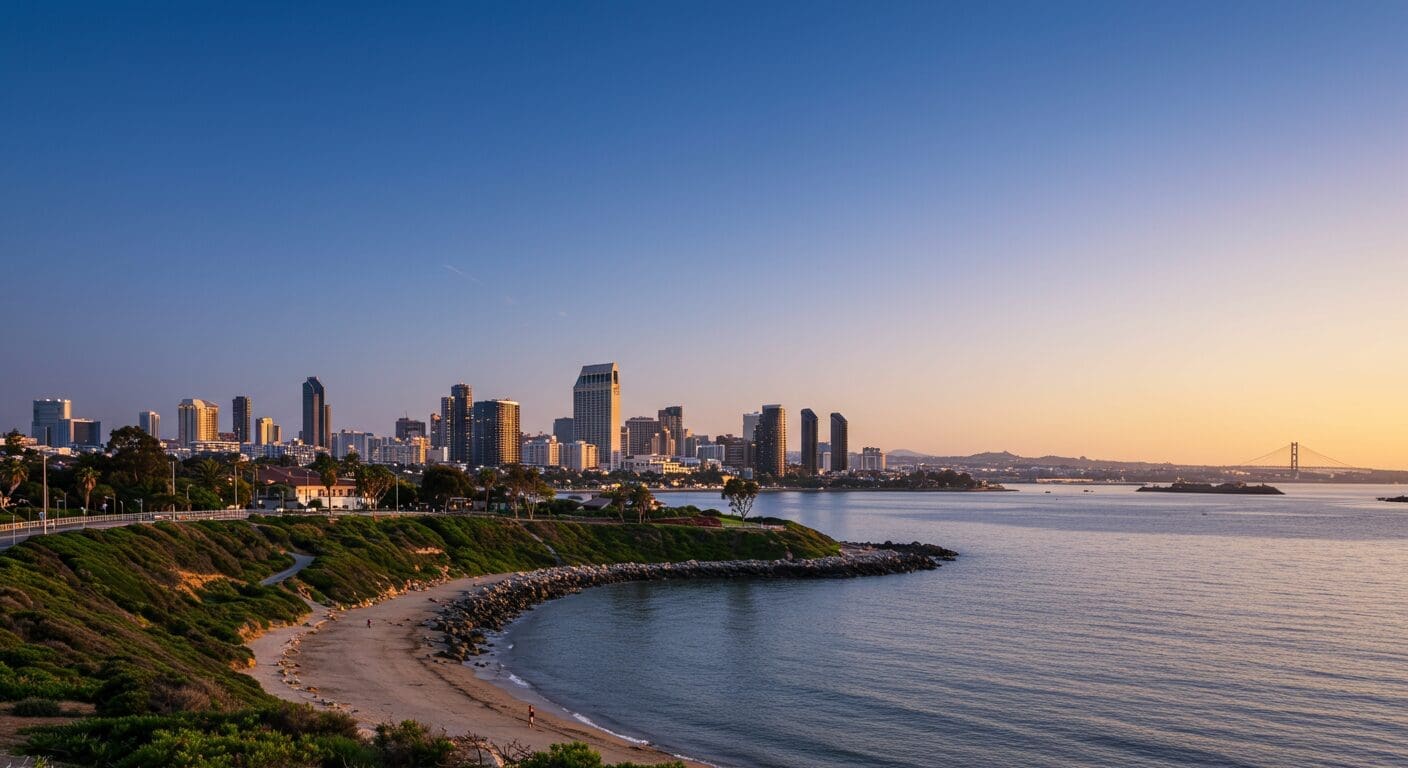
The morning light hits the Pacific at an angle that makes you wonder, briefly, whether Southern California has signed some kind of deal with the sun. You’re on a terrace. There is coffee. The kind of coffee that arrives already perfect, not the kind you have to negotiate with. Below, through a gap in the coastal sage, you can see the water – flat and pewter-blue at this hour, warming slowly toward turquoise. You are not on a schedule. This is not an accident. You chose San Diego specifically because it does this: it takes the noise down, redistributes your priorities, and makes the idea of checking emails feel genuinely absurd. The temperature is 74 degrees. It will probably still be 74 degrees next week. You’ll check. You’ll find that it is.
San Diego is one of those places that works with disarming effectiveness across a surprisingly wide range of travellers. Families seeking genuine privacy – not the performative seclusion of a hotel “family suite” but actual space, an actual private pool, an actual garden where children can exist at full volume without a disapproving glare – find exactly what they need here. So do couples marking milestones, lured by La Jolla’s cliffs and a dining scene that has collected Michelin stars without developing the corresponding self-importance. Groups of friends who’ve graduated from sharing hostel bathrooms (and, frankly, from most hotels) thrive in a city where the outdoors is always immediately available and the evenings never quite want to end. Remote workers discover that reliable connectivity plus a private villa with ocean views does remarkable things for productivity – and for the work-life balance they’ve been meaning to address since approximately 2019. And wellness-focused guests, drawn by the Pacific coast’s particular combination of surf, trail, farmers’ markets and yoga culture, find the city meets them exactly where they are. San Diego doesn’t shout. It doesn’t have to.
Getting Here Without the Usual Indignities
San Diego International Airport – formally Lindbergh Field, because aviators deserve their monuments – sits with extraordinary convenience just three miles from downtown. This is either delightful or slightly alarming depending on your relationship with low-flying aircraft, but the brevity of the taxi ride does a great deal to improve one’s mood upon arrival. It handles direct flights from most major United States hubs, and a growing number of transatlantic routes mean the airport has become a credible entry point for international visitors who’d prefer to skip the Los Angeles experience entirely. From the United Kingdom, connections through Dallas, Chicago, or New York are the standard route – manageable, if not quite glamorous.
Los Angeles International (LAX) remains an option for those with a philosophical tolerance for freeway traffic; it sits around two hours north, conditions permitting, which in Southern California is a phrase that carries significant weight. For those approaching from inland or Arizona, the drive via the I-8 corridor through the Cuyamaca mountains is genuinely worth doing in daylight. Tijuana’s Cross Border Xpress offers a curious alternative for those arriving from Mexico – a literal bridge between a shopping mall and an international airport – but that is perhaps a more adventurous proposition than this particular guide needs to endorse.
Within San Diego itself, a car remains the most useful tool for villa guests who want to range freely between La Jolla, Coronado, North Park, Del Mar and the beach communities. Rideshare apps are reliable and well-priced. The city’s trolley system covers downtown and surrounding areas with surprising efficiency, and the coastal communities are genuinely cyclable. Arriving at your villa directly from the airport by private transfer – ideally a black SUV with cold water and no conversation about traffic, unless you want it – is the correct opening move for a luxury holiday in San Diego.
A Dining Scene That Has Stopped Apologising for Itself
Fine Dining
San Diego’s fine dining landscape used to carry a faint air of apology, as though the city half-expected to be compared unfavourably to Los Angeles or San Francisco and wanted to get ahead of any criticism. That era is emphatically over. The clearest evidence is Addison at the Fairmont Grand Del Mar, which holds three Michelin stars – the only restaurant in San Diego to have done so, and one of the most quietly assured fine dining experiences in the whole of Southern California. The setting is theatrical without being silly: a Moorish-inspired grand house at the end of a long drive, surrounded by the Carmel Valley hills. Chef William Bradley’s multi-course tasting menus are French in inspiration and Californian in ingredient, which is a combination that, here at least, produces results of real elegance. Book early. Book very early.
At the Lodge at Torrey Pines in La Jolla, A.R. Valentien delivers modern American cuisine against a backdrop of rolling golf greens and that particular quality of light that La Jolla seems to have arranged for itself. Named after an early California plein air painter and beloved by food critic Troy Johnson and the readers who’ve voted for it in their tens of thousands, it’s the sort of place where you order the fish and immediately know you made the right decision. Ember & Rye, under Executive Chef Jonathan Bautista, represents something interesting: a steakhouse that takes its own traditions seriously enough to interrogate them. The A5 Japanese Wagyu New York steak is not an item you will forget, or indeed look at a price list before ordering. Some experiences have their own logic.
Where the Locals Eat
The neighbourhoods north and east of downtown – North Park, University Heights, South Park, Hillcrest – form the authentic beating heart of San Diego’s food culture, and the distinction between “local” and “excellent” does not apply here the way it might in other cities. Cori Pastificio Trattoria in North Park is a case in point. Chef Accursio Lota makes pasta by hand every day, drawing on Sicilian tradition while using the extraordinary produce California makes available year-round. The restaurant holds the Three Forks honour from Gambero Rosso and appears in its 2025 Top Italian Restaurants Guide, which is remarkable for a place that still feels, warmly and deliberately, like someone’s kitchen. The gnocchi, when it appears, is not to be passed over.
Tacos are a civic religion in San Diego – the city sits so close to the Mexican border that Baja California is less a foreign country than an extended neighbourhood, and the fish taco here is an object of genuine civic pride. Point Loma’s Liberty Station has evolved from a former naval training centre into a food and culture hub with seafood stalls, casual restaurants and one of the city’s most pleasant afternoon atmospheres. The Little Italy district does excellent farmers’ market mornings on Saturdays, where the produce is the point rather than the performance, and where locals arrive with canvas bags and genuine intent.
Hidden Gems Worth Seeking Out
Soichi, a Michelin-starred omakase bar in University Heights, is the sort of restaurant that people who live in San Diego mention in lowered voices, slightly possessively, in the way that suggests they’re not entirely sure they want you to know about it. It seats a handful of guests and operates with the concentrated precision of somewhere that has no interest in being anything other than exactly what it is. Chef Soichi Kadoya’s omakase is built around seasonal Japanese technique and the finest fish he can source – the experience is intimate, quiet and entirely memorable. Reservations require advance planning of the kind that repays the effort considerably. Consider it the counterpoint to Addison’s grandeur: same devotion, very different room.
The Lay of the Land – and the Coast
San Diego County covers an area larger than Rhode Island and smaller than Connecticut, which is the kind of comparison that means more to Americans than to everyone else, but the essential point is this: there is a great deal of it, and it contains genuine variety. The city itself stretches from the Mexican border at the south to the affluent beach communities of Del Mar and Solana Beach in the north, with the Pacific providing an emphatic western boundary and the Peninsular Ranges rising inland to the east. The geography does real work on the character of each neighbourhood.
Downtown and the Gaslamp Quarter are the obvious centre – walkable, animated, good for an evening – but villa guests rarely end up spending much time there. La Jolla is where the coast reaches its most dramatic expression: chalky cliffs falling to coves of extraordinary clarity, sea lions occupying the rocks with the confidence of homeowners, and an enclave of galleries, restaurants and boutiques that manages elegance without complete stiffness. Coronado, reached by the graceful sweep of the Coronado Bridge or by ferry, is a barrier island community of wide Victorian-era streets, the iconic Hotel del Coronado (all white gables and red turrets), and a beach that consistently appears on lists of the finest in the country. The beach communities of Ocean Beach, Mission Beach and Pacific Beach offer a more boisterous, sun-bleached California that has its own considerable appeal on the right afternoon.
Inland, the story changes. The Cleveland National Forest, the Cuyamaca Rancho State Park and the Anza-Borrego Desert State Park – the largest state park in California – sit within comfortable reach. In spring, Anza-Borrego blooms with wildflowers in a display that borders on the theatrical. The wine country around Temecula is an hour’s drive north and makes for an unhurried day trip from most villa locations.
Things to Do That Don’t Require an Itinerary (and One That Does)
The Pacific Ocean is, from a practical point of view, the main attraction. Whale watching off the San Diego coast operates year-round, which is worth pausing on – this is not a seasonal footnote but a genuine, sustained marine spectacle. Gray whales arrive on their migration from December through April, heading south toward Baja California lagoons and returning north in spring with calves. Humpbacks and blue whales – the largest animals that have ever existed, a fact that never quite loses its effect when you’re standing on a deck watching them surface – appear through the warmer months. Several operators run morning departures from the harbour, and while the experience is never guaranteed, the success rate in San Diego waters is high enough that uncertainty is part of the pleasure rather than the point.
La Jolla Cove has become one of the most famous snorkelling and kayaking spots on the California coast for entirely justified reasons. The protected waters of the San Diego-La Jolla Underwater Park Ecological Reserve mean the marine life has had decades to develop at its own pace: leopard sharks, garibaldi fish (the state marine fish, and very orange about it), sea turtles on warmer days, and the ever-present sea lions who regard the entire cove as their personal territory and you as the visitor. Kayak hire is straightforward; guided snorkel tours are the smarter choice for first-timers and provide context that makes the experience considerably richer. The cliffs above the cove are worth walking for the views alone.
Torrey Pines State Natural Reserve requires a separate mention. It sits on a coastal bluff north of La Jolla, protecting one of only two native stands of Torrey pine in the world – gnarled, wind-twisted trees that look like they’ve been considering the Pacific for several centuries, which they have. The trails range from easy clifftop walks to more involved descents to the beach. The views from the top are the kind that make you take photographs you’ll never quite be satisfied with, and the reserve’s relative accessibility from most San Diego villa locations makes it an obvious morning choice. It is, to use a purely functional word, excellent.
Balboa Park – 1,200 acres of public gardens, museums, theatres and the world-famous San Diego Zoo – deserves a full day. The Zoo needs no elaborate selling: it is one of the finest in the world, with conservation programmes of genuine significance and the kind of immersive habitat design that makes other zoos feel apologetic by comparison. Plan for a morning at minimum. The park’s Spanish Colonial Revival architecture, built for the 1915 Panama-California Exposition, is a secondary pleasure that sneaks up on you.
The Athletic Pursuits of an Outdoors-Obsessed City
San Diego produces an improbable number of professional surfers for a city of its size, and the reason is straightforwardly geographical. Ocean Beach, Pacific Beach, and particularly the breaks around La Jolla and further north at Del Mar and Encinitas offer conditions that suit both beginners and the genuinely accomplished. Surf schools are good here, staffed by instructors who take the teaching seriously rather than treating it as a holding operation until better waves arrive. Adults who’ve never surfed and are quietly terrified will find the beginner beaches forgiving; those with some experience can find their way to more demanding breaks with appropriate guidance.
Hiking has its own ecosystem in San Diego. Beyond Torrey Pines, the trails of Mission Trails Regional Park sit remarkably close to the city’s eastern suburbs and include Cowles Mountain, the highest point within the city limits at just under 1,600 feet – less alpine challenge than genuine satisfaction, with panoramic views that make the ascent entirely worthwhile. The Cuyamaca mountains, an hour east, offer proper trail hiking with elevation, wildflowers in season and the particular silence of higher ground. Cycling is equally well-served: the Bayshore Bikeway around San Diego Bay is flat, scenic and family-appropriate; the inland routes are more demanding and rewarding accordingly.
Sailing on San Diego Bay is as close to a perfect afternoon as the city offers. The bay is large, protected from serious swell, and busy enough with traffic to feel animated without being dangerous. Charter options range from crewed sailboats to private sunset catamaran trips, and the view of the city skyline from the water at golden hour is the kind of thing that makes people extend their holidays. Paddleboarding on Mission Bay – a purpose-built aquatic park carved out of wetlands in the mid-twentieth century – is calmer and more accessible, particularly good for those who prefer their aquatic activities to involve less water in the face.
Why Families Find San Diego Difficult to Leave
San Diego has a strong claim to being the finest family destination in the continental United States, and the argument is not complicated. The weather removes the primary variable that defeats family holidays in most other locations. The city maintains world-class child-specific attractions without making adults feel like they’ve been parked. And the outdoor life – beaches, parks, wildlife, water – is immediately and continuously available without significant planning or expense.
The San Diego Zoo has already been mentioned; the San Diego Zoo Safari Park in Escondido, about an hour north, is its companion institution and arguably more impressive for older children and teenagers, with open savanna-style enclosures and behind-the-scenes wildlife experiences. SeaWorld San Diego remains a significant draw for younger children, though its programming has evolved considerably toward conservation education in recent years. Legoland California in Carlsbad – 30 minutes north – is exactly what it sounds like, which at ages five through twelve is a recommendation rather than a limitation.
The private villa advantage for families is not subtle. The difference between managing children in a hotel – the corridor negotiations, the pool hours, the breakfast buffet logistics, the genuine anxiety about noise levels – and having a private property with its own pool, its own garden, its own kitchen and its own rhythm is the difference between a holiday and a logistics exercise. Villa guests in San Diego let children sleep in proper beds rather than rollaway cots, establish routines that don’t require negotiation with front desks, and use the pool at 8pm if that’s when the mood takes them. The concierge arrangements available through Excellence Luxury Villas mean that child-specific needs – high chairs, beach equipment, babysitting arrangements, private chef dinners timed to school-age appetites – are handled before they become problems. It is, quietly, a very different experience.
History, Culture and the California That Got Here First
San Diego makes a credible claim to being the birthplace of California, which is either historically accurate or mildly contested depending on who you ask. The Kumeyaay people inhabited this region for at least 10,000 years before Spanish missionaries arrived in 1769 to establish Mission San Diego de Alcalá – the first of California’s 21 missions, and still standing in its later-rebuilt form in Mission Valley. The Old Town San Diego State Historic Park preserves the layout and feel of the original Mexican pueblo that grew up around the mission era, with adobe buildings, a central plaza and an atmosphere that, unlike most heritage sites, feels genuinely rooted rather than staged.
The city’s military history is substantial and unavoidable: San Diego has housed a major naval base since the early twentieth century, and the USS Midway Museum – a decommissioned aircraft carrier moored on the downtown waterfront – is one of the most visited museums in California for very good reasons. The experience of standing on a flight deck with an F/A-18 at your elbow while the bay spreads out around you does something immediately cinematic. Balboa Park’s sixteen museums cover natural history, anthropology, air and space, photography, model railroading (a surprisingly passionate constituency), and the performing arts, with the Museum of Man and the San Diego Museum of Art among the most substantive.
The arts scene has deepened considerably in recent years. The new San Diego Central Library, a civic building of architectural confidence, anchors a growing downtown cultural district. The La Jolla Playhouse has a well-established reputation for producing works that subsequently transfer to Broadway – a track record that earns it genuine national attention. The Little Italy district, once straightforwardly Italian-American, has evolved into one of the most creative neighbourhoods on the West Coast, with galleries, studios and design-led shops occupying the spaces between restaurants.
Shopping Without the Usual Disappointments
San Diego resists the generic retail experience with more success than most American cities. The neighbourhood shopping of Little Italy, North Park and South Park rewards slow browsing: independent bookshops, ceramics studios, vintage clothing that hasn’t been priced as though it’s new, design objects that don’t appear on the first page of any Google search. The Headquarters at Seaport – a converted 1939 police headquarters building on the waterfront – houses independent shops and restaurants within its original cell blocks and courtyard, which gives the shopping an architectural context that the mall cannot provide.
Old Town’s markets lean heavily toward Mexican handicrafts and Baja-inspired goods – hand-painted pottery, embroidered textiles, silver jewellery, mezcal – and while the provenance varies, the selection is genuine enough to reward careful attention. The weekly farmers’ markets, particularly the Little Italy Mercato on Saturday mornings, are where local producers bring Californian citrus, avocados, microgreens, artisan preserves and bread that is considerably better than anything available at the airport. This is also, incidentally, an excellent way to stock a villa kitchen for the week.
For luxury retail, the Fashion Valley Mall in Mission Valley hosts the predictable collection of premium brands – Hermès, Louis Vuitton, Nordstrom, the usual cast – while the boutiques of La Jolla Village offer a more curated selection of clothing, jewellery and homewares that reflects the neighbourhood’s particular brand of understated affluence. What San Diego does not do especially well is the kind of concentrated luxury retail district that exists in Beverly Hills or central Manhattan, but the trade-off is a shopping culture that feels more like local commerce and less like a transaction.
The Practical Notes That Actually Matter
The best time to visit San Diego is a question with a more straightforward answer than most: the city maintains a semi-arid Mediterranean climate that produces approximately 266 sunny days per year, with average temperatures ranging from the low 60s Fahrenheit in winter to the mid-70s in summer. June is locally known as “June Gloom” – a coastal marine layer settles in during morning hours and burns off by midday, which is a greater psychological burden than a meteorological one. July through October offers the warmest, clearest conditions; December through February is cooler but genuinely mild and considerably less crowded. Spring is perhaps the most underrated season: wildflowers inland, baby gray whales off the coast, and a city that hasn’t yet reached peak summer occupancy.
Currency is the US dollar; no surprises. Tipping culture operates at the familiar American rate of 18-20% at restaurants, and the expectation is consistent enough that it functions as a de facto service charge. The city is safe by the standards of major American cities, with La Jolla, Coronado, Del Mar and the coastal communities all operating at levels of public safety that will not require adjustment for visitors from most international origins. Tap water is perfectly drinkable. The legal drinking age is 21, which catches out some European visitors more than they expect.
The city is English-speaking with significant Spanish-language presence, particularly south of downtown, and basic Spanish is useful and warmly received in markets and smaller restaurants. Driving is on the right; speed limits are strictly enforced by cameras in ways that the local roads don’t always suggest. Most villa guests will find an international driving licence sufficient, though US renters will use their standard licences. Sun protection is not optional – the latitude and the reliability of the sun produce UV levels that visitors from the United Kingdom reliably underestimate on the first day and overestimate on every subsequent day thereafter.
Why a Luxury Villa in San Diego Is the Only Sensible Arrangement
The hotel experience in San Diego is, broadly, excellent. There are excellent properties on the waterfront, excellent properties in La Jolla, and the Fairmont Grand Del Mar is a genuinely impressive resort by any measure. The hotel, however, remains a shared infrastructure. The pool is shared. The garden, if there is one, is shared. The breakfast is shared with every other guest who has the same idea at the same time. The concept of genuine solitude – the kind that a luxury holiday in San Diego is supposed to deliver – requires a different arrangement entirely.
A private villa changes the fundamental terms of the stay. The pool is yours, available at any hour in any weather you consider reasonable, with no pool attendant politely suggesting you reserve a sun lounger before 7am. The space – and San Diego’s finest villa properties offer genuinely significant space, often across multiple levels, with outdoor dining areas, fire pits, chef’s kitchens and interiors that put most hotel suites at a certain disadvantage – belongs entirely to your party. For groups of friends, this means the evening extends as long as it needs to extend without reference to bar closing times. For families, it means children exist in their natural habitat rather than in a constrained version of it. For couples, it means privacy that hotels, however well-intentioned, cannot quite replicate.
The wellness dimension is particularly well-served by villa accommodation in San Diego. Properties with private gyms, treatment rooms, infrared saunas and pool areas designed for contemplation rather than performance are available across the Excellence Luxury Villas portfolio – and the surrounding environment does the rest. The coastal trails, the morning surf, the farmers’ markets, the evening temperature that allows outdoor dining without a coat: the city itself functions as a wellness amenity in a way that requires no programme, no booking and no fee.
Remote workers – and San Diego attracts them with increasing purpose – find the villa arrangement particularly effective. High-speed broadband is standard across premium properties; where fibre infrastructure hasn’t reached, Starlink provides the coverage that ensures a Monday morning video call proceeds without the particular anxiety of hotel Wi-Fi. A dedicated workspace, a private terrace, morning coffee made in your own kitchen, a swim at noon: this is what the work-life balance conversation was theoretically about, and it turns out it was a villa in Southern California all along.
The concierge and staffing options available through Excellence Luxury Villas extend the experience considerably. A private chef who shops the Little Italy Mercato on Saturday morning and produces a dinner around what he finds is a different proposition from a restaurant, however good the restaurant. A chauffeur who knows which breaks are working and which whales have been spotted that morning is a more useful travelling companion than any app. These are not luxuries in the sense of the unnecessary; they are the mechanisms by which a very good holiday becomes an unrepeatable one.
Excellence Luxury Villas offers an extensive portfolio of luxury villas in San Diego with private pool – from La Jolla clifftop properties to secluded Coronado retreats and contemporary coastal homes in Del Mar. The full collection is available to browse, with dedicated travel specialists who know the properties personally and can match the right villa to your party with a precision that a search algorithm, however sophisticated, cannot quite replicate.
More San Diego Travel Guides
- Best Restaurants in San Diego: Fine Dining, Local Gems & Where to Eat
- San Diego Food & Wine Guide: Local Cuisine, Markets & Wine Estates
- San Diego with Kids: The Ultimate Family Holiday Guide
- Best Time to Visit San Diego: Month by Month Weather, Crowds & Tips
- San Diego Luxury Itinerary: The Perfect 7-Day Guide
- Romantic San Diego: The Ultimate Couples & Honeymoon Guide
What is the best time to visit San Diego?
San Diego’s climate is consistently good enough that the question is really about trade-offs rather than avoidance. July through October offers the warmest temperatures and clearest skies, and is peak season accordingly. Spring – March through May – brings wildflowers, whale calves and lower occupancy. June brings the coastal marine layer (locally “June Gloom”) that burns off by midday but can catch visitors by surprise. December through February is genuinely mild, considerably quieter and arguably the most underrated time to visit if you are not sun-dependent to a clinical degree.
How do I get to San Diego?
San Diego International Airport (SAN), just three miles from downtown, is the primary arrival point and handles direct flights from most major US cities. International visitors typically connect through Dallas/Fort Worth, Chicago O’Hare or New York JFK. From the United Kingdom, connecting flights take approximately 14-18 hours total. Los Angeles International (LAX) is an alternative at around two hours north by road, conditions permitting – a phrase that carries real weight on Southern California freeways. Private transfer from SAN to villa accommodation typically takes 20-40 minutes depending on location.
Is San Diego good for families?
Unusually, straightforwardly, yes. The combination of reliable weather, world-class child-oriented attractions (the San Diego Zoo, the Safari Park in Escondido, Legoland in Carlsbad, SeaWorld), accessible beaches and outdoor activities that work across ages makes San Diego one of the most effective family destinations in the United States. The private villa advantage for families is significant: proper space, a private pool, a kitchen for early suppers, and no corridor negotiations about noise levels. San Diego rewards multi-generational groups particularly well, because the range of activities available means everyone finds their version of the day.
Why rent a luxury villa in San Diego?
The short answer is privacy and proportion. A luxury villa provides space – real space, not hotel-room space – along with a private pool, a private garden, a kitchen that works for your schedule rather than a restaurant’s, and a staff-to-guest ratio that hotels at any price point cannot match. For families, the freedom is transformative. For couples, the seclusion is the point. For groups, the shared villa experience is categorically different from booking adjacent hotel rooms. San Diego’s finest villa properties also benefit directly from the outdoor lifestyle the city makes available: a private pool matters more in a climate that allows year-round swimming.
Are there private villas in San Diego suitable for large groups or multi-generational families?
Yes, and the portfolio across Excellence Luxury Villas’ San Diego collection includes properties specifically suited to large groups and multi-generational travel. Villa sizes range from intimate four-bedroom properties for smaller families up to estate-scale homes accommodating 14 or more guests across separate wings, guest houses and staff quarters. Private pools, outdoor entertaining areas with full kitchens, cinema rooms, games rooms and spa facilities are common features at the larger end of the portfolio. Multi-generational groups benefit particularly from the layout flexibility – grandparents in a ground-floor suite, teenagers in a separate wing, everyone converging at the pool.
Can I find a luxury villa in San Diego with good internet for remote working?
Reliable high-speed broadband is standard across Excellence Luxury Villas’ premium San Diego properties. Most homes in La Jolla, Del Mar, Coronado and the coastal communities are served by fibre-based infrastructure capable of supporting multiple simultaneous video calls without difficulty. Where infrastructure varies, properties increasingly feature Starlink satellite systems providing consistent, high-speed connectivity regardless of location. Dedicated workspaces – home offices, library rooms or simply well-positioned desks with natural light – are features guests can request specifically when booking. San Diego’s time zone (Pacific) also works well for remote workers maintaining contact with both US East Coast and European counterparts.
What makes San Diego a good destination for a wellness retreat?
San Diego’s outdoor culture is essentially a wellness infrastructure that requires no formal programme. The coastal trails, surf breaks, farmers’ markets, paddleboarding on Mission Bay, whale watching on the open Pacific and hiking through Torrey Pines are all immediately available without booking or fee. Private villa amenities – pools for morning laps, private gyms, treatment rooms, infrared saunas and outdoor spaces designed for the kind of contemplative stillness that hotels cannot quite provide – extend the experience inward. The city’s food culture, rooted in exceptional local produce and heavily influenced by the Baja California culinary tradition, is healthy without being evangelical about it. The pace of life does the rest.