Setúbal with Kids: The Ultimate Family Holiday Guide
Setúbal with Kids: The Ultimate Family Holiday Guide
In July, when the rest of Portugal’s coast is operating at full tourist capacity and the Algarve has become an exercise in towel-placement strategy, something quietly extraordinary happens in Setúbal. The Atlantic light turns long and golden, the Serra da Arrábida smells of wild rosemary and warm limestone, and the beaches – protected inside a natural park – fill up with Portuguese families who know exactly what they’re doing. They’ve known about this place for generations. The rest of the world is only just catching on. For families travelling with children, particularly those who’ve grown weary of the predictable resort carousel, Setúbal offers something genuinely different: beauty without the performance, nature without the roughing-it, and a pace of life that even a bored eleven-year-old can’t quite resist.
Why Setúbal Works So Well for Families
There’s a particular kind of family holiday alchemy that doesn’t happen very often. It requires beaches that aren’t exhausting to navigate with children, towns that reward curious minds without demanding enormous effort, food that adults actually want to eat, and enough space for everyone to decompress. Setúbal has all of this, largely because it hasn’t been engineered for tourism. It’s a working port city with real character – fishing boats, local markets, the particular smell of fresh catch being unloaded at the docks – and that authenticity is, paradoxically, enormously child-friendly.
Children tend to be excellent anthropologists when given the chance. Give them a real place rather than a managed tourist environment, and they engage with it. The Parque Natural da Arrábida wraps around the entire coastal stretch here, which means development is limited by law. That’s not a marketing line – it’s the reason the water at Portinho da Arrábida is the shade of blue that makes adults go oddly quiet and children immediately want to jump in.
The region also has an inherent variety that makes it work across different ages and temperaments. Water babies, history enthusiasts, beach readers, kayak adventurers, wildlife spotters – Setúbal accommodates them without anyone needing to compromise badly. That’s rarer than it sounds. For more context on what the wider area offers, the Setúbal Travel Guide covers the destination in fuller depth.
The Best Beaches for Families with Children
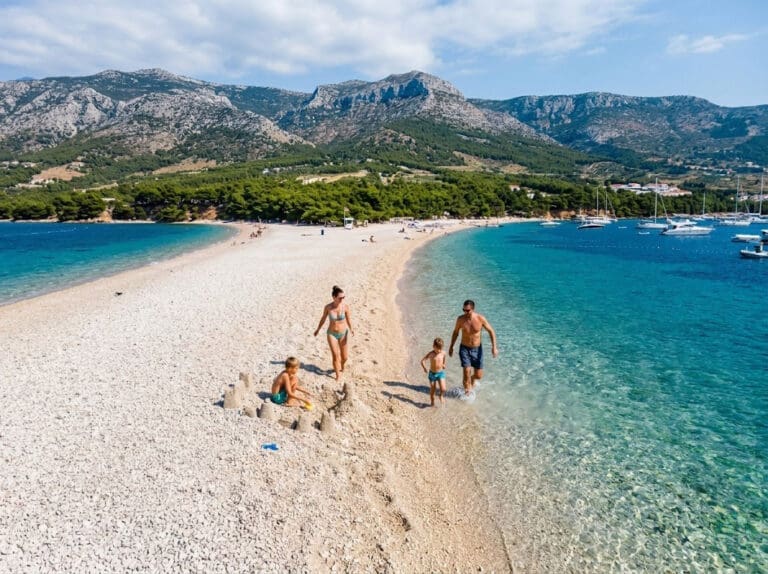
The beaches of the Arrábida Natural Park are the centrepiece of any family visit to Setúbal, and they merit being treated as such. Portinho da Arrábida is the most celebrated – a sheltered cove with water so calm and clear it reads more like the Mediterranean than the Atlantic. For families with younger children, this near-absence of waves is transformative. You can actually watch your toddler from where you’re sitting. Nobody is being unexpectedly knocked over by a rogue swell. These things matter.
Galapinhos is a wilder, less accessible option that suits older children and teenagers well – the walk down through pine and cistus woodland is part of the experience, and the sense of earned arrival is real. It was named Europe’s best beach for a reason, though the locals will tell you they were aware of this long before any award committee got involved. Portinho offers small beach restaurants for lunch; Galapinhos asks you to bring your own, which is an excellent excuse for an early-morning market run.
For a completely different kind of family beach day, the wider Setúbal bay side offers calmer, more expansive stretches ideal for young children and paddling without the terrain navigation. The important practical note: Arrábida beaches have limited parking in summer, and access can be restricted to preserve the natural park. Arriving early – genuinely early, not holiday-early – is essential, or using licensed boat transfers from Setúbal town, which children reliably consider more exciting than the beach itself.
Family Activities and Experiences Worth Planning Around
The Arrábida Natural Park is the obvious headline, but the activity possibilities within it are extensive enough to structure an entire week around. Kayaking and stand-up paddleboarding through the park’s sea caves and along the limestone cliff lines is available through local operators for families with children roughly eight and up, though this varies by provider. The combination of turquoise water, dramatic rock formations overhead, and the physical effort of paddling creates the kind of afternoon that children talk about for months. Adults too, though they tend to describe it slightly differently at dinner.
Boat trips from Setúbal port offer dolphin-watching excursions that are genuinely rather good. The Sado Estuary is home to a resident population of bottlenose dolphins – not visiting, not occasional, but actually resident – and sightings are reliable rather than hopeful. For families with younger children, the calmer estuary waters also make this considerably more comfortable than open-ocean wildlife experiences.
In Setúbal town itself, the Museu de Arqueologia e Etnografia do Distrito de Setúbal offers a manageable introduction to local history and culture without the scale that overwhelms children. The 16th-century Igreja de Jesus – one of Portugal’s earliest Manueline buildings – is worth a short visit for the extraordinary twisted stone columns alone. Even children who are broadly indifferent to churches tend to find the stonework peculiar enough to be interesting. The covered market near the waterfront is ideal for a morning with older children: fresh fish, local cheese, the general organised theatre of a working market.
For families with teenagers specifically, the area around the Arrábida fortress offers excellent hiking with real views at the end. Cycling routes along the Sado Estuary provide a different kind of exploration, and several operators offer guided half-day trips at an accessible pace.
Eating Out with Children in Setúbal
Portuguese culture is genuinely, not performatively, welcoming to children in restaurants. This is a cultural reality rather than a marketing claim. Children are included, not accommodated – there’s a difference, and you feel it. The seafood in Setúbal is as fresh as anywhere in Portugal, and while a formal tasting menu is probably not the ideal format for a family with a five-year-old, the region’s simpler, quality-first approach to food translates exceptionally well to family dining.
The waterfront in Setúbal town has a cluster of seafood restaurants where grilled fish, arroz de lingueirão (razor clam rice), and generous bread baskets arrive without fuss. Children who eat fish – and many more will, given what arrives on the plate here – are well served. Those who don’t will find the familiar comfort of good bread, cheese, and ham appearing without drama. The local moscatel wine, which adults will be investigating seriously, comes with perfectly adequate grape juice for the younger party members.
Practical tip: lunch is the main meal in Portugal, and restaurants fill quickly from around 1pm. For families with children, arriving at 12:30 gets you seated, settled, and served before the heat of the afternoon peaks. It also means everyone is considerably better-tempered. Dinner at around 7:30pm, which feels early to Portuguese locals but reasonable to most travelling families, works well.
Practical Advice by Age Group
Toddlers (under 5): Setúbal rewards families with very young children more than many coastal destinations because the sheltered beaches at Portinho da Arrábida offer calm, shallow water without strong current or wave action. The main practical consideration is the summer heat – temperatures regularly reach the high 30s in July and August. A villa with a private pool, covered terrace, and blackout naps built into the afternoon schedule is not a luxury here, it’s a survival strategy. Bring a good quality UV shade tent for beach days and plan activity around the cooler morning and early evening hours.
Juniors (5-12): This age group is, arguably, the sweet spot for Setúbal. Old enough for kayaking, snorkelling in the clear Arrábida water, dolphin-watching excursions, and proper market mornings; young enough to find the novelty of a different country genuinely exciting. The variety of the region means that no two days need to look the same, which is its own kind of gift during a longer stay. A week here rarely produces the hollow ‘I’m bored’ that a purely beach-based resort week can invite.
Teenagers: Teenagers tend to find places either interesting or not, and rarely update their opinion mid-holiday. Setúbal makes a reasonable case for interesting. The hiking in the Arrábida park has enough physical commitment to feel like a genuine undertaking; the snorkelling and paddleboarding deliver the kind of independent physical experience teenagers respond to; and Setúbal town has enough authentic local life that the culturally curious ones find genuine material. The beaches are, without question, impressive enough to communicate through a phone screen to maximum effect. That matters. Don’t pretend it doesn’t.
Why a Private Villa with Pool Changes Everything
There is a version of the family holiday where everyone shares a hotel corridor, meals require advance negotiation, a toddler’s early wake-up becomes a public event, and the pool hours are printed on a laminated card. And then there is the villa version, which operates entirely differently and produces an entirely different kind of holiday.
A private villa with pool in Setúbal – and the region offers exceptional options, set into hillsides above the Arrábida with views that do something unquantifiable to the mood – gives a family its own rhythm. Children can be in the water at 8am. Teenagers can stay up late on a terrace without anyone negotiating. Grandparents can read in peace. Parents can cook when they choose, eat when they choose, and have a quiet glass of wine after the youngest has gone to sleep without it being a logistical operation.
The practical advantages compound quickly. A villa with a well-equipped kitchen means breakfast is easy, packed lunches for beach days are straightforward, and the afternoon gelato run is the only catering decision that genuinely requires consensus. For families with children at different ages – the most complex travelling unit known to modern tourism – having enough space that everyone can find their own corner of it is not a small thing. It’s the thing.
Villas in the Setúbal area also tend to offer a level of integration with the landscape that hotel rooms simply cannot. Waking up to the Arrábida hills, eating dinner with a view of the Sado Estuary in the evening light, having a pool that feels like it belongs to the place rather than to a facility – these are the details that mean holidays are genuinely remembered rather than pleasantly forgotten. For families, memory-making is rather the point.
If this is the kind of holiday you’re planning, explore our curated selection of family luxury villas in Setúbal – properties chosen specifically for families who want privacy, quality, and genuine connection to one of Portugal’s most rewarding landscapes.
What is the best time of year to visit Setúbal with children?
June and early September are ideal for families with children. The weather is warm and settled, the Arrábida beaches are at their best, and the summer peak crowds have either not yet arrived or have begun to thin. July and August are also excellent but hotter and busier – access to Arrábida beaches can be restricted during peak weeks, so early starts and pre-planned logistics matter. Families with school-age children constrained to peak summer dates will still have a wonderful trip, but arriving early at beaches and booking boat excursions in advance is essential.
Are the Arrábida beaches suitable for young children and toddlers?
Yes – Portinho da Arrábida in particular is well suited to young children because of its sheltered cove position, calm water, and gentle entry. The Atlantic swell that makes some Portuguese beaches challenging for very small children is largely absent here. The water is clear enough to see the bottom, which also helps nervous paddlers of any age. The main practical consideration is the heat in high summer and the limited shade on the beach itself, so a UV tent, early arrival, and a well-timed afternoon return to a villa pool is the sensible family strategy.
Is Setúbal a good destination for a multi-generational family holiday?
Setúbal works exceptionally well for multi-generational groups, largely because of the variety it offers across different ages and mobility levels. Grandparents can enjoy the town’s waterfront, local markets, and excellent seafood restaurants at a comfortable pace while younger family members tackle the Arrábida hiking trails or spend long days at the beach. A private villa serves as the natural base that brings everyone together in the evenings without requiring the group to operate as a single unit all day. The region’s cultural depth – good food, a beautiful natural environment, genuine Portuguese character – gives everyone something to engage with on their own terms.