Sicily with Kids: The Ultimate Family Holiday Guide
Sicily with Kids: The Ultimate Family Holiday Guide
Here is the thing nobody tells you before you take children to Sicily: they will eat better here than almost anywhere else in Europe. Not in a polished, please-keep-your-voice-down kind of way, but in the way that actually matters – arancini handed over a counter, granita eaten on a harbour wall at nine in the morning, pasta so simple it involves approximately three ingredients and somehow undoes everything you thought you knew about cooking. Sicily, for all its ancient drama and baroque grandeur, is an island that feeds children like they are the most important people in the room. Which, in Sicilian culture, they more or less are.
This is not a destination you endure with children in tow. It is one that genuinely improves with them along. That is not something you can say about everywhere.
Why Sicily Works So Well for Families
Sicily has the kind of scale and variety that quietly solves the problem every family holiday eventually presents: keeping everyone happy at the same time. It is the largest island in the Mediterranean, and it wears its size with a pleasing lack of fuss. In the space of a single day, you can move from black volcanic beaches on the east coast to the chalky white cliffs of the west, from a Norman cathedral older than most countries to a fish market so alive with theatre it practically narrates itself. Children, who have not yet been told to find this sort of thing overwhelming, tend to love it unreservedly.
There is also the question of welcome. Italian culture famously centres the child – waiters will produce bread before you have sat down, locals will coo at toddlers in a way that could make a British grandparent feel emotionally underprepared, and no one will make you feel like an inconvenience for arriving at a restaurant with a buggy and unrealistic ambitions. Sicily, in this regard, takes the Italian instinct and amplifies it. The island has its own particular warmth, less performed than Rome, more rooted. It is an easy place to relax into – which is, ultimately, what a family holiday is for.
Practically, the combination of geography, food culture, history and climate makes the planning almost offensively easy. For a fuller picture of what the island offers, the Sicily Travel Guide is a sensible starting point before you begin booking anything.
The Best Beaches for Families
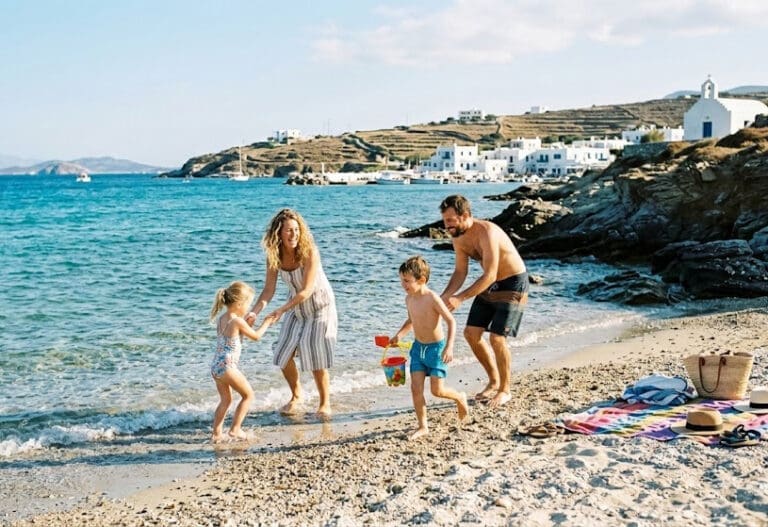
Sicily’s coastline is not a single thing. It is a series of quite different arguments about what a beach should be, and families will find their preferred side of the debate quickly. The northwest offers the shallow, warm, turquoise waters of the Gulf of Castellammare and the beaches around San Vito Lo Capo – waters so calm and clear they look engineered for children who have not quite mastered swimming yet. The sand here is fine and pale, the sea approaches gently, and the surrounding nature reserve keeps the development tasteful.
On the south coast, the beaches near Agrigento and Sciacca stretch for implausible distances with the kind of space that means a game of cricket – or whatever version of it your eight-year-old insists is correct – is entirely viable. The Scala dei Turchi, a white marl cliff that descends into the sea in a series of natural steps, is one of those rare places that photographs cannot quite contain. Children and adults both tend to fall silent when they see it. Then someone slips and the moment passes.
The east coast, around Taormina and the Ionian stretch, trades some of the white-sand perfection for drama and history. Isola Bella, the tiny island connected to its beach by a narrow strip of pebbles, has snorkelling that will occupy teenagers for hours. Further south towards Syracuse, the coastline softens into coves and inlets well suited to exploring by kayak or paddleboard – activities that can be arranged through most reputable local operators.
Things to Do with Children in Sicily
Mount Etna is the unavoidable centrepiece of any family itinerary in eastern Sicily, and rightly so. At over 3,300 metres, it is Europe’s largest active volcano, and it has the good manners to look exactly as dramatic as it should. Guided excursions to the upper craters are suitable for older children and teens, while the lower slopes – covered in ancient lava fields, chestnut forests and vineyards – can be explored on foot, by jeep, or on the narrow-gauge Circumetnea railway, which winds around the volcano’s base in the manner of a train set that got slightly out of hand.
The Valley of the Temples near Agrigento is the kind of history that does not require explanation. Children who would glaze over at a museum will stand in front of the Temple of Concordia – intact, golden, 2,500 years old – and understand, without being told, that something significant happened here. Time the visit for late afternoon, when the light is low and the crowds have thinned, and it becomes one of those genuinely memorable family moments. The ancient Greek theatre at Taormina, with Etna smouldering behind it and the sea glittering below, offers similar pause-and-look-up energy.
For something more hands-on, the Palermo street food scene is an experience in itself – wandering the Ballarò or Vucciria markets with children introduces them to noise, colour, and the question of what exactly is in that, which is a formative travel skill in its own right. Cooking classes for families are widely available across the island, usually centred on pasta, arancini or Sicilian pastries. Children who are uninterested in cooking at home are frequently evangelical about it the moment someone hands them an apron in a farmhouse kitchen.
Eating Out with Children in Sicily
The good news arrives quickly: finding places that welcome children with genuine enthusiasm rather than polite tolerance is not a challenge in Sicily. The more interesting question is calibrating your ambitions. Lunch, eaten early and long at a trattoria, tends to work better than dinner for smaller children – both for the quality of the food and the collective sanity of everyone involved. Most Sicilian trattorias will produce a simple pasta al pomodoro, a grilled fish, or a pizza-adjacent something without drama or additional charge.
Arancini deserve their own mention. These deep-fried rice balls – filled with ragù, mozzarella and peas, or with butter and béchamel – are sold from counters, bars and markets across the island and represent the ideal child-feeding mechanism: portable, filling, impossible to dislike, and entirely acceptable at ten in the morning. The debate between eastern Sicily (where they are spherical and called arancine) and the western version (cone-shaped, arancini) is taken seriously by locals and completely ignored by children, who simply eat them.
Gelato, granita, and brioche col tuppo – the sweet, brioche roll traditionally served alongside granita – complete the picture. The Sicilian breakfast of granita with brioche is not a tourist affectation. It is the actual breakfast. Children accept this immediately and without the moral hand-wringing adults tend to apply.
Age-by-Age Guide: Toddlers, Juniors and Teens
Toddlers (0-4): Sicily’s pace, once you are established somewhere, is accommodating for very young children. The key is not overscheduling – a beach, a good lunch, and a wander around a hilltop town is an entirely complete day. The heat between July and August is genuine and should be respected; May, June and September are the sensible choices for families with babies or toddlers who have not yet developed strong opinions about the weather. Most villas will supply cots, highchairs and pool fencing on request, and the local pharmacies are excellent for anything you have forgotten.
Juniors (5-12): This is arguably the sweet spot for Sicily with children. Old enough to absorb Etna and the Valley of the Temples, young enough to be delighted by a day’s snorkelling and a market visit in equal measure. This age group tends to take to the island’s food culture readily – the straightforwardness of Sicilian cooking, its reliance on quality ingredients rather than complexity, produces meals that even selective eaters can navigate. A day trip to the Aeolian Islands on a boat, with lunch at a waterfront restaurant and swimming off rocks, is the kind of thing this age group remembers with unusual accuracy for years.
Teens (13+): Teenagers, famously difficult to please, tend to find Sicily more interesting than they expected. The combination of volcanic landscape, excellent swimming, and a food culture that rewards curiosity gives them enough to engage with on their own terms. Hiking on Etna, diving or snorkelling in the marine reserves around the Egadi Islands or Ustica, and the genuine antiquity of sites like Segesta – where the unfinished Doric temple sits alone on a hilltop as if waiting for something – land differently for this age group than a theme park ever could. Give a teenager a scooter’s worth of independence in a Sicilian hilltop town and they will probably have a more formative afternoon than anything you planned.
Why a Private Villa with Pool Changes Everything
There is a particular kind of family holiday exhaustion that has nothing to do with how far you have walked. It comes from the constant negotiation of shared space – the hotel breakfast timing, the corridor noise, the business of existing alongside strangers while trying to hold a holiday together. A private villa removes this problem so completely that it takes a day or two to notice it has gone.
In Sicily, where villas range from converted masserie in the countryside to whitewashed retreats above the sea, the private pool is not a luxury in the frivolous sense. It is the functional centre of the family day. Children have somewhere to be – loudly, safely, without restriction – while adults have somewhere to sit near them with a glass of something cold. Meals happen when they happen. Bedtimes are observed, or not, without reference to restaurant sittings. The morning is unhurried in the way that hotel mornings, however lovely the hotel, fundamentally are not.
Villa kitchens matter too. A Sicilian market visit followed by cooking in a properly equipped kitchen – pasta for the children, something more considered for the adults after they are in bed – becomes a ritual that structures the holiday pleasantly. Many villas can arrange a private chef for part or all of a stay, which solves the dinner question entirely while adding a dimension that the best restaurant in the area could not replicate. Someone cooking for your family, in your kitchen, on your schedule, while the children are already in pyjamas watching something in Italian they do not understand: this is the quiet luxury that justifies itself on the first evening.
Space, finally, is what villas give that nothing else does. Room to spread out, room for children to have their own territory, room for adults to have a conversation that isn’t held through gritted teeth in a hotel corridor. Sicily’s villas tend to deliver on grounds and gardens too – old stone terraces, lemon trees, views that reward sitting still. Which is, in the end, what the island asks of you.
Whether you are travelling with toddlers who need a safe enclosed garden or teenagers who need their own room and a fast Wi-Fi connection, the right villa makes the whole enterprise significantly more enjoyable for everyone involved. Browse our collection of family luxury villas in Sicily to find the right base for your particular family’s version of a perfect holiday.
What is the best time of year to visit Sicily with children?
Late May through June and September into early October are the ideal windows for families with children. The sea is warm enough to swim comfortably, the temperatures are manageable without the intense heat of July and August, and the main sites are noticeably less crowded. Families with toddlers or young children in particular should avoid peak summer months, when midday heat can be genuinely punishing. School holiday timing in July and August is workable with the right villa base – particularly if you have a private pool to retreat to during the hottest part of the day – but the shoulder seasons offer a noticeably more relaxed experience.
Is Sicily a safe destination for families with young children?
Sicily is a very safe family destination. Petty crime exists in busy city centres, as it does across southern Europe, but the island’s towns and countryside are relaxed and welcoming environments for families. Beaches generally have calm, shallow entry points suited to young swimmers, and private villas with pool fencing offer additional peace of mind for families with toddlers. It is worth checking sea conditions and any local guidance before swimming off rocks or in coves, particularly on the windward northern coast. Overall, the infrastructure for family travel is well developed, and locals are exceptionally accommodating towards children of all ages.
How do I get around Sicily with children – do I need to hire a car?
A hire car is strongly recommended for families in Sicily, particularly if you are staying in a villa outside a town centre. The island’s public transport network covers the main routes between cities but is slow and not particularly well suited to family travel with luggage, buggies and the general paraphernalia of children. A car gives you the freedom to reach the quieter beaches, hilltop villages and countryside that represent some of Sicily’s best experiences, and to work around children’s schedules rather than the timetable’s. Roads in rural areas vary in quality, and a mid-size or larger vehicle is generally more practical than a compact car for family luggage. International car hire companies operate from Palermo, Catania and Trapani airports.