Sicily Travel Guide: Best Beaches, Restaurants & Luxury Villas
What if the most captivating island in the Mediterranean isn’t the one everyone is currently arguing about on travel forums? Sicily has been quietly making that case for centuries – through its baroque hilltop cities, its lava-scarred coastline, its food that somehow manages to be both elemental and revelatory, and a pace of life that makes you feel guilty for ever having rushed anything. It is an island of genuinely startling contradictions: Arab-Norman cathedrals in the middle of sun-scorched towns, ancient Greek temples standing in fields of almond blossom, a volcano that is technically still active (and still drawing crowds, which tells you something about human nature). This is Sicily – and a luxury holiday here is, rather quietly, one of the best decisions you will make all year.
Who comes here? Everyone, in the best possible sense – but certain travellers find Sicily particularly transformative. Families seeking genuine privacy and space gravitate here: a private villa with a pool and a terrace the size of a tennis court means children can be feral in the best way while adults rediscover what it feels like to be horizontal before noon. Couples celebrating milestone anniversaries find the combination of extraordinary food, ancient history and long golden evenings entirely unbeatable. Groups of friends who have outgrown the idea of a package holiday but still want to be somewhere warm and glamorous together thrive in the villa-and-courtyard lifestyle Sicily enables. Remote workers – increasingly the silent majority of long-stay villa renters – find the island combines reliable connectivity with a quality of life that makes the 9am Zoom call significantly less grim. And wellness-focused guests, drawn by the volcanic landscape, the clean air and the extraordinary local diet, have discovered that Sicily offers the kind of restorative holiday that spas in other postcodes charge a great deal more to approximate.
Getting Here: Easier Than You Think, More Rewarding Than You Expect
Sicily has two main airports worth knowing about. Palermo Falcone-Borsellino in the northwest handles flights from most major European cities, including direct services from London, Manchester, Paris, Amsterdam and beyond. Catania Fontanarossa on the east coast is the better choice if you are heading to Taormina, the Ionian coast, Mount Etna or the baroque cities of the southeast – and in summer it is positively busy with well-dressed people pulling trolley cases in the direction of waiting transfer cars.
Flying time from London is approximately two and a half hours. From most of northern Europe, it is under three. For a destination that rewards you with this level of beauty and complexity, the journey is almost impertinently short.
Getting around the island itself requires some strategic thought. Sicily is large – about the size of Wales, if Wales had Greek temples and better weather – and while the main towns are linked by a reasonable motorway network, exploring properly really demands a hire car. The roads between the coastal towns and the interior are, shall we say, characterful: occasionally narrow, sometimes breathtaking in both senses, and populated by other drivers who treat road markings as suggestions rather than instructions. Hire your car, embrace the freedom, and perhaps give yourself an extra twenty minutes for each journey. Transfers from airports to villas can be arranged through your villa host or concierge – private drivers are readily available and thoroughly recommended, particularly for long cross-island drives after a flight.
The Table Is the Point: Sicily’s Food and Wine Scene
Fine Dining
Sicily is not, historically, a destination most people associate with Michelin stars – and that perception is precisely what makes its fine dining scene so quietly triumphant. The island currently has two two-starred restaurants, both of which are, in the considered opinion of anyone who has eaten there, worth building a trip around.
Chef Ciccio Sultano’s Duomo in the baroque jewel of Ragusa Ibla is an experience that dismantles your assumptions politely but thoroughly. Working from the aristocratic and rural traditions of the island simultaneously, Sultano transforms what are ostensibly humble Sicilian ingredients – sea urchin, bitter greens, caponata’s sweet-sour logic – into something that feels genuinely revelatory. The room is as considered as the cooking. Book well in advance and pretend you had planned it all along.
In Licata, on the south coast, La Madia under Chef Pino Cuttaia holds the island’s other two Michelin stars. This is a restaurant of extraordinary restraint and intelligence, where the sea and the land of this particular corner of Sicily arrive on the plate with a kind of lucid precision that makes you realise you have spent your entire life being distracted by unnecessary elaboration. That there are two two-starred restaurants on the same island and yet neither is consistently mentioned in the same breath as their northern Italian counterparts is one of gastronomy’s more inexplicable oversights.
In Taormina, dining options are exceptional and concentrated. The Principe Cerami at the legendary San Domenico Palace – a hotel of such cinematic grandeur it makes you want to put on better clothes just to look at the building – holds one Michelin star, with Chef Massimo Mantarro producing interpretations of Sicilian classics that draw on ingredients from Mount Etna’s volcanic slopes. Tasting menus run from €280 to €350, which sounds like a great deal of money until you are four courses in and reconsidering your whole value system.
Also in Taormina, the arrival of Vineria Modì has been one of the more quietly exciting developments in the island’s restaurant scene. Run by a creative young couple with chef Dalila Grillo at the helm, this intimate restaurant on a narrow street combines innovative cooking – red shrimp carpaccio with burrata, orange and bitter cocoa, for instance – with a wine list that takes Sicily’s remarkable wine culture seriously. It earned its first Michelin star and shows no signs of coasting on the achievement.
In Catania, Sapio brings one-starred elegance to a beautifully restored 16th-century space that doubles as an art gallery. Chef Alessandro Ingiulla works with ingredients from the Etna region to produce refined, modern Sicilian cooking in a room that is as beautiful to be in as the food is to eat. It is the kind of restaurant where you arrive for dinner and briefly forget you had a return flight to get home on.
Where the Locals Eat
The honest truth is that in Sicily, eating like a local is not a consolation prize. The street food culture alone – arancini in every variation, panelle (chickpea fritters), sfincione (the Palermitano answer to pizza), granita from a good bar with a brioche to scoop it with at eight in the morning – constitutes a serious argument for an extended stay. Palermo’s Ballarò and Vucciria markets are chaotic, fragrant and entirely authentic: wander through with no particular plan and something wonderful will inevitably happen.
Beach clubs on the Ionian coast have evolved considerably. Lido Tao at Taormina is the prime example: a terraced beach club with private sunloungers, four-person cabanas, cocktails to be consumed while watching the Ionian shimmer in every conceivable colour, Sicilian seafood for lunch or dinner, and DJs after dark. It manages to be both relaxed and genuinely well-run, which is rarer than you might hope.
Hidden Gems Worth Seeking Out
Every small coastal town has a trattoria where a single family has been cooking the same three dishes since roughly 1974, and these remain among the finest dining experiences on the island. Ask your villa host. Ask the person at the bar where you stop for espresso. Ask anyone local and not in a hurry. The recommendation you receive will be better than anything an algorithm can produce, and will probably involve someone’s grandmother.
The wine scene deserves its own paragraph. Sicily’s indigenous grape varieties – Nero d’Avola for the reds, Grillo and Catarratto for the whites, Nerello Mascalese from the volcanic slopes of Etna for something truly distinctive – have attracted serious international attention in recent years. The Etna DOC is now one of the most talked-about wine regions in Europe. Tasting at the wineries is easy to arrange, deeply enjoyable and entirely advisable.
Coastline That Wins Arguments: Sicily’s Beaches and Coves
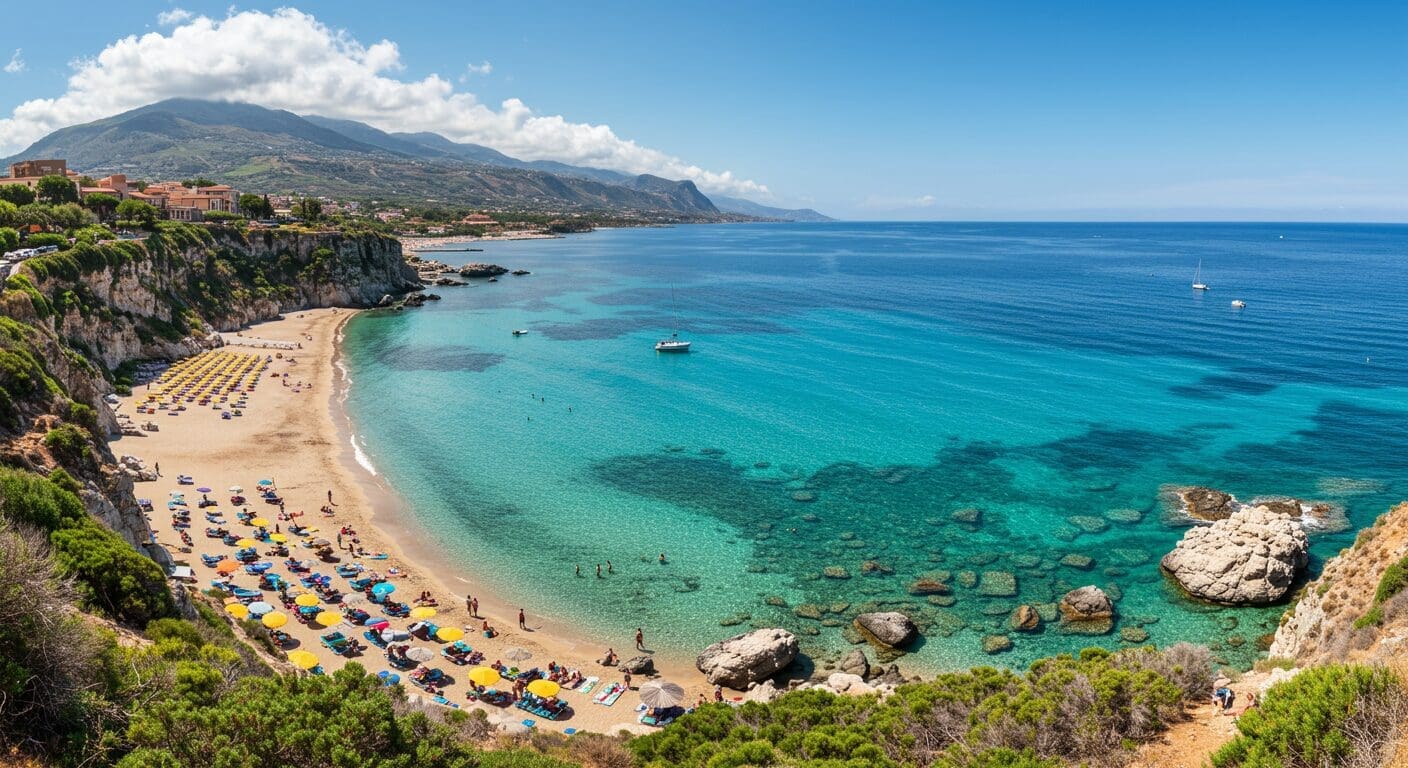
Sicily’s coastline is approximately 1,500 kilometres long, which means that the very concept of “the beach” here requires some disambiguation. The north coast, particularly the stretch west of Palermo towards Scopello and the Zingaro Nature Reserve, offers some of the most dramatically beautiful coves in the entire Mediterranean – clear turquoise water, rocky headlands, the odd beached fishing boat for atmosphere. The Zingaro is a protected reserve accessible only on foot, which has the enormously beneficial effect of limiting the crowds to people who are actually prepared to walk for their swim.
The east coast, anchored by Taormina with its improbable perch above the sea, gives you the volcanic black sand beaches of the Etna coast – Giardini Naxos, Letojanni, the beaches north towards the Messina strait. They are not conventionally postcard-blue, these beaches, but they have a character that grows on you quickly. The sea itself is warm, clear and seriously swimmable from June through to October.
The southwest coastline around Agrigento and Sciacca, and the far west around Marsala and the Egadi Islands, has arguably Sicily’s finest stretches of pale sand and shallow turquoise water. The Scala dei Turchi – a brilliant white marl rock formation that cascades into the sea like a frozen waterfall near Realmonte – is one of those sights that photographs cannot quite do justice to and that arrives in your memory long after the holiday is over.
The Aeolian Islands, technically separate but easily reached by hydrofoil from Milazzo, offer a different kind of coastal beauty entirely: volcanic, vertical, with geothermal activity that makes the water bubble in places and produces a sulphurous smell that you either find dramatic or deeply off-putting. Most people settle somewhere in between.
Beach clubs along the Ionian coast – Lido Tao in Taormina being the benchmark – have elevated the beach day into something more organised and thoroughly enjoyable. Private cabanas, decent food, properly made drinks, the option to stay until the sun drops over Etna behind you. It is an excellent way to spend a day that would otherwise be entirely without structure.
What to Actually Do: Activities That Earn Their Place in the Itinerary
There is a version of a Sicily holiday that is entirely passive – pool, book, repeat, punctuated by exceptional meals – and this is a perfectly legitimate choice. But for those inclined towards activity, the island offers an extraordinary range of things to do that range from mildly energetic to thoroughly absorbing.
Mount Etna is the obvious starting point and remains one of the most singular experiences available anywhere in Europe. Europe’s largest active volcano can be explored at various levels of commitment: a cable car and 4×4 jeep combination for the serious ascent, guided crater walks for those who want to look into something that is actively smouldering, or simply driving up to the observatory level at around 1,800 metres and appreciating the extraordinary moonscape from a respectful distance. Guided jeep tours are offered by several reputable operators and are the best way to understand the volcanic landscape’s peculiar beauty.
The Valley of the Temples at Agrigento is, without hyperbole, one of the best-preserved collections of ancient Greek temples anywhere in the world – better than much of what you will find in Greece itself, a fact the Greeks are understandably unenthusiastic about. The Temple of Concordia, still standing almost entirely intact after 2,500 years, is the kind of sight that makes you briefly reconsider everything you thought you knew about the ancient world. Go at dawn or dusk, not midday.
Boat hire along any stretch of the coast is simple to arrange, either with or without a skipper, and opens up the coastline in a way that driving simply cannot match. Sea caves, inaccessible coves, the chance to anchor in water the colour of a swimming pool tile – this is Sicily from the water, and it is a different island entirely.
Wine tours in the Etna DOC region and around the Marsala and Nero d’Avola territories are increasingly well-organised and can be combined with cooking classes, olive oil tastings, and visits to historic masserie (farm estates) that offer a deeper understanding of the island’s agricultural identity. This is the kind of itinerary addition that sounds educational and turns out to be an excellent afternoon.
Cooking classes, particularly in private villas or at local farms, are available island-wide and range from one-hour pasta sessions to full-day immersions in Sicilian market shopping, street food, and home cooking. Several villa concierges can arrange private chefs who will cook with you – or simply for you, if the day has been sufficiently active already.
For Those Who Like Their Holidays Slightly Aerobic: Adventure and Sport
Sicily’s combination of mountains, coastline, volcanic terrain and clear warm seas makes it a genuinely excellent destination for people who consider a holiday incomplete without at least one day where something slightly challenging has occurred.
Diving is exceptional, particularly along the north coast and around the Aeolian Islands. The waters are warm (reaching 26°C in summer), visibility is often extraordinary, and the underwater geography – volcanic rock formations, sea caves, the occasional ancient shipwreck – makes it interesting for divers of all levels. Dive schools operate from most coastal resorts, and private guided dives can be arranged through villa concierge services for those who prefer things somewhat more tailored.
Hiking on Etna is in a category of its own – there are marked trails at various altitudes, including routes through the Valle del Bove, the vast volcanic depression on the eastern flank of the mountain, which is one of the more otherworldly hiking experiences available in the Mediterranean. The Zingaro Nature Reserve on the northwest coast offers lower-altitude coastal hiking with the reward of private cove swimming at intervals – a combination that works extremely well.
Cycling has grown significantly as an organised activity in Sicily, with routes through the interior’s rolling landscapes, along the coastal roads, and up through the Etna wine country. The terrain is varied enough to suit both serious cyclists and those who prefer something more gentle and regularly interrupted by espresso stops. Road cycling and e-bike touring are both available, with guides and support vehicles for the longer routes.
Sea kayaking along the rocky northern coastline – through sea caves and around headlands into coves inaccessible by larger boat – is one of those activities that feels entirely worth doing and often ends up as the unexpectedly memorable part of the trip. Kitesurfing is popular along the western coast, particularly around Marsala, where the flat, shallow water and reliable afternoon winds create near-ideal conditions. Sailing charters from Palermo, Catania or Syracuse can take you to the Aeolian Islands or along the coast, with skippered yachts available for anything from a day to a full week.
Bringing Children to Sicily: Why It Actually Works Rather Well
Sicily is, in many ways, an ideal destination for families with children – provided you plan for space, privacy and a degree of flexibility. The island is child-friendly in the genuine sense, not the euphemistic one: Italians are famously welcoming to children in a way that goes beyond tolerance to something approaching delight, and a family arriving at any Sicilian restaurant, market or coastal town will be received with genuine warmth.
A private luxury villa with a pool is the foundational choice for families here, and for obvious reasons. Children who have access to their own pool, their own garden, their own space for organised chaos are children who do not require significant management at a hotel pool surrounded by other people’s belongings. Parents who have experienced both will confirm this without hesitation. Many villas on the island come with staff – housekeeping, a private chef, a concierge who can arrange childcare or baby equipment – which shifts the family holiday from logistics exercise to something more closely resembling an actual rest.
Practically speaking, the beaches are safe and accessible, the food is something that children almost universally embrace (pasta, pizza, granita, arancini – Sicily is not a country asking children to be adventurous), and the cultural sights are distributed across the island in a way that allows for short, manageable excursions rather than full-day museum marathons. Mount Etna, for instance, is genuinely exciting for older children and teenagers in a way that ancient Greek temples might not be – though the Valley of the Temples at Agrigento tends to impress most ages simply through scale.
Water sports are broadly family-friendly: boat hire, kayaking, snorkelling in the clear Ionian and Tyrrhenian waters, and beach club days at places like Lido Tao in Taormina where the structure and facilities mean the day organises itself. For multi-generational families where the grandparents have also been invited – a scenario that requires particularly careful villa selection – the island’s combination of accessible culture, beautiful scenery and long tables of good food tends to keep everyone adequately satisfied.
Layer Cake History: Sicily’s Culture and Architecture
Sicily has been invaded, occupied, colonised and ruled by what amounts to an implausible succession of civilisations – Greeks, Romans, Arabs, Normans, Aragonese, Bourbons, and eventually, with some reluctance, the unified Italian state – and the result is a cultural and architectural layering that is genuinely unparalleled anywhere in the Mediterranean.
Palermo is perhaps the most vivid expression of this. The Palatine Chapel, built by Norman king Roger II in the 12th century and decorated with Byzantine mosaics of extraordinary beauty, sits inside a palace that was itself built on Arab foundations. Walk twenty minutes from there and you are in the Ballarò market, which has been operating in one form or another since Arab rule in the 9th century and has not significantly quietened since. The city is simultaneously ancient and frantically alive, magnificent and magnificently chaotic. It rewards slow, unscheduled exploration more than most cities of its size.
The Val di Noto in the southeast is a UNESCO World Heritage Site comprising eight baroque towns – including Noto, Ragusa, Modica and Scicli – rebuilt after a catastrophic 1693 earthquake with such architectural ambition and honey-stone consistency that it constitutes perhaps the finest single concentration of baroque architecture in the world. Noto in particular, with its cathedral and surrounding palaces catching the late afternoon light, is the kind of place that makes you reach for your phone not to show anyone, but simply because you cannot quite believe what you are looking at.
Syracuse, on the southeast coast, was once one of the most powerful cities in the ancient world – larger than Athens at its peak, a fact that Athenians were deeply unhappy about in the 5th century BC and that has been somewhat underreported since. The archaeological park contains a Greek theatre still used for performances in summer, a Roman amphitheatre, and the Ear of Dionysius, a limestone cave with acoustics so perfect that a whisper carries to the far end. The island of Ortigia, the ancient core of the city, is all golden stone, sea walls and baroque churches built over Greek temples, and it remains one of the most atmospheric places to spend an evening in Sicily.
Festivals punctuate the Sicilian calendar with colour and religious intensity. Holy Week in Trapani, Noto’s Infiorata flower festival in May, the Taormina Arte festival in summer, and the almond blossom festival in Agrigento in February all offer access to a Sicilian cultural identity that goes considerably deeper than the tourist brochure version. The Sicilian puppet theatre tradition – opera dei pupi – is a UNESCO-recognised art form that predates television as local entertainment by several centuries, and considerably more enjoyable than most of what replaced it.
What to Bring Home: Shopping With Actual Thought
The Sicilian shopping landscape rewards specificity. The most obvious and entirely justified purchases are food and wine: Nero d’Avola, Marsala, Etna DOC wines, Modica chocolate (made to an ancient Aztec recipe without refined sugar, producing a granular, intensely flavoured bar that is either revelatory or confusing depending on your reference points), local olive oils, dried oregano, sun-dried tomatoes in oil, capers from Pantelleria (the finest capers in the world, an assertion that most serious food people will agree with immediately). These are things you can actually use at home and that will make you briefly feel like a person of considerable taste.
Ceramics from Caltagirone are the island’s most recognisable craft export: the town’s Scala di Santa Maria del Monte – a baroque staircase with each step tiled in a different ceramic pattern – is effectively a very long advertisement for the local industry, and it works. The ceramics themselves, in the traditional blue, yellow and green colour palette, range from tourist trinkets to seriously beautiful objects, and the better workshops will ship larger pieces home. Worth distinguishing between the two categories before purchasing.
Palermo’s antique markets, particularly around Piazza Marina, occasionally throw up genuinely interesting finds – antique textiles, old ceramics, wrought iron objects – amidst the less distinguished merchandise. The approach requires patience and a willingness to look at a great many unremarkable things before encountering the remarkable ones. Markets in every town offer local produce, street food and handmade goods in sufficient variety that even those with no particular shopping inclination tend to emerge carrying something.
Linen – either from established local producers or from the small clothing boutiques that populate the boutique streets of Taormina and Palermo – is the ideal Sicilian purchase for those who are purchasing clothing rather than food. The quality is high, the style is appropriate to the climate, and it will remind you of the holiday every time you wear it in a grey November, which in northern Europe is surprisingly motivating.
The Practical Business: What to Know Before You Go
Sicily uses the Euro, naturally, and card payments are widely accepted in restaurants, shops and petrol stations, though smaller establishments and market vendors will expect cash. ATMs are plentiful in towns and cities, less reliable in very rural areas. Withdraw before driving into the interior.
Italian is the language, with a Sicilian dialect that differs enough from standard Italian to occasionally confuse mainland Italians. English is widely spoken in tourist areas, Taormina most of all. In smaller inland towns, less so – which is part of the appeal, and an incentive to learn a handful of phrases that will be received with disproportionate warmth.
Tipping is not as formalised as in the US or UK. In restaurants, rounding up or leaving a few euros on the table is appreciated but not expected in the way it might be elsewhere. Service at the higher-end restaurants is included or already accounted for in the pricing. Use judgement and generosity in equal measure.
Safety is not a significant concern for tourists. Sicily’s historical association with organised crime is real but largely irrelevant to the visitor experience – it is emphatically not the kind of place where tourists feel at risk, and violent crime directed at tourists is essentially unknown. Petty theft in busy city centres and markets warrants the same common-sense precautions you would apply anywhere in Europe.
The best time to visit for a coastal luxury holiday is May through June and September through October. July and August are extremely hot – inland temperatures regularly exceed 38°C – and the island’s most popular destinations, particularly Taormina, become seriously crowded. If you must visit in August, a private villa with a pool is the difference between a holiday and an endurance event. Spring and early autumn offer warm sea temperatures (the Ionian cools slowly and remains swimmable well into October), lighter crowds, and the island at its most agricultural and fragrant.
Dress modestly when visiting churches – shoulders and knees covered – which is enforced rather than merely suggested at many of Sicily’s more significant religious sites. Dining is taken seriously: even casual restaurants expect that you are not wearing a wet swimsuit to the table. Sicilians dress well for dinner and it is worth reciprocating the effort.
Why a Private Villa Is Simply the Better Choice
There is a hotel argument to be made for Sicily, and some of the island’s hotels – the San Domenico Palace in Taormina, the Villa Igiea in Palermo – make it with considerable eloquence. But for a significant number of travellers, the private villa experience is not merely preferable to a hotel; it is a categorically different kind of holiday that the hotel model simply cannot replicate.
Privacy is the foundational advantage. In a private villa you are not sharing a pool with strangers at 9am, not adjusting your itinerary around breakfast service times, not negotiating lobby noise or competing for the best terrace table. The property is yours. The pool is yours. The view – and in Sicily, views can be genuinely spectacular, taking in the sea, the coast, Etna’s silhouette, or the baroque roofscapes of a hilltop town – is yours to appreciate in your own time.
Space matters particularly for families and groups. A five-bedroom villa provides not just bedrooms but communal space: a dining terrace large enough for a proper shared meal, a kitchen for those who want to cook (or for a private chef to cook in), a garden where children can disappear into without adult supervision every thirty seconds. Multi-generational families and groups of friends who have travelled together before will confirm that having this kind of space is the difference between a holiday everyone remembers fondly and one that is merely survived.
For those who work remotely – and Sicily’s growing appeal to the digital nomad and long-stay professional segment is well-documented – the connectivity question is increasingly well-answered. Many premium villas now offer high-speed fibre internet or Starlink connections that are entirely adequate for video calls, cloud work and the other non-negotiable requirements of the modern remote working life. A morning of work on a terrace overlooking the Ionian, followed by an afternoon entirely off the clock, is not an unusual day for the well-organised villa guest in Sicily. Other destinations offer remote working. Sicily makes you not particularly mind doing it.
Wellness-focused guests find the villa environment naturally supportive: space for yoga on the terrace at dawn, a pool for daily swimming, access to the island’s clean air and extraordinary diet, and – crucially – a pace and privacy that the hotel environment does not naturally provide. Some villas come equipped with gyms, hammams, or outdoor spa areas. Most can connect guests with local massage therapists, yoga instructors or wellness practitioners who will come to the property.
The concierge service available through premium villa rental – restaurant bookings made in advance, boat hire arranged, private guides organised for Etna or the Valley of the Temples, private chefs confirmed for specific evenings – transforms what could be a logistical exercise into something effortless. Sicily rewards the well-organised visitor, and having someone do the organising on your behalf is, it turns out, a significant part of what luxury actually means in practice.
Excellence Luxury Villas offers an extensive portfolio of private pool villa rentals in Sicily, ranging from intimate coastal retreats for couples to large estate properties sleeping twenty or more. Whether you are planning a milestone trip, a family summer, a group escape or a long working stay, the right villa is the foundation on which an exceptional Sicily holiday is built.
More Sicily Travel Guides
- Best Restaurants in Sicily: Fine Dining, Local Gems & Where to Eat
- Best Beaches in Sicily: Hidden Coves, Beach Clubs & Coastal Secrets
- Sicily with Kids: The Ultimate Family Holiday Guide
- Best Time to Visit Sicily: Month by Month Weather, Crowds & Tips
- Sicily Luxury Itinerary: The Perfect 7-Day Guide
- Romantic Sicily: The Ultimate Couples & Honeymoon Guide
What is the best time to visit Sicily?
May, June, September and October offer the ideal combination of warm weather, swimmable sea temperatures and manageable crowds. July and August are genuinely very hot – particularly inland – and the most popular coastal towns become significantly busier. If you are visiting in peak summer, a private villa with a pool is the most effective way to enjoy the season on your own terms. Spring brings almond blossom, wildflowers and a quieter island; early autumn brings the grape harvest, golden light and a sea that has spent the whole summer warming up.
How do I get to Sicily?
Sicily has two main international airports. Palermo Falcone-Borsellino serves the northwest of the island and has direct connections from most major European cities, including London, Manchester, Paris, Amsterdam and Frankfurt. Catania Fontanarossa on the east coast is the better choice for Taormina, the Ionian coast, Mount Etna and the baroque cities of the southeast. Flying time from London is approximately two and a half hours. Car hire is available at both airports and is highly recommended for exploring the island properly. Private transfers from airport to villa can be arranged through your villa concierge and are particularly worthwhile for longer journeys.
Is Sicily good for families?
Sicily is an excellent family destination, and genuinely so rather than by reputation only. Italians are famously welcoming to children, the food is almost universally embraced by younger travellers (pasta, pizza, granita, arancini), the beaches are safe and accessible, and the island’s cultural sights are distributed in a way that allows for short, manageable excursions. A private villa with a pool is the most practical and enjoyable base for families: children have space and freedom, parents have privacy, and the option of a private chef or housekeeping staff transforms the logistics considerably. Multi-generational families – grandparents included – are particularly well-served by Sicily’s combination of accessible culture, long dining tables and beautiful coastal scenery.
Why rent a luxury villa in Sicily?
A private luxury villa offers a level of privacy, space and personalisation that the hotel model simply cannot replicate. Your pool, your terrace, your view, your timetable – without the shared spaces, the breakfast queues or the competing demands of other guests. For families, the space means children can be children without constant management. For groups of friends, a shared villa with a large dining terrace and communal living space is the natural setting for the kind of relaxed, generous holiday that actually feels like a break. Staff options – private chef, housekeeping, concierge – can be added to shift the holiday from enjoyable to genuinely effortless. The staff-to-guest ratio in a private villa is simply incomparable to any hotel at the same price point.
Are there private villas in Sicily suitable for large groups or multi-generational families?
Yes – Sicily has an excellent range of larger villa properties specifically suited to groups and multi-generational families. Properties sleeping ten, fifteen or twenty guests are available, many with multiple private pools, separate wings or cottages for different family units within the same estate, and outdoor entertaining space designed for large shared meals. Staff arrangements – including private chef, housekeeping and a dedicated concierge – scale appropriately with larger properties and make the logistics of a big group holiday considerably more manageable. The key is selecting a property with sufficient communal space alongside enough privacy for individual family units, which an experienced villa specialist can help identify.
Can I find a luxury villa in Sicily with good internet for remote working?