Surat Thani Travel Guide: Where to Stay, Eat & Explore in Luxury
Most travel writers, when they think about Surat Thani at all, think about it as a place you leave. The ferry to Koh Samui departs from here. The night train south stops here. The budget bus from Bangkok disgorges its passengers here, briefly, before they scatter towards the islands like seeds in a strong wind. What almost nobody tells you is that the province itself – 8,000 square kilometres of rainforest, river delta, limestone karst and working Thai city – is one of the most rewarding places in southern Thailand to actually stay. This is the local secret Surat Thani has been quietly keeping since tourism first descended on the Gulf Coast. The islands get the Instagram posts. Surat Thani gets the interesting life.
Which brings us, usefully, to who this place is actually for. Surat Thani suits a particular kind of traveller – the kind who finds satisfaction in going somewhere that rewards curiosity rather than simply confirming expectations. Couples on milestone anniversaries will find the seclusion and the scenery without the Koh Samui price tag and the selfie-stick density. Families seeking genuine privacy – the kind where children can run riot around a villa garden and nobody minds – will appreciate the space that this region offers at a fraction of what similar privacy costs in Europe. Groups of friends after an experience that feels curated rather than packaged will find river cruises, jungle hikes, Michelin-recognised food and zero crowds at the waterfall. Remote workers who need genuinely reliable connectivity will discover that Thailand’s infrastructure has caught up with its reputation, and that writing a brief from a private villa with a pool view beats any co-working space in London or Berlin, possibly including the ones with kombucha on tap. And for the wellness-focused traveller, the combination of tropical calm, Thai massage culture and jungle air quality does something measurable to the nervous system. Usually within about forty-eight hours.
Getting Yourself to the Place Nobody’s Racing To
Surat Thani Airport (URT) receives direct domestic flights from Bangkok’s Suvarnabhumi and Don Mueang airports, with flight times around an hour and fifteen minutes. AirAsia, Thai Airways and Bangkok Airways all serve the route. If you’re arriving internationally, Bangkok remains the most practical hub – you’ll clear customs there and connect south, which is considerably less stressful than it sounds when you’ve got it organised in advance.
The airport sits about 27 kilometres south of the city, and taxis and private transfers are readily available. If you’ve booked a luxury villa, your property manager will almost certainly arrange a private transfer – this is worth confirming before you land, partly for convenience and partly because arriving in an air-conditioned car rather than negotiating a shared minibus is the kind of small decision that sets the tone for the whole trip.
Surat Thani city is accessible and navigable. Songthaews – the red pickup truck taxis that are simultaneously Thailand’s most democratic and most confusing transport system – cover most local routes. Tuk-tuks and metered taxis fill the gaps. Renting a car or motorbike gives you freedom to explore the province’s quieter corners, though motorbike rental is one of those activities that warrants honest self-assessment before commitment. For island day trips, ferry services depart from Donsak Pier (around an hour from the city), connecting to Koh Samui, Koh Phangan and Koh Tao.
Eating in Surat Thani – Where Southern Thai Heat Meets Happy Accidents
Southern Thai cuisine is a distinct and serious thing. It’s spicier, sharper and more turmeric-forward than the food most Western visitors encounter at Thai restaurants back home, and Surat Thani sits right at the heart of it. The region’s food culture rewards the curious and occasionally tests the stoic. In the best possible way.
Fine Dining
The headline act for discerning diners is Khao Hom – a Michelin-recognised restaurant that has become something of a local institution, situated conveniently close to the airport (making it either an excellent first-night dinner or a triumphant final meal, depending on your itinerary). The green curry here is the kind that recalibrates your understanding of what green curry is supposed to taste like. The deep-fried shrimp cakes are extraordinary, and the pork mince with Thai basil deserves its own review. One visitor memorably described it as “a Michelin-recognised gem that blends delicious Thai cuisine with a unique touch” – the unique touch being an impressive collection of automotive memorabilia displayed throughout the dining room. Which is not a sentence you expect to write about a Michelin-level restaurant, but here we are. It works, somehow.
For evenings when you want something different in atmosphere but no compromise on quality, Day & Night in Suratthani delivers a fusion of Thai, Asian and European cuisine in a space that feels genuinely like a New York brewpub transported to the Gulf Coast. Open until midnight, it’s the kind of place where a Hojicha latte bleeds into a plate of perfectly cooked ribs, the desserts are non-negotiable, and the pizzas outperform their modest setting by some distance. It handles the transition from fine dinner to late-night drinks without any visible effort.
Where the Locals Eat
Lucky Restaurant is the real education. This is the family-run southern Thai institution that serves the kind of deeply spiced dishes the region is known for, and the trick – insiders will tell you – is to ask for the Thai menu rather than the tourist version and deploy a translation app with equal parts confidence and humility. The Yum Tua Pu, a winged bean salad dressed with coconut and a heat level that sneaks up on you, is a genuine discovery. The Butterfly Pea Coconut Juice – electric blue and improbably good – has become something of a signature. Lucky also carries what may be the most extensive vegetarian menu in the province: nearly two pages. This is not something you see coming.
The night markets throughout Surat Thani city operate with the organised chaos that defines Thai street food culture. The Talad Kaset morning market is worth setting an alarm for – an early rise is the price of admission, but the reward is fresh produce, ready-made curries, and coffee served by vendors who have been there since before most tourists have considered breakfast.
Hidden Gems Worth Seeking Out
Yok Kheng earns its local reputation through straightforward excellence: good noodles, good Thai desserts, and the unpretentious confidence of somewhere that has never needed to advertise. It’s the kind of place where the menu is handwritten and the broth has clearly been going since yesterday. Seek it out.
And then there is Milano Restaurant, near Bandon Pier – which exists in Surat Thani with a cheerful disregard for context. Hand-made, stone-baked pizzas. Homemade pasta. A reviewer who declared it “the best I’ve had in southern Thailand.” The owners love pizza so much, the story goes, that they named their daughter Cheese. Whether this is literally true is perhaps less important than the spirit of commitment it represents.
The Province That the Ferry Passengers Never See
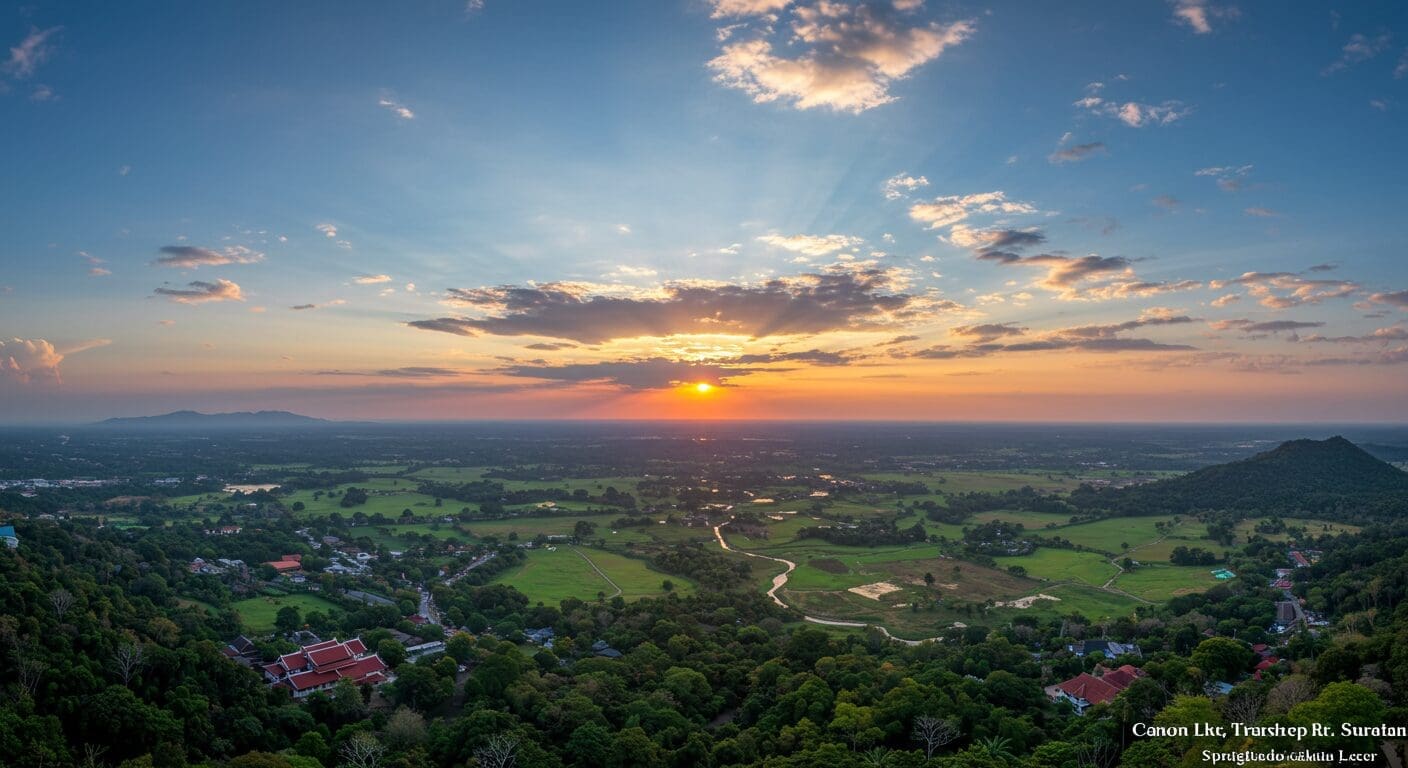
Surat Thani province is considerably larger and more varied than most visitors – who are usually looking at it through a ferry terminal window – ever realise. The provincial capital sits at the confluence of the Tapi and Phum Duang rivers, giving the city its character as a working river town with a commerce-first energy that is entirely different from the resort towns to the east. The waterfront along the Tapi has a particular quality in the early morning: fishing boats unloading, markets setting up, monks on their alms rounds. It is, in the truest sense of the phrase, the real Thailand.
Drive north and the landscape shifts towards the Khao Sok National Park – one of the oldest rainforests in the world, older than the Amazon by some estimates, draped across a karst mountain range of genuinely theatrical drama. The park’s Cheow Lan Lake, created by a dam in the 1980s, is framed by vertical limestone cliffs and jungle-covered hillsides and sits with considerable satisfaction in the top tier of Thai natural landscapes. The contrast between the busy coastal ferry hub and this ancient forest interior – reachable within ninety minutes – is one of the province’s defining surprises.
To the east, the coastline of the Gulf of Thailand opens up towards Don Sak and the pier towns, with mangrove forests lining river estuaries that reward slow exploration by boat. The islands are close enough to visit, far enough to feel like a deliberate choice rather than an obligation. Koh Samui, Koh Phangan and Koh Tao are all within comfortable ferry range, making the province an excellent base for a multi-island trip without the cost of island accommodation for the entire duration.
Things to Actually Do Here (Which Are More Than You’d Expect)
The experience that most consistently surprises first-time visitors is Khao Sok National Park. A guided jungle trek here operates on a different register from the trail-walk experiences offered at Thailand’s more domesticated nature reserves. The forest canopy is genuinely old and genuinely wild – the birdsong alone is worth the journey – and an overnight stay in one of the floating bungalows on Cheow Lan Lake is the kind of experience that lodges permanently in memory. Dawn on the lake, with mist hanging in the limestone valleys and no sound but water, is one of those moments that quietly makes a person reassess their relationship with five-star hotels. (The five-star hotel wins on plumbing. The lake wins on everything else.)
River cruises along the Tapi River offer a more gentle but no less rewarding pace. Evening cruises with dinner aboard are a particular pleasure – the river lights up at dusk in a way that makes the city look unexpectedly cinematic. For those interested in the working culture of the region, visits to rubber plantations and fruit orchards – Surat Thani is the source of much of Thailand’s finest mangosteen – can be arranged through local operators and provide a grounded counterpoint to beach-based itineraries.
Wat Suan Mokkh, the famous forest monastery founded by the Buddhist teacher Buddhadasa Bhikkhu, sits about 60 kilometres north of the city near Chaiya. This is one of the most significant meditation centres in Southeast Asia, and its grounds – spread across 120 acres of forest – are open to visitors with an appropriate degree of quiet and respect. Monthly silent meditation retreats are available for those seeking something more immersive than a brief visit.
Closer to the city, the Monkey Training School at Koh Samui – accessible by ferry – is one of the region’s more unusual attractions. The tradition of training monkeys to harvest coconuts is ancient in this part of Thailand, though visitor attitudes to it are divided, which is a reasonable reflection of a complicated topic. Worth knowing about; worth forming your own view on.
For Those Who Need More Than a Swimming Pool
Khao Sok is the adventure heartland of the province, and it delivers across multiple disciplines. Kayaking through the flooded karst valleys of Cheow Lan Lake is available through several operators based at the park entrance, and the combination of limestone walls and jungle-draped overhangs creates paddling conditions that are, aesthetically speaking, almost unfair. White-water kayaking on the Sok River – best undertaken during the wet season months when water levels oblige – offers a more technically demanding option for those whose idea of relaxation involves an elevated heart rate.
Hiking within the national park ranges from accessible half-day walks to multi-day treks that penetrate genuinely remote jungle. A guide is strongly recommended – not because the trails are dangerous exactly, but because the difference between a guided and unguided experience in old-growth rainforest is roughly the difference between reading a book and understanding it. Birdwatching, wildlife spotting and night walks are all available with the right operator.
For water sports closer to the coast, the Gulf of Thailand offers decent conditions for kayaking, stand-up paddleboarding and sailing from Don Sak and the surrounding beach areas. Koh Tao, accessible by high-speed ferry from the province, is one of the best dive sites in the entire Gulf of Thailand – the visibility, the marine life and the relatively calm conditions make it a destination in its own right for divers of all experience levels. PADI certification courses are run here at prices that make comparable courses in the United States or United Kingdom look considerably less sensible.
Cyclists with stamina and a tolerance for tropical humidity will find the rural back roads of the province genuinely rewarding. The routes between coconut plantations and rice paddies are largely traffic-free and offer close-up access to agricultural Thailand that no air-conditioned bus tour comes close to replicating.
Surat Thani with Children – and Why the Villa Makes All the Difference
Thailand is, in the general experience of families who have visited, one of the most straightforwardly welcoming countries on earth when it comes to children. Thai culture’s instinctive warmth towards small people – the country has a genuine and unperformative affection for children that puts many Western tourist destinations to shame – makes travelling here with kids a qualitatively different experience from navigating, say, certain categories of boutique hotel in southern Europe where the presence of a seven-year-old is treated as a minor social infraction.
For families specifically, the private villa model transforms the holiday entirely. The consistent challenge of travelling with children – the synchronisation of nap times and restaurant reservations, the hotel room that seemed perfectly adequate until four people were actually living in it, the pool hours that end precisely when your children have found their rhythm – dissolves when you have your own compound. Children swim when they want. Meals happen when people are hungry rather than when the kitchen is ready. There is space to spread out, make noise, and exist without performing the social contract of shared hotel spaces.
Practically speaking, Surat Thani’s proximity to Khao Sok means families can access genuinely extraordinary wildlife experiences – gibbons, hornbills, monitor lizards – without the logistical complexity of remote travel. The elephant sanctuaries in the region – ethical ones, operating on a no-riding, walk-and-observe basis – are among the most affecting animal encounters available in Thailand. For teenagers who have outgrown the hotel pool, the jungle activities, kayaking and island day trips provide a programme that requires no parental persuasion.
History, Spirit Houses and the Ancient Kingdom You Didn’t Know About
Surat Thani’s history is longer and more substantial than its current reputation as a ferry hub would suggest. The area around Chaiya – about 50 kilometres north of the city – was once a regional centre of the Srivijaya Empire, the maritime trading civilisation that controlled much of Southeast Asia between the 7th and 13th centuries. Wat Phra Borommathat Chaiya contains a chedi – a bell-shaped Buddhist tower – that is among the oldest surviving structures in Thailand, dating to the Srivijaya period and still in remarkable condition. The provincial museum in Chaiya houses Srivijaya-era artefacts of genuine archaeological significance that receive a fraction of the visitor attention they deserve.
The city of Surat Thani itself has the feel of a working Thai provincial capital that has never entirely adapted itself to tourism, which is, in its way, part of the appeal. Spirit houses – the ornate miniature temples placed outside homes and businesses to house protective spirits – are maintained here with a seriousness that reflects genuine belief rather than decorative habit. The annual Chak Phra Festival, which takes place in October or November according to the Buddhist calendar, involves the ceremonial procession of the Buddha image by boat along the Tapi River. It is spectacular, deeply meaningful to participants, and attended by remarkably few foreign visitors. Which means, if your timing is right, you experience it rather than observe it.
The Buddhist monastery culture of the province, centred significantly on Wat Suan Mokkh, represents one of Thailand’s more significant contributions to 20th-century Buddhist philosophy. Buddhadasa Bhikkhu’s teachings, developed here from the 1930s onwards, attracted practitioners from across the world and remain profoundly influential in contemporary Buddhist scholarship. The forest monastery grounds are a place of genuine contemplative beauty, quite apart from their historical significance.
Shopping Without the Tourist Tax
Surat Thani is not a shopping destination in the sense that Chiang Mai or Bangkok are shopping destinations. There is no night bazaar engineered for international visitors, no street of souvenir shops offering identical items at negotiable prices. What there is instead is more interesting: the commercial infrastructure of a working Thai city, operating largely without tourist markup.
The Talad Kaset markets – there are two, operating on complementary schedules – offer fresh produce, prepared food, household goods and the kind of textile and clothing selection that reveals itself slowly. Surat Thani’s position as a major producer of Thai fruits means the fresh market section is genuinely exceptional. Buying mangosteens here, in season, at provincial market prices, is one of those experiences that makes the imported version at home seem like a philosophical argument rather than a fruit.
The local craft tradition leans towards basketwork, woven palm products and shadow puppetry – Nang Talung, the distinctive southern Thai form of shadow theatre, originates in this region, and the puppet figures made for it are among the most striking craft objects in southern Thailand. Specialist shops and market stalls sell both performance-quality pieces and smaller tourist-oriented versions. For those seriously interested in acquiring quality pieces, asking accommodation staff for recommendations on reputable dealers is worthwhile. Central Festival and Tesco Lotus department stores provide modern retail for practical needs, while the walking street markets that operate on weekends offer clothing, street food and local goods in a format that is more sociable than commercial.
The Practical Stuff – Useful, Not Boring, We Promise
The best time to visit Surat Thani depends, usefully, on what you’re there for. The dry season runs roughly November through April, offering lower humidity, reliably blue skies and the most comfortable conditions for outdoor activities. December through February is peak season – the weather is as close to perfect as Thailand gets, and prices and visitor numbers reflect this accordingly. April and May bring pre-monsoon heat that is genuinely serious; this is less the warm embrace of the tropics and more a negotiation with atmospheric physics.
The wet season, May through October, brings the southwest monsoon and significant rainfall, particularly in June and July. This is not, however, the travel disaster it is sometimes painted as. Khao Sok is arguably more dramatic in the wet season – the waterfalls are fuller, the jungle more intensely green, the rivers more exciting. Hotel and villa prices drop, crowds thin to nothing, and the afternoons of heavy rain are the afternoons for long lunches and excellent novels. The province’s dual-coast position means that when the Gulf side is rougher, the Andaman side (accessible within a couple of hours) is often clearer, and vice versa.
The Thai Baht is the currency, and ATMs are widely available throughout the city. Major credit cards are accepted at restaurants and hotels of the calibre discussed in this guide, though carrying some cash is sensible for markets and smaller establishments. Tipping is appreciated but not compulsory – 20 to 50 Baht is appropriate for good service at casual restaurants; 10% is reasonable at higher-end establishments. Taxi meters should be running; if a driver suggests a flat fare before you’ve stated a destination, a second taxi is sometimes the most efficient response.
Thai is the working language, and while tourist-area English is functional, the further from hotel receptions you venture, the more useful a translation app becomes. Basic Thai courtesy – the wai greeting, removing shoes before entering temples, dressing modestly at religious sites – is genuinely appreciated rather than merely expected. The Thai capacity for good humour in the face of linguistic confusion is considerable, and the attempt is invariably received better than the achievement.
Safety in Surat Thani is not a significant concern by any reasonable benchmark. Exercise the standard urban awareness you’d apply anywhere – busy areas attract the usual small-scale opportunism – and you’ll encounter no difficulties. The motorcycle taxi and tuk-tuk experience requires its own assessment of personal risk tolerance, particularly after dark, though this is true across Thailand.
Why a Private Villa Changes Everything Here
There is a particular quality to the luxury villa experience in Surat Thani that differs from what you’d find at a resort or a hotel, and it’s worth being specific about what that quality actually is. Hotels, even good ones, involve a constant background hum of managed experience – breakfast at the designated hour, the pool shared with thirty strangers, the villa that is actually a room, the concierge whose job is to be helpful within defined parameters. A private luxury villa in this province operates on an entirely different logic.
The privacy, to start with the obvious: your own compound, your own garden, your own pool. In a region where the landscape is this varied and the outdoor living this genuinely pleasurable, having a private pool is not a luxury add-on – it is the difference between experiencing the destination and observing it. Morning swims before the heat builds, evening meals served at your own table as the sky changes colour over the jungle, the ability to be somewhere beautiful without an audience – these are the experiences that private villas make possible and hotels structurally cannot.
For groups of friends, the villa format creates a shared holiday experience that hotel accommodation simply cannot replicate. Common spaces, shared kitchens, the gathering dynamic of a private home – these matter enormously when you’re travelling with people you actually want to spend time with. For multi-generational families, the ability to have separate sleeping wings, flexible meal times and a garden that functions as a genuine living space transforms what is otherwise the considerable logistical challenge of travelling with small children and elderly parents simultaneously.
Remote workers have discovered Surat Thani for good reason. Connectivity has improved dramatically across the province, with fibre broadband and, in many properties, Starlink connectivity providing speeds that support video calls, large file transfers and the full working day with comfortable margins. The combination of reliable connectivity, a private workspace, a pool for decompression and the general pace of Thai provincial life has produced an informal community of digital nomads who discovered that the time zone works surprisingly well for European and Middle Eastern business hours.
The wellness dimension of villa life here operates quietly but effectively. The access to Thai massage – genuinely one of the world’s great therapeutic traditions, practised here at a standard that has nothing to prove – combined with the ability to maintain personal routines in a private space, the air quality of a region with serious rainforest cover, and the general disposition towards slowness that Thai provincial culture encourages, produces results that no structured wellness programme quite replicates. It is, in a sense, the accidental retreat: you arrive for the holiday and leave with something recalibrated.
Excellence Luxury Villas offers an extensive collection of properties in the region for every configuration of traveller – intimate couples retreats, expansive family compounds, group villas with multiple pools and dedicated staff. If you’re ready to experience this underestimated corner of Thailand on its own terms, start by browsing our luxury villas in Surat Thani with private pool and see what happens when the destination stops being a transit point and starts being the destination.
More Surat Thani Travel Guides
- Best Restaurants in Surat Thani: Fine Dining, Local Gems & Where to Eat
- Surat Thani Food & Wine Guide: Local Cuisine, Markets & Wine Estates
- Surat Thani with Kids: The Ultimate Family Holiday Guide
- Best Time to Visit Surat Thani: Month by Month Weather, Crowds & Tips
- Surat Thani Luxury Itinerary: The Perfect 7-Day Guide
- Romantic Surat Thani: The Ultimate Couples & Honeymoon Guide
What is the best time to visit Surat Thani?
November through April is the dry season and offers the most reliable weather for outdoor activities, beach visits and island day trips. December to February is peak season – clear skies, lower humidity and the most comfortable temperatures, though prices and visitor numbers are at their highest. The wet season (May to October) brings significant rainfall but also lower prices, fewer visitors, spectacular waterfalls in Khao Sok, and the dramatic green intensity that the jungle reserves for its wettest months. October and November can bring the Chak Phra Festival – one of the most atmospheric local celebrations in southern Thailand, and largely undiscovered by foreign visitors.
How do I get to Surat Thani?
Surat Thani Airport (URT) is served by direct domestic flights from Bangkok Suvarnabhumi and Don Mueang airports, with a flight time of approximately one hour and fifteen minutes. AirAsia, Thai Airways and Bangkok Airways all operate the route. International visitors typically connect through Bangkok. Ground transfers from the airport to the city take around 30-45 minutes by private car or taxi. Ferry services to Koh Samui, Koh Phangan and Koh Tao depart from Donsak Pier, approximately one hour from the city. Night trains from Bangkok also serve Surat Thani, with a journey time of around 9-11 hours – the overnight sleeper is a comfortable and surprisingly atmospheric option.
Is Surat Thani good for families?
Genuinely, yes – and more so than many Thailand guidebooks suggest. Thai culture is exceptionally welcoming to children, and the province offers a range of family-appropriate experiences: ethical elephant sanctuaries, wildlife encounters at Khao Sok, river cruises, and easy access to island beaches by ferry. The private villa model is particularly well-suited to families with young children – having your own pool, flexible meal times and a private garden eliminates the friction that hotel-based family travel routinely involves. Multi-bedroom villas with staff can accommodate multi-generational groups comfortably.
Why rent a luxury villa in Surat Thani?
Privacy and space are the headline advantages – your own pool, your own compound, your own pace. But the practical benefits compound quickly: a villa with dedicated staff means a cook preparing meals to your schedule and preferences, a concierge managing activity bookings and transfers, and a housekeeping team that exists entirely for your party rather than an entire hotel floor. For families, the freedom of a private space with a safe garden and pool is transformative. For couples, the seclusion and personalised service creates an intimacy that no hotel, however well-run, can replicate. The staff-to-guest ratio at a private luxury villa is simply incomparable.
Are there private villas in Surat Thani suitable for large groups or multi-generational families?
Yes. The villa inventory in the Surat Thani region includes properties ranging from intimate two-bedroom retreats to large multi-villa compounds with five or more bedrooms, multiple pools, separate living wings and full staff teams. Multi-generational groups benefit particularly from villas with separate bedroom pavilions – ensuring privacy within the group while maintaining shared common spaces for meals and socialising. Many larger properties include dedicated children’s areas, indoor-outdoor living spaces designed for group dining, and staff configurations that can include a private chef, villa manager and housekeeping team. Excellence Luxury Villas can advise on the most suitable properties for specific group sizes and configurations.
Can I find a luxury villa in Surat Thani with good internet for remote working?
Connectivity across the province has improved significantly, and many luxury villas now offer fibre broadband or Starlink satellite internet – providing speeds that comfortably support video conferencing, large file uploads and a full working day. When enquiring about a property, it’s worth confirming connection speeds and asking whether a dedicated workspace or desk area is available. Surat Thani’s time zone (GMT+7) aligns reasonably well with European and Middle Eastern business hours, making it a practical remote working base for those clients. The combination of reliable connectivity and a private pool for between-meeting decompression has made the province increasingly popular with longer-stay remote workers.
What makes Surat Thani a good destination for a wellness retreat?
Several things converge here that are harder to find in combination elsewhere. The air quality of a province with genuine old-growth rainforest cover is measurably different from resort areas with heavy tourist infrastructure. Thai massage culture is embedded and authentic in Surat Thani – practitioners trained in traditional southern Thai techniques are accessible at a standard that tourist-area spas rarely match. Private villa amenities – pools for daily swimming, gardens for yoga and meditation practice, kitchens for clean eating – support personal wellness routines in a way that hotel wellness programmes, however well-intentioned, cannot. And the pace of Thai provincial life – unhurried, rooted in routine, oriented around food and community rather than entertainment – does something quietly restorative that structured retreat programmes spend considerable effort trying to manufacture.