Valencia Travel Guide: Where to Stay, Eat & Explore in Luxury
In March, Valencia does something quietly extraordinary. The orange blossom comes out. Not in a showy, Instagram-ready kind of way – it simply perfumes the entire city, drifting through the old quarter, settling over café terraces, following you home. You’ll smell it before you see anything. Then the light changes too, warming from winter’s pale gold to something richer and more insistent, and the city – which has been going about its business with characteristic unhurried confidence – seems to exhale. This is when Valencia rewards the traveller who chose it deliberately rather than by default. And those travellers, it turns out, are a very particular and rather discerning lot.
Valencia has a way of being exactly what different people need it to be, simultaneously. Families who want privacy, space and a private pool without the performative chaos of a resort hotel find it here. Couples marking a significant anniversary, quietly tired of the obvious choices, find a city that delivers genuine romance without demanding they perform it. Groups of friends who want great food, warm evenings and somewhere to actually talk find the long Valencian dinner table is practically designed for them. Remote workers – increasingly, sensibly, relocating their laptops somewhere the Wi-Fi is reliable and the afternoon light is extraordinary – find that Valencia’s modern infrastructure and year-round liveability make it one of Europe‘s most workable bases. And wellness-focused guests, drawn by the clean air, the cycling routes, the Mediterranean diet in its actual home, find something more nourishing than any retreat itinerary could promise. The city does all of this without trying particularly hard, which is, of course, the most impressive thing about it.
Getting to Valencia: Easier Than You Think, More Rewarding Than You Expect
Valencia Airport – Aeropuerto de Valencia, officially known as Manises – sits just eight kilometres west of the city centre, which is the kind of airport proximity that makes you realise how much of your life you’ve wasted at Heathrow. Direct flights connect Valencia to most major European cities year-round, with routes from London, Manchester, Amsterdam, Paris, Berlin and beyond. From the United Kingdom, flight times hover around two hours and fifteen minutes – short enough that it feels almost indulgent to fly business class, though nobody will judge you if you do.
The metro line connects the airport directly to the city centre in around twenty minutes, though if you’re arriving with luggage and the ambition to transfer directly to a villa, a private transfer is the more civilised option. Most luxury villa concierge services will arrange this seamlessly. Taxis are metered, regulated and refreshingly honest – a rarity in Spain‘s more tourist-saturated corners.
Once in Valencia, you’ll find a city that has invested seriously in getting around without a car. The tram runs beautifully along the coast to the beach districts of La Malvarrosa and El Cabanyal. The bike infrastructure is genuinely excellent – more on that shortly. And the old quarter is almost entirely walkable, compact enough that you’ll cover serious ground on foot without noticing. For day trips to El Saler, El Palmar and the Albufera lagoon, a hire car or organised transfer makes the most sense. The city also sits on Spain’s high-speed rail network, putting Madrid within about ninety minutes and Barcelona under four hours – a useful reminder that Valencia makes an excellent base for a broader itinerary.
The Table Is the Point: Valencia’s Food Scene, Properly Explored
Fine Dining
Valencia’s fine dining scene has arrived at a moment of genuine confidence. This is not a city imitating somewhere else. It is doing its own thing, rooted in the extraordinary produce of the Valencian orchard – the huerta – and the waters of the Mediterranean, and finding increasingly inventive ways to express both.
At the serious end of the table, Ricard Camarena Restaurant is the undisputed jewel. Housed in the former Bombas Gens factory – a remarkable industrial space that has been converted into a cultural centre of considerable elegance – Camarena holds two Michelin stars and a Michelin Green Star, the latter awarded for his commitment to vegetables grown in his own orchard. His cuisine is technically immaculate and philosophically rooted: this is cooking that knows exactly where it comes from. Three Repsol suns to complete the collection. If you eat one serious meal in Valencia, eat it here.
El Poblet, close to the Town Hall Square, represents a different and equally compelling vision. Chef Luis Valls holds two Michelin stars and brings a quietly revolutionary sensibility to traditional Valencian flavours – his reinventions of classic local sausages are genuinely surprising, and his use of citrus is the work of someone who grew up eating oranges from the tree rather than from a supermarket bag. The products of the sea, the huerta and L’Albufera define his menu, interpreted through a haute cuisine lens that clarifies rather than obscures their origins.
La Salita, set in a beautiful mansion in the Russafa neighbourhood, offers something altogether different in mood. Chef Begoña Rodrigo – one of Valencia’s most distinctive culinary voices – weaves local Valencian ingredients through influences from Asia and Latin America with a confidence that could easily tip into confusion in lesser hands. It doesn’t. The ten- and twelve-course tasting menus are genuinely transportive, built on organic local produce and recognised by the Michelin Green Guide. Russafa itself is worth the visit for the neighbourhood alone.
Where the Locals Eat
The Mercado Central is one of the finest covered markets in Europe – a 1920s Modernista building of extraordinary beauty that functions, daily, as a working market. Come here in the morning for the spectacle and the produce: glistening seafood, the kind of vegetables that make you understand why Valencian chefs have built entire careers around them, local cheeses, almonds, dried fruits. Come hungry and stay longer than you planned.
For paella – the real thing, cooked over open wood fire the way it has been cooked here for centuries – Casa Carmela behind the beach is the consensus favourite for good reason. Consistently listed among the very best in the city, it is packed at every service, every day. The paella is sticky with umami, properly charred on the bottom (the socarrat – the caramelised crust – is the mark of craft, not accident), and cooked fresh for the day. Book ahead. Go hungry.
The Russafa neighbourhood is Valencia’s most creatively alive quarter – the kind of place that has been “up-and-coming” long enough to simply be excellent. Its streets are lined with independent bars, natural wine spots, afternoon vermut haunts and the sort of café tables that seem designed specifically for lingering. The barrio hums on weekend mornings with a market energy that has nothing to do with tourists and everything to do with locals doing what Valencians do: eating well, talking at length, and refusing to be hurried.
Hidden Gems Worth Seeking Out
Canalla Bistro, the more relaxed sibling of Ricard Camarena’s Michelin-starred flagship, delivers the same kitchen intelligence in a format that feels more like a party than a ceremony. The food is creative Spanish fusion, the ambience genuinely unlike anywhere else in the city, and the burger – yes, the burger – is the kind of thing that takes up residence in your memory uninvited. The Torrija dessert, a Spanish take on something between French toast and a religious experience, is not to be missed. It is the ideal place to take someone who says they’re not interested in fine dining. They will be interested in this.
Beyond the obvious, Valencia rewards the walker who goes slightly off-script. The El Cabanyal neighbourhood, long neglected and now in the middle of a careful revival, contains some of the most remarkable Modernista tile-fronted houses in the country and a local bar culture that has not yet recalibrated itself for visitors. The small fishing village rhythm survives, just. Go now, before it doesn’t.
The Lay of the Land: Valencia’s Geography, Properly Understood
Valencia is Spain‘s third city, which tells you the statistical fact and almost nothing else useful. What it actually is: a coastal city of around 800,000 people, set on the eastern Mediterranean shore, flanked by flat agricultural land to the south and west and by the sea to the east. The light is extraordinary. That is the first thing anyone who has spent time here will tell you, and the first thing you should believe about it.
The city centre – the Ciutat Vella, or old town – contains the Cathedral, the Mercado Central, the Llotja de la Seda (the Silk Exchange, a UNESCO World Heritage Site), and a medieval street pattern that rewards wandering. Around it, the Eixample district provides a more ordered, bourgeois Valencia of wide avenues and elegant apartment buildings. Russafa edges the Eixample to the south – technically part of it, spiritually its own thing entirely.
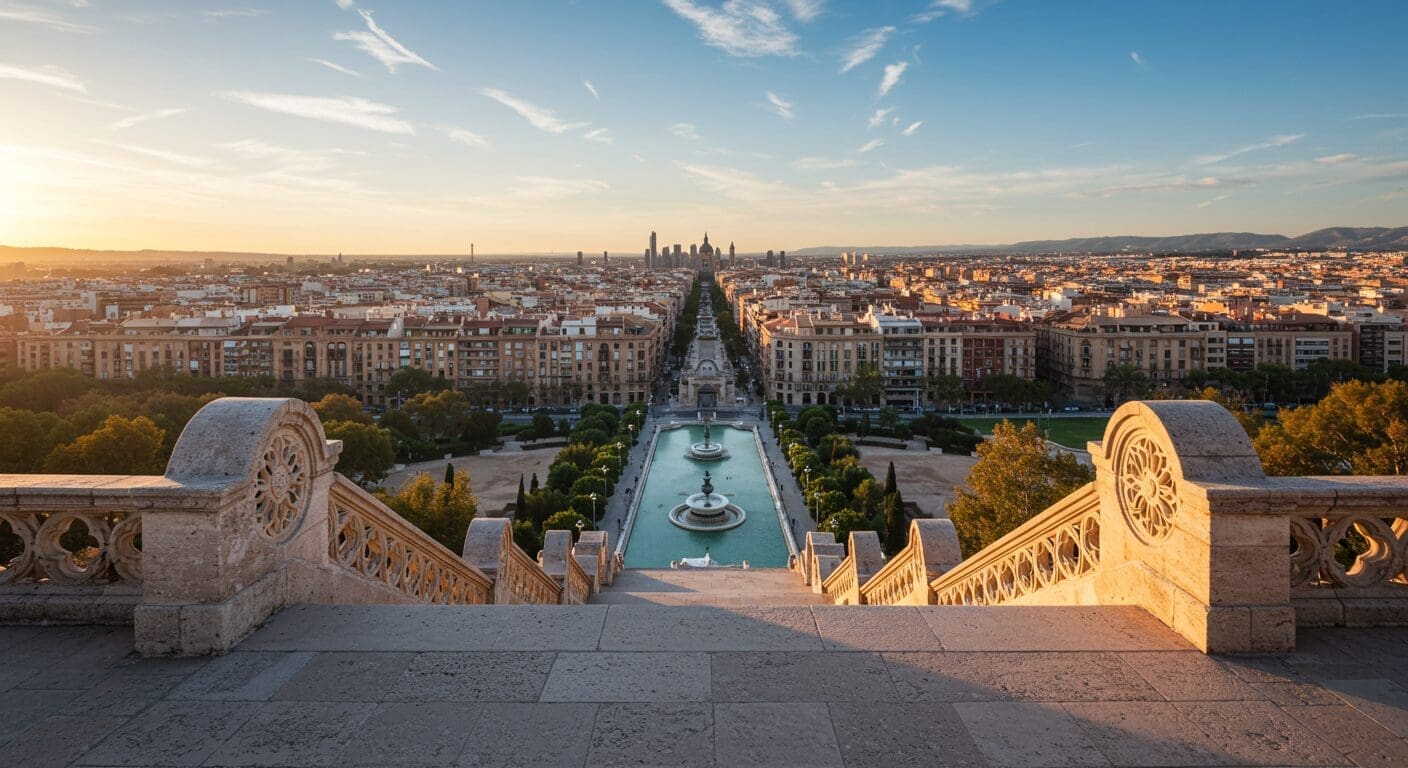
Then there’s the Turia. In 1957, Valencia experienced catastrophic flooding from the River Turia, which ran through the heart of the city. The river was subsequently diverted south. The old riverbed – nine kilometres of it – was then converted into a park: the Jardines del Turia, a green lung that runs like a green ribbon through the city from the western outskirts to the sea, ending at Santiago Calatrava’s extraordinary City of Arts and Sciences. It is one of the great pieces of civic landscape design in Europe. You can cycle it end to end in under an hour, stopping exactly where the light or a café terrace demands.
South of the city, the Albufera natural park is the other essential geography. A freshwater lagoon ringed by rice fields – this is where paella was genuinely born, in the agricultural villages that farmed the rice – it offers boat trips, migratory birdlife, extraordinary sunsets, and a stillness that is hard to find anywhere near a city of this size. The villages of El Palmar and El Saler sit within it, unhurried and entirely themselves.
What to Actually Do: Valencia Beyond the Postcard
The Turia Gardens deserve more than a passing mention in any serious account of Valencia’s pleasures. Nine kilometres of park running through the heart of a city – a park with cycling paths, children’s play areas, football pitches, running tracks, orange groves and the occasional impromptu yoga class – represents an act of civic imagination that most cities would struggle to match. Hire a bike and ride the full length. Start from the west and let the City of Arts and Sciences reveal itself gradually at the eastern end. Santiago Calatrava’s white futurist complex – the Palau de les Arts, the Museu de les Ciències, the Hemisfèric – is either the most spectacular thing you’ve seen in a Spanish city or a reminder that architects occasionally need someone to say “perhaps not quite so dramatic?” It is spectacular. Particularly at dusk, when it reflects in the surrounding water.
A boat trip on the Albufera lagoon at sunset is one of those travel experiences that delivers exactly what it promises – which is rarer than it should be. The light on the water, the rice fields at the edge of vision, the birds moving overhead in numbers that feel ancient – it earns its reputation without needing to try harder.
Paella in its birthplace is not just a meal. It is, if done properly, an education. The best paella restaurants in El Saler and El Palmar require advance reservations and a degree of commitment – you’ll need to specify what kind of rice dish you want, as everything is prepared fresh for the day. The effort is entirely proportionate to the reward. Valencian paella is not the saffron-yellowed rice with peas and prawns that colonised the world’s restaurant menus. It is typically rabbit and chicken, sometimes with snails, cooked over orange wood, timed to the minute. The difference is considerable.
The City of Arts and Sciences is not purely decorative. The Museu de les Ciències Príncep Felip is genuinely engaging, the Hemisfèric runs IMAX programming that justifies the visit, and the Oceanogràfic – Europe’s largest aquarium – is remarkable both architecturally and in terms of its marine life collection. With or without children, it rewards an afternoon.
Getting Physical: Adventure and Sport in and Around Valencia
Valencia’s coastline is longer and more varied than its beach reputation suggests. The city beaches of La Malvarrosa and Las Arenas are broad, well-serviced and popular – very popular in July and August, when half of inland Spain descends. But venture south toward El Saler and the coastline thins and quietens: long stretches of natural beach backed by pine forest and dunes, protected within the Albufera park, where the crowds thin rapidly and the Mediterranean does its best work.
Road cycling around Valencia is serious business. The region has produced professional cyclists, and the roads through the orange groves south of the city and up into the Serra Calderona hills to the north are well-maintained and scenic in the way that makes distance feel irrelevant. Guided cycling tours operate at every level, from leisurely Turia Gardens rides to full-day mountain routes. The flat coastal plain makes for superb casual cycling if you simply want to cover ground without effort.
Water sports are concentrated around the Marina Real Juan Carlos I – the venue for the 2007 America’s Cup, which transformed Valencia’s waterfront and left behind a serious sailing infrastructure. Charter sailing and yacht rentals operate from the marina, ranging from half-day coastal trips to multi-day excursions along the Costa del Azahar. Paddleboarding, kayaking and windsurfing all operate from the main beaches, with equipment hire readily available from May through October.
Climbers are drawn to the limestone routes of the Sierra Calderona, just 30 kilometres north of the city – a range of hills that offers everything from sport climbing crags to longer multi-pitch routes with coastal views. The contrast between the industrial outskirts of Valencia and the wild, quiet limestone country above is one of those geographical incongruities that makes Spanish geography continually surprising.
For those who prefer their adventure horizontal, Valencia’s golf scene is unhurried and well-maintained. Several courses operate within easy reach of the city, including El Saler – consistently rated among the best links-style courses in Spain, set between pine forest and the sea. It is the kind of course that makes golfers who have played it speak in the slightly disbelieving tones of people recounting something they weren’t sure was real.
Valencia with Children: Why This Works Better Than You Think
Cities that are genuinely good for families are rarer than the marketing would suggest. Valencia is actually one of them. The reasons are structural as much as scenic. The Turia Gardens provide a safe, traffic-free corridor of outdoor space that runs through the heart of the city – a park that functions as a playground, sports ground and picnic zone simultaneously, and that leads naturally to the City of Arts and Sciences, which is effectively the world’s most architecturally ambitious science museum complex. The Oceanogràfic alone will hold children of almost any age for a full afternoon. The Natural Sciences Museum, the hands-on science exhibits, the IMAX experience – the whole complex is calibrated for curiosity.
Beaches are accessible and calm. The Mediterranean is warm, shallow and relatively gentle from May through October. The coast south of the city – particularly around El Saler and the protected stretches within the Albufera park – offers long, safe stretches of beach that are quieter than the city beaches and backed by natural landscape rather than promenade development.
The deeper advantage for families travelling to Valencia is the private villa. The logistics of travelling with children – the early mornings, the unpredictable mealtimes, the need for outdoor space and a pool that belongs to you rather than being shared with strangers – are transformed by the right property. A luxury villa in Valencia with a private pool gives families the rhythms of home with the rewards of travel: the children swim while the adults cook, or the whole family sits around a table in the garden for a long lunch that nobody needs to rush. It is simply a different mode of travel, and the difference matters more with children than it does with anyone else.
Time Travelling in Valencia: History, Architecture and Culture
Valencia is older than it usually gets credit for. Founded as a Roman colony in 138 BC – Valentia Edetanorum, for the record – it accumulated Visigothic, Moorish and medieval Christian layers before emerging as one of the wealthiest cities in the Mediterranean during the fifteenth century. The Silk Exchange, the Llotja de la Seda, was built during this golden age and remains one of the most beautiful Gothic civil buildings in Europe. Its Hall of Columns – tall twisted columns rising to a palm-vault ceiling – is the kind of space that stops conversations. It was awarded UNESCO World Heritage status in 1996 and has been standing for five hundred years. It will survive the selfie-takers.
The Cathedral, begun in the thirteenth century on the site of the former mosque, holds something remarkable in its Borgia Chapel: the Valencia Cathedral claims to hold the actual Holy Grail. Whether it does or not is a theological and archaeological argument that has been running since the twelfth century and shows no signs of resolution. The cup itself – a first-century agate vessel of Roman origin – is genuinely ancient, whatever its provenance. Worth seeing regardless of your position on the matter.
Las Fallas, Valencia’s defining annual festival, runs through the first three weeks of March and culminates on the night of March 19th – the Nit del Foc – with the burning of enormous papier-mâché satirical sculptures throughout the city. It is one of the great public festivals of the world: loud, smoky, completely committed to its own excess, and impossible to convey in photographs. The fireworks – daily, at 2pm, in the central square – are not symbolic. They are genuinely enormous. Bring ear protection and lean into it.
The contemporary cultural scene is anchored by the Institut Valencià d’Art Modern (IVAM), one of Spain’s leading modern art museums, which has been quietly building a collection of international significance since 1989. The Bombas Gens cultural centre – the former factory that houses Ricard Camarena’s restaurant – also contains galleries of considerable quality. Culture and cuisine occupy the same building, which tells you something about Valencia’s priorities.
What to Bring Home: Shopping in Valencia
Valencia is not a shopping destination in the way that Barcelona is – which is, from a certain angle, entirely to its credit. There are no kilometre-long shopping malls dressed up as cultural experiences. What there is instead is specific and worth knowing about.
The Central Market, beyond its produce, contains stalls selling local preserved foods – tinned seafood from the Mediterranean, rice varieties specific to the region, paprika, local almonds, turron from the nearby town of Xixona – that make genuinely useful and genuinely Valencian things to take home. The kind of gift that says “I actually went somewhere and thought about you” rather than “I went somewhere and panicked in an airport.”
Ceramics are the local craft tradition with the deepest roots. The town of Manises – just west of Valencia, adjacent to the airport – has been producing ceramic work since the Moorish period and remains the centre of Valencian pottery. Hand-painted tiles, tableware and decorative pieces from here carry a genuine cultural lineage. The Museo de Cerámica González Martí, housed in the extraordinary Palacio del Marqués de Dos Aguas in central Valencia, tells the full story and sells nothing, which is rather refreshing.
For fashion and design, the Russafa neighbourhood offers independent boutiques and concept stores operating at a remove from global retail homogeneity. The pace is unhurried, the curation is personal, and the likelihood of finding something that nobody else at home will have is considerably higher than in most city shopping districts. The barrio’s weekend market also delivers handmade jewellery, vintage finds and the kind of craft objects that have been made by someone who cared about making them.
The Practical Stuff: What You Actually Need to Know Before You Go
Currency is the euro. Tipping is appreciated but not the semi-mandatory social ritual it has become in the United States. A five to ten percent tip in restaurants is generous; rounding up a bar bill is entirely sufficient. Nobody will follow you to the door if you don’t.
The language is Spanish – Castilian – with Valencian (a variety of Catalan) co-official throughout the Valencian Community. Most Valencians speak both fluently and will meet your Spanish or English equally well. In restaurants, a genuine attempt at even rudimentary Spanish will be appreciated out of proportion to its quality.
The best time to visit is arguably spring – March through May – when the orange blossom is out, the weather is warm without being fierce, the beaches are pleasantly uncrowded and Las Fallas (in March) offers one of the most extraordinary public spectacles in Europe. September and October run it close: the summer heat is retreating, the sea retains its warmth, the tourists begin to thin, and the city relaxes back into itself. July and August are hot – consistently above 30°C – and the beaches are packed with the organised enthusiasm of Spanish summer holidaymakers. It is lively rather than unpleasant, but it is emphatically not the Valencia that belongs to you.
Safety is not a significant concern. Valencia is one of Spain’s most liveable cities – low in petty crime relative to Barcelona or Madrid, well-policed and navigable without anxiety at most hours. Standard urban vigilance around the main tourist areas is sensible. The rest is largely relaxed.
Water is safe to drink from the tap throughout the city, though many locals prefer bottled. Pharmacies – farmacias, marked by a green cross – are plentiful and extraordinarily helpful for minor medical needs. The Spanish public health system is excellent should anything more serious arise.
Why a Private Villa in Valencia Changes the Nature of the Holiday Entirely
Hotels in Valencia are good. Some are very good. But a hotel gives you a room, a lobby, a breakfast service at the hours the hotel decides are reasonable, and a pool shared with people you have not chosen to spend your holiday with. A luxury villa in Valencia gives you something structurally different: a home, a rhythm, a private pool, and the particular freedom that comes from having space that belongs entirely to you for the duration.
For couples on a significant trip – a milestone birthday, a honeymoon, an anniversary that deserves more than a city-break hotel – the privacy and quality of space in a luxury villa is not a luxury in the marketing sense. It is a practical transformation of the experience. Breakfast at the time you want it, in a kitchen garden if the property has one, or beside a pool with no performance required. Evenings that begin when you decide they should. A wine list that is yours.
For families, the case is even clearer. The private pool is the first thing, but not the only thing. A villa with multiple bedrooms, a generous outdoor space, a kitchen that allows you to feed children at the hours children need feeding, and proximity to the beach without the logistics of a resort – this is how family travel should feel but rarely does. Children sleeping in their own rooms while adults sit outside in the warm Valencian night with a bottle of something local is a holiday rather than an endurance test.
Groups of friends travelling together – and Valencia is ideally configured for this, with its long evenings, its superb restaurant scene and its culture of the long table – find that a large villa accommodates the group’s different rhythms without friction. The introvert has somewhere to retreat. The morning swimmer has the pool. The late night contingent has the terrace. Everyone convenes for the meal that nobody is in any hurry to end.
Remote workers – and the Valencian climate, year-round liveability and excellent connectivity have made the city a draw for location-independent professionals from across Europe – find that many luxury villas now offer reliable fibre broadband as standard, with some properties offering Starlink for the more remote locations in the surrounding countryside. A dedicated workspace, strong connectivity and a Mediterranean afternoon outside your window: this is the working arrangement that the open-plan office could not have anticipated.
Wellness-focused guests will find that Valencia’s outdoor life, clean Mediterranean air, excellent local produce and the simple, profound pleasure of a private pool in warm weather does more for the nervous system than most structured retreat programmes. Add a villa with a gym, a steam room, or an infinity pool overlooking the coast, and the case is complete without requiring a single group meditation session.
Excellence Luxury Villas offers a curated collection of over 27,000 properties worldwide, with an exceptional range of private villa rentals in Valencia to suit every group size, travel style and ambition. Whether you’re seeking a whitewashed retreat amid the orange groves, a contemporary villa within reach of the city’s finest restaurants, or a sprawling coastal property with staff and concierge services included – the right base makes all the difference to the kind of holiday Valencia is capable of delivering.
More Valencia Travel Guides
- Best Restaurants in Valencia: Fine Dining, Local Gems & Where to Eat
- Valencia Food & Wine Guide: Local Cuisine, Markets & Wine Estates
- Valencia with Kids: The Ultimate Family Holiday Guide
- Best Time to Visit Valencia: Month by Month Weather, Crowds & Tips
- Valencia Luxury Itinerary: The Perfect 7-Day Guide
- Romantic Valencia: The Ultimate Couples & Honeymoon Guide
What is the best time to visit Valencia?
Spring – particularly March through May – is widely considered the finest time to visit Valencia. The weather is warm and consistently pleasant (18-24°C), the orange blossom fills the city with scent, the beaches are accessible without being overcrowded, and March brings Las Fallas, one of Europe’s most extraordinary festivals. September and October are a very close second: the summer heat eases, the sea remains warm enough for swimming well into autumn, and the city relaxes into a more local rhythm once the peak-season crowds thin. July and August are hot, lively and busy – perfectly enjoyable, but a fundamentally different experience.
How do I get to Valencia?
Valencia Airport (Manises) sits just eight kilometres west of the city centre and receives direct flights from most major European cities year-round. From the United Kingdom, flight times are approximately two hours fifteen minutes from London, slightly longer from northern UK airports. From within Spain, Valencia is connected to Madrid by high-speed rail in around ninety minutes and to Barcelona in under four hours – making it easily accessible as part of a wider Spanish itinerary. A private transfer from the airport to a luxury villa is the most comfortable and direct option for arriving guests; the metro also connects the airport to the city centre in around twenty minutes.
Is Valencia good for families?
Valencia is genuinely excellent for families – not just in the aspirational travel-brochure sense, but practically. The City of Arts and Sciences complex offers a full day of engagement for children of almost any age, including Europe’s largest aquarium. The Turia Gardens provide nine kilometres of safe, traffic-free outdoor space running through the heart of the city. The beaches are warm, calm and accessible from late spring through early autumn. Staying in a private luxury villa adds a further dimension: a private pool, flexible mealtimes, outdoor space and the freedom of your own schedule make family travel considerably more relaxed than any hotel alternative.
Why rent a luxury villa in Valencia?
A luxury villa transforms the nature of the holiday rather than simply upgrading its category. The privacy and space – a private pool, multiple bedrooms, a kitchen and generous outdoor areas – give groups and families a freedom that no hotel room ratio can match. For couples, a villa offers seclusion and intimacy without the performative sociability of a hotel. For groups of friends, it provides communal space at a scale that actually works for gathering. Many luxury villas in Valencia also include concierge services, private chefs, daily housekeeping and staff – delivering the service standards of a high-end hotel with the comfort and privacy of a home. The staff-to-guest ratio alone typically exceeds what any hotel can offer.
Are there private villas in Valencia suitable for large groups or multi-generational families?
Yes – the villa inventory around Valencia includes properties ranging from intimate two-bedroom retreats to large estates sleeping twenty or more guests, making it well suited to large groups, multi-generational family holidays and special occasion gatherings. Many larger villas feature separate wings or annexes that give different family groups their own privacy while sharing communal spaces – pools, terraces, dining areas – for the group moments that matter. Private chef and catering services are readily available for larger bookings, and some properties include dedicated event spaces for milestone celebrations. Excellence Luxury Villas can help match specific group sizes and requirements to the right property.
Can I find a luxury villa in Valencia with good internet for remote working?
Valencia is one of Europe’s most connectivity-conscious cities, and the villa rental market has responded accordingly. Most luxury villas in and around Valencia now offer reliable high-speed fibre broadband as a standard amenity. For more rural properties in the surrounding Valencian countryside – orange grove estates or hillside retreats in the Sierra Calderona – Starlink satellite connectivity is increasingly available, delivering workable speeds even in locations without fixed-line infrastructure. When booking for remote working purposes, it is worth confirming connection speeds and specifying workspace requirements; many villas offer dedicated study rooms or covered outdoor workspace areas suitable for video calls and focused work.
What makes Valencia a good destination for a wellness retreat?
Valencia offers the ingredients for genuine wellness without needing to package them as a programme. The Mediterranean climate delivers reliable warmth and exceptional light for most of the year. The city’s cycling infrastructure – including the nine-kilometre Turia Gardens route – makes daily outdoor movement effortless