Wales Travel Guide: Where to Stay, Eat & Explore in Luxury
The rain arrives sideways. Not dramatically, not apologetically – just with the matter-of-fact efficiency of something that has been doing this for several thousand years and sees no reason to change now. You’re standing on a headland above the Pembrokeshire coast, the Atlantic unfolding in every shade of grey and green below you, a seal watching you from the water with what can only be described as mild contempt, and the thing is – the genuinely surprising thing – you wouldn’t swap this for anywhere else on earth. Wales does this. It catches you off guard. You arrive expecting scenery and you find something rarer: a place with actual soul, where the land feels ancient and inhabited in ways that the polished Mediterranean never quite manages, where the food has quietly become extraordinary, and where a luxury villa on a clifftop or tucked into the Brecon Beacons can feel like the most private address in the world.
Wales rewards the traveller who understands what it’s actually offering. Couples celebrating something significant – a milestone birthday, an anniversary, a decision they’ve been circling for years – find in its dramatic, uncrowded landscapes the privacy and atmosphere that the world’s more obvious destinations rarely deliver. Families who want genuine seclusion, with enough space that the children can be loud and the parents can pretend not to hear them, will find luxury villas in Wales that sit in their own grounds with the kind of breathing room that a hotel corridor simply cannot replicate. Groups of friends who want to actually spend time together rather than in adjacent hotel rooms discover that a large villa with a hot tub and a fire pit in Snowdonia changes the entire dynamic of a holiday. Remote workers requiring reliable connectivity are increasingly finding Wales a revelation – the infrastructure has improved dramatically, and a morning of video calls against a backdrop of the Black Mountains is, statistically, more tolerable than the same calls in a London flat. And those drawn to wellness in its truest sense – not the branded kind with chilled towels and ambient music, but the raw, restorative kind that comes from cold air, long walks, and absolute quiet – tend to leave Wales looking noticeably better than they arrived.
Getting Here Without Making It a Project
Wales is part of the United Kingdom, which means it suffers slightly from being perceived as easy to get to and therefore not quite glamorous enough to plan properly. Resist this instinct. Plan it properly. Cardiff Wales Airport serves the south, with direct flights from a growing number of European cities – Dublin, Amsterdam, Geneva, Lanzarote – and is a smooth 20-minute drive into the capital. For north Wales, Liverpool John Lennon Airport and Manchester Airport are the practical gateways, both within comfortable driving range of Snowdonia, the Llŷn Peninsula and Anglesey. Bristol Airport feeds nicely into south and mid-Wales, and for those travelling from England, the M4 into south Wales and the A55 along the north coast are the main arteries.
Once you’re in, a car is non-negotiable – and this is not a hardship. Driving in Wales is one of the quiet pleasures of being here. The roads thin out almost immediately, the sat-nav starts to doubt itself around mile three of any B-road, and you will almost certainly end up behind a tractor at some point, which is, frankly, a reasonable price for the views. Trains serve Cardiff, Swansea and the coastal routes beautifully, but if your villa sits in the hills of Ceredigion or on the edge of the Beacons, you’ll need your own transport. Hire something with reasonable ground clearance if you’re heading off-piste. Wales takes its lanes seriously.
The Food Has Stopped Being a Well-Kept Secret
Fine Dining
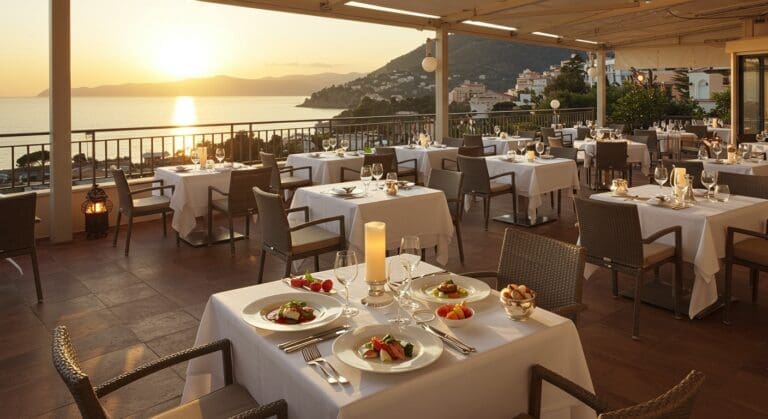
The conversation about Welsh fine dining now begins, correctly, with Ynyshir. Gareth Ward’s restaurant in Machynlleth – a small market town in mid-Wales that most people couldn’t find on a map before Ward arrived – holds two Michelin Stars, making it the only two-starred restaurant in Wales and, by the reckoning of most serious food writers, one of the most singular dining experiences in the entire country. This is not a restaurant where you book a table; it’s one where you block out a day, because the tasting menu unfolds over the course of an evening in a way that feels more like a performance than a meal. The fact that you can stay overnight – in a room or, with admirable eccentricity, in a tipi – is either a practical solution to the wine list or simply the only appropriate response to what you’ve just experienced. Both, probably.
Cardiff’s food scene, for years the most unfairly overlooked capital city table in Britain, has recently announced itself with force. Gorse, in the Pontcanna neighbourhood, became the first restaurant in the Welsh capital to earn a Michelin Star when it received the honour in 2025. Chef Tom Waters’s modern Welsh cooking is precise and personal, and the same year Gorse was also named AA Restaurant of the Year for Wales with three AA Rosettes – a clean sweep that suggests this is not a fluke but a kitchen at the top of its game.
In the Wye Valley, The Whitebrook represents a different kind of excellence. Chef Chris Harrod’s restaurant in leafy Monmouthshire has earned both a Michelin Star and a Michelin Green Star, the latter for an approach to sustainability that goes well beyond the performative. The ingredients are foraged, grown and sourced locally with a rigour that produces dishes of genuine beauty – and the setting, deep in one of the most ancient wooded valleys in Britain, matches them entirely. For something equally serious but worn a little more lightly, The Walnut Tree near Abergavenny is a masterclass in deceptive simplicity. Shaun Hill, one of Britain’s most respected culinary figures, describes his Michelin-starred country bistro as operating at “the rough end of Michelin”, which is the kind of understated confidence that only the very good can afford.
Where the Locals Eat
Welsh food culture is anchored in markets, and the best of them repay proper attention. Cardiff’s Central Market is a Victorian cast-iron cathedral that sells everything from laverbread and cockles to salt marsh lamb and artisan cheese – the kind of shopping that makes you want to immediately book a villa with a good kitchen. Swansea’s indoor market, particularly the wet fish hall, is the largest indoor market in Wales and has a Monday-morning energy that feels entirely its own. In north Wales, the Saturday markets in towns like Abergavenny (technically just over the border, but Wales claims it in spirit) and Caernarfon reward the patient browser with local produce of real quality.
Pubs in Wales remain what pubs in much of Britain have stopped being – local, unself-conscious, occasionally startling in their food quality. Any pub in Pembrokeshire serving crab from the boats at Fishguard has made a reasonable argument for its existence. The craft brewing scene has matured considerably in the last decade, with small breweries across Ceredigion, Gower and the Brecon Beacons producing work that belongs in a glass rather than a press release.
Hidden Gems Worth Seeking Out
Paternoster Farm in Hundleton, Pembrokeshire, is the kind of place that Good Food Guide readers guard jealously. Michelle Evans – formerly a divorce lawyer, now cooking on a family farm with a devotion that makes the career change feel entirely logical – runs what one reader described simply as a place where “Michelle cares about every bite you eat and always has time for a chat.” The produce is exceptional, the atmosphere is warm, and the fact that it sits on a working farm in a quiet corner of west Wales is entirely appropriate. This is cooking that comes from somewhere, and it tastes like it.
The Geography, Which Refuses to Be Summarised Briefly
Wales is roughly the size of Massachusetts, which sounds manageable until you discover that it contains three national parks, five Areas of Outstanding Natural Beauty, one of Europe’s oldest mountain ranges, over 1,200 kilometres of coastline, and a linguistic tradition so stubbornly alive that the road signs remain bilingual and the language itself – one of the oldest in Europe – is spoken daily by over half a million people. It is, in short, considerably more than it first appears.
The north is dominated by Snowdonia – Eryri in Welsh – a national park built around Yr Wyddfa (Snowdon) and the high moorland that surrounds it. This is dramatic, uncompromising country: lake-filled valleys, ancient slate quarries, ridgelines that disappear into cloud and reappear at improbable angles. The Llŷn Peninsula stretches west like an arm reaching into the Irish Sea, ending at Aberdaron in a landscape of such quietness and clarity that it has drawn pilgrims and poets for centuries. Anglesey, connected to the mainland by Telford’s suspension bridge, is flatter and coastal and has a personality entirely distinct from the mountains across the water.
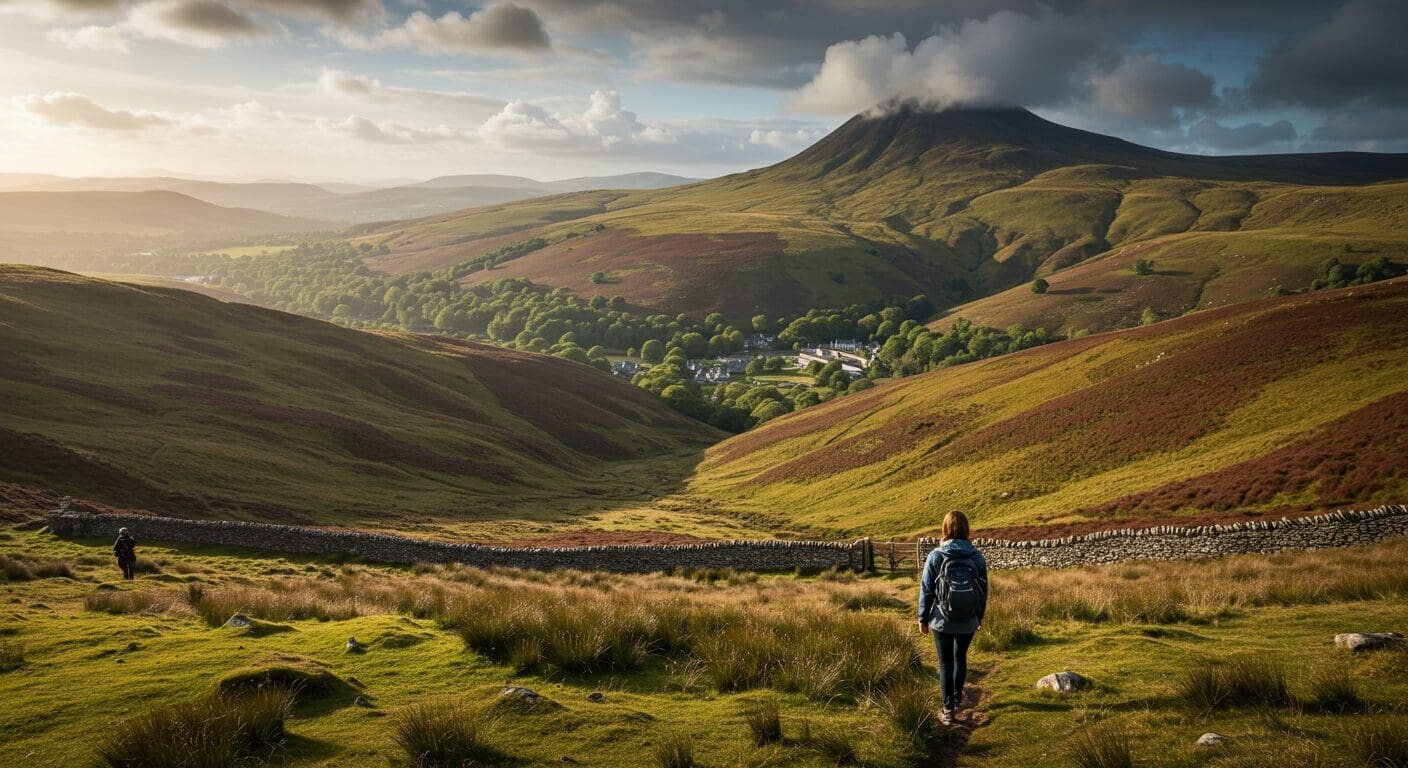
Mid-Wales – Powys, Ceredigion, the Cambrian Mountains – is the Wales that most visitors miss and regulars quietly prefer. Empty uplands, red kites circling above the Elan Valley reservoirs, market towns of particular charm. This is the Wales for long walks without encountering another soul, for sitting with a book and watching the weather move across the hills at a pace that recalibrates the nervous system.
The south brings Cardiff – compact, confident, genuinely fun – and the Vale of Glamorgan’s limestone cliffs. West along the M4 leads to Swansea and then to Gower, Britain’s first Area of Outstanding Natural Beauty and the possessor of beaches that would be internationally famous if they were located somewhere warmer. Pembrokeshire, in the far southwest, is where Wales does its most self-evidently spectacular coastal work: 186 miles of National Park coastline, Iron Age forts on headlands, grey seals hauled up on inaccessible beaches, water of impossible clarity in the right light.
Things to Actually Do Here (The List is Longer Than You Think)
The temptation with Wales is to spend the entire time outdoors, which is not necessarily wrong – but the best Wales holidays tend to combine the physical with the cultural in a ratio that changes by the day. Castles are the obvious starting point, and Wales has more castles per square mile than anywhere in the world, ranging from Caernarfon’s extraordinary World Heritage ring of fortifications to Carreg Cennen in Carmarthenshire, which sits on a limestone crag above the Brecon Beacons in a way that suggests it was designed specifically to be photographed at golden hour. It was not, obviously – it was built to project military dominance in the thirteenth century – but it has aged into the landscape with considerable grace.
The Brecon Beacons offer some of the finest ridge walking in Britain, with the Pen y Fan horseshoe giving a full day’s outing and views on clear days that extend to the Bristol Channel and beyond. Waterfall Country, in the Neath and Mellte valleys, is a network of wooded gorges and falling water that qualifies as genuinely dramatic – the kind of place that makes you feel you’ve discovered something, even when you’re sharing it with forty other people with exactly the same expression of delighted surprise.
On the coast, the Pembrokeshire Coast Path’s full 186 miles is a multi-day undertaking, but individual sections – the stretch between St Davids Head and Whitesands Bay, or the section above the cliffs at Stack Rocks – deliver the full experience in a morning. Sea kayaking in Pembrokeshire is accessible, well-organised and remarkable: paddling through sea arches and alongside grey seal colonies on a calm day is an experience that doesn’t require a superlative to describe it accurately.
For something entirely different, Portmeirion – the Italianate village on the Dwyryd estuary in north Wales, designed by Clough Williams-Ellis between 1925 and 1975 – is one of the most genuinely surreal built environments in Britain. It is simultaneously ridiculous and completely charming, which perhaps explains why Patrick McGoohan chose it as the location for The Prisoner. The hotel is worth a night; the village is worth a morning of wandering with no particular plan.
For Those Who Prefer Their Landscapes With a Side of Adrenaline
Climbing Yr Wyddfa by any of its six main routes is the canonical Welsh physical challenge, and it earns its reputation. The Pyg Track and the Miners’ Track are the most popular approaches, taking between five and seven hours for the round trip and arriving at 1,085 metres with views – on clear days – across to Ireland, the Isle of Man and the Lake District simultaneously. For those with reasonable fitness but a healthy attitude to mountain railways, the Snowdon Mountain Railway from Llanberis is a Victorian rack-and-pinion train that has been taking people to the summit since 1896 and continues to do so with charming unhurriedness.
The slate quarries of north Wales have found remarkable second lives as adventure venues. Zip World at Penrhyn Quarry near Bethesda runs the fastest zip line in the world over a flooded slate pit at speeds approaching 100 miles per hour, which is either exhilarating or unnecessary depending entirely on your disposition. Nearby, Bounce Below turns a series of underground caverns in Blaenau Ffestiniog into a cathedral-scale trampolining experience that is, against all initial scepticism, genuinely extraordinary. Surf Snowdonia in the Conwy Valley is a man-made inland surf lagoon that generates consistent waves year-round – a solution to a problem that Wales technically didn’t have, given its Atlantic coastline, but which works brilliantly regardless.
Cycling in Wales has proper infrastructure now. The Lon Las Cymru route runs the length of the country from Holyhead to Cardiff, taking in the Cambrian Mountains and the Brecon Beacons in a way that is challenging even by the standards of people who find things challenging. Mountain biking in the Afan Forest Park in south Wales and at Coed y Brenin in the Snowdonia foothills has attracted serious riders from across Europe for two decades – the trail networks here are considered among the best on the continent.
Wales With Children (It Works Better Than You’d Expect)
The honest answer about Wales and families is that it suits them very well, provided the family in question contains at least one person who can read a map and one person prepared to accept that an afternoon in light rain is, actually, fine. The outdoor infrastructure is genuinely child-friendly – most of the major walking routes have accessible versions, the beaches are safe and supervised, and the castles are the kind that children recognise as real castles rather than the reconstructed kind that require a helpful placard to make the point.
Anglesey has beaches – Rhosneigr, Llanddwyn Island, Trearddur Bay – that combine genuine beauty with the kind of shallow, sheltered water that makes parents noticeably more relaxed. In south Wales, the Gower Peninsula’s Oxwich Bay and Three Cliffs Bay are similarly rewarding. The National Showcaves of Dan yr Ogof in the Brecon Beacons is a vast underground cave system that delivers genuine drama and has been entertaining families for generations without becoming cynically branded about it.
The private villa advantage for families is significant in Wales. A large country house with its own grounds, an outdoor pool (heated, given the climate’s views on the matter), games rooms and enough bedrooms that everyone has their own space transforms a family holiday from a logistical exercise into something that actually resembles relaxation. The ratio of indoor to outdoor living that Wales requires means that a well-equipped villa – a good kitchen, comfortable sitting rooms, somewhere for the children to be energetically separate from the adults – is genuinely the best base from which to experience the country.
History Embedded in the Landscape Itself
Wales is one of the places in Europe where history is not contained in museums but expressed in the landscape directly. The standing stones and burial chambers of the Preseli Hills in Pembrokeshire predate Stonehenge – and it is from these hills that the bluestones of Stonehenge were transported, which raises questions about the organisational ambitions of Neolithic people that have never been entirely satisfactorily answered. The hillforts and Iron Age settlements visible from almost every ridge in the country tell a story of continuous habitation stretching back four thousand years.
The Norman and Plantagenet castle-building campaign of the twelfth and thirteenth centuries left Wales with its extraordinary legacy of fortifications – Caernarfon, Conwy, Harlech and Beaumaris together form a UNESCO World Heritage Site that represents some of the finest medieval military architecture in the world. Conwy’s walled town retains its complete circuit of medieval walls, which you can walk in their entirety in under an hour and which give the town a physical coherence that most medieval settlements lost centuries ago.
The industrial history of Wales is less widely appreciated but equally significant. The slate quarries of Gwynedd – also now a UNESCO World Heritage Site – shaped the rooftops of the world in the nineteenth century, shipping Welsh slate to cities from New York to Sydney. The coal valleys of the south created the communities, the choral traditions and the labour movement that defined twentieth-century British politics. Blaenavon, near Abergavenny, preserves a remarkable example of the industrial landscape that produced all of this, and the Big Pit Mining Museum there offers underground tours of particular atmosphere and honesty.
The eisteddfod tradition – competitive festivals of poetry, literature and music conducted largely in Welsh – continues annually, most visibly at the Royal National Eisteddfod held each August in alternating north and south Welsh locations. The International Musical Eisteddfod at Llangollen in July draws choirs and dancers from over fifty countries to a small north Welsh market town in what has to be one of the most improbable annual gatherings in Britain.
Shopping in Wales: Small, Independent, Worth Your Time
Welsh shopping rewards the browser rather than the mission shopper. The high streets of the small market towns – Brecon, Abergavenny, Hay-on-Wye, Aberaeron – tend to be more independent than most, with bookshops, galleries and craft shops that feel curated by people with genuine taste rather than franchise agreements. Hay-on-Wye, on the English-Welsh border in the Brecon Beacons, has approximately forty second-hand bookshops in a town of approximately fifteen hundred people, a ratio that is either culturally admirable or a sign of serious underlying issues. Possibly both. The Hay Festival in May and June brings writers from across the world to what has styled itself, with complete accuracy, “the town of books.”
Welsh wool is the obvious craft purchase, and it earns its reputation. The mills of mid-Wales – particularly the Melin Tregwynt mill in Pembrokeshire and the Welsh Woollen Museum at Drefach Felindre – produce blankets, throws and clothing in traditional geometric patterns that translate well beyond the heritage context. The quality is genuine and the designs are restrained enough to live happily outside Wales. Artisan food is the other bringing-home staple: Halen Môn sea salt from Anglesey, which has held a Protected Designation of Origin since 2012 and supplies several of the country’s best restaurants; Welsh lamb and beef from farms across Powys and Pembrokeshire; Perl Wen and Perl Fynydd cheeses from Caws Cenarth in Ceredigion, which have taken the Welsh artisan cheese category somewhere considerably more interesting than it was a generation ago.
The Practical Details That Actually Matter
Wales uses pounds sterling and is part of the United Kingdom, which means the practical infrastructure – healthcare, transport, communications – functions to British standards. Tipping customs follow British norms: ten to fifteen percent in restaurants when service is not included, rounding up in taxis, nothing expected in pubs (though nobody objects to a bought round). The language situation is worth understanding: Welsh is a living first language in significant parts of the country, particularly in the northwest – Gwynedd, Anglesey, parts of Ceredigion – and speaking even basic Welsh phrases (diolch for thank you, bore da for good morning) is received with genuine warmth rather than the patronised amusement that bad French in Paris sometimes produces.
The best time to visit Wales is, without great controversy, May through September, with June and September offering the most reliable combination of weather, manageable visitor numbers and the full range of outdoor activities. July and August are school holiday months, which means the most popular spots – Pembrokeshire’s beaches, Snowdonia’s main summits, the Gower – see significant crowds by Welsh standards (which remain significantly lower than by most European standards). Spring brings extraordinary wildflower displays on the coastal paths and the arrival of seabird colonies on Pembrokeshire’s offshore islands. Autumn turns the wooded valleys – particularly the Wye Valley and the valleys of mid-Wales – into something genuinely arresting.
The weather is the elephant in the room that any honest Wales guide must address directly. It rains. Not constantly, not exclusively, but reliably enough that packing a waterproof is not optional – it is the single most important piece of travel advice applicable to this destination. The west-facing coasts and the uplands receive the Atlantic weather systems most directly; the Vale of Glamorgan and the eastern borders have a notably more moderate climate. The thing about Welsh rain, once you’ve accepted its existence, is that it moves quickly, clears suddenly, and leaves the light in a state that photographers describe as extraordinary and everyone else describes as “almost worth it.”
Why a Luxury Villa in Wales Is, Actually, the Point
There is a version of a Wales holiday that takes place in a chain hotel in Cardiff or a bed and breakfast above a pub in Betws-y-Coed. These are perfectly good options that miss, fairly comprehensively, what Wales does best. The country’s particular genius is in its landscape and its privacy – the sense that you have arrived somewhere that hasn’t been packaged and processed for your convenience – and a luxury villa captures this in ways that no hotel room can approach.
A private country house in the Brecon Beacons with its own grounds and a heated outdoor pool places you inside the landscape rather than adjacent to it. You wake to the sound of nothing in particular, which turns out to be considerably more restorative than the sound of corridor doors and room service trolleys. You have a kitchen in which to deploy the produce from Pembrokeshire’s farms and markets. You have a sitting room in which the group actually sits together, which is the thing about shared spaces – they produce the conversations and the evenings that you actually remember.
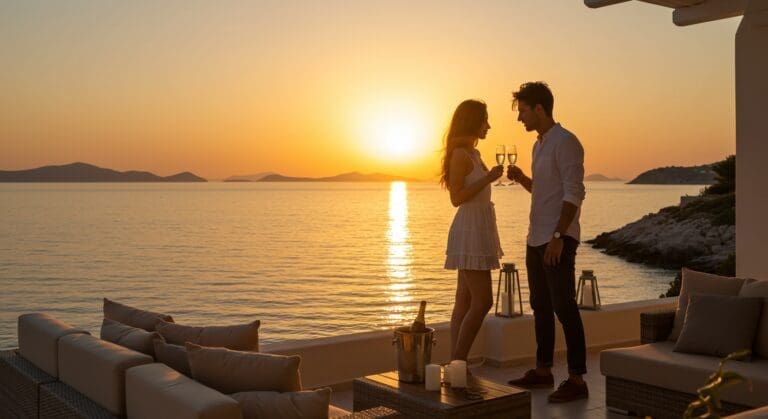
For groups, the arithmetic of a large Welsh villa versus equivalent hotel rooms is straightforward in every direction. For families, the combination of private space, private garden and – where the property has one – private pool with a heated option removes the tyranny of shared hotel amenities and the mild anxiety of being responsible for small children in public dining rooms. For couples, a restored farmhouse or coastal retreat with views to the sea offers a kind of deliberate seclusion that the world’s more visited destinations simply cannot replicate at any price.
The remote working question has been settled, practically speaking. The rural broadband and Starlink coverage across Welsh countryside properties has improved to the point where a morning of reliable high-speed connectivity is achievable from most well-equipped villas, including those in locations that look, from the outside, as though they haven’t encountered the twenty-first century yet. Working with a view of Cadair Idris or the Pembrokeshire coast doesn’t make the work more meaningful, but it makes the work considerably more bearable. And the afternoons, when you close the laptop, are immediately and entirely the point.
Wellness, in the genuine sense, is one of the strongest arguments for Wales. The combination of clean air, physical landscape, absolute quiet and the particular quality of light that arrives after rain – which is, in Wales, not an infrequent occurrence – works on the nervous system in ways that expensive spa treatments approximate but rarely equal. A villa with an outdoor hot tub, a garden for morning yoga, and direct access to walking country delivers a wellness week without the need for anyone to use the word “journey” unironically.
Browse the full range of luxury holiday villas in Wales and find the right base for the Wales you’re looking for – whether that’s a clifftop retreat above the Atlantic, a farmhouse at the edge of the Brecon Beacons, or a country house deep in the quiet centre of a country that rewards those who take the trouble to find it.
More Wales Travel Guides
- Best Restaurants in Wales: Fine Dining, Local Gems & Where to Eat
- Wales Food & Wine Guide: Local Cuisine, Markets & Wine Estates
- Wales with Kids: The Ultimate Family Holiday Guide
- Best Time to Visit Wales: Month by Month Weather, Crowds & Tips
- Wales Luxury Itinerary: The Perfect 7-Day Guide
- Romantic Wales: The Ultimate Couples & Honeymoon Guide
What is the best time to visit Wales?
May through September offers the most reliable conditions, with June and September being the sweet spot – warm enough for coast and mountain, before the school holiday crowds of July and August arrive in force. Spring brings exceptional wildflowers along the coastal paths and the return of seabirds to the Pembrokeshire islands. Autumn turns the river valleys golden and the walking conditions remain excellent well into October. The honest answer is that Wales in any season, with the right gear and the right expectations, delivers something that the fairer-weather months of more predictable destinations rarely match.
How do I get to Wales?
Cardiff Wales Airport is the main gateway for south Wales, with direct flights from Dublin, Amsterdam, Geneva and several European leisure destinations. For north Wales, Manchester Airport and Liverpool John Lennon Airport are the most practical entry points, both within comfortable driving distance of Snowdonia and the north coast. Bristol Airport serves south and mid-Wales well. Eurostar to London followed by a direct train to Cardiff takes around three hours from the city centre. Once in Wales, a hire car is strongly recommended – the most rewarding properties and experiences lie well beyond the reach of public transport.
Is Wales good for families?
Very much so. The outdoor infrastructure – beaches, castles, national parks, cave systems, adventure centres – is genuinely well-suited to children across a wide age range, and the fact that Welsh beaches and walking routes remain significantly less crowded than equivalent European destinations is a practical advantage that parents appreciate immediately. The private villa model works particularly well for families in Wales: properties with their own grounds, heated outdoor pools and enough indoor space to accommodate the full range of weather conditions (which Wales will provide) transform the logistics of a family holiday considerably.
Why rent a luxury villa in Wales?
Because Wales’s greatest quality – genuine privacy in a genuinely beautiful landscape – is best experienced from inside it rather than from a hotel car park. A luxury villa places you directly within the countryside, coast or hills, with private space, private outdoor areas, and the freedom to use Wales on your own terms. The staff-to-guest ratio of a well-serviced villa – with optional private chef, housekeeper, or concierge – exceeds anything a hotel of equivalent price delivers. For groups and families particularly, the economics and the experience both favour the villa decisively.
Are there private villas in Wales suitable for large groups or multi-generational families?
Yes – Wales has a strong inventory of large country houses, converted farmhouses and coastal estates that comfortably accommodate eight to twenty guests across multiple bedrooms and separate living wings. Many of the larger properties include private heated pools, games rooms, cinema rooms, large kitchen-dining spaces designed for communal use, and grounds sufficient that different generations can occupy different parts of the property simultaneously. Some come with dedicated event spaces suitable for celebrations. Multi-generational groups in particular find that a large Welsh country house delivers the combination of togetherness and personal space that hotels simply cannot engineer.
Can I find a luxury villa in Wales with good internet for remote working?
Increasingly, yes. Rural broadband coverage has improved significantly across Wales, and many premium villa properties have invested in Starlink or dedicated high-speed business-grade connectivity to meet the demand from remote workers and workcation guests. When booking, it is worth confirming connection speeds and whether a dedicated workspace is available – the better-equipped properties offer both. Working from a well-connected villa in the Brecon Beacons or on the Pembrokeshire coast is entirely achievable, and the quality of the afternoons, once the laptop closes, makes the arrangement difficult to abandon.
What makes Wales a good destination for a wellness retreat?
Wales offers the kind of wellness that predates the industry built around it: clean Atlantic air, physically demanding and rewarding landscapes, absolute quiet in the uplands and rural valleys, and a quality of light – particularly in the west – that has a measurably calming effect. The practical infrastructure supports this: coastal path walking, wild swimming in rivers and sea, cycling networks, and a growing number of retreat centres and spa facilities in country house settings. A private villa with a heated outdoor pool, hot tub, gym and direct access to walking country provides a self-directed wellness week that requires no timetable, no group sessions and no one describing anything as transformative.