
Florence Travel Guide: Best Restaurants, Culture & Luxury Villas
What does it feel like to stand in front of a Botticelli that you’ve only ever seen on a poster? Not in a museum gift shop, not on a tote bag, not in a slide projected onto a lecture theatre wall at 9am on a Tuesday – but the actual thing, three feet away, painted by a human hand in Florence in the 1480s? That’s the question Florence answers, repeatedly, and with a certain magnificent indifference to how overwhelmed you happen to be. This is a city that has been extraordinary for so long it doesn’t feel the need to try. The Renaissance didn’t happen somewhere nearby – it happened here, in these streets, in these buildings, in the workshops of artists whose names you have known since childhood. Florence is, in the most literal sense, the place where the modern world learned to look at itself.
It is also, conveniently, one of the finest places on earth to eat pasta and drink wine in the company of people you love. Which brings us to who Florence is actually for – and the answer is: quite a lot of people, for quite different reasons. Couples marking a significant anniversary will find a city that takes romance as seriously as urban planning. Families seeking privacy from the hotel corridor world will discover that a luxury villa in the Florentine hills, with a private pool and olive trees and a terrace that faces west for the sunsets, renders the entire concept of a resort hotel faintly absurd. Groups of friends who have been promising themselves a proper trip for years will find that Florence rewards people who sit still long enough to notice things. Remote workers – yes, they exist even in paradise, and their deadlines are mercilessly indifferent to the view – will find reliable connectivity in most quality villas, with some offering Starlink-level speeds that make an afternoon of work entirely compatible with an evening of Chianti. And those travelling with wellness in mind will find a city surrounded by hills made for walking, thermal spas within easy reach, and a general pace of life that, outside of Ponte Vecchio at noon in August, has the quality of something deeply unhurried.
Getting Yourself to Florence Without Losing the Plot
Florence is served by Amerigo Vespucci Airport – or Peretola, as locals still tend to call it – which sits just four kilometres from the city centre. Direct flights operate from most major European hubs, and the transfer into the city takes somewhere between fifteen and thirty minutes depending on traffic and the time of day. For those arriving from further afield, the more practical gateway is often Pisa’s Galileo Galilei Airport, roughly an hour away by road or rail, with a direct train service – the Pisa Mover connecting to the station, then a fast regional service into Santa Maria Novella. Bologna Guglielmo Marconi Airport is a similar distance in the other direction and can work well for travellers routing through northern Europe.
Once in Florence, the question of getting around answers itself fairly quickly. The historic centre is compact and, for significant stretches, pedestrianised – your feet are genuinely the best tool available. For villa guests staying in the hills of Fiesole, Chianti, or the broader Florentine countryside, a hire car is worth considering, though it should be noted that a ZTL (Zona Traffico Limitato) sign is not a suggestion. These restricted traffic zones cover much of central Florence and are monitored by cameras that will find you with an efficiency that is, in its own way, impressive. Private transfers arranged through your villa concierge are the civilised solution – someone else drives, you look at the view.
The Florentine Table: Where to Eat When Every Meal Matters
Fine Dining
The benchmark for exceptional dining in Florence is, and has been for decades, Enoteca Pinchiorri. Three Michelin stars since 1993 – held continuously, which is not the casual achievement it sounds – and a wine cellar that is, without exaggeration, among the finest in Italy. The restaurant occupies a Renaissance palazzo on Via Ghibellina, and the experience of dining there is one of those rare occasions when the setting and the food are so perfectly matched that you find yourself eating more slowly than usual, partly to savour it, partly because you don’t want it to end. This is the pinnacle of Florentine fine dining, and it knows it – though it carries that knowledge with considerably more grace than it might.
For something that sits in more interesting territory – innovative, occasionally provocative, and with the particular energy of a restaurant that understands it is doing something unusual – Gucci Osteria da Massimo Bottura is not to be dismissed merely because a fashion house owns it. Chef Massimo Bottura, whose main restaurant Osteria Francescana in Modena has twice been named the world’s best, brings his habit of reinterpreting Italian classics in ways that are simultaneously irreverent and deeply respectful. The location, just off Piazza della Signoria near the Uffizi, is exactly as central as it sounds. Booking ahead is not optional. Gucci owns the room and Bottura owns the menu – the combination produces something quite unlike anywhere else in the city.
Where the Locals Eat
Il Santo Bevitore, across the Arno in the Oltrarno neighbourhood, has the specific quality of a place that manages to be romantic without being precious about it. Summer evenings bring tables onto the street; the candlelight on exposed stone walls does the work that a lesser restaurant might leave to a playlist. The food is excellent in the way that confident, properly sourced Italian food tends to be – it doesn’t shout – but the wine list is the real reason to linger. A strong natural wine offering and hundreds of bottles make this a destination in its own right for anyone who considers choosing wine a legitimate use of half an hour.
Trattoria Mario, meanwhile, exists in a category of its own. This is Florentine cooking in its most fundamental form: communal tables, daily-changing menus, and a ragù that operates as a kind of local argument for why simplicity should never be confused with lack of ambition. Getting a table requires a particular kind of dedication – they only answer the phone between 7 and 11am, which has the effect of filtering out anyone who isn’t genuinely serious. Worth every minute of the effort.
Hidden Gems Worth Seeking Out
In the Sant’Ambrogio neighbourhood, away from the more trodden tourist paths, Cibrèo has been doing something quietly radical since the late 1970s. Chef Fabio Picci’s culinary philosophy was built on cucina povera – peasant food, nose-to-tail cooking, dishes that Florentine grandmothers made not from choice but from necessity. Chicken heads, tripe, ribollita made from stale bread: these were the ingredients Picci brought from the home kitchen to the restaurant before that approach had a name or a trend attached to it. The restaurant has since grown into a small empire – a café, an organic supermarket, an Asian-fusion venture – transforming the area around the Sant’Ambrogio market into something that functions as Florence’s culinary heartland. Less visited than the centre and considerably more interesting for it.
Neighbourhoods That Repay Slow Walking
Florence is not a city that reveals itself from a tourist map. It rewards the approach of choosing a direction and following it until something arrests you – a courtyard glimpsed through an open gate, a church whose façade announces nothing and whose interior turns out to contain a Masaccio. The historic centre is broadly walkable in its entirety, and orientation is simple enough: the Arno divides north from south, and most of what draws visitors is within the loop formed by the old city walls.
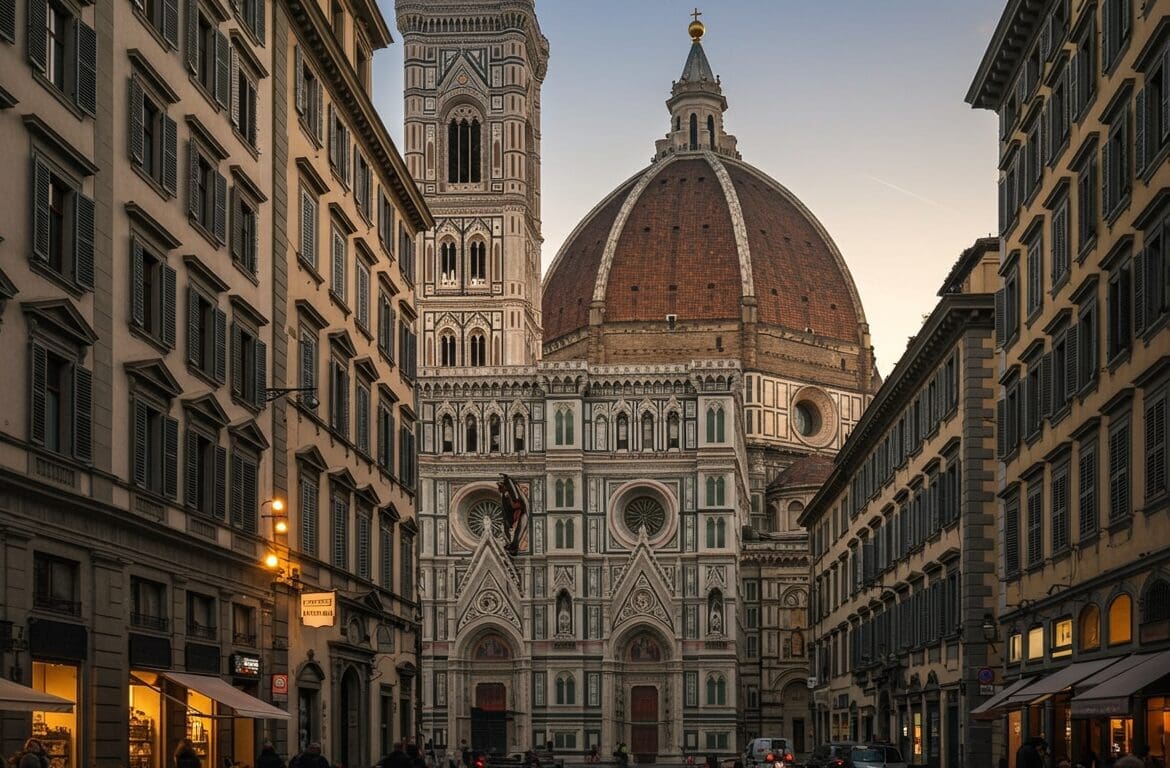
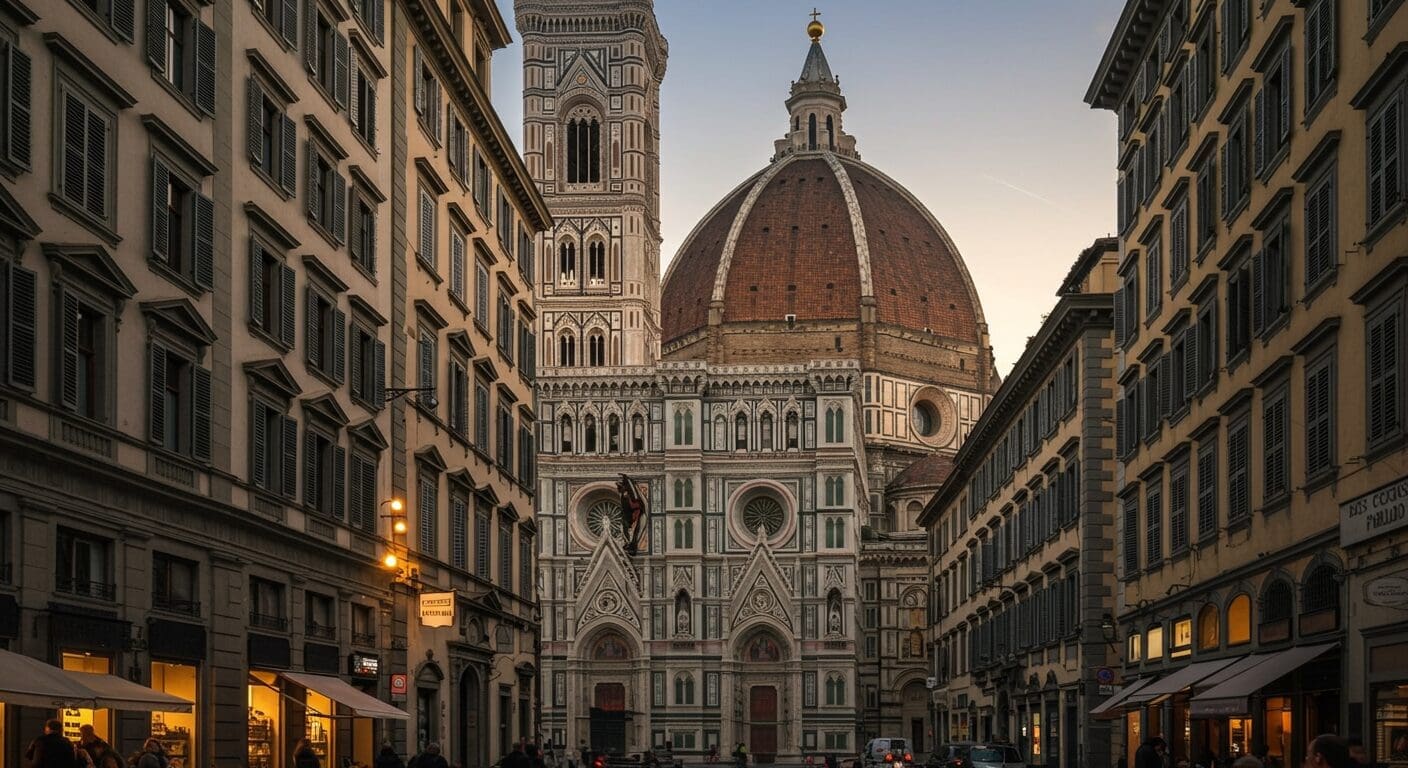
The neighbourhood immediately surrounding the Duomo – Florence’s great cathedral, whose terracotta dome Brunelleschi solved with a structural ingenuity that still defeats full explanation – is, in high season, an exercise in managing your relationship with crowds. The Piazza della Repubblica has a pleasant café culture and a certain grandeur, even if it is the part of Florence that most resembles the kind of square you might find in any major Italian city. The Piazza della Signoria, outside the Palazzo Vecchio, is where the city’s civic power was literally exercised for centuries, and where a copy of Michelangelo’s David stands in the spot where the original once stood. The original is in the Accademia. Both are worth seeing, and the marble, in both cases, is extraordinary.
Cross the Ponte Vecchio – the medieval bridge lined with jewellers’ shops, which survived the Second World War because Hitler is said to have found it too beautiful to destroy, which is a complicated compliment at best – and you enter the Oltrarno, a neighbourhood that operates at a slightly different frequency from the rest of the city. Artisan workshops, independent restaurants, the Pitti Palace with its astonishing contents, and a general atmosphere of people who live here rather than visiting. This is the Florence that doesn’t appear on the first page of search results, and it is markedly better for it. San Niccolò, at the far eastern end of the Oltrarno, has a village quality that becomes particularly pronounced in the evenings when locals gather at the wine bars along Via San Miniato.
Fiesole, five kilometres north of the city on a hill that Romans found conveniently elevated, offers the rare gift of looking down at Florence from above. There are Etruscan and Roman ruins here, a spectacular view over the valley, and a pace of life that makes the city below seem like something happening in another dimension. Worth a half-day at minimum.
Things to Do That Go Beyond Standing in Queues
The obvious activities in Florence – visiting the Uffizi, climbing the Duomo, crossing Ponte Vecchio – are obvious because they are genuinely unmissable, and the best approach to all of them is to book in advance with the focused determination of someone who has stood in an August queue once before and formed strong opinions about it. The Uffizi, with its 60-plus rooms of Renaissance art, could occupy three full days if you let it. Most people don’t, which is fine; there is a good argument for choosing five things to see properly rather than seventeen things to see in a state of visual overwhelm.
Beyond the major museums, Florence sustains a rich calendar of private tours, artisan workshops, and experiences that don’t appear in the standard itinerary. Leather-working classes in the Oltrarno, where craft has been practised in the same neighbourhoods for centuries. Private after-hours visits to the Uffizi, which some specialist concierge services can arrange and which produce the particular, slightly eerie pleasure of having Botticelli to yourself. Wine tastings in the Chianti Classico zone, twenty minutes south of the city, where some of Italy’s most serious wine is produced from vineyards that have been doing roughly the same thing since the thirteenth century. Cooking classes with a Florentine nonna who will have opinions about your knife technique. These are the things people remember.
Day trips from Florence are genuinely excellent. Siena is ninety minutes by bus or car and deserves more than the brief visit most people give it. San Gimignano, with its medieval towers rising improbably from the Tuscan hills, is forty minutes further. Lucca, an hour west, is encircled by intact Renaissance walls wide enough to cycle along – which people do, cheerfully, on rented bikes. For the artistically obsessed, Arezzo, which contains some of Piero della Francesca’s greatest frescoes, is forty-five minutes by train and almost never as crowded as it deserves to be.
Moving Through the Tuscan Landscape: Active Florence
Florence is not, it must be said, the first city that comes to mind when someone mentions adventure sports. It is not a place people associate with kitesurfing or backcountry skiing. What it offers instead is a landscape built for movement at a more contemplative pace, which is, depending on your temperament, either a limitation or a significant advantage.
Cycling in and around Florence has become genuinely enjoyable since the expansion of cycle infrastructure in recent years. The route along the Arno towards Pontassieve is particularly fine – flat enough to be undemanding, varied enough to sustain interest, and punctuated by wine estates at intervals that seem deliberately planned. E-bike rental has made the hillier routes into the Chianti accessible to people who would otherwise consider “hilly Tuscany” and “cycling” incompatible concepts.
Walking and hiking in the surrounding hills is, arguably, the best way to understand why Florentines have the relationship they do with their landscape. The hills visible from almost every elevated point in the city are genuinely there to walk in, and trails connecting villages in the Chianti Classico zone, the Mugello valley to the north, or the Casentino forests to the east offer everything from a gentle two-hour ramble to a proper multi-day route. The Via Francigena, the ancient pilgrimage route to Rome, passes through Tuscany and can be walked in sections without the full spiritual commitment of completing the whole thing.
For water, the Arno itself is swimmable in places further upstream, and Lake Bilancino, thirty kilometres north of Florence, offers sailing, windsurfing, and the specific pleasure of lying on a lakeside beach far from a tourist menu. Horse riding through the Chianti hills is available at numerous agriturismi and is the kind of activity that sounds affected until you’re actually doing it, at which point it seems entirely reasonable.
Florence with Children: Better Than You Might Expect
The concern that Florence is too serious, too museum-heavy, too adult for a family holiday is understandable and also largely unfounded. Children who are given the freedom to move around the city – to climb things, to eat gelato at irregular hours, to feed pigeons in piazzas and find faces carved into medieval doorways – tend to find Florence entirely absorbing. The city is walkable, relatively safe, and contains enough architectural spectacle to satisfy a ten-year-old who has been promised something impressive.
The practical advantage of booking a luxury villa in Florence with a private pool cannot be overstated from a family perspective. A hotel room, however elegant, does not accommodate the particular domestic ecosystem of a family with children: the morning chaos, the afternoon need for somewhere to splash around, the evening requirement for a terrace where adults can sit in peace while children run in a garden. A villa provides all of this, and the privacy it affords means that the family holiday ceases to be a performance conducted in front of strangers.
Child-appropriate activities in Florence are more plentiful than the art-history focus of most travel guides suggests. The Museo Galileo, on the Arno near the Uffizi, has early scientific instruments that most children find either fascinating or genuinely disturbing – Galileo’s preserved finger is there, in a glass case, which provokes a reaction from most visitors regardless of age. The climb to the top of the Duomo’s dome is physically demanding and spectacular, and most children of seven or above will remember it. The Boboli Gardens, behind the Pitti Palace, are large enough to get genuinely lost in, which is not a bad quality in a garden when the alternative is another church.
Why Florence Looks Like This: Five Centuries of Remarkable Patronage
It helps, when walking around Florence, to understand very roughly why it looks the way it does. The short version: the Medici family. Banking wealth accumulated over two centuries funded an almost incomprehensible quantity of art and architecture, much of it still visible in the city today. The Medici understood – with a shrewdness that was equal parts political calculation and genuine aesthetic conviction – that commissioning great art was a form of power. Brunelleschi’s dome, Ghiberti’s Baptistery doors, Donatello’s sculptures, Botticelli’s paintings: these were not purely devotional acts. They were statements about who ran Florence and what that meant.
The result, for the twenty-first century visitor, is a city where the density of significant art and architecture is, frankly, a little overwhelming if you try to process all of it simultaneously. The Uffizi Gallery alone, with its more than 3,000 works spanning the Byzantine period through the early modern, including rooms devoted to Botticelli’s Birth of Venus and Primavera, Leonardo da Vinci, Raphael, Caravaggio, and several dozen other artists whose names appear in art history courses, could occupy a week of serious attention. Most visitors give it three hours, which is both understandable and slightly heartbreaking.
Beyond the galleries, the architectural texture of the city is its own kind of museum. The Palazzo Vecchio, the Bargello, the churches of Santa Croce (where Michelangelo, Galileo, and Machiavelli are buried, which is a remarkable gathering of permanent residents), Santa Maria Novella, San Miniato al Monte on its hill above the city: each of these is worth dedicated time rather than a brisk walk-through. The annual Scoppio del Carro – the “explosion of the cart” – at Easter, in which a cart full of fireworks is detonated in Piazza del Duomo, is the kind of local tradition that rewards being somewhere on the right day. Florence does not organise its cultural calendar for the convenience of the short-break traveller, but it rewards those who plan around it.
Shopping in Florence: The Case for Buying One Very Good Thing
Florence has been producing things worth buying for longer than most contemporary brands have existed. The leather goods industry here is genuine – this is not the tourist-market simulation of craft that proliferates in some European cities, but an actual tradition of production rooted in workshops that have been operating in the Oltrarno and Santa Croce neighbourhoods for generations. The Scuola del Cuoio, housed within the complex of Santa Croce church, teaches and sells leather goods made on the premises. Buying a bag or wallet here is, in the most literal sense, buying something made where you are standing.
The gold on Ponte Vecchio has been sold since 1593, when Ferdinando I de’ Medici decreed that only goldsmiths and jewellers could trade on the bridge – replacing the butchers who had previously occupied it, a transition that improved the neighbourhood considerably. The shops are small, many are family-run, and the quality varies considerably, which is the most useful thing anyone can tell you before you start looking.
Via Tornabuoni is Florence’s answer to Bond Street – Gucci, Ferragamo, and Bulgari among the anchors of a street that takes luxury retail seriously. The Ferragamo museum on the same street is worth an hour and is significantly less crowded than most of the art museums. For those who find flagship stores slightly airless, the streets around Via della Vigna Nuova offer independent boutiques carrying Florentine designers at various price points. The Mercato Centrale, in the San Lorenzo neighbourhood, is the best food market in the city: two floors, a roof with restaurant stalls, and a ground level where Florentines actually shop for cheese, meat, and produce rather than performing the act of buying for the benefit of observers.
The Practical Matters: What Florence Actually Requires of You
Florence operates on the euro, naturally. Tipping is not expected in the way it is in the United States – a rounding up of the bill, or a euro or two left after a good meal, is perfectly appropriate; anything beyond that will be accepted graciously and noted as indicating your likely nationality. Service charges are sometimes included in restaurant bills (look for “coperto” – a cover charge – which is standard and not optional), so reading the bill before adding more is always worthwhile.
The best time to visit Florence depends on what you are optimising for. April, May, and early June offer mild temperatures, manageable crowds, and the particular quality of Tuscan light in late spring that explains why so many painters worked here. September and October are arguably even better – the summer crowds have thinned, the vendemmia (grape harvest) is underway in the surrounding vineyards, and the city feels, fractionally, like itself. July and August are hot – genuinely, relentlessly hot in a city full of stone and brick that retains heat overnight – and August in particular sees many Florentines leave the city for the coast, which has the consequence of closing some of the better local restaurants at the precise moment when most visitors arrive. December and January are cold, quiet, and atmospheric in a way that rewards a certain temperament.
Language: Italian. Florence is tourist-fluent in the centre, but making the attempt in Italian – however badly – is the difference between being treated as a visitor and being treated as someone worth talking to. “Buongiorno” before any transaction is not merely polite; it is, in Florence, genuinely expected. The Florentine dialect has particular characteristics that sometimes baffle even other Italians, but this is more interesting than it is problematic.
Safety is not a significant concern in Florence – the usual urban common sense applies, particularly around crowded attractions like the Ponte Vecchio and the Uffizi where pickpocketing is the primary risk. The city has a low violent crime rate, and solo travellers, including women travelling alone, report feeling comfortable in most areas at most hours.
Why a Private Villa Transforms a Florence Holiday Entirely
There is a version of a Florence holiday that takes place in a fine hotel room: a minibar, a view of a neighbouring building, a breakfast that costs as much as lunch. It is a perfectly serviceable version. There is another version that takes place in a private villa – perhaps in the hills above Fiesole, or within the Chianti Classico zone, or tucked into the Florentine countryside with Florence glittering in the valley below – and this version is different in kind, not just degree.
The privacy argument is straightforward: a villa is yours, entirely, in a way that no hotel room or suite ever quite manages to be. There is no lobby to negotiate, no other guests in the corridor, no performance of being on holiday in front of strangers. For families with children, this freedom is transformative – the morning routine, the nap schedule, the evening meal that runs late because nobody has to be quiet – all of it happens on your terms. For couples on a significant trip, the seclusion of a private villa with a pool and a terrace offers a particular intimacy that even the most romantic hotel suite cannot replicate.
Groups of friends who have assembled from different cities for a shared week – the kind of trip that gets planned optimistically in February and somehow actually happens by September – will find that a villa with six or eight bedrooms, a shared kitchen, a long table for dinner, and a pool for the afternoons is infinitely more satisfying than a block of adjacent hotel rooms. The logistical advantage alone justifies the decision; the experiential difference makes it obvious in retrospect.
For those who intend to work during part of their stay – because the world continues, regrettably, while you are in Tuscany – quality villas now routinely offer high-speed internet, dedicated workspace, and in some cases Starlink connectivity that delivers reliable bandwidth even in rural locations. The combination of morning calls handled from a stone-floored study and afternoons by a private pool is not a contradiction; it is the specific form that the modern working holiday has taken, and Florence’s surrounding countryside accommodates it extraordinarily well.
Wellness guests will find that the Florentine villa landscape caters to them with increasing sophistication: private pools for morning laps, gardens for yoga, concierge services that can arrange in-villa massage or connect you with thermal spa facilities within easy reach of the city. The pace of life in a Tuscan villa – the unhurried mornings, the long lunches, the absence of any particular obligation – is itself a form of recovery that no spa menu can fully replicate.
Excellence Luxury Villas offers a curated collection of over 27,000 properties worldwide, including properties throughout the Florentine hills and Tuscan countryside that place you close enough to the city to see its museums and far enough away to forget, occasionally, that a city exists. To find your perfect base for Tuscany, explore our full range of luxury villa holidays in Florence.
More Florence Travel Guides
- Best Restaurants in Florence: Fine Dining, Local Gems & Where to Eat
- Florence Food & Wine Guide: Local Cuisine, Markets & Wine Estates
- Florence with Kids: The Ultimate Family Holiday Guide
- Best Time to Visit Florence: Month by Month Weather, Crowds & Tips
- Florence Luxury Itinerary: The Perfect 7-Day Guide
- Romantic Florence: The Ultimate Couples & Honeymoon Guide
What is the best time to visit Florence?
April, May, and early June offer the most balanced combination of mild weather, manageable crowds, and exceptional light. September and October are equally good – often better for those who dislike heat – with the added pleasure of the grape harvest underway in the surrounding Chianti vineyards. July and August are genuinely hot and significantly more crowded, with many local restaurants closing in August as Florentines head to the coast. December through February is quiet, cold, and atmospheric; winter visitors often find the city at its most local and least performative.
How do I get to Florence?
Florence is served by Amerigo Vespucci Airport (also known as Peretola), just four kilometres from the city centre – transfers take fifteen to thirty minutes. For international connections, Pisa’s Galileo Galilei Airport is around an hour away, with a direct train link into Florence’s Santa Maria Novella station. Bologna Guglielmo Marconi Airport is a similar distance to the north and works well for travellers arriving from northern European hubs. High-speed rail connects Florence to Rome in ninety minutes and to Milan in under two hours, making train travel a genuinely compelling alternative for European arrivals.
Is Florence good for families?
Yes, considerably more so than its reputation as a serious art city might suggest. The historic centre is walkable, relatively safe, and full of things that genuinely capture children’s attention – the Duomo dome climb, the Galileo Museum’s strange instruments, the Boboli Gardens. The practical case for a private villa with a pool is particularly strong for families: the space, the flexibility, the private outdoor area, and the freedom to organise meals and schedules without hotel constraints make the family holiday considerably more relaxed for everyone involved.
Why rent a luxury villa in Florence?
Privacy and space, primarily – a private villa gives you the city’s riches at arm’s reach and a genuinely private base to return to. For families, a villa with a private pool eliminates the logistical friction of hotel life. For couples, the seclusion offers a quality of intimacy that even the best hotel suite cannot fully match. Many villas come with dedicated staff – housekeeping, a concierge, in some cases a private chef – providing a level of personalised service that, in a hotel, would require a very substantial budget and still wouldn’t give you the run of the whole property.
Are there private villas in Florence suitable for large groups or multi-generational families?
Yes. The Florentine hills and Tuscan countryside offer some of Italy’s finest large villa properties, with options ranging from six to twelve or more bedrooms, private pools, expansive gardens, and in some cases separate guest wings that give different generations or friend groups their own space within a shared property. Many properties in the Excellence Luxury Villas collection are specifically suited to large gatherings – milestone celebrations, family reunions, group holidays – and can be arranged with dedicated staff including housekeeping and private chef services.
Can I find a luxury villa in Florence with good internet for remote working?
Increasingly yes. Quality villa properties in and around Florence now routinely offer high-speed fibre internet, and rural properties in the wider Tuscan countryside are seeing growing Starlink availability that delivers reliable connectivity regardless of location. If remote working is a requirement, specify it when enquiring – our team can match you with properties where the connection has been verified and, where relevant, a dedicated workspace is available. The combination of a stone-floored Tuscan study in the morning and a private pool in the afternoon is not as contradictory as it sounds.
What makes Florence a good destination for a wellness retreat?
The landscape as much as the city. Florence sits within a region of hills, valleys, and thermal springs that has been used for recovery and restoration since Roman times. Private villa amenities – pools, gardens, outdoor terraces, in some cases private gyms or treatment rooms – provide a strong wellness infrastructure within the property. Beyond the villa, hiking and cycling routes through the Chianti and Mugello are excellent, thermal spa facilities are within easy driving distance, and the general pace of life in the Florentine countryside, particularly outside of summer peak, has the quality of somewhere that does not rush. The food and wine, consumed with appropriate attention to quantity, is also good for the soul.