Ionian Islands Travel Guide: Best Beaches, Restaurants & Luxury Villas
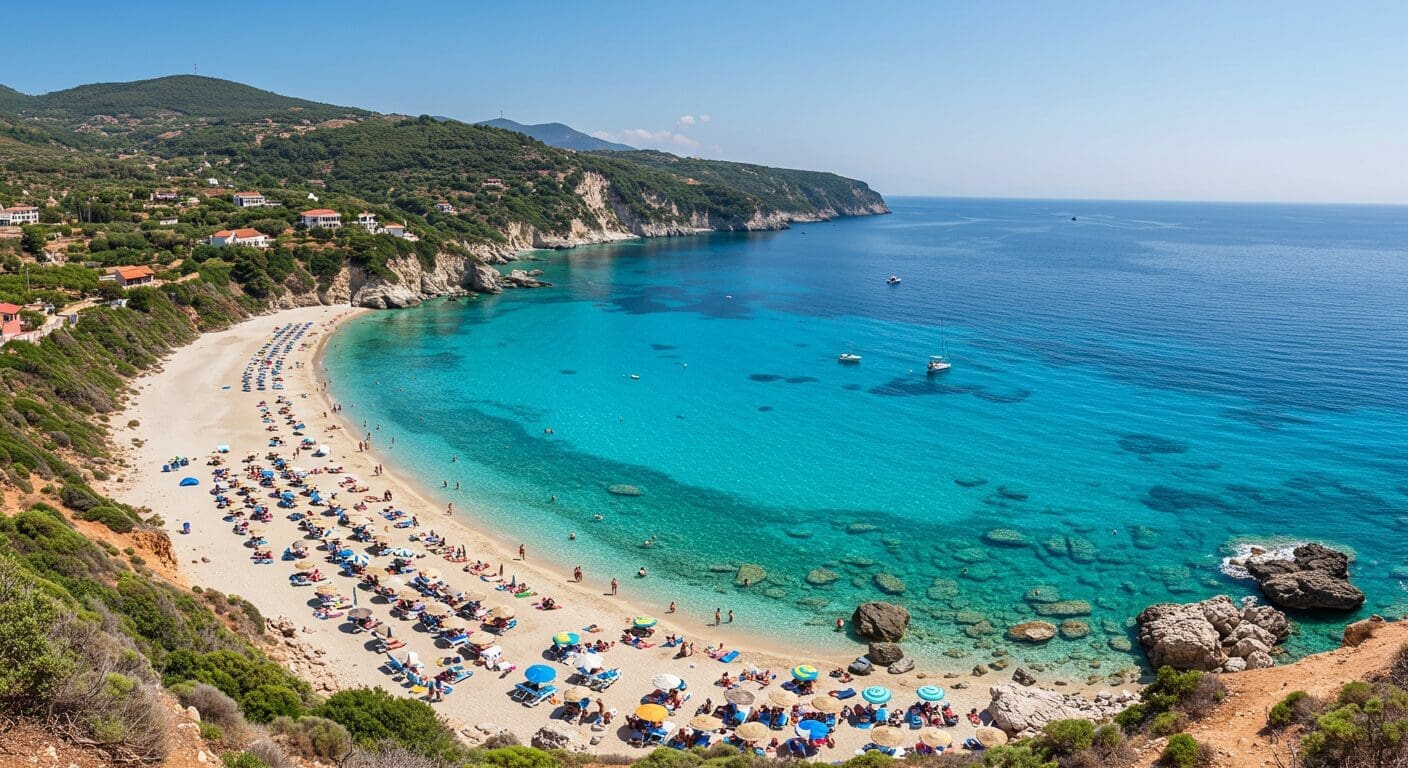
In late June, something shifts in the Ionian. The light thickens to amber by six in the evening, the sea settles into a shade of blue that has no satisfactory name in English, and the air carries the particular combination of wild thyme, warm stone and salt that you will spend the rest of the year trying to describe to people who weren’t there. This is the Ionian Islands at their most seductive – not the frantic peak of August, when the ferries are full and the tavernas are heaving, but that sweet early-summer window when the crowds haven’t quite arrived and the islands still feel, against all odds, like a secret. Come in May or September and the feeling intensifies further: the sea is warm, the hillsides are green rather than scorched, and you will find yourself wondering why anyone chooses anywhere else.
The Ionian archipelago – Corfu, Kefalonia, Zakynthos, Lefkada, Ithaca, Paxos, Antipaxos – attracts a particular kind of traveller. Families who want privacy and space rather than the organised chaos of a hotel pool find exactly what they’re looking for here. Couples marking milestone anniversaries or honeymoons discover that the combination of extraordinary food, extraordinary scenery and genuine tranquillity does more for a relationship than any spa weekend. Groups of old friends – the kind who’ve been promising each other a proper holiday for three years – tend to arrive, exhale and immediately book again for next summer. Wellness-focused guests drawn to open-water swimming, long coastal walks and genuinely unhurried days find the Ionian pace of life is not a marketing concept but an actual reality. And the growing number of remote workers who’ve discovered that a villa with reliable connectivity and a private pool is a considerably more pleasant office than an open-plan in Shoreditch – they understand something the rest of us are catching up on. The Greek Islands as a whole offer extraordinary variety, but there is something about the Ionian – greener, lusher, less overrun than the Cyclades – that rewards those who actually bother to seek it out.
Getting Here Is Half the Pleasure – If You Do It Right
The main entry points to the Ionian depend on which island you’re heading to, and the distances between islands are significant enough that it’s worth thinking about this before you book. Corfu International Airport (CFU) serves the northernmost island with direct flights from most major UK and European cities year-round, with the network expanding considerably from April through October. Kefalonia Airport (EFL) handles the central island and is well connected from the UK in summer. Zakynthos Airport (ZTH) in the south sees a steady stream of direct services, while Lefkada – technically connected to the mainland by a short causeway – is most easily accessed via Preveza Airport (PVK), a 30-minute drive away.
Getting between the islands is part of the experience, or at least that’s what you tell yourself when the ferry is late. In practice, inter-island ferry routes exist but are not always the seamlessly integrated network the tourist brochures suggest. For travellers based in one location – which most villa guests sensibly are – the better strategy is to rent a car on arrival and use it to explore. Roads on Corfu and Kefalonia are genuinely good; on Paxos, which has no airport and is reached by ferry from Corfu or Parga, they are charming and narrow and require a certain philosophical approach to oncoming traffic. Private water taxis can be arranged between many of the smaller islands, and for those staying in particularly well-appointed villas, helicopter transfers from Athens or Corfu are available and make an absurd amount of sense when you do the time arithmetic.
Eating in the Ionian: Where the Food Is as Good as the View
Fine Dining
The Ionian Islands have, over the past two decades, quietly built a fine dining scene that would embarrass several European capitals. At the very top of that scene sits Etrusco, in Kato Korakiana on Corfu – a destination restaurant in the truest sense of the phrase, meaning people genuinely fly in for dinner. Helmed since 1992 by Greek-Italian chef-owner Ettore Botrini, Etrusco takes the deep culinary history of Corfu – itself shaped by centuries of Venetian occupation – and reinterprets it with modern precision and extraordinary finesse. The result has earned Etrusco four stars at the FNL Best Restaurant Awards, second place at The List 2024, and Greece’s highest culinary honour at the 2018 Toques d’Or awards. Reviewers reach for superlatives and find them justified: “the best restaurant in Corfu and quite possibly the entire country.” Whether or not you accept the latter claim, the former seems beyond dispute. Book early. Book very early.
On Zakynthos, at the award-winning Porto Zante resort, MAYA Asian Restaurant occupies an altogether different register. A former Nobu chef has created what is, by any serious reckoning, one of the finest Japanese restaurants in Greece – for just a handful of covers per night. The setting alone is remarkable: a beachfront terrace above the Ionian, the water visible in every direction, the service immaculate. The Chef’s Signature Omakase tasting menu is the obvious choice, though the à la carte – featuring a Royal King Crab tartare, Clams and Oysters Platter, and sushi and sashimi prepared from locally caught fish – is not without its own quiet brilliance. One couple who dined here on their anniversary described it as “truly unforgettable,” which, given that every restaurant in Greece claims to be unforgettable, carries some weight when the evidence supports it. The combination of world-class Japanese technique with Ionian-sourced ingredients is one of those ideas that sounds unlikely on paper and is revelatory on the plate.
Back on Corfu, Pomo d’Oro in the Skaramaga area of Corfu Town deserves serious attention. Chef-owner Aristotelis Megoulas takes a bistronomy approach – relaxed in form, uncompromising in substance – building menus around locally sourced Ionian ingredients, revived historical recipes and the island’s enduring Venetian influences. Some of his dishes are dedicated to individual local producers; others reference Corfiot food history with the kind of specificity that only comes from genuine obsession. The level of cooking consistently prompts reviewers to observe that Pomo d’Oro “deserves a Michelin star.” Whether Michelin agrees will be a matter of time and geography. Whether it matters to the experience is a different question entirely.
Where the Locals Eat
The real rhythm of Ionian eating happens at considerably lower volume and considerably closer to the water. Every village on every island has its taverna – sometimes several – where the menu is whatever was caught or harvested that day, handwritten on a small board or simply recited with the confidence of someone who has cooked this food their entire life. Grilled octopus, slow-cooked lamb, sofrito (that specific Corfiot preparation of veal with white wine and garlic), bourdeto (the spiced fish stew that the Venetians arguably started and the Corfiots perfected) – these are the dishes the islands do best, and no amount of fine dining technique changes that fundamental fact. Follow local families to lunch, eat where the fishing boats are visible from the table, and accept that the rough house wine in a carafe may be the best thing you drink all week. It frequently is.
On Corfu, the Liston arcade in Corfu Town – modelled, somewhat improbably, on the Rue de Rivoli in Paris – is lined with cafés where the local kumquat liqueur is served with something approaching religious devotion. The morning market near the old port is where serious cooks shop, and where visitors who’ve rented villas with proper kitchens lose an enjoyable hour or two choosing between vegetables, olives and cheeses of various assertiveness. On Lefkada, the waterfront of Lefkada Town itself is lined with places to eat that are relentlessly ordinary in appearance and regularly excellent in practice.
Hidden Gems Worth Seeking Out
Agni Bay on the northeast coast of Corfu is one of those places that the northeast-coast-of-Corfu cognoscenti will tell you about in hushed tones, presumably hoping you won’t tell anyone else. It is accessible only by boat or on foot, which keeps it pleasingly unspoiled, and at its heart is Toula’s Seaside – a restaurant that has been feeding visitors and locals alike for roughly four decades. Self-educated head chef Mrs. Toula built her reputation on fresh ingredients, traditional recipes and an approach to Greek seafood that was ahead of its time and remains definitive. The setting is spectacular; the cooking is the kind that makes you forget to take photographs because you’re too busy eating. Arrive by water taxi from Kassiopi or Kalami, and you will understand immediately why this particular corner of Corfu inspires the loyalty it does. Toula’s is not undiscovered – the discerning have been finding it for years – but it rewards the effort of getting there in a way that very few restaurants anywhere manage.
On Ithaca – Homer’s island, which is either a selling point or a piece of information you file and never use, depending on your relationship with the Odyssey – the village of Kioni has a small harbour and a handful of unpretentious tavernas where the catch is genuinely fresh and the setting is quietly extraordinary. It is the sort of place you find yourself returning to for dinner three nights in a row without quite planning to.
The Coastline That Keeps You From Going Home
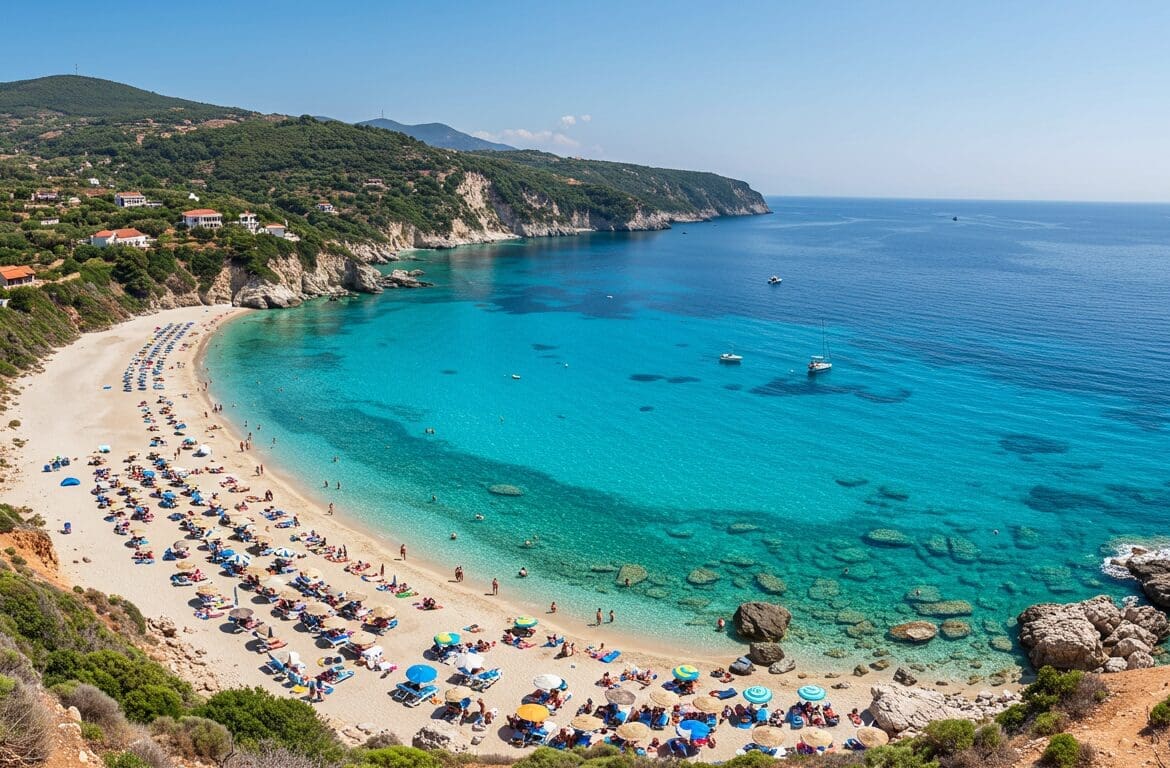
The beaches of the Ionian Islands are the reason the rest of the Aegean occasionally feels hard done by. The geology here – limestone cliffs, turquoise coves, sand ranging from white to gold – produces a variety of coastal environments that can occupy an entire fortnight without repetition. Myrtos Beach on Kefalonia is probably the most photographed stretch of coast in the Ionian, and the photographs don’t lie: the combination of sheer white cliffs and improbably blue water is as dramatic as Greece gets. The descent to the beach requires some commitment, which usefully deters anyone who wasn’t really sure they wanted to be there.
Navagio Beach on Zakynthos – the shipwreck beach – is iconic enough that it appears on Greek tourist marketing with almost tedious regularity, and yet seeing it in person from a boat, with the rusted hull of the MV Panagiotis still lodged in the sand where it came to rest in 1980, is genuinely arresting. It is accessible only by boat, which gives it an edge over beaches that can be reached with a hire car and a set of questionable flip-flops. Porto Katsiki on Lefkada runs Myrtos close for dramatic impact, with cliff-backed turquoise water and a narrow wooden staircase descending from the plateau that adds a pleasing sense of occasion to the arrival.
The more astute beach-goers head for the smaller, less-publicised coves – the ones that require a boat, a water taxi, or simply the local knowledge that comes from spending time here rather than following a listicle. Antipaxos, reachable in 20 minutes from Paxos by water taxi, has beaches of a quality that would make the Caribbean take a long look at itself. Voutoumi and Vrika are two of the finest small beaches in Europe – water so clear and so brilliantly coloured that first-time visitors tend to stand at the water’s edge for an unnecessarily long time, simply looking. The island has almost no permanent residents and no tourist infrastructure to speak of, which in this context is an unqualified virtue.
Beach clubs exist – Corfu in particular has developed a small selection of grown-up coastal venues with proper sunbeds, cocktails and DJs calibrated to a tempo that does not require earplugs – but the defining Ionian beach experience is quieter and more personal than that. A cove, a boat, cold water, shade when you need it. The simplicity is the point.
Things to Do That Are Not Just Lying by the Water (Though That Is Also Valid)
The Ionian rewards activity without demanding it, which is exactly the right balance for a luxury holiday. Water-based activities dominate, reasonably enough. Sailing around the islands is genuinely one of the best ways to experience the archipelago – the winds are consistent (the Maestros, the reliable northwesterly, blows from June to August), the anchorages are spectacular and the distances between islands are manageable. Crewed charter yachts can be arranged from Lefkada Marina, one of the better-equipped sailing bases in the eastern Mediterranean, and will introduce you to coves and bays that the land-based visitor never reaches.
Sea kayaking along the Ionian coastlines – particularly around Lefkada’s western cliffs, or through the sea caves of Kefalonia’s Melissani area – delivers a scale of scenery that is quite different from the view from a yacht deck. You are at water level, moving slowly, and the cliffs are very large. It has a specific kind of impact. Stand-up paddleboarding has become ubiquitous in ways that would have baffled a Corfiot fisherman twenty years ago, but it is genuinely well-suited to the calm inshore waters of the islands and provides an agreeable way to cover small distances in the morning before the heat arrives.
Day trips reward the curious. Corfu Town – a UNESCO World Heritage Site since 2007 – is one of the most architecturally layered towns in the Mediterranean, with Byzantine, Venetian, French and British influences visible in successive geological strata as you walk through it. The Old Fortress, the Liston, the Spianada square (the largest in Greece), the warren of the Campiello district with its washing lines and peeling paintwork and cats conducting territorial negotiations – it is a town that repays serious walking. Kefalonia’s Melissani Cave, where an underground lake glows an extraordinary shade of turquoise in the midday light when the sun passes through an opening in the rock above, is one of those natural phenomena that could reasonably be accused of trying too hard, and yet is completely real. The Drogarati Cave nearby, with its extraordinary stalactite formations, is quieter and arguably stranger.
For Those Who Like Their Adventures with a Side of Adrenaline
The underwater world of the Ionian is one of the most rewarding in Greece for divers, and the visibility in the clear western waters consistently exceeds expectations. PADI centres operate on the main islands throughout the summer season, and the range of sites – from shallow reef dives accessible to beginners, to wrecks and deeper wall dives for certified divers – means there is something here regardless of experience level. The waters around Kefalonia and Zakynthos in particular are known for their clarity and their populations of loggerhead sea turtles (Caretta caretta), who nest on Zakynthos’s Laganas Beach in numbers that have made the bay a National Marine Park. Snorkelling with sea turtles is not an activity that requires advance planning or specialist equipment, and is exactly as good as it sounds.
Hiking the Ionian hinterland is rewarding and significantly less explored than the coastal areas, which means you will often have the trails to yourself. Corfu’s interior – olive groves, cypress trees, Venetian manor houses subsiding gently into the landscape – is more beautiful than most visitors realise, because most visitors don’t go inland. The Corfu Trail, a long-distance walking route running the length of the island, covers around 220 kilometres and can be walked in stages of varying ambition. Kefalonia’s Mount Ainos, covered in a native species of black pine found nowhere else in Europe, offers hiking through genuine forest at altitude – an unexpectedly dramatic landscape on a Mediterranean island. On Lefkada, the path down to the remote beach of Egremni (since partially restored after the 2015 earthquake) rewards the descent with solitude and scenery in equal measure.
Cycling is increasingly well served on Corfu and Kefalonia, with road cycling routes that combine challenging gradients, extraordinary views and enough café stops to make the gradients seem less relevant. For those who prefer their adventure closer to the water, windsurfing conditions around Vassiliki on Lefkada are considered among the best in Europe – the afternoon thermal known locally as “the Eric” picks up reliably from around noon and reaches speeds that delight the expert and alarm the beginner in roughly equal measure.
Why Families Keep Coming Back, Summer After Summer
The Ionian Islands are an almost unreasonably good destination for families, and the key to understanding why lies in the combination of safe, calm seas – particularly on the eastern coasts, sheltered from the prevailing westerlies – and the genuine warmth Greek culture extends to children. Greek society has not adopted the slightly formal relationship with other people’s children that characterises parts of northern Europe, and taverna owners will frequently bring small visitors drawing paper, additional bread, or a detailed explanation of where the fish came from, unprompted and without any theatrical performance of child-friendliness. Children are simply welcome. The concept of a separate children’s menu is considered mildly eccentric.
For families in private villas – which is the natural habitat for a family that values privacy, unpredictable schedules and the ability to produce snacks at all hours without embarrassment – the Ionian offers an exceptional range of properties. A villa with a private pool and direct sea access, or a short walk to a calm-water bay, removes at once the social anxiety of the hotel pool and the logistical friction of beach days with small children. Teenagers who would resist any outing that sounds like an organised activity tend to find that snorkelling with turtles is acceptable because they suggested it themselves. This is a reliable family holiday dynamic, and the Ionian accommodates it beautifully.
Practically speaking: the main islands have good supermarkets, reliable pharmacies, and medical facilities adequate for the minor incidents of family travel. Corfu and Kefalonia both have hospitals. Ferry trips between islands are short enough to be adventures rather than ordeals. The seas in July and August are warm enough for prolonged daily swimming without complaint from anyone under the age of twelve – or, frankly, over it.
A History That Explains Everything, Including the Food
The Ionian Islands were never part of the Ottoman Empire. This single historical fact explains more about the culture, architecture, food and general atmosphere of the islands than almost any other. While the rest of Greece spent roughly four centuries under Ottoman rule, the Ionian Islands remained under Venetian sovereignty from the 14th century until Napoleon arrived in 1797 and decided, with characteristic decisiveness, that they were his. The British then took control until 1864, when the islands were finally united with Greece. The result is an archipelago whose cultural DNA contains influences that are entirely unlike mainland Greece or the Aegean islands – Venetian architecture in the towns (the arcaded buildings, the campaniles, the painted shutters), Italian culinary traditions woven into the local food, and a particular cosmopolitan ease that four centuries of Venetian rule apparently instilled and that hasn’t entirely dissipated.
Corfu Town – the Kerkyra of the locals – is the most visible expression of this layered history. The Palaiò Frourio, the Old Fortress, occupies a promontory above the sea and was built by the Byzantines and expanded by the Venetians to create one of the most formidable defensive structures in the eastern Mediterranean. The Néo Froúrio, the New Fortress (newer being a relative term – it dates from the 16th century), rises above the old town with its own considerable authority. In between, the Campiello district preserves a medieval street plan in which it is entirely possible to lose your orientation and your afternoon, in the most agreeable possible way. The Museum of Asian Art in the Palace of St. Michael and St. George – a British Regency building of all things, here on a Greek island – contains one of Europe’s finest collections of Asian antiquities and is almost always less crowded than it deserves to be.
Kefalonia’s relationship with its own history is somewhat more complicated, given that the devastating earthquake of 1953 destroyed most of the island’s traditional architecture and necessitated a wholesale rebuilding. What remains is a landscape that is beautiful in a raw, uncurated way – the rebuilt towns lack the Venetian patina of Corfu but the island’s personality, its fierce independence and the quality of its wine and olive oil, are entirely intact. The Robola wine of Kefalonia – a dry white made from a grape variety found almost nowhere else – is worth investigating seriously. It goes well with seafood. It goes well with most things, as it turns out.
Shopping in the Ionian: What to Buy and Where Not to Bother
The Ionian is not, in honesty, a destination for dedicated shopping tourism. It does not have the boutique density of Mallorca‘s Palma or the market culture of Marrakech. What it has instead is a selection of genuinely excellent local products that are worth seeking out and considerably worth bringing home. Corfu’s kumquat products – liqueur, marmalade, preserved fruit, chocolate-covered varieties of debatable culinary purpose – are distinctive enough to make useful gifts and are available throughout the island. The kumquat is not native to Corfu; it was introduced in the 19th century and has since been adopted with the possessive enthusiasm that the Corfiots apply to most things they decide are theirs.
Olive oil from both Corfu and Kefalonia reaches a quality level that renders most supermarket alternatives difficult to return to. The Corfiot olive variety – Lianolia, small and aromatic – produces an oil with a distinctive green-gold colour and a peppery finish. Buy it from local producers where possible, in quantities you will need to declare at the airport and will not regret. Honey from the Ionian hillsides, particularly from producers using thyme and wildflower pastures, is similarly worth the luggage space. Kefalonian honey has a specific reputation for quality that its producers would prefer you not to verify for yourself, lest you stop buying it in moderation.
Corfu Town has a small selection of independent shops selling locally made ceramics, leather goods and textiles, concentrated in the streets behind the Liston and in the Campiello district. The quality is variable but the better pieces are genuinely good. Avoid the souvenir shops immediately adjacent to the main tourist sites, which sell the same blue-and-white inventory available in every port in the Mediterranean, and instead look for the smaller, more personal operations where someone has clearly made a decision about what they want to sell.
The Things Worth Knowing Before You Arrive
Currency in Greece is the euro. English is spoken confidently throughout the tourist-facing economy on all the main islands; in the more remote villages and the smaller tavernas, Italian – a legacy of the Venetian centuries – is sometimes more useful than English. Greek is always appreciated, and even a serviceable “efcharistó” (thank you) is received with genuine warmth rather than the slightly patronising approval it might attract elsewhere.
Tipping is customary but not the quasi-mandatory ritual it has become in some countries. Rounding up the bill or leaving five to ten percent for good service is entirely appropriate; the automatic service charge that appears on some bills in Corfu Town is worth checking carefully. Taxi drivers do not expect tips but are generally unshocked to receive them.
The best time to visit for a luxury Ionian Islands holiday is unquestionably late May to mid-June, or the whole of September into early October. In this window the sea is warm (or warming rapidly in May), the crowds are manageable, the light is extraordinary, and every restaurant and activity is operating without the pressurised atmosphere of August. High summer – mid-July to late August – brings the largest crowds and the highest prices but also the longest days, the warmest water, and the particular social energy of the Ionian at full volume. For remote workers and wellness-focused visitors, shoulder season is the obvious choice. For families with school-age children, the school holiday window is simply the school holiday window, and the Ionian handles it with more grace than most comparable destinations.
A note on driving: Greek road markings and Greek driving conventions have an improvisational quality that requires some acclimatisation. Roads on the west coast of Kefalonia and through the interior of Corfu are occasionally narrow and occasionally dramatic. A small car and a calm disposition are both advisable. The roads themselves are better than they were a decade ago, and nowhere on the main islands requires four-wheel drive under normal conditions.
Healthcare: EU citizens with an EHIC or GHIC card are entitled to state healthcare at reduced or zero cost. Travel insurance covering medical treatment is strongly advisable for non-EU visitors and sensible for everyone. The main islands have adequate to good medical facilities; for anything serious, evacuation to Athens is possible and sometimes arranged.
Why a Private Villa Makes Everything Better – and Not in the Way Brochures Usually Mean
Hotels in the Ionian range from perfectly comfortable to genuinely excellent. This is not the argument against them. The argument against them is simply one of arithmetic: when you are travelling as a family of six, or a group of friends who haven’t all been in the same place for three years, or a couple who want to eat breakfast in their swimwear at eleven without any social reckoning, a private villa is not a luxury upgrade. It is the correct solution to the problem of how to spend time together without the structural impositions of shared hotel spaces, communal pool politics and the mild indignity of a breakfast buffet.
Luxury villas in the Ionian Islands range from three-bedroom olive grove retreats on Paxos with private pools and direct sea access, to ten-bedroom Corfiot estates with staff, a chef, a boat, and a level of considered detail that takes several days to fully appreciate. The private pool is not incidental to the experience – in the Ionian heat, it becomes the organising principle of the day, around which everything else arranges itself. Morning swim before breakfast. Long lunch on the terrace. Afternoon drift between pool and sea. The rhythm is specific and entirely good for you.
For remote workers, the better villa properties now offer Starlink connectivity or high-speed fibre that makes the idea of working from a hillside terrace above the Ionian Sea entirely practical rather than aspirational. A morning of focused work, a dedicated outdoor workspace, a reliable video connection – and then an afternoon in which none of that is relevant. It is a reasonable way to operate, and the Balearic Islands and the Algarve offer comparable connectivity appeal, but the Ionian’s particular combination of scenery, food and relative undiscovery gives it a certain edge for those who’ve already been everywhere obvious.
Wellness amenities in the top-tier Ionian villas are increasingly serious – private gym equipment, outdoor yoga decks with sea views, infinity pools designed for contemplative rather than recreational swimming, in-villa massage and treatment options that can be arranged through villa concierge services. The islands themselves provide the rest: clean air, clean water, long walks, excellent food, and the specific restorative quality of a place that has not yet fully surrendered to the demands of mass tourism. The Ionian operates at a pace that adjusts you rather than requiring you to adjust to it.
Whether you’re planning a milestone celebration, a multi-generational family gathering, or simply the kind of summer holiday you want to remember when February in the northern hemisphere is doing its worst, explore our full collection of luxury villas in Ionian Islands with private pool and find the property that fits your version of the Ionian perfectly.
More Ionian Islands Travel Guides
- Best Restaurants in Ionian Islands: Fine Dining, Local Gems & Where to Eat
- Best Beaches in Ionian Islands: Hidden Coves, Beach Clubs & Coastal Secrets
- Ionian Islands with Kids: The Ultimate Family Holiday Guide
- Best Time to Visit Ionian Islands: Month by Month Weather, Crowds & Tips
- Ionian Islands Luxury Itinerary: The Perfect 7-Day Guide
- Romantic Ionian Islands: The Ultimate Couples & Honeymoon Guide
What is the best time to visit Ionian Islands?
Late May to mid-June and the whole of September into early October represent the sweet spot for a luxury Ionian Islands holiday. The sea is warm, the islands are uncrowded by August standards, and every restaurant and experience is operating at full quality without the pressurised pace of high summer. For families tied to school holidays, mid-July to late August is still excellent – the water is at its warmest, the days are longest, and the Ionian handles the summer crowds better than many comparable Mediterranean destinations. For remote workers and wellness-focused visitors, September is arguably the finest month of the year on these islands.
How do I get to Ionian Islands?
The main entry points depend on your destination island. Corfu International Airport (CFU) has direct flights from most major UK and European cities, particularly from April to October. Kefalonia Airport (EFL) and Zakynthos Airport (ZTH) are both well served by direct flights from the UK in summer. Lefkada is most easily reached via Preveza Airport (PVK) on the mainland, roughly a 30-minute drive from the causeway connecting Lefkada to the coast. Paxos has no airport and is reached by ferry from Corfu or Parga. Car hire is strongly recommended on arrival for all islands. For the ultimate arrival experience, helicopter transfers from Athens or Corfu are available and make logistical sense when you factor in the time saved versus the cost.
Is Ionian Islands good for families?
The Ionian is one of the best family destinations in the Mediterranean, for reasons that go beyond the obvious. The eastern coasts of most islands are sheltered from the prevailing westerly winds, producing calm, clear, shallow-entry seas that are safe for children of all ages. Greek culture extends genuine warmth to children in a way that makes family dining relaxed and enjoyable rather than anxious. And practically, a private villa with a pool removes the hotel-pool social dynamics that can quietly undermine a family holiday. Snorkelling with loggerhead sea turtles off Zakynthos, exploring the sea caves of Kefalonia, and taking water taxis to deserted beaches on Antipaxos are the kinds of experiences that constitute actual childhood memories, rather than just holiday photographs.
Why rent a luxury villa in Ionian Islands?
A private villa in the Ionian Islands gives you space, privacy and a level of flexibility that no hotel can match. The private pool becomes the centre of the day; the terrace becomes the dining room; the kitchen allows you to cook with the extraordinary local produce you find at morning markets. For groups and families, the cost per person often compares favourably with equivalent hotel rooms once you factor in the space, the meals and the freedom. Many top Ionian v