
Best Time to Visit Marbella: Month by Month Weather, Crowds & Tips
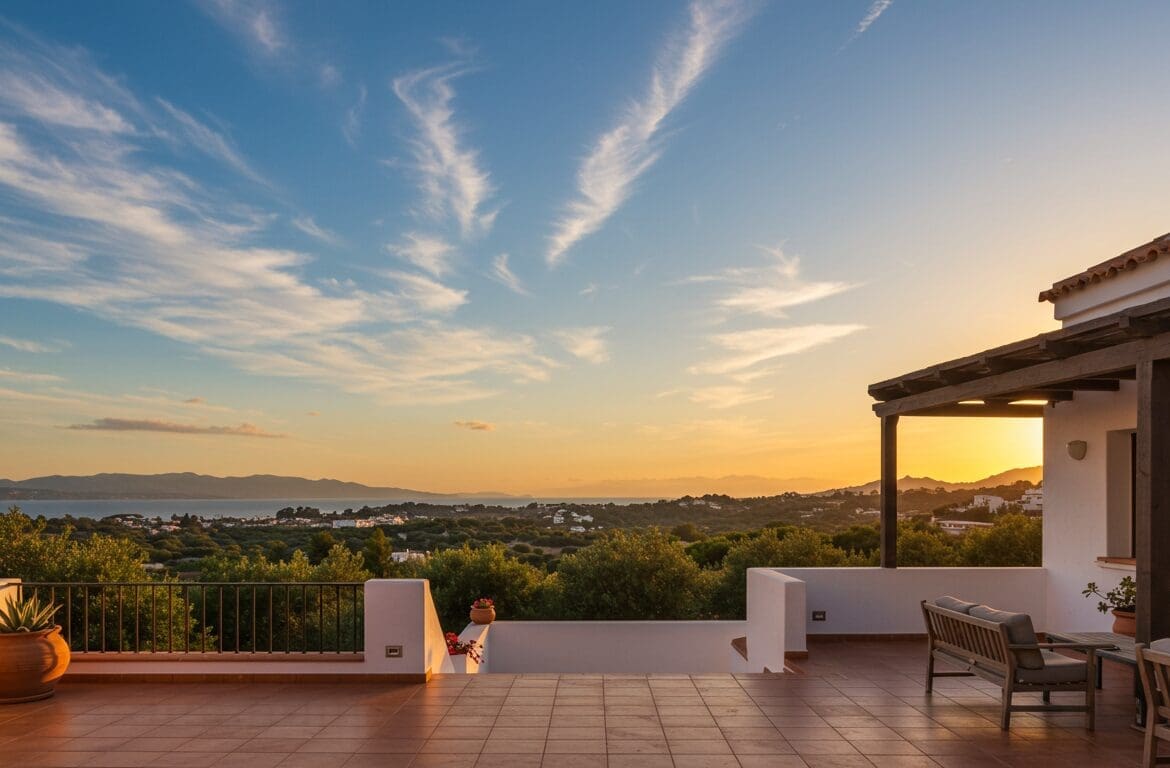
It is ten in the morning and you are already on your second coffee, taken at a table that catches the sun on the terrace of your villa. The Sierra Blanca sits sharp and white-capped above the town. Below you, the Mediterranean is doing that thing it does in Marbella – going an almost unreasonable shade of blue, as if it is trying to make a point. The pool is warm from yesterday. The jasmine is doing its best work of the day. You have no particular plans and approximately no regrets. This is Marbella at its best – and the good news is that depending on what you want from it, that moment is available to you across more of the calendar than most people realise.
Marbella’s Climate: The Broad Picture
Marbella sits in a geographic sweet spot. The Sierra Blanca shields it from the cold air that sweeps down through the rest of Andalusia in winter, while the Mediterranean moderates temperatures in summer. The result is one of the most reliably comfortable climates in Europe – roughly 320 days of sunshine a year, mild winters, and summers that are hot without quite tipping into the brutal. Average annual temperatures hover around 20°C, which sounds modest until you realise that even in January, a clear afternoon can feel entirely convincing.
The honest answer to when to visit Marbella is: it depends what you want. Families chasing school holidays want July and August and will get them, along with every other family in Europe. Couples seeking warmth without the circus should look at May, June, or September. Those who like a place to themselves, and can tolerate a jumper after sunset, will find October through April quietly revelatory.
Spring: March, April and May
Spring in Marbella arrives early and makes a strong case for itself. By March, daytime temperatures are regularly reaching 18-20°C, the almond trees have already done their brief, spectacular flowering, and the countryside behind the coast is green in a way it will not be by June. April settles into a rhythm of warm, clear days and cool evenings, and May is arguably the finest month on the entire Costa del Sol – temperatures in the mid-20s, the sea warming up toward swimmable (around 19-21°C by late May), and crowds that are still, by Marbella’s high-season standards, entirely manageable.
Easter (Semana Santa) brings a domestic surge of Spanish visitors, and the celebrations in the old town – the processions, the solemnity, the sound of drums in narrow streets – are worth building a trip around rather than avoiding. Outside that week, spring is the shoulder season at its most persuasive: restaurants are eager, villa prices are lower, and you can actually get a table at somewhere good without a reservation made six weeks in advance. Spring suits couples particularly well, and anyone who considers themselves a traveller rather than a tourist.
What is open: virtually everything. What is not yet open: the full summer-season beach clubs, some of which stagger their openings toward late May or June. What that means in practice: the beach is yours.
Summer: June, July and August
This is, unambiguously, peak Marbella. Temperatures in July and August sit between 28-35°C, the sea reaches 24-26°C, the beach clubs are operating at full, glorious, extremely loud capacity, and Puerto Banús is doing what Puerto Banús does – which is to say: performing wealth with considerable commitment. June is the most civilised entry point into summer, still warm but not yet saturated, with the long Andalusian evenings beginning to stretch past nine o’clock in a way that feels like a personal gift.
July and August bring the full summer cast: international families, groups celebrating milestone birthdays, the yacht crowd, the villa crowd, the hotel crowd, and approximately half of Madrid. It is not intimate. It is, however, spectacular in its own particular way – the energy is high, the events calendar is full (the Starlite Marbella Festival, held in a natural quarry above the city, runs July through August and draws genuinely significant musical acts), and if you are travelling with children who want beach, pool, and stimulation in roughly equal measure, this is the season that delivers.
The trade-off is well known: prices are at their highest, villa availability requires early planning, and the motorway into Marbella on a Friday evening in August is a spiritual experience of the wrong kind. Book well in advance – six months is not excessive for July or August – and consider a villa with a serious pool so that the beach club queues become optional rather than mandatory.
Autumn: September, October and November
September is the open secret that experienced Marbella visitors guard with the quiet possessiveness of people who have found a very good thing. The crowds begin their retreat around the second week of the month, the temperatures drop to a perfect 26-28°C, and the sea is at its warmest of the entire year – holding the summer heat in a way the air no longer does. Swimming in late September in Marbella is one of those small, uncomplicated pleasures that justifies long-haul flights to other continents.
October cools gently, settling into the low-to-mid 20s, and Marbella takes on a different character entirely – unhurried, local, still entirely beautiful. The olive harvest begins in the hills above Ronda. The restaurants that were booked solid in August become accessible again. A round of golf at one of the dozens of courses along the Costa del Sol – Los Naranjos, Valderrama, La Quinta – becomes the main event of the day rather than a footnote to beach activities.
November sees some businesses reduce hours or close for their annual break, and the evenings cool meaningfully. But daytime temperatures still regularly reach 18-20°C, and a clear November day in Marbella, with the mountains above and the sea below and almost no one between you and either, is genuinely worth having. This suits couples and golfers and anyone who finds the off-season version of a place more interesting than the on-season one. They are usually right.
Winter: December, January and February
Let us be honest: you are not coming to Marbella in January to swim. The sea is around 15°C, the days are short, and some beach businesses are shuttered until spring. But Marbella in winter has its own quiet appeal, and it is significantly underrated by people who have never tried it.
Daytime temperatures in December and January regularly reach 15-18°C in full sun – which, compared to most of northern Europe in the same period, feels indecent. The old town in the low season is genuinely charming in a way high summer does not quite allow: you can browse the boutiques on Calle Larios without navigating through a crowd, sit in the Plaza de los Naranjos in the afternoon sun without competing for a table, and have a restaurant to yourself on a Tuesday evening in a way that feels like a private booking.
Christmas in Marbella carries real warmth – the Calle Larios lights are handsome, the Spanish festive calendar runs through to Reyes (Three Kings Day, 6th January), and the town’s own celebration has a local, domestic feel that is quite different from its summer identity. February is the quietest month, but by the end of it there are hints – the almond blossoms again, the light changing, an extra degree or two – that suggest winter will not last much longer. It never does, here.
Winter suits retirees, remote workers, golfers (the courses are in their best condition), and anyone who responds well to the idea of having somewhere largely to themselves. Villa prices in winter are at their lowest, which means that a property that requires a significant budget in August becomes considerably more accessible in January.
Month-by-Month Quick Reference
January: 15-18°C days, very quiet, low prices, golf season, old town charm. Not for swimmers.
February: Similar to January, first signs of spring by month’s end. The quietest month.
March: 18-20°C, countryside at its greenest, still uncrowded, excellent value.
April: Warming up, Semana Santa brings a lively spike, beautiful light, shoulder season prices.
May: The best shoulder season month. Mid-20s, sea warming, manageable crowds. Highly recommended.
June: First real summer month. Warm, long evenings, beach clubs opening. The civilised entry to high season.
July: Peak season. Hot, busy, expensive, electric. Book everything months in advance.
August: Same as July, intensified. Starlite Festival. The full Marbella experience, for better and occasionally for worse.
September: The insider’s favourite. Warm sea, retreating crowds, excellent conditions.
October: Cooling gently, still very pleasant, golf is excellent, restaurants accessible. Underrated.
November: Some closures begin, but mild days, very quiet, meaningful price reductions.
December: Festive and unhurried. 15-18°C in sun. Christmas atmosphere with a Spanish accent.
Who Should Visit When
Families with school-age children: July and August, with advance planning. The infrastructure – beach clubs, activities, warm sea – is at full capacity and purpose-built for it.
Couples seeking romance and space: May, June, or September. The weather is ideal, the atmosphere is more considered, and you will not have to raise your voice across a dinner table.
Groups and celebrations: June or September for the best balance of warmth, access, and value. August if the energy is the whole point.
Golfers: October through April. The courses are quieter, the temperatures are comfortable for walking, and the fairways are in excellent condition. Several of the region’s finest courses sit within easy reach of Marbella.
Culture and food focused travellers: Spring and autumn, or the low season entirely. The old town, the local restaurants, the hinterland villages above Ronda – they all reveal themselves more generously when the summer crowd has thinned.
Shoulder Season: The Honest Case
The shoulder seasons – May and September in particular – are where Marbella overdelivers relative to expectations. The sun is reliable, the sea is swimmable (particularly in September), the restaurants are operating at full quality without the pressure of a full house every night, and the price difference on villas can be substantial. A property that sits at premium rates in August may be available at thirty to forty percent less in May or October, with weather conditions that the August visitor would envy. The shoulder season visitor gets most of the product at a fraction of the premium. This is not a particularly well-kept secret, but it is surprisingly widely ignored.
Plan Your Stay
Whichever month brings you here, a private villa changes the nature of the visit entirely. You have your own outdoor space, your own pool, your own schedule – which matters more in Marbella than almost anywhere, because the best of the place is often found in the unplanned hours: the morning coffee on the terrace, the evening swim as the light turns, the dinner that starts at ten and finishes at no particular time. For more on planning the wider trip, including where to eat, what to do, and which neighbourhoods suit different kinds of travellers, see our Marbella Travel Guide.
When you are ready to find the right property for your visit – whether that is a June week with a group or a quiet November fortnight for two – browse our full collection of luxury villas in Marbella and find the one that suits your version of perfect.