
Best Beaches in Peloponnese & Ionian
Here is the thing every guidebook gets slightly wrong about this part of Greece: it treats the Peloponnese and the Ionian Islands as two separate conversations, when in fact they form one continuous, gloriously unhurried world of water. The Ionian Sea doesn’t care about administrative boundaries. Neither should you. What this coastline actually offers – stretching from the wild Mani peninsula up through Messinia, arcing north past Kefalonia and Ithaca to Corfu – is the full spectrum of what a Greek beach can be: bone-white pebble coves that appear on no map, wide sandy crescents built for families and afternoon torpor, surf-friendly headlands, and beach clubs where the aperitivo hour slides gracefully into dinner. The local secret? The Peloponnese coast in particular is dramatically undervisited relative to the Aegean islands, which means you can find a serious stretch of turquoise water on a Saturday in August and share it with approximately nobody. Do keep that between us.
Voidokilia, Messinia – Best Overall Beach in the Peloponnese
There are beaches that photograph well and beaches that actually deliver. Voidokilia does both, which is almost unfair. The near-perfect horseshoe of pale sand on the southwest Peloponnese coast, tucked below the ancient hilltop fortress of Navarino Castle, is one of those places that makes you wonder why you ever went anywhere else. The water here – a sequence of greens and blues graduating to deep cobalt – is reliably some of the clearest in the Mediterranean. Geologists will tell you this is partly due to the natural lagoon formation and the absence of river sediment. The rest of us simply swim in it and don’t ask too many questions.
Access is the trade-off. You reach Voidokilia via a moderate walk from the car park near the lagoon of Divari – perhaps 20 minutes on foot across sand and low scrub, which quietly discourages the less committed. There are minimal facilities on the beach itself: a small seasonal cantina, sun loungers for hire, and that is broadly it. No jet skis, no bar blasting chart music. For families with older children, this is ideal. For families with toddlers and a full complement of beach infrastructure, you may want to pair it with a morning here and an afternoon at a more serviced beach nearby. The water is shallow at the shoreline and the sand is soft and fine – this is not a pebble-and-flip-flop situation.
The surrounding area, including the nearby town of Pylos and the wider Costa Navarino resort zone, adds a useful layer of luxury infrastructure. Staying in a luxury villa in Peloponnese & Ionian within range of Voidokilia means you can time your visit early morning or late afternoon, when the light is theatrical and the beach is at its most peaceful.
Porto Katsiki, Lefkada – Most Dramatic Approach
Porto Katsiki is the beach that earns its reputation and then slightly overcharges you for the privilege. The descent – some 100 steep steps cut into white limestone cliffs – is part of the experience. The water at the bottom is an almost implausible shade of electric blue, framed by sheer chalk-white rock faces that glow in the afternoon sun. The beach itself is pebbly rather than sandy, which is worth knowing before you commit to an afternoon here in thin-soled shoes.
This is unambiguously one of the best beaches in Peloponnese & Ionian for sheer atmosphere and visual impact. It attracts a crowd – more precisely, it attracts a boat crowd – and the midsummer hours between 11am and 3pm can feel like a shared experience with much of northern Europe. The solution is obvious: arrive by water (speedboat or yacht charter from Lefkada town or Nydri) and time your visit outside peak hours. The water quality is exceptional throughout the season, and the deep-water swimming off the rocks on the eastern side is excellent for confident swimmers. Facilities are limited to a cantina at the top of the steps and loungers at the base. There is no beach club as such, which is either a disappointment or the entire point, depending on your disposition.
Myrtos Beach, Kefalonia – Best for Atmosphere
Myrtos is the beach that appears on every Kefalonia poster, tin of olive oil, and regional tourism campaign – and still somehow exceeds expectations in person. That is a genuinely remarkable achievement. The wide curve of white-grey pebbles sits between two imposing limestone headlands, the water cycling through tones of jade, sapphire and deep navy depending on the time of day and the angle of light. It is the kind of beach that makes even quite jaded travellers momentarily forget themselves.
The character here is pure spectacle. The beach is not particularly practical – the pebbles are large, the incline into the water is steep, and the waves can be lively when the wind picks up from the northwest, which it does with some regularity in July and August. This makes Myrtos genuinely interesting for swimmers and snorkellers who want a bit of drama, and slightly less ideal for those who prefer to wade in gradually while holding a cocktail. Beach towel holders with good grip are the unofficial local currency. Parking above the beach fills quickly in high summer; the road down is narrow and the drive back up is the kind of thing that concentrates the mind. The journey, as with most things in the Ionian, is worth it.
Stoupa, Mani – Best for Families
Stoupa is the Mani’s most agreeable concession to comfort. Where much of the Mani coastline is rugged, remote and entirely uninterested in your convenience, Stoupa offers two sandy beaches, shallow calm water, proper facilities, reliable tavernas within walking distance, and the general sense that someone has thought about what visitors might actually need. It is the exception to the Mani’s general rule of magnificent indifference.
The main beach is broad and sandy, with water that remains shallow and calm well into the summer months – genuinely ideal for younger children. The second beach, Stoupa Kalogria, is quieter and slightly more sheltered, with equally good water quality and a more relaxed atmosphere. Sun loungers and umbrellas are available for hire on both; there are several good tavernas immediately adjacent to the beach, and the village itself has proper amenities including pharmacies and well-stocked supermarkets. Parking can be tight in August, but the village is walkable from several accommodation options nearby. For water sports, a small school on the main beach offers paddleboarding and kayaking for beginners – low-key and well-suited to families.
The water at Stoupa has a mild curiosity attached to it: two freshwater springs emerge directly from the seabed offshore, which creates slightly odd cold pockets mid-swim. Local children treat this as a game. Adults tend to look mildly startled before recovering their composure.
Paleokastritsa, Corfu – Best for Water Sports and Beach Club Experience
Paleokastritsa occupies a long, deep inlet on Corfu’s northwest coast, lined with a series of small coves and one larger beach, backed by olive-covered hills and the silhouette of a Byzantine monastery on the headland above. The water is famously clear – this is one of the most cited snorkelling locations in the entire Ionian – and the sea caves accessible by pedalo or boat from the main beach are a genuine draw for those inclined to explore.
The beach clubs and water sports infrastructure here are among the most developed outside of Corfu’s resort towns. Several operators offer jet skiing, parasailing, pedalo hire, scuba diving introductions, and boat excursions to the sea caves. For travellers who want an active beach day with solid amenities and good food nearby, Paleokastritsa is the answer. The Corfu Trail Hotel’s beach bar and the handful of quality tavernas along the cove road serve fresh grilled fish and Corfiot mezze to a reliably high standard.
Parking is organised but limited in peak season – arrive before 10am or accept the walk from the upper car parks. The larger central beach gets busy; the smaller coves flanking it (accessible by a short walk or by hiring a small boat for the afternoon) offer considerably more privacy and are worth the modest extra effort.
Seranì Beach, Ithaca – Most Secluded
Ithaca resists tourism with the quiet confidence of an island that has seen empires come and go and is entirely unbothered. Much of its coastline is accessible only by boat or on foot, which serves as a natural filter. Seranì, on the island’s eastern flank, is the kind of beach that requires mild commitment – a boat trip from Vathy, or a rough track on foot – and rewards it with near-guaranteed solitude, deep clear water, and the particular silence that only comes with genuine remoteness.
There are no facilities here. No loungers, no cantina, no Wi-Fi. You bring what you need and take everything back. The water is outstanding – some of the deepest, clearest blue in the Ionian – and the snorkelling along the rocky edges is exceptional. This is a beach for those who regard the absence of a beach club as a positive feature, and who have thought to bring a cool box. It is, by any measure, one of the most rewarding swimming spots in the entire region.
Navarino Beach at Costa Navarino – Best Luxury Beach Infrastructure
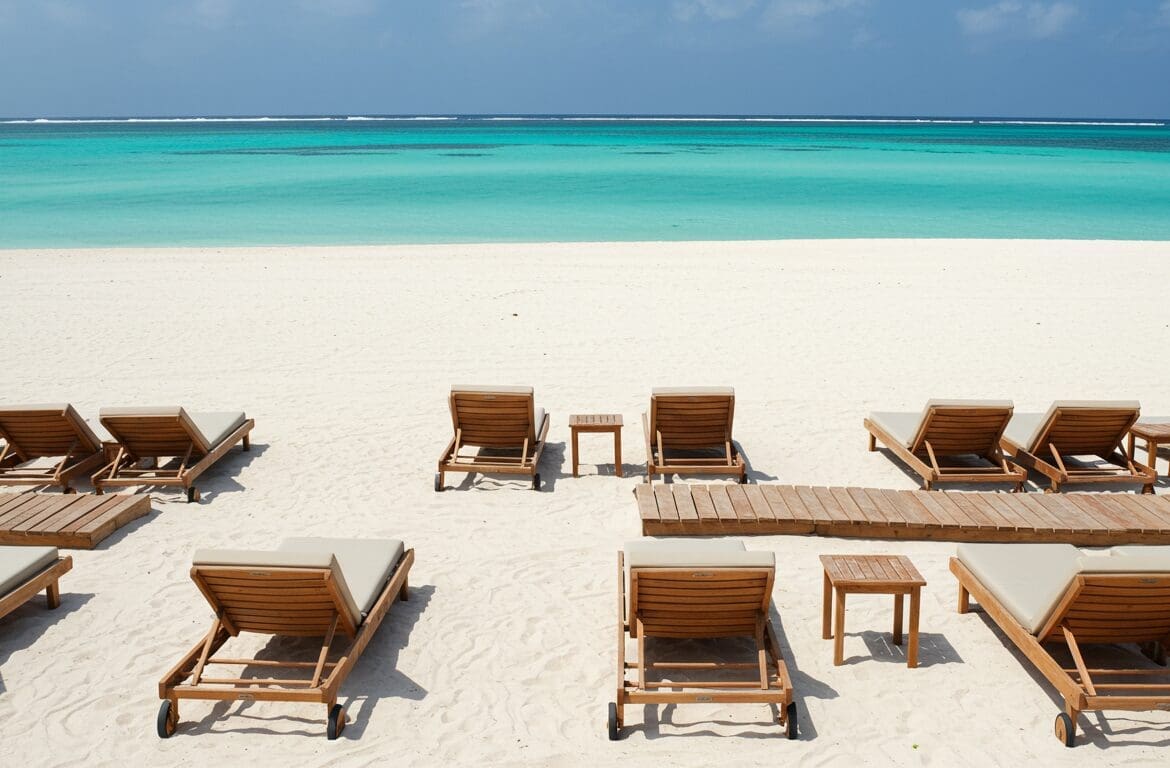
Costa Navarino represents what happens when serious investment meets one of the most naturally blessed stretches of coastline in southern Greece. The beach at Navarino Dunes – part of the broader Costa Navarino resort complex in Messinia – is private, impeccably managed, and furnished with the kind of lounger and service infrastructure that makes you feel the beach has been personally arranged for your arrival. The sand is fine and pale, the water is clear and shallow-shelving, and the beach club operation is seamless.
This is the best beaches in Peloponnese & Ionian experience for those who want zero compromise: full service, excellent food, and direct access to the resort’s considerable amenities. The beach clubs within Costa Navarino serve food and cocktails to a consistently high standard, and the proximity to Paráfrasi by CTC – the fine dining collaboration between Costa Navarino and Michelin-starred Chef Alexandros Tsiotinis at Navarino Dunes – means that a beach day here can segue naturally into one of the most serious dining experiences in the region. Tsiotinis brings his particular brand of refined Greek gastronomy to an environment that encourages you to linger well past sunset.
Dunes Beach, Agios Georgios, Corfu – Best for Long Walks and Wide Open Space
The west coast of Corfu is a different proposition entirely from the busy resort beaches of the northeast. Agios Georgios South offers a long, wide, almost deserted stretch of sand backed by low dunes – unusual for Corfu – with reliable Atlantic-style waves courtesy of the prevailing westerly winds. This makes it the best beach in the Ionian for kite surfing and windsurfing, with several schools operating from the beach offering lessons for beginners and equipment hire for the experienced.
The atmosphere is free and informal in a way that the more developed beaches are not. Families spread out across the sand without worrying about territory; the waves are lively enough to be interesting without being genuinely hazardous. Facilities are modest but adequate: a handful of tavernas along the beachfront, sun lounger hire, and basic parking. It is not a luxury beach club experience, but the scale and the quality of the water more than compensate.
Where to Eat Near the Best Beaches
The quality of the restaurant scene in this region deserves its own conversation, but proximity to exceptional food is part of what makes beach days here feel genuinely civilised rather than merely pleasant.
In Corfu, Etrusco at Kato Korakiana is the reference point – the 25-minute drive from Corfu town delivers you to chef Ettore Botrini’s bougainvillea-clad terrace, which in 2024 was named Best Restaurant in Greece by Athinorama magazine and received Four Stars at the FNL Best Restaurant Awards. This is creative Mediterranean cooking of the highest order, molecular technique meeting premium island produce in tasting menus that are worth rearranging an entire evening for. For something more intimate, The Venetian Well in Corfu Old Town’s Kremasti Square offers chef Spyros Agios’s refined Corfiot cooking – the broth of porphyries with oyster and sea urchin is the kind of dish that demonstrates just how good a committed local kitchen can be, alongside a wine cellar of over 1,200 labels.
In the Peloponnese, Costa Navarino’s dining offer is extensive and consistently excellent. Beyond Paráfrasi by CTC, The Private Kitchen at Mandarin Oriental, Costa Navarino is chef Bertrand Valegeas’s intimate gastronomic laboratory – 14 seats around an open kitchen, a private terrace lounge, and a creative menu that treats the Messinian larder as both starting point and inspiration. For those exploring the Arcadian interior en route to or from the coast, Manna Restaurant at the Manna Hotel offers a serious regional kitchen grounded in Arcadian produce and genuine hospitality.
Practical Notes for Beach Days in Peloponnese & Ionian
A few things worth knowing before you go. Parking at popular beaches in July and August – Voidokilia, Porto Katsiki, Myrtos – fills by 9am on fine days. This is not an exaggeration. The solution is either early arrival or arriving by water, which is an option more travellers should consider: boat hire is accessible and relatively affordable throughout the region, and arriving at a beach from the sea remains one of the more satisfying ways to spend a morning.
Water quality across the Peloponnese and Ionian coasts is uniformly excellent – this is one of the least-industrialised coastlines in Mediterranean Europe, with consistently high EU Blue Flag standards and minimal river pollution impact. The Ionian in particular benefits from deep, clean water and strong currents that keep the sea cool and clear even in August.
For the most secluded beaches – Seranì on Ithaca, the lesser coves of the Mani – go without expectation of facilities and with proper sun protection. The Mani sun in July is not a gentle proposition.
Staying in a luxury villa in Peloponnese & Ionian puts the best beaches within easy reach, and gives you the kind of early-morning flexibility – a cooler packed at dawn, departure before the crowds – that makes the difference between a good beach day and a genuinely memorable one. For the full picture of the region, the Peloponnese & Ionian Travel Guide covers everything from inland villages to ferry logistics.