
Family Guide to Peloponnese & Ionian
Family Guide to Peloponnese & Ionian
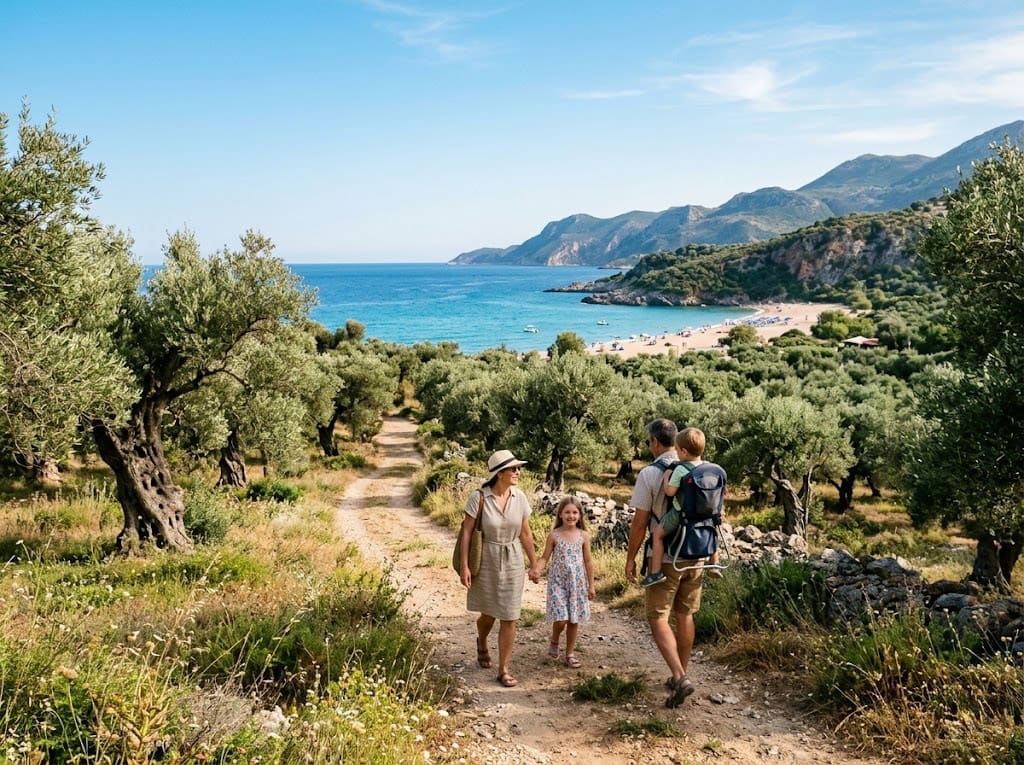
At around seven in the morning, before the heat has settled in and the cicadas have really committed to the day, the air in this part of Greece smells of wild oregano, warm stone, and something faintly briny drifting up from the sea. A cockerel announces itself from somewhere implausibly distant. A fishing boat putters back into harbour. If you have small children, of course, you have been awake for two hours already – but the point stands. This corner of Greece, where the rugged southern Peloponnese meets the luminous arc of the Ionian islands, has a particular quality at dawn that manages to feel ancient and entirely unhurried all at once. It is, without question, one of the finest places in the world to bring a family.
Not because it has the most elaborate children’s clubs or the most aggressively Instagram-ready infinity pools – though it has plenty to satisfy on both counts – but because it offers something harder to manufacture: genuine variety, real culture, extraordinary nature, and the kind of slow, sun-soaked ease that reminds everyone in the family, including the adults who badly need reminding, what a holiday is supposed to feel like.
For more on what makes this region so compelling before you dive into the family specifics, our Peloponnese & Ionian Travel Guide covers the broader landscape in full.
Why This Region Works So Well for Families
There is a reason families who discover the Peloponnese and Ionian coast tend to become quietly evangelical about it. It is not one thing – it is the layering of things. The beaches here range from powdery white coves on Zakynthos and Kefalonia to the dramatic pebble shores and sea caves of the Mani peninsula, meaning children who get bored of identical horizons are perpetually appeased. The water is extraordinarily clear – children who have learned to snorkel will spend entire mornings face-down in the shallows, investigating whatever the sea is quietly getting on with underneath.
The region is also unusually forgiving in terms of scale and pace. Villages are small enough that children can roam with a degree of freedom that has largely vanished from urban life. Taverna lunches stretch comfortably to two hours without anyone feeling they have overstayed. The Greek attitude to children – genuinely warm, spontaneously affectionate, remarkably tolerant of small people running between tables at nine in the evening – means that dining out with a family is a pleasure rather than an exercise in damage limitation.
And then there is the history, which here is not the preserved-behind-glass kind but the walk-right-through-it kind. Ancient sites sit open to the sky, close to beaches, surrounded by olive groves. A six-year-old can stand in the theatre at Epidaurus and shout something embarrassing, and it will echo perfectly. That kind of magic tends to stick.
The Best Beaches for Families
The Ionian islands deliver some of the most family-suitable beaches in the Mediterranean. On Kefalonia, Antisamos and Myrtos are breathtaking in scale – though Myrtos, with its theatrical white pebbles and deep blue water, has surf and undertow that make it better suited to older swimmers than toddlers. For younger children, the sheltered coves around Skala and the calm, shallow bay at Lourdas are more forgiving. The water is warm from June through September, and the shelving is gentle enough that adults can actually relax rather than spend the entire afternoon performing impromptu lifeguard duties.
On Zakynthos, the famous Navagio Shipwreck Beach is strictly a boat-trip-and-photograph affair – you cannot land there – but the Blue Caves on the northern tip are extraordinary to explore by small motorboat, and children find them quietly spectacular. The beaches along Porto Roma and the quieter southeastern coast offer shallow, transparent water perfect for families with mixed ages.
On the Peloponnese itself, the beaches around Porto Heli and the Argolic Gulf are calm, sheltered, and within easy reach of several excellent restaurants. The Mani’s western coast has some remarkable isolated coves accessible only by boat or a healthy walk – which, depending on the age of your children, is either an adventure or a negotiation.
Activities and Experiences That Actually Land With Children
The ancient site of Olympia – birthplace of the Olympic Games and remarkably easy to visit as a family – is one of those rare historical destinations that genuinely captivates children without requiring them to read anything. The scale of the stadium, the fact that you are allowed to run on the original track, and the proximity of the excellent archaeological museum make it a full and satisfying day out. Teenagers who roll their eyes at ancient ruins in the abstract become surprisingly engaged once they are actually standing in them. This is consistent behaviour across multiple continents and centuries.
The medieval citadel of Mystras, near Sparta, is a UNESCO World Heritage site that feels like a film set – crumbling Byzantine churches, frescoes still clinging to the walls, a whole abandoned city climbing a steep hillside. It rewards curious older children and teens enormously. For the younger set, boat trips are a reliable constant: sea cave exploration, snorkelling trips, and gentle coastal cruises can be arranged privately and tailored to the ages and temperaments of whoever is on board.
Kayaking and paddleboarding are widely available from beach operators across both the Ionian islands and the Peloponnese coast. Horse riding through olive groves and along coastal tracks can be arranged through local stables. And for older teenagers with a sense of drama, coasteering along the rockier stretches of Kefalonia is the kind of thing they will mention for years afterwards – possibly while asking if you can go back.
Eating Out With Children: What to Expect
Greek food, mercifully, is the kind of cuisine that tends to go down well across age groups without requiring negotiation. Grilled fish, slow-roasted lamb, flatbreads, dips, fried courgettes, proper chips cooked in olive oil – even the most determined small-scale refuseniks tend to find something to eat at a Greek taverna. The mezze format, where multiple dishes arrive continuously and everyone shares, is extraordinarily child-friendly. It is also excellent for adults, though for entirely different reasons.
In the Peloponnese, harbour-side tavernas in towns like Nafplio, Gythio, and Pylos serve unpretentious, honest food at tables that spill directly onto waterfronts. The standard is consistently high because the produce – local fish, Kalamata olives, citrus, honey, fresh vegetables – is genuinely exceptional. On Kefalonia and Zakynthos, village tavernas away from the main tourist strips offer the best combination of quality and atmosphere. Look for the places with handwritten menus and a blackboard specials list. Look away from the places with laminated photographs of every dish.
Lunch, in this region, is the meal to treat seriously. Many of the finest family meals happen at one in the afternoon at a harbourside table with a carafe of local white wine for the adults and an inexplicable quantity of bread consumed by the children before any actual food arrives.
Age by Age: Practical Thinking for Different Stages
Toddlers and under-fives do remarkably well here, provided you lean into the pace of the region rather than fight it. The calm, shallow beaches of the Ionian coast are ideal for small children who need to be in and out of the water repeatedly and require a beach bag the size of a small wardrobe. A private villa with a pool (more on this below) takes the pressure off beach logistics considerably. The main practical consideration is heat – the Peloponnese in July and August is genuinely hot, and nap schedules should be structured around the middle of the day rather than abandoned in a spirit of optimistic ambition.
Primary age children – broadly six to eleven – are in many ways the ideal demographic for this region. Old enough to snorkel, to walk to a ruin, to appreciate a boat trip, to engage with ancient history at an accessible level; young enough to be thrilled by finding a sea urchin or sleeping in an unfamiliar house. Activities can range more widely at this age, and the combination of beach mornings and cultural afternoons tends to work well. The Olympia visit lands particularly effectively for this group.
Teenagers are, as every parent knows, a special case. The good news is that the Ionian and Peloponnese have genuine teenage currency: water sports, boat trips, dramatic landscapes for photographs, excellent food, and – for those at the older end – villages and small towns with enough independent life to feel like freedom. Kefalonia in particular has a quality of landscape that tends to impress people who are not easily impressed. Teenagers who are given some autonomy in how days are structured tend to enjoy themselves considerably more than those on a fixed itinerary. This is worth remembering.
Why a Private Villa Changes Everything
A hotel, for a family, is a series of compromises conducted in a corridor. A private villa is something else entirely. In the Peloponnese and Ionian, luxury villa rentals offer the kind of space, flexibility, and privacy that reframe the entire nature of a family holiday – and that statement is not hyperbole so much as the distilled experience of every family who has made the switch and never gone back.
The private pool is the obvious entry point. There is no competition for sun loungers, no negotiating pool hours, no strategic towel placement at seven in the morning. The pool is yours, and it is available from the moment the children wake up to well after they go to bed. For families with toddlers and young children, this alone reduces the ambient stress of the holiday by a measurable amount. For teenagers who prefer to swim at midnight for reasons best understood by teenagers, it is simply ideal.
Beyond the pool, a villa provides a kitchen – which matters more than it sounds. The ability to stock a fridge with Greek yoghurt, local honey, fresh fruit, good cheese, and excellent bread means that breakfast happens on your terms, at your pace, without anyone having to be presentable before nine. Children who have food preferences or requirements are accommodated without ceremony. Packed lunches for beach days are possible. The domestic infrastructure of the holiday actually supports the holiday rather than adding friction to it.
In the Peloponnese and Ionian specifically, the villa stock is particularly strong. Properties range from converted stone houses on Kefalonia with private sea access to architecturally considered modern villas above the Mani coast with pools that appear to merge with the sea below. Many come with household staff – housekeeping, villa managers, and in some cases private chefs – which provides a level of service closer to a luxury hotel while retaining all the freedom of a private home. Several can be arranged with private chefs who will cook whatever the family actually wants to eat, rather than what the kitchen has decided to offer that evening. For families with particular tastes or dietary needs, this is genuinely transformative.
The other thing a villa provides, less tangibly but no less importantly, is the sense of having a base rather than a room. Children unpack properly. Toys and books are distributed across surfaces. There is an outside table where dinner happens when the evening is warm enough, which in Greece between June and September is nearly every evening. The family establishes its own rhythms – early swimmers and late risers coexisting without the architecture of a hotel imposing a single schedule on everyone. It sounds small. It is not small.
Getting There and Getting Around
International flights serve Kefalonia and Zakynthos directly from most major UK and European airports during the summer season, making the Ionian islands among the more accessible Greek destinations for families. Patras on the Peloponnese is reachable by ferry from Italy as well as by domestic flight to Athens followed by a drive – the road south from Athens through the Corinth canal and into the Argolic Gulf is surprisingly straightforward and rewarding. Kalamata has its own regional airport, making the southern Peloponnese and Mani considerably more accessible than it once was.
Within the region, a hire car is non-negotiable. The most interesting beaches, villages, and sites are not served by public transport to any meaningful degree, and the freedom to follow a road that looks promising is one of the genuine pleasures of the Peloponnese. Roads in rural areas can be narrow and occasionally approximate in their surface quality – this is worth knowing, and worth considering when selecting a vehicle. A larger SUV is genuinely useful rather than merely aspirational.
For inter-island travel or coastal exploration, private boat charter is widely available and, for a group of the size a villa typically accommodates, not dramatically more expensive per head than organised tours. It is also considerably more pleasant. Arriving at a sea cave or a remote beach by private boat, with a cooler of drinks and nowhere to be until you decide otherwise, is one of those experiences that retrospectively defines an entire holiday.
When to Go
June and September are, for most families, the optimal months. The sea is warm – particularly in September, when it has had the entire summer to accumulate heat – the main sites are manageable rather than overwhelming, and the light in the early morning and evening has a quality that makes everything look as though it has been professionally lit. July and August are hotter, busier, and more expensive, but they remain excellent for families who are accustomed to heat and have secured their villa well in advance. The Ionian islands, sitting slightly further west, tend to catch more of a breeze than the Peloponnese interior, which can be genuinely fierce in high summer.
October is worth serious consideration for families with older children or teenagers who can miss a week of school without catastrophe. The crowds have vanished, the prices have dropped, the sea remains warm well into the month, and the Peloponnese in autumn – with the olive harvest beginning and the hillsides shifting colour – has a particular quality that is quite different from the summer experience and no less rewarding.
Browse our full collection of family luxury villas in Peloponnese & Ionian and find the private base that turns a good holiday into one the family will be attempting to recreate for years.
What is the best age to take children to the Peloponnese and Ionian islands?
There is genuinely no wrong age, though the experience differs considerably by stage. Toddlers and young children thrive on the calm, shallow Ionian beaches and benefit enormously from the space and flexibility of a private villa with pool. Primary-age children have the most varied options – snorkelling, ancient sites, boat trips, and village exploration all become accessible at once. Teenagers respond well to the combination of dramatic landscape, water sports, and cultural depth, particularly on Kefalonia and around the Mani peninsula. Families with mixed ages – which is most families – find the region unusually adept at satisfying everyone simultaneously, which is rarer than it sounds.
Is a private villa better than a hotel for a family holiday in this region?
For most families, yes – and the gap widens the more children you have and the younger they are. A private villa provides a pool that belongs entirely to your family, a kitchen that makes breakfast and packed lunches straightforward, space for children to be children without the constraints of shared hotel corridors, and the freedom to structure each day around your family’s actual rhythms rather than a hotel’s. Many luxury villas in the Peloponnese and Ionian also come with housekeeping and optional private chef services, which preserves the comfort of a high-end hotel while eliminating most of its compromises. For families renting with another family or a set of grandparents, the economics also become considerably more favourable.
Which Ionian island is most suitable for families with young children?
Kefalonia and Zakynthos are both strong choices, for slightly different reasons. Kefalonia offers a greater range of sheltered, shallow bays alongside more dramatic coastline, a well-developed infrastructure of family-friendly tavernas and boat operators, and excellent villa stock. Zakynthos has the advantage of the famous Blue Caves and Navagio Shipwreck Beach as day-trip experiences, along with calm southeastern beaches well-suited to young swimmers. Families with toddlers and very young children tend to find Kefalonia’s bay around Skala and Lourdas particularly forgiving. For older children and teenagers, both islands offer ample to keep them engaged – the choice often comes down to the specific villa rather than the island itself.