
Pollença Food & Wine Guide: Local Cuisine, Markets & Wine Estates
What does it actually taste like, this corner of Mallorca that everyone keeps discovering and then trying to keep to themselves? The answer, as with most things in Pollença, is more layered and more satisfying than the postcard version suggests. This is not the island of infinite pa amb oli and sangria – though pa amb oli, done properly, deserves its reputation and then some. This is the north: cooler, greener, more agricultural than the sun-bleached coasts further south, shaped by the Tramuntana mountains and the particular stubbornness of people who have been farming and fishing this land for centuries. The food reflects all of that. So does the wine. And if you arrive knowing nothing, you’ll leave considerably better informed – and considerably better fed.
The Foundation: Understanding Northern Mallorcan Cuisine
Mallorcan cooking is, at its heart, peasant food elevated by extraordinary ingredients. The north of the island – and Pollença sits squarely within it – has historically been shaped by the interplay of mountain and sea, olive groves and vegetable gardens, fishing boats out of the Port and pigs raised on the farms of the interior. The result is a cuisine that is generous, unfussy, and quietly remarkable.
The philosophical foundation of the local table is the sofregit: a slow-cooked base of tomato, onion and sometimes pepper, reduced with patience into something deeply savoury and almost jammy. It underpins an enormous number of traditional dishes, from the simplest rice to the most elaborate meat preparations. Once you know it’s there, you taste it everywhere – in the way a sauce has depth without pretension, in the way a stew tastes as though someone actually cared.
The other cornerstone is quality local produce. The Tramuntana’s microclimate produces olives, almonds, citrus and herbs of exceptional character. Garigue-fed lamb and kid are excellent. The coastline contributes sea bream, red mullet, squid, and the kind of langoustines that make you reconsider every langoustine you’ve eaten before. The cumulative effect is a larder that doesn’t need to be complicated – and, to its credit, largely isn’t.
Signature Dishes Worth Seeking Out
Any honest reckoning with Mallorcan food begins with pa amb oli – bread rubbed with ripe tomato, drizzled with local olive oil, and finished with sea salt. It sounds almost absurdly simple. It is also, when the bread is good and the oil is serious, one of the genuinely best things you can eat on the island. The versions served in Pollença’s traditional bars and restaurants vary considerably in quality; the difference between the best and the average is the oil, and the attentiveness of whoever is making it.
Tumbet is the Mallorcan ratatouille – layers of fried aubergine, potato, red pepper and courgette in tomato sauce, baked in a clay dish. It is vegetable cookery that would embarrass a lot of ambitious restaurants. Frit mallorquí – a sauté of offal, potatoes and vegetables, seasoned with herbs – is not for the squeamish but rewards the curious. Arròs brut, the local dirty rice, is a soupy, saffron-tinged broth-rice hybrid with meat and seasonal vegetables, and it is absolutely the thing to order on a cooler evening when the Tramuntana wind is picking up.
For something more indulgent: llom amb col, pork loin wrapped in cabbage, is a dish of surprising elegance. And ensaïmada – the spiral pastry dusted with icing sugar that you see everywhere – is either a transcendent breakfast or a perfectly respectable accompaniment to a late-morning coffee, depending on your level of self-restraint. (Most visitors abandon self-restraint by day two, which is the correct approach.)
The Wines of Mallorca – and What to Drink in Pollença
Mallorca’s wine renaissance is one of the more quietly impressive stories in Spanish wine. The island has been producing wine since Roman times, but the modern era – driven by serious investment, better viticulture, and a move away from bulk production toward quality estate wines – has transformed what’s available. The two DO regions are Binissalem, in the central plains, and Pla i Llevant, in the east; but an increasing number of producers operate under the broader Vi de la Terra Mallorca designation, which gives winemakers more flexibility and has produced some of the most interesting bottles on the island.
The grapes to know are the indigenous varieties: Manto Negro and Callet for reds, producing wines that tend toward elegance rather than weight – medium-bodied, aromatic, with a pleasing savouriness that pairs naturally with local food. Premsal Blanc and Moll (also called Prensal) lead the whites, and done well they offer floral, mineral expressions that hold up beautifully through a long Mallorcan lunch.
The north of the island does not have a formal wine appellation, but that doesn’t mean you’re drinking badly in Pollença. The better restaurants here carry carefully considered wine lists with serious representation from Mallorcan estates. Asking the sommelier – or indeed the owner, who in many of the smaller places doubles as both – for a local recommendation is rarely a mistake. They tend to be genuinely enthusiastic. Wine people in Mallorca are almost suspiciously proud of what the island is producing, and in most cases, the pride is justified.
Wine Estates Worth Visiting
The wine estates of Mallorca generally welcome visitors, and an afternoon spent driving the island’s interior to visit a bodega is one of the more civilised ways to spend a day. From Pollença, the wine regions of Binissalem and Pla i Llevant are within comfortable driving distance – close enough for a purposeful excursion, far enough that the drive itself earns the destination.
In Binissalem, the established estates include names that have been instrumental in defining Mallorcan wine’s international reputation. Bodegas José L. Ferrer is the region’s most historic producer, with a visitor experience that covers the history of the appellation alongside a serious tasting programme. Can Ribas produces wines that regularly outperform their modest prices and offers estate visits with advance booking. For something on a more intimate scale, smaller producers in the area offer the kind of direct access – to the winemaker, to the vineyard, to the story behind the bottle – that larger estates simply cannot replicate.
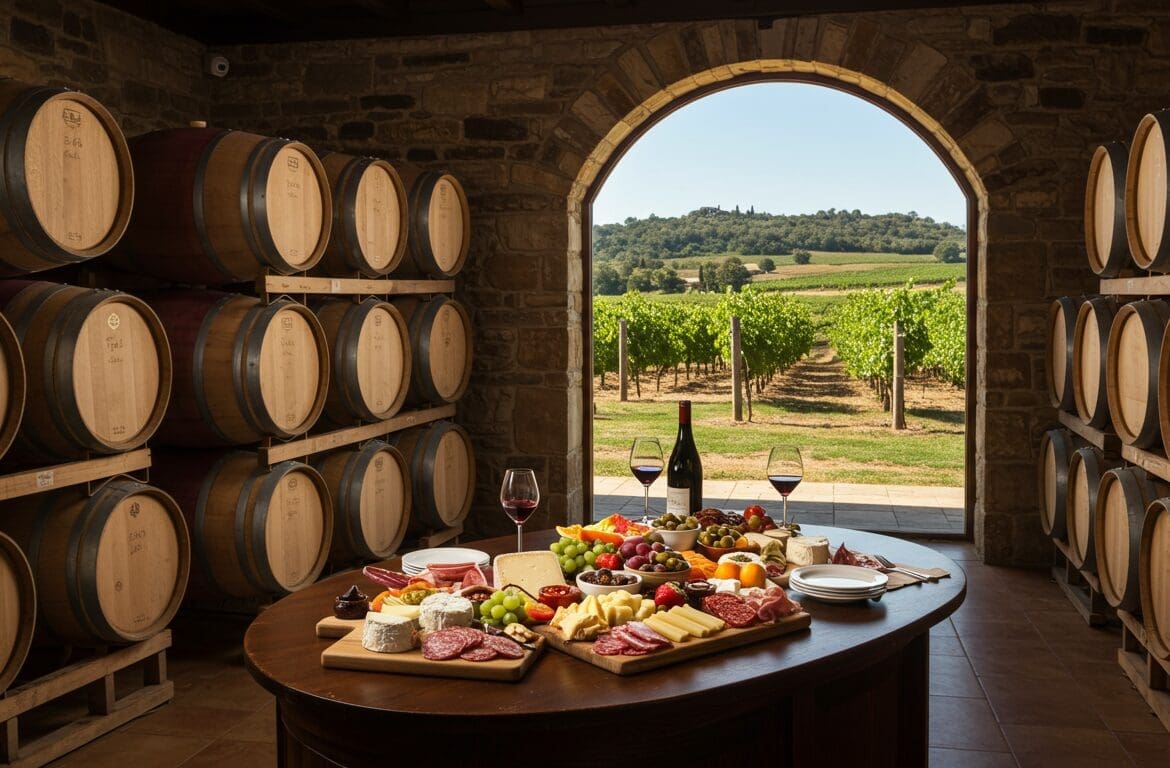
In Pla i Llevant, Miquel Oliver in Petra is one of the island’s most admired family producers, making structured, age-worthy whites alongside its reds. Bodegas Bordoy and Can Xanet – the latter set in a historic property in Campanet, reasonably close to Pollença – produce wines of genuine character and offer tastings in settings that are as compelling as what’s in the glass. A private, pre-arranged visit to an estate like Can Xanet, with a guided tasting and a local cheese and charcuterie board, is exactly the kind of afternoon that justifies the concept of a holiday entirely.
Pollença’s Food Market – and Where to Shop Like a Local
The Sunday market in Plaça Major is one of the finest in Mallorca – which is saying something on an island that takes its markets seriously. It runs through the morning and occupies the main square and the streets radiating from it with a mix of produce, local artisan goods, and the kind of cheerful, unhurried commerce that is almost entirely absent from modern retail elsewhere. The food section is the heart of it: local cheeses, freshly cured olives, honey from the Tramuntana, almonds, dried herbs, sobrasada in various states of cure and ambition.
Sobrasada – the soft, spreadable paprika-cured pork sausage that is to Mallorca what marmite is to Britain, in the sense that people feel strongly about it in both directions – is worth understanding before you buy. The quality varies. Look for products made with black pig, which carries a designation and signals a more serious product. The difference in flavour between standard and artisan sobrasada is roughly the difference between a supermarket tomato and one still warm from the garden. Worth knowing.
For olive oil specifically, the local cooperative and smaller artisan producers in the area offer oils cold-pressed from Mallorcan varieties – principally Arbequina and Mallorquina – that range from delicate and grassy to robust and peppery. Buying a bottle or two at the market is one of the better impulse purchases you can make; it also survives the journey home rather better than the ensaïmada, which is delicious but structurally optimistic as hand luggage.
Olive Oil Producers and Tastings
The olive groves of the Tramuntana foothills are among the oldest agricultural landscapes in the Mediterranean – some of the trees in this region are centuries old, shaped by generations of careful tending into the extraordinary silver-leaved forms that define the landscape. The oil they produce is, predictably, excellent. What is perhaps less predictable is how different the oils from different estates and different harvest timings can be.
Several producers in and around Pollença offer tastings and estate visits, typically by appointment. An olive oil tasting, properly conducted, is a more genuinely revelatory experience than most people expect – the progression from early-harvest, intensely green and peppery oils to later-harvest, rounder and more fruited ones covers more ground than a casual brush with a bread basket ever would. Pairing those oils with local bread, local cheeses and a glass of cold Premsal Blanc on a terrace overlooking the groves is, objectively speaking, a very fine way to spend two hours of any life.
The Tramuntana’s designation as a UNESCO World Heritage Site reflects in part the agricultural heritage of the olive and citrus cultivation that has shaped it. The oil is not incidental to the landscape – it is part of the reason the landscape exists as it does. There is something satisfying about eating your way into understanding a place’s history rather than just reading about it.
Food Experiences Worth the Investment
For travellers who want to go beyond restaurants and markets, the north of Mallorca offers several genuinely exceptional food experiences that merit the planning required to access them.
Private cooking classes in the Pollença area are increasingly available, often hosted in private fincas or organised through specialist local operators. The format varies: some focus on traditional Mallorcan dishes – tumbet, arròs brut, a proper ensaïmada – with instruction from local cooks who have been making these things their entire lives. Others take a more modern approach, connecting guests with chefs working in the island’s contemporary culinary scene. Both are worthwhile. The former tends to produce more food and more laughter; the latter tends to produce more technique and more wine pairings. It depends entirely on what kind of afternoon you want.
Truffle hunting in Mallorca is a more recent addition to the experiential food calendar and, while the island is not Périgord, the black truffle (Tuber melanosporum) does grow in the mountainous interior during the winter season, roughly December through February. A guided morning with a trained dog in the Tramuntana foothills, followed by a simple lunch built around whatever has been found, is the sort of experience that sounds eccentric and delivers memorably. Off-season visitors with a serious interest should enquire locally – availability is limited but the experience, for those who find it, is genuinely singular.
For those who prefer their indulgences pre-arranged and maximally comfortable: a private catered dinner at a Pollença villa, with a local chef sourcing from the morning market and cooking a menu of traditional dishes with serious wines from Mallorcan estates, represents the regional food experience at its most concentrated. No menus, no neighbouring tables, no ambient muzak. Just the food, the wine, the view, and whoever you’ve brought with you. It is, to put it plainly, the point.
Planning Your Pollença Food Experience
The best time to eat your way through Pollença is – contentiously, perhaps – not peak summer. The shoulder seasons of May, June, September and October offer cooler temperatures that make long lunches more physically comfortable, better access to seasonal produce, and restaurants that are fully staffed and operating at their best rather than their highest capacity. Summer is perfectly fine. But the light in October, the market in September, and a bowl of arròs brut on an October evening with a glass of local red when the temperature has finally dropped below 25 degrees – that is the version of Pollença food worth planning around.
The Sunday market runs year-round, though it is at its liveliest from spring through autumn. Wine estate visits typically require advance booking, particularly for the smaller producers. Cooking classes and truffle experiences should be arranged before arrival – ideally through a specialist local contact or a villa concierge service that knows the genuine operators from the tourist-facing approximations of them.
For the broader picture of what Pollença offers beyond the table, our Pollença Travel Guide covers the town, the port, the beaches and the cultural itineraries that make this corner of Mallorca so consistently compelling to the people who keep coming back. Which, it turns out, is most people who visit once.
Your Base: Luxury Villas in Pollença
The most natural way to fully engage with the food and wine of Pollença is to be based here properly – with a kitchen that can accommodate a market haul, a terrace suitable for a private catered dinner, and enough space to arrange a cooking class without anyone having to move the furniture. A well-chosen villa in the area provides all of that, plus the kind of autonomy that hotels, however comfortable, cannot quite replicate.
Whether you’re imagining lazy breakfasts with local pastries and pressed citrus, afternoon wine tastings on a shaded terrace, or a serious private dinner with a Mallorcan chef and a carefully chosen cellar selection, the right property makes all of it more possible – and considerably more enjoyable. Explore our collection of luxury villas in Pollença and find the base that matches your appetite, in every sense of the word.