South Africa Travel Guide: Where to Stay, Eat & Explore in Luxury
You wake up to the sound of something large moving through the bush outside. Not alarming, exactly – just a reminder that you are not in a hotel in central London. The sun is already doing serious work, painting the Winelands copper before most of the world has had breakfast. By mid-morning you’re on a veranda in Franschhoek with a glass of something cold and local that has absolutely no business being this good before noon. By afternoon you’re watching a family of elephants cross a dusty track in the Kruger, close enough that you can hear them breathing. That evening, a chef you didn’t know you’d have – because the villa comes with one – produces a dinner that would get a table mention in a Condé Nast spread. And you haven’t even been to the beach yet. South Africa is that kind of place. It gives too much, almost rudely.
It is also, frankly, one of the most intelligently structured destinations on earth for a certain kind of traveller – which is to say, almost any kind. Couples marking a significant anniversary find the kind of privacy and drama that turns a trip into a proper memory. Families seeking a place where children can roam freely, swim in their own pool, and come home with actual stories rather than screentime recaps discover that South Africa delivers this at a scale that almost nowhere else matches. Groups of friends celebrating milestones – a significant birthday, a long-overdue reunion – find the country accommodates them without herding them. Remote workers who have exhausted the romantic fiction of “working from the Amalfi Coast” and need genuine fibre broadband discover that many South African villas, particularly around Cape Town, are genuinely, properly connected. And those travelling with wellness as a purpose, not just a talking point, find a country where outdoor living, therapeutic landscapes, and extraordinary food align so naturally that restoration feels effortless. Whatever kind of luxury holiday South Africa becomes for you, it tends to be the one you measure all subsequent trips against.
Getting Yourself to the Bottom of the World (It’s Easier Than You Think)
The principal gateway is OR Tambo International Airport in Johannesburg – Africa’s busiest airport, efficient enough to pass through without existential distress, and a genuine hub connecting flights from Europe, the United States, Asia, and beyond. Direct flights from London to Johannesburg run at around eleven hours – long enough to watch three films and have a complete change of heart about your book choice. British Airways, Virgin Atlantic, and South African Airways all serve the route. Cape Town International is the other main entry point, handling direct long-haul routes from the United Kingdom and several European cities, and it sits with remarkable convenience just twenty minutes from the city centre – a fact so civilised it almost seems like showing off.
Within South Africa, domestic flights connect the major hubs swiftly. The Johannesburg to Cape Town corridor is one of the busiest air routes on the continent, with frequent services throughout the day. If you are combining a Winelands stay with a safari – and you absolutely should – then a quick domestic hop to Kruger Mpumalanga International Airport saves you the kind of drive that sounds adventurous in planning and less so on the day. For getting around once you arrive, self-driving is genuinely practical and the roads are notably good by regional standards. Left-hand traffic for visitors from England will require approximately twenty minutes of recalibration before it feels completely natural. Private transfers and chauffeur services are widely available and, at South African prices, rather more accessible than equivalent services in, say, central Paris.
South Africa Eats: A Country That Has Quietly Become One of the World’s Great Food Destinations
Fine Dining
Cape Town’s arrival as a serious culinary city is no longer a local secret, and the 2025 World’s Best Restaurants list makes the case plainly. La Colombe, set within the Silvermist organic wine estate above Hout Bay with views that constitute an unfair advantage, achieved its sixth appearance on the list – sitting at number 55 globally. FYN, occupying a beautifully considered space in the CBD, ranked 82nd on its fifth consecutive appearance. And Salsify at The Roundhouse in Camps Bay earned its first-ever World’s 50 Best placement in 2025, entering at number 88. Three restaurants from one city on a single global shortlist is the kind of statistic that other food capitals notice.
Beyond Cape Town’s headline acts, the Winelands town of Stellenbosch produces dining experiences that regularly stop serious food travellers in their tracks. Good to Gather in Stellenbosch claimed the top position in the 2025 Dineplan Reviewers’ Choice Awards – an accolade based on over 330,000 verified diner reviews across more than 1,700 South African restaurants, which means the result is the aggregate opinion of people who actually ate there rather than the view of a single critic in a good mood. It is recognised as one of the most authentic dining experiences in the country. Also in Stellenbosch, VUUR completed the top five of the same awards – its name meaning “fire,” which tells you something about the culinary philosophy at work. Fire, smoke, and the kind of ingredients that a country with South Africa’s biodiversity and climate simply has in abundance.
Where the Locals Eat
Reverie Social Table in Cape Town took second place in the Dineplan awards – a beloved fixture in the Mother City that earns its following through consistency and genuine hospitality rather than Instagram architecture. Cape Town’s food markets deserve serious attention: the Neighbourgoods Market in Woodstock on Saturday mornings is the city’s best weekly ritual – a dense, fragrant gathering of artisan producers, street food vendors, and very good coffee, frequented by the kind of local who knows where everything worth eating actually comes from. The V&A Waterfront’s market offerings are more tourist-facing but not without merit. Across the city, the Bo-Kaap neighbourhood serves up Cape Malay cooking that is both historically fascinating and delicious – a cuisine shaped by the spice trade routes and centuries of cultural layering that make South African food such a rewarding subject. If you are self-catering in a villa, the local farmers’ markets and delis around Constantia, Franschhoek, and Stellenbosch will make you wish you could take the whole stall home in your luggage.
Hidden Gems Worth Seeking Out
In Gansbaai – a small coastal town perhaps best known for an activity involving Great White sharks and a cage (more on that shortly) – Schneider’s Cape Floral Kitchen placed third in the national Dineplan rankings, which for a restaurant in what visitors might dismiss as a pass-through town is a pointed lesson in not judging a destination by its postcode. It is the kind of discovery that serious travellers collect. Further north from Cape Town, AA Badenhorst Family Wines in Malmesbury rounds out the Dineplan top five – a farm winery where the dining experience is inseparable from the landscape and the extraordinary hospitality of the Badenhorst family, who have been producing some of the Swartland’s most interesting natural wines for years. It is worth the detour even if you arrive purely for the wine and the food turns out to be the better story.
The Lay of the Land: A Country That Cannot Be Summarised in a Single View
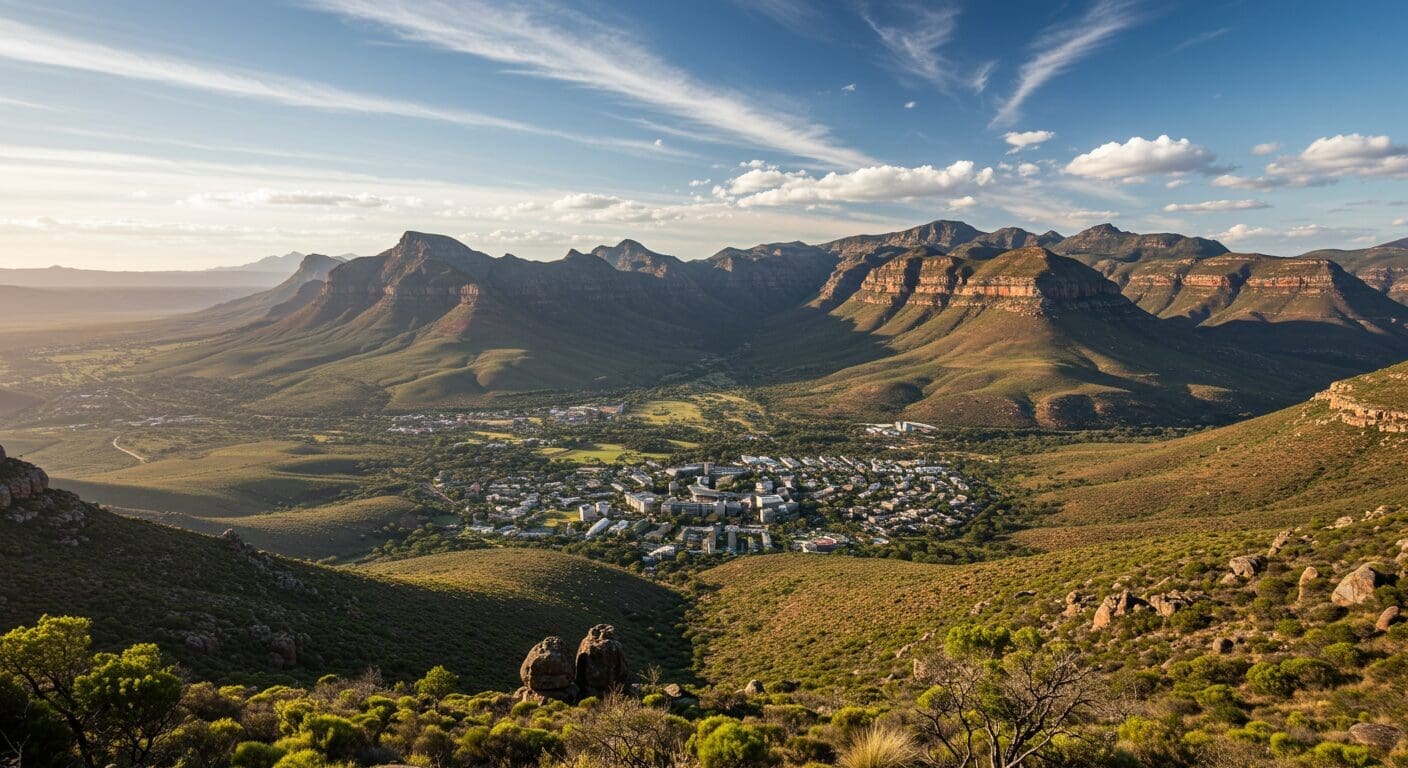
The failure mode of most destination guides to South Africa is attempting to describe the country as if it were a single coherent thing. It is not. South Africa covers nearly 1.2 million square kilometres across nine provinces, and the geographical diversity is the kind that requires you to genuinely reset your expectations as you move between regions. The Western Cape – home to Cape Town, the Winelands, and the Garden Route – is Mediterranean in character, with mountain backdrops, dramatic coastal scenery along the Atlantic seaboard, and an agricultural landscape producing wines that increasingly give Bordeaux reason for mild anxiety.
The Garden Route itself deserves particular mention. Stretching roughly 300 kilometres from Mossel Bay to the Storms River Mouth, it moves through forests, lagoons, and a coastline that the phrase “dramatic cliffs” was essentially invented to describe. The towns of Knysna and Plettenberg Bay offer a kind of relaxed coastal luxury that draws South Africans themselves year after year – which is usually a reliable indicator of a place worth taking seriously.
Moving north and east, the landscape transforms utterly. The Kruger plateau is semi-arid savanna – vast, golden, and in full possession of the kind of scale that adjusts your internal sense of distance permanently. The Drakensberg mountains in KwaZulu-Natal introduce dramatic altitude and ancient San rock art into the equation. The east coast – Durban and beyond – is subtropical, humid, and possessed of a surf culture and a culinary scene shaped by a significant Indian population, producing one of South Africa’s most distinctive regional cuisines. Cape Town-centric itineraries are understandable. But treating the Winelands and the Waterfront as the whole picture would be like visiting Italy and stopping at Rome.
What to Actually Do: A Country That Does Not Let You Sit Still for Long
Predictably, the Big Five safari experience is the activity that brings many visitors to South Africa in the first place – and with reason. Kruger National Park, covering almost two million hectares in the northeast, is one of Africa’s finest wildlife destinations. It is home to lion, leopard, elephant, buffalo, and rhino, and the infrastructure for both self-drive and guided experiences is genuinely world-class. Self-driving Kruger is a particular pleasure – the freedom to stop when you want, to spend forty minutes watching a leopard because it pleases you and no itinerary demands otherwise. Private game reserves bordering Kruger, including the Sabi Sand, offer more intimate exclusivity, with rangers who know their patch with the kind of granular intimacy that transforms a wildlife encounter into something approaching revelation.
Cape Town’s Table Mountain is one of the most recognisable natural landmarks on earth, and it delivers in person. The aerial cableway deposits you at the summit with relatively little effort; hiking up via Platteklip Gorge or the more demanding India Venster route offers the satisfaction of arrival on its own terms. The Cape Peninsula – a forty-kilometre drive down to Cape Point through coastal mountain passes – is a half-day that consistently produces more photographs than storage capacity allows. Boulders Beach near Simon’s Town hosts a colony of African penguins who conduct themselves with an air of mild indifference to human visitors that is both amusing and endearing.
Wine estates throughout the Winelands offer tastings, cellar tours, and estate restaurants at a pace that rewards lingering. Franschhoek, in particular, has positioned itself as a culinary and wine village of genuine international standing – its main street a sequence of restaurants and boutique hotels that would not look out of place in Provence, at somewhat more forgiving prices. The Franschhoek Wine Tram – a hop-on, hop-off tram-and-bus system connecting several estates – is unapologetically tourist-oriented and is therefore absolutely excellent.
For Those Who Like Their Holidays with an Adrenaline Chaser
Great White shark cage diving in Gansbaai is, by any reasonable measure, an extraordinary thing to do. The waters around Dyer Island – nicknamed “Shark Alley” with the unambiguous directness that South Africans tend to bring to naming – host one of the densest populations of Great Whites on the planet. No special qualifications are required; the cage sits at surface level and operators provide all necessary equipment and briefings. What is required is a willingness to be in the ocean while a four-metre apex predator investigates whether you are interesting. Most people find it life-affirming rather than traumatic. Most.
The Drakensberg offers multi-day hiking trails through high mountain terrain of genuine grandeur. The Amphitheatre – a five-kilometre basalt cliff wall in the Royal Natal National Park – is one of the most dramatic geological formations in the southern hemisphere. Surfing conditions along the east coast, particularly around Jeffreys Bay (J-Bay to anyone who has been) are globally renowned – the Supertubes break produces waves that appear on surf documentary highlight reels with reliable regularity. Mountain biking trails in the Western Cape have expanded dramatically in recent years, with the Stellenbosch area in particular developing routes that combine technical interest with views that make stopping for them feel entirely justified. Kloofing – essentially the pursuit of mountain streams downhill through a sequence of pools, jumps, and slides – is an activity that sounds alarming until you are doing it, at which point it becomes the most fun you have had since childhood.
South Africa with Children: Where Space Actually Means Space
South Africa is one of those destinations where travelling with children genuinely improves the experience rather than constraining it – a claim that can be made of rather fewer places than guidebooks tend to suggest. The wildlife encounters alone produce the kind of sustained, screen-free astonishment in children that parents quietly spend years trying to engineer. A first sighting of an elephant at close range, or watching lion cubs play in the golden hour light of the Kruger, creates the sort of memory that families reassemble at dinner tables for years afterwards.
Beyond the safari, the country’s practical infrastructure for families is solid. Beaches along both the Atlantic seaboard and the Garden Route are safe, spacious, and largely uncrowded by European standards. The Two Oceans Aquarium on the V&A Waterfront in Cape Town handles the inevitable rainy day with some competence – including an Open Ocean exhibit featuring ragged-tooth sharks and a touch pool that children approach with equal measures of excitement and caution. The Cape’s farms and wine estates frequently offer child-friendly activities – horse riding, tractor tours, farm animals – that give adults an excuse to linger over a tasting without entirely abandoning their parental responsibilities.
The private villa model is particularly well-suited to family travel in South Africa. The combination of a private pool, outdoor space large enough for children to actually run around, dedicated family bedrooms, and a kitchen that accommodates early mealtimes without the tyranny of restaurant booking windows removes the logistical friction that makes hotel-based family travel so wearing. The value equation, relative to equivalent luxury hotel room rates in the country’s major resort areas, is notably favourable.
History, Culture, and the Country That Invented a New Kind of Forgiveness
South Africa carries more history per square kilometre than most countries twice its size – and it carries that history with a kind of open-eyed engagement that is both admirable and, for visitors, genuinely instructive. The constitutional transition of 1994, and the Truth and Reconciliation process that followed, produced a model of societal reckoning that scholars and policymakers have studied from every continent. Visiting Robben Island – where Nelson Mandela spent eighteen of his twenty-seven years of imprisonment – is an experience that tends to recalibrate perspectives in ways that are difficult to articulate and impossible to forget. Former political prisoners serve as guides. The weight of that is considerable.
Cape Town’s District Six Museum is a measured, affecting memorial to a community forcibly displaced under apartheid legislation – its maps, photographs, and personal testimonies making the abstract statistical horror of removals policies viscerally human. The Apartheid Museum in Johannesburg is one of the finest museum experiences on the African continent, using architecture and curated silence as effectively as any exhibit label. It is not a comfortable visit. It is an important one.
On a different register, South Africa’s arts and cultural scene is vibrant and increasingly internationally recognised. Cape Town’s First Thursdays – a monthly evening of open galleries across the city – draws large crowds and produces the kind of impromptu street culture that urban planners spend fortunes trying to manufacture. The country’s fashion, music, and visual arts scenes, particularly in Johannesburg’s Maboneng Precinct, are producing work of genuine international relevance. Street art in Woodstock and the Salt River corridor in Cape Town is worth a dedicated afternoon. The city’s design infrastructure has, in recent years, developed at a pace that repeatedly surprises visitors arriving with outdated assumptions about what South African culture looks like.
Shopping: From Craft Markets to Cutting-Edge Local Design
The question of what to bring home from South Africa admits of several satisfying answers. The craft markets – Greenmarket Square in Cape Town’s city bowl, the markets along the Garden Route, the vendors around Kruger’s gateway towns – offer carved wooden pieces, beadwork, hand-printed textiles, and ceramics at prices that have a tendency to make visitors buy more than originally intended. The quality varies considerably, and developing a quick eye for the difference between genuine craft and mass-produced tourist goods is one of the minor skills the country teaches at no extra charge.
Cape Town’s retail scene has matured considerably in recent decades. The Old Biscuit Mill in Woodstock is home to a concentration of South African designer studios, independent food producers, and concept stores that rewards browsers. Designers such as Missibaba (leather goods), Young & Lazy (fashion), and a growing cluster of jewellers working with locally sourced stones and metals produce objects worth taking seriously. The V&A Waterfront covers conventional retail comprehensively if unsurprisingly; the more interesting shopping exists in the city’s emerging design districts.
Wine, obviously, travels home well – and at South African cellar-door prices, filling a suitcase corner with bottles from Stellenbosch or the Swartland makes a practical and pleasurable kind of sense. Rooibos tea, fynbos-derived skincare products, and biltong (dried cured meat, which you will either understand immediately or require one taste to convert you) round out the edible exports. Local olive oils and preserves from the Winelands farms are worth the customs declaration paperwork. Almost.
Practical South Africa: What They Don’t Put in the Brochures
The currency is the South African rand (ZAR), and for visitors arriving from Western Europe or North America, the exchange rate tends to make things feel rather pleasingly affordable – particularly at the mid-to-luxury level, where the gap between price and quality is unusually generous. Credit cards are widely accepted in cities and tourist areas; cash remains useful in markets and more remote locations. ATMs are plentiful in urban centres; less so deep in the Karoo or the Kruger bush, where forward planning is recommended.
South Africa has eleven official languages, which is a statistical achievement that does little to clarify practical communication – though English is widely spoken in tourist contexts, business settings, and most urban areas. Afrikaans is widely spoken in the Western Cape. Zulu is predominant in KwaZulu-Natal. Learning even a few words of Zulu – sawubona (hello), ngiyabonga (thank you) – is received with disproportionate warmth relative to the effort involved.
Tipping is standard and expected: 10-15% at restaurants, small tips for safari guides and trackers (a more significant sum in USD or ZAR for multi-day private safaris), and comparable norms for hotel porters and housekeeping. South Africa’s safety reputation requires honest acknowledgement. Urban crime is a genuine factor in parts of Johannesburg, Cape Town, and Durban, and basic urban-awareness precautions – not displaying expensive equipment in public, avoiding certain areas after dark, using trusted transfers – apply as they would in any major city with significant inequality. The country’s tourist areas and villa zones are, in most cases, well-managed and safe; local knowledge, which a good villa concierge provides automatically, is the most useful tool available.
Best time to visit depends on what you’re there for. The Western Cape’s peak summer – November to March – brings dry heat, long evenings, and full beaches. The Kruger and game reserves are best visited in the dry season (June to October) when vegetation thins and animals congregate around water sources, making sightings considerably more reliable. The shoulder months of April-May and September-October offer a balance of good weather and less crowded conditions across most regions.
Why a Private Villa Is, Quietly, the Best Decision You’ll Make for This Trip
There is a version of a luxury holiday in South Africa that involves a five-star hotel, a portioned view of Table Mountain through a floor-to-ceiling window, and the particular pleasure of a very good breakfast buffet. Nothing wrong with that version. But the villa version – which in South Africa can mean anything from a cliffside Camps Bay property with an infinity pool and a chef to a six-bedroom Winelands farm estate surrounded by vineyards – tends to produce a fundamentally different quality of experience.
Privacy in South Africa is not merely a comfort preference; it is logistically meaningful. The country’s landscape is made for outdoor living, and having access to a private pool, a large terrace, and garden space that belongs entirely to your group rather than being shared with forty other guests is the difference between a holiday and an actual retreat. For families, the villa model removes the relentless negotiation of hotel timings – mealtimes, pool access, noise considerations after 9pm – and replaces it with something that actually resembles domestic life at a higher altitude of comfort.
Groups of friends or multi-generational families discover that a properly sized villa – six, eight, ten bedrooms – creates a shared base that a collection of hotel rooms never quite achieves. The common spaces, the shared meals, the evening on the terrace with wine from the estate down the road: this is the texture of the kind of trip that people refer back to for years. Many of South Africa’s finest villas include dedicated staff – a housekeeper, a chef, a concierge who knows which table at which restaurant matters – at price points that remain competitive with equivalent luxury hotel rates for larger groups.
For remote workers – and South Africa has become a genuinely compelling long-stay destination in this regard – many Cape Town and Winelands villas now offer fibre connectivity and, in some cases, Starlink, providing the kind of upload speeds that make a two-week “working holiday” practically feasible rather than aspirationally fictional. The work gets done. The afternoons involve a wine estate or a mountain. This is not a difficult calculation.
Wellness-focused guests find that the villa format aligns naturally with how South Africa’s restorative qualities actually work – through space, outdoor living, exceptional food, and landscapes that do something useful to the nervous system. A morning swim before the heat arrives, a hike through fynbos in the late afternoon, a dinner assembled from the morning’s market run: this is wellness that doesn’t require a programme or a wristband. It simply requires the right address.
Excellence Luxury Villas offers an extensive collection of handpicked properties across the country’s finest destinations. Browse luxury holiday villas in South Africa and find the property that makes this extraordinary country genuinely your own.
More South Africa Travel Guides
- Best Restaurants in South Africa: Fine Dining, Local Gems & Where to Eat
- South Africa Food & Wine Guide: Local Cuisine, Markets & Wine Estates
- South Africa with Kids: The Ultimate Family Holiday Guide
- Best Time to Visit South Africa: Month by Month Weather, Crowds & Tips
- South Africa Luxury Itinerary: The Perfect 7-Day Guide
- Romantic South Africa: The Ultimate Couples & Honeymoon Guide
What is the best time to visit South Africa?
It depends significantly on what you want to do. For Cape Town, the Winelands, and the Garden Route, the summer months of November through March offer hot, dry weather, long evenings, and excellent beach conditions – though this is also peak season and prices reflect that. For a Kruger safari, the dry winter months of June through October are far superior: the bush thins out, animals concentrate around water sources, and sightings become considerably more reliable. October and November offer a useful overlap – warm enough in the Cape, still good game viewing in the north. The shoulder months of April-May are often the country’s quiet secret: pleasant temperatures, smaller crowds, and better value across the board.
How do I get to South Africa?
The two main international entry points are OR Tambo International Airport in Johannesburg and Cape Town International Airport. Both receive long-haul flights from Europe, the UK, North America, and Asia. Direct flights from London operate on both routes – roughly eleven hours to Johannesburg, around eleven and a half to Cape Town. British Airways, Virgin Atlantic, and South African Airways all serve the UK-South Africa corridor. Cape Town International is particularly convenient, sitting just twenty minutes from the city centre. Once in the country, a well-developed domestic air network connects the major regions quickly – useful if you are combining a Cape Town stay with a Kruger safari, which is one of the most satisfying dual-destination combinations in southern Africa.
Is South Africa good for families?
Exceptionally so – and not in a generic “there’s something for everyone” way, but for specific, concrete reasons. Wildlife encounters, particularly in the Kruger and private game reserves, produce the kind of genuine wonder in children that is increasingly difficult to manufacture in the age of screens. The country’s beaches – Atlantic seaboard, Garden Route, KwaZulu-Natal – are spacious, safe, and varied. Child-friendly attractions in Cape Town, including the Two Oceans Aquarium and Boulders Beach penguin colony, are genuinely excellent. And the private villa model, widely available throughout the country, removes the logistical friction of hotel-based family travel: a private pool, outdoor space, flexible mealtimes, and enough room for children to actually move around. South Africa rewards families who want an adventure rather than a resort holiday.
Why rent a luxury villa in South Africa?
The villa advantage in South Africa is particularly pronounced because the country’s best qualities – landscape, outdoor living, privacy, food – are most fully experienced away from hotel lobbies. A private villa gives you a pool that belongs entirely to your group, outdoor space that rewards the country’s long, warm evenings, and – in many cases – dedicated staff including chefs and concierge services who provide the kind of personalised attention that no hotel front desk can replicate at scale. For groups and families, the economics become compelling quickly: a six-bedroom villa in the Winelands or Camps Bay, divided among a group, often costs less per person per night than an equivalent luxury hotel room, while delivering substantially more space, privacy, and flexibility. The staff-to-guest ratio in a well-staffed villa is simply unmatched.
Are there private villas in South Africa suitable for large groups or multi-generational families?
Yes, and in considerable variety. South Africa has a well-developed villa market catering specifically to larger parties. Properties with six, eight, or ten bedrooms are available across the key regions – Cape Town’s Atlantic suburbs, the Stellenbosch and Franschhoek Winelands, the Garden Route, and private game reserve areas. Many larger villas are designed with multi-generational use in mind: separate wings, multiple living areas, and configurations that allow adults and children to occupy different parts of the property comfortably. Private pools, large outdoor entertaining spaces, and dedicated staff – including chefs, housekeepers, and concierge support – are standard at the upper end of the market. The combination of scale and privacy that a large villa provides is, for groups of ten or more, something no collection of hotel rooms can reasonably replicate.
Can I find a luxury villa in South Africa with good internet for remote working?
Increasingly, yes – and more reliably than many visitors expect. Cape Town in particular has developed strong fibre infrastructure, and many villa properties in the city’s Atlantic suburbs, Constantia valley, and surrounding Winelands are now equipped with high-speed fibre broadband capable of supporting video conferencing, large file transfers, and the general demands of a working day. Some more rural properties – particularly in the Winelands and Garden Route – now offer Starlink connectivity, addressing the gap that previously made truly remote locations impractical for serious work. It is worth confirming connectivity specifications with any villa before booking if reliable internet is a firm requirement rather than a preference. The combination of genuine broadband access and South Africa’s outdoor living culture makes it one of the more compelling long-stay remote-working destinations currently available.
What makes South Africa a good destination for a wellness retreat?
South Africa’s wellness credentials are structural rather than marketed – which is the more durable kind. The combination of outdoor living, extraordinary natural landscapes, a food culture rooted in exceptional local produce, and a climate that encourages physical activity for much of the year creates conditions for genuine restoration without requiring a programme or a schedule. Hiking in the Drakensberg or along Table Mountain’s network of trails, swimming in the Indian or Atlantic Oceans, cycling through wine country, or simply spending unhurried time in a garden with a pool and access to a kitchen stocked from a local farm market – these experiences reset the nervous system in ways that a hotel spa menu rarely manages. The country also has a growing number of dedicated wellness retreats and spa facilities, particularly in the Western Cape. Private villa rentals in South Africa, with their outdoor pools, gyms, and space for private yoga or meditation, make particularly natural wellness bases.