Albufeira Travel Guide: Where to Stay, Eat & Explore in Luxury
Most people arrive in Albufeira expecting one thing and get something considerably more interesting. The received wisdom – usually delivered by someone who went once in 1998 and has been dining out on the story ever since – is that Albufeira is a package-holiday resort, all sunburned shoulders and frozen cocktails, the Algarve’s contribution to the great European tradition of coastal overindulgence. And yes, the Strip exists. It is exactly what it sounds like. But Albufeira is considerably more than its most photogenic cliché, and travellers who scratch even slightly beneath the surface find themselves in a place of real beauty, excellent food, dramatic coastline, and a warm Portuguese character that stubbornly persists despite decades of tourism. The mistake first-time visitors make is writing it off before they’ve given it a chance to surprise them. It will, reliably, surprise them.
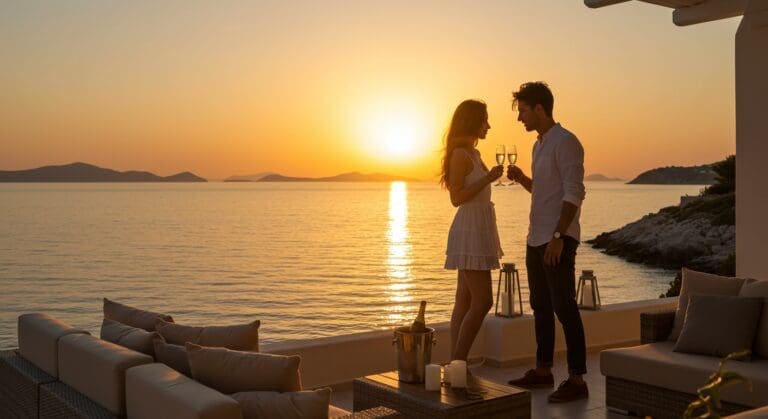
What makes Albufeira work as a destination – genuinely work, not just function as a backdrop for a sun holiday – is how many different travellers it suits simultaneously without feeling like it’s trying too hard for any of them. Families seeking genuine privacy and the kind of space that hotels simply can’t provide find it here, particularly in the quieter residential areas inland and along the western coast where luxury villas Albufeira sit behind high hedges with their own pools and terraces. Couples on milestone trips – anniversaries, honeymoons, significant birthdays – can dial the experience all the way up to two Michelin stars and a cliffside table with an Algarve sunset doing its level best to make the occasion even more dramatic. Groups of friends who’ve reached the age where they want something better than a budget apartment but haven’t entirely lost the urge to stay up late find the town obliges on both counts. Remote workers who need reliable connectivity and a reliable reason to stop working at a reasonable hour find the combination of fast fibre internet, year-round mild weather, and a villa pool surprisingly effective at solving both problems at once. And wellness-focused guests who want long walks on Atlantic coastal paths, outdoor yoga by a private pool, and restaurant menus built around the Mediterranean diet discover that Portugal has been doing this long before it became a trend.
Getting Here Without Losing a Day of Your Holiday
Faro Airport is the gateway to the eastern and central Algarve, and it is one of Europe‘s more pleasantly manageable regional airports – small enough to feel human, busy enough to have direct routes from most major United Kingdom airports year-round, with flight times hovering around two and a half hours from London. Albufeira sits roughly 45 minutes west of Faro along the A22 motorway, which means you can land, clear arrivals, and be sitting by your villa pool within about 90 minutes of touching down. That is, in holiday terms, essentially teleportation.
Private transfers are the obvious choice for a luxury holiday Albufeira – particularly if you’re arriving as a family with the full complement of luggage that somehow materialises when children are involved, or as a group whose collective suitcases could comfortably furnish a small apartment. Pre-booking a private driver through your villa concierge is straightforward and eliminates the particular airport-taxi anxiety that plagues less organised travellers. Lisbon’s Humberto Delgado Airport is also an option if you’re combining the Algarve with time in the capital – it’s around three hours by road or a scenic train journey on the Alfa Pendular service to Faro, from where you pick up a local connection or transfer.
Once you’re in the region, a hire car is, frankly, the best decision you’ll make. The Algarve rewards exploration – its best beaches, restaurants, and viewpoints are scattered across a coastline that doesn’t lend itself to public transport timetables. Albufeira town itself is eminently walkable once you’ve parked, and most quality villas come with adequate parking. The EN125 is the main coastal road, known locally for its scenic qualities and, during peak summer, its considerable traffic. The A22 toll road runs parallel and is considerably more efficient if you’re covering distance.
Where to Eat: From Two Michelin Stars to the Best Octopus of Your Life
Fine Dining
The headline act is unambiguous. Vila Joya, located in the coastal enclave of Galé a short drive west of Albufeira, is the kind of restaurant that makes the entire journey worthwhile even if you’d never planned to spend any time at the beach. Chef Dieter Koschina has held two Michelin stars here, and the restaurant has featured repeatedly among the world’s fifty best – which is, in the context of a resort town on the southern Portuguese coast, rather extraordinary. The cooking draws on the finest local ingredients and applies to them a precision and creativity that earns the word ‘exceptional’ without having to resort to hyperbole. Book well in advance. Dress accordingly. Order the wine pairing and accept whatever they put in front of you with a degree of trust you rarely extend to strangers.
Closer to Albufeira itself, Achado by Petrunyak deserves special attention – a restaurant so quietly, confidently excellent that it sits on a residential backstreet between the Strip and the Old Town as though mildly embarrassed by the neighbourhood. The menu moves between seafood and meat with equal conviction, each dish showing the kind of technical intelligence and restraint that, in a more prominent location, would already have attracted the attention of Michelin’s inspectors. It is, by any reasonable measure, rivalling the best restaurants in major European cities. The fact that you can walk to it from your Albufeira villa rather than flying to Paris is one of the better-kept secrets on the Algarve dining circuit.
Where the Locals Eat
Copos & Petiscos has a 4.9 rating from nearly 700 reviews, which in the age of algorithmic suspicion about such things is worth examining more closely. The reviews are genuine – sustained, detailed, enthusiastic in the specific way that people become enthusiastic when food is actually very good rather than just inoffensive. The focus is Mediterranean and European, executed in the spirit of Portuguese petiscos – small plates built for sharing, each one better than the last. The octopus salad is consistently singled out. So is the chorizo, the prawns, the clams, the padron peppers. It is the kind of meal that makes you order another glass of wine to justify staying at the table a little longer. This is correct behaviour and should be encouraged.
For straightforward, high-quality steak that doesn’t require a special occasion to justify, Steak House O Farnel delivers precisely what its name promises and does it at a price point that makes you briefly question whether you’ve misread the menu. A 4.8 rating from over 540 reviews, with particular praise for the fillet steaks, points to a kitchen that knows exactly what it’s doing and has been doing it consistently for long enough that regulars have stopped bothering to look at other options when meat is what they want.
Hidden Gems Worth Seeking Out
In the Old Town, on the main pedestrian street a few steps from the famous tunnel that connects this part of Albufeira to the beach, Alfredo is an Italian restaurant that operates on a simple and effective principle: be reliably excellent, take bookings seriously, and be full every night of the year regardless of season. It is considered the best Italian in the Old Town – high praise in a town that has had decades to learn what tourists want and has largely concluded that Italian food is a safe bet. Alfredo is well beyond safe. The menu covers bruschetta, carpaccio, pasta, risotto, and pizza with the kind of breadth that makes it genuinely suitable for everyone at the table, including the person who ‘doesn’t really like anything too adventurous’ and the one who orders the most obscure thing on the menu out of a combination of curiosity and competitive instinct.
The Algarve Coastline: What You Actually Need to Know Before You Go
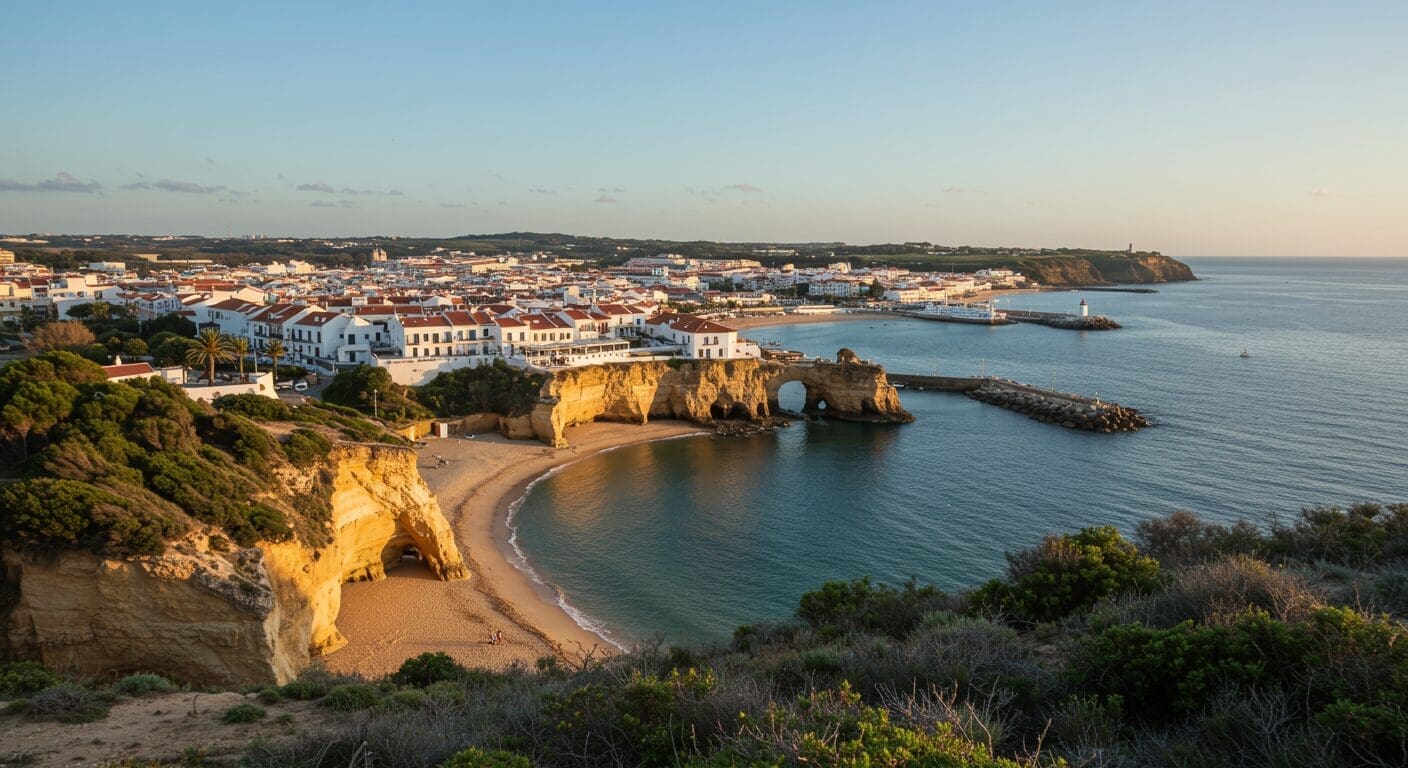
The Algarve coast from Lagos in the west to Faro in the east is one of the most varied stretches of southern European coastline, and Albufeira sits at something of a geographical sweet spot within it. The landscape here is defined by golden limestone cliffs, carved by Atlantic weather into formations of considerable drama – arches, sea stacks, sea caves, and grottoes that appear around headlands without warning and justify the long detours required to reach them.
The central Algarve beaches immediately around Albufeira are popular for good reason – Praia dos Pescadores sits directly below the Old Town and has the kind of accessibility that makes it a natural gathering point. But the best beach experiences in the region require a little more commitment. Praia da Falésia, stretching east towards Vilamoura, is the longest beach on this stretch of coast – a continuous expanse of red-gold cliffs dropping to pale sand that manages to absorb visitors without ever feeling crowded, particularly in the early morning when the light is extraordinary. Praia de São Rafael and Praia da Coelha are smaller, more sheltered coves accessible by road and short path, with the natural rock formations that characterise this part of the coast framing the water in a way that explains why the Algarve has been photographed approximately eight million times without ever quite exhausting its visual material.
Inland, the picture changes considerably. The Algarve interior – Serra do Caldeirão to the north and east – is rolling, cork oak-covered hills, white villages, and a quietness that feels like a different country from the coastal strip. Day trips into this landscape are one of the better decisions you can make on a luxury holiday Albufeira, particularly in spring when the wildflowers are in full force and the light is soft. The contrast between the Atlantic-facing coast and the pastoral interior is one of the Algarve’s genuine pleasures.
The Best Things to Do in Albufeira (Beyond Lying on a Beach)
The Benagil Cave boat trip is, without question, the most popular excursion departing from Albufeira, and its reputation is entirely warranted. The cave itself – located on the coast near Lagoa, accessible only by sea – has a natural skylight in its domed ceiling that opens onto a small hidden beach below. The effect, when you approach by boat and the full scale of the thing becomes clear, is one of those moments where the geological time required to create something like this briefly makes you feel very small and appropriately humble. Tours depart regularly from Albufeira marina, start from around €30 per person, and should be booked in advance during summer because they sell out. The better operators combine the cave with a broader coastal tour, passing sea arches, cliff faces, and hidden coves along the way, and many include dolphin watching – the waters off the Algarve coast are home to bottlenose and common dolphins that appear, infuriatingly photogenic, with remarkable reliability.
Beach-hopping deserves its own planning session. The beaches around Albufeira vary significantly in character – Praia dos Arrifes has dramatic rock formations and is quieter than the town beaches; Praia do Castelo is sheltered and relatively uncrowded; the aforementioned Falésia is the choice for long coastal walks combined with swimming. The practice of working through them systematically over a week is one of the more civilised ways to structure a holiday itinerary. A hire car makes this significantly more achievable.
Vilamoura, a short drive east, is the Algarve’s upmarket marina resort and worth an afternoon or evening – the marina itself has a concentration of good restaurants and the waterfront promenade is pleasant in the way that places designed for pleasant promenading tend to be. The casino is there if you need it. The golf courses – of which the Algarve has an almost comical abundance, covering most of the terrain between Albufeira and Vilamoura – are genuinely excellent, with several ranking among the best courses in Europe.
Adventure on the Water and Along the Cliffs
The Atlantic here is not the Mediterranean. It is cooler, more dynamic, and considerably more interesting if water sports are your reason for being on a coastline. The waters around Albufeira support a full range of activities: jet skiing and wakeboarding are available from most beach concessions, parasailing offers the aerial perspective on the cliff formations that ground-level photography cannot achieve, and stand-up paddleboarding on calmer days is both excellent exercise and, on the right beach, one of the more meditative ways to spend a morning.
Scuba diving and snorkelling in this part of the Algarve reward the effort – the underwater topography mirrors what’s happening above the surface, with sea caves, rock formations, and reasonable visibility in good conditions. Several dive schools operate from Albufeira and offer everything from introductory dives for beginners to guided dives for certified divers exploring the deeper sites.
On land, the coastal walking trails between headlands are genuinely worthwhile – the Rota Vicentina and Via Algarviana are the headline long-distance routes, but shorter sections near Albufeira offer cliff-top walking with Atlantic views that requires no particular fitness or gear beyond sensible shoes. Cycling is increasingly well-supported, with a network of routes through the interior and coastal paths, and several villa concierge services can arrange quality bike hire or guided cycling tours. Road cycling in the quieter back roads of the Serra do Caldeirão is particularly good in spring and autumn when temperatures are moderate and traffic is minimal.
Coasteering – the practice of navigating sea cliffs via swimming, jumping, and scrambling – is available through specialist operators and represents the most physically committed way to engage with the Algarve’s extraordinary coastal geology. It is, predictably, excellent.
Why Albufeira Works Brilliantly for Families
The honest answer to why Albufeira works for families is that it removes the usual sources of family holiday friction and replaces them with things that make everyone, including parents, actually enjoy themselves. The beaches are safe and accessible with lifeguard coverage during peak season, the sea temperature reaches a genuinely pleasant swimming temperature by June and stays there through October, and the resort infrastructure – restaurants with children’s menus, water parks, boat trips – is well developed without being overwhelming.
But the more interesting answer involves the private villa. A luxury villa Albufeira with a private pool removes the central injustice of hotel pools – the one where sixty people compete for twelve sunbeds and the shallow end is perpetually occupied by strangers – and replaces it with something children find considerably more satisfying: their own pool, accessible whenever they want it, with adults who have the uninterrupted peace to actually read a book rather than perform the complex surveillance exercise that public pools require.
Villas in the Albufeira area range from three-bedroom properties ideal for a single family to large estates accommodating multi-generational groups where grandparents, parents, and children can share a property while retaining the independence that makes extended family holidays survive beyond day three. Gardens with space to play, outdoor dining areas where mealtimes become relaxed occasions rather than logistical challenges, and proximity to the beach without being on top of the tourist strip – these are the specific advantages that explain why families who try the villa model rarely go back to hotels.
Albufeira’s History: Older Than It Looks
Albufeira’s modern reputation as a resort town rather obscures the fact that it is an ancient settlement with a history stretching back to Roman occupation and through Moorish rule – the name itself derives from the Arabic Al-Buhera, meaning ‘castle on the sea’. The Moors held the town for several centuries before it was retaken during the Christian Reconquista in 1249, and traces of this layered history survive in the street patterns and some architecture of the Old Town, even if the earthquake of 1755 – the same cataclysm that effectively demolished Lisbon – did considerable damage to Albufeira’s older structures.
The Old Town that exists today is a compact, genuinely charming maze of whitewashed buildings, narrow pedestrian streets, and small squares that reward wandering. The Igreja de Sant’Ana – rebuilt after the 1755 earthquake – is the principal church and worth a look inside, while the viewpoints over the beach below the Old Town offer context for the settlement’s original strategic logic: whoever held this cliff controlled this harbour. The famous tunnel connecting the Old Town to Praia dos Pescadores was cut through the cliff to improve beach access and is now one of those landmarks that people photograph largely because it’s there, which is reason enough.
The Algarve’s cultural calendar has genuine highlights beyond its beach season. Carnival celebrations in February have real local flavour, the Seafood Festival in late summer celebrates the fishing heritage that predates the tourism industry, and local markets throughout the year offer the crafts, ceramics, and food products – the dried figs, the almond sweets, the local honey – that represent the region’s agricultural character more accurately than most of what’s sold in tourist shops.
Shopping: What to Buy and Where to Find It
Albufeira’s shopping divides neatly into the things you’ll buy because they’re genuinely good and the things you’ll buy because you’ve been in the sun for a week and your judgement has softened accordingly. The latter category includes novelty items best left unexamined. The former is more interesting.
The Old Town shops carry a reasonable selection of Portuguese ceramics – the hand-painted azulejo tiles that are legitimately worth buying as both decorative objects and as representations of a craft tradition with real depth. Quality varies, and the better pieces cost more than the tourist versions, which is as it should be. Locally made lacework and embroidery from the Algarve tradition are also worth seeking out, as are the small speciality food shops selling regional products: cataplana sets (the distinctive copper cooking vessels that define Algarve cuisine), almond-based sweets, local honey, fig products, and the region’s olive oils.
For more serious retail therapy, Faro has the better shopping infrastructure – Forum Algarve is the main mall for familiar international brands, while the older pedestrian centre around Rua de Santo António has independent retailers and more interesting options. The weekly markets in surrounding towns – Loulé’s Saturday market is the best known and most worthwhile – offer fresh produce, local crafts, and the particular pleasure of shopping somewhere that exists primarily for local residents rather than tourists.
Practical Things That Actually Matter
Portugal uses the Euro, and Albufeira is well equipped with ATMs, card acceptance, and the general infrastructure of a functioning tourist economy. The language is Portuguese, and while English is widely spoken in tourist areas, making any attempt at Portuguese – obrigado (thank you), por favor (please), bom dia (good morning) – is received with warmth that exceeds what the effort strictly merits. It is the correct approach and should be adopted.
Tipping is not mandatory but is customary at around 10% in restaurants if service has been good. In casual or beachside settings, rounding up is fine. Nobody will chase you down the street if you don’t, but the economics of the hospitality industry in resort towns are worth bearing in mind.
The best time to visit Albufeira for a luxury holiday depends on what you’re optimising for. July and August deliver guaranteed heat and sunshine, full beach atmosphere, and the full operational capacity of the resort – every restaurant open, every activity running. They also deliver peak crowds and peak prices. June and September offer something considerably more appealing to discerning travellers: weather that is reliably excellent (26-28°C, minimal rain), beaches that are enjoyable without being impossible, and a version of Albufeira that feels more like a real place. May and October are for those who want the landscape, the food, the golf, and the coastal walking without any of the summer holiday congestion – temperatures are mild, the wild flowers in May are remarkable, and prices drop meaningfully across accommodation and flights.
Portugal is, by any reasonable measure, one of the safest countries in Europe for travellers. Standard urban common sense applies in crowded tourist areas, but Albufeira is not a place that requires special vigilance.
Why a Private Villa Is the Only Sensible Way to Do Albufeira
There is a version of Albufeira that happens in hotel rooms and all-inclusive resorts, and there is a version that happens in a private villa with your own pool, your own kitchen, your own schedule, and enough space that people who love each other can also occasionally be in different rooms. The second version is objectively better, and not just in the ways that seem obvious at first.
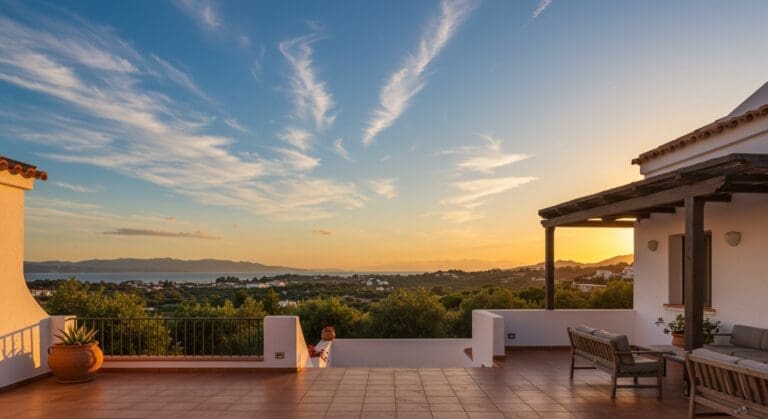
Privacy is the headline advantage, and it is a real one. The best luxury villas Albufeira are positioned in elevated or secluded locations – cliff-top properties with Atlantic views, rural retreats in the hills behind the coast, residential estates where the nearest neighbours are sufficiently distant to be theoretical. A private pool that nobody else is in. A terrace for dinner that is yours entirely. A morning swim before anyone else is awake, with no performance element required.
The space argument is particularly compelling for families and groups. A six-bedroom villa with a private pool, multiple living areas, and a fully equipped kitchen does something that no hotel configuration achieves: it makes a large group of people feel like they’re staying somewhere together rather than in adjacent rooms that happen to share a floor number. Multi-generational groups – where different ages have genuinely different rhythms, bedtimes, and tolerance for noise – find the villa model resolves conflicts that would otherwise need careful management.
For those who work remotely, the combination of fast fibre internet (increasingly common in quality Algarve villas, with Starlink available in properties where fixed connectivity is limited), a dedicated workspace that isn’t a hotel desk, and a pool to justify logging off at a reasonable hour represents a work-life balance arrangement that most corporate wellness programmes have failed to identify. The Algarve’s time zone – matching the United Kingdom in winter and one hour behind in summer – makes remote working from here genuinely viable without the time zone arithmetic that complicates other destinations.
Wellness guests will find that the better villas come with gym equipment, outdoor yoga space, heated pools, and access to concierge-arranged spa treatments and private fitness instruction. The outdoor life in the Algarve – the coastal walks, the clean air, the sea swimming, the early mornings on a sun terrace with good coffee – does a significant amount of wellness work before any formal programme begins.
Staff and concierge options at the premium end of the Albufeira villa market include private chefs who can bring the quality of the region’s restaurant scene into your own dining room, housekeeping services that maintain the property without intruding on the rhythms of your stay, and concierge teams who can arrange everything from boat trips and restaurant reservations to private golf tuition and helicopter transfers. This is the full service hotel experience delivered to a property that feels entirely your own. The distinction matters more than it might initially seem.
Explore our collection of luxury holiday villas in Albufeira and find the property that matches exactly the version of this destination you’re looking for.
More Albufeira Travel Guides
- Best Restaurants in Albufeira: Fine Dining, Local Gems & Where to Eat
- Albufeira Food & Wine Guide: Local Cuisine, Markets & Wine Estates
- Albufeira with Kids: The Ultimate Family Holiday Guide
- Best Time to Visit Albufeira: Month by Month Weather, Crowds & Tips
- Albufeira Luxury Itinerary: The Perfect 7-Day Guide
- Romantic Albufeira: The Ultimate Couples & Honeymoon Guide
What is the best time to visit Albufeira?
June and September are the sweet spot for most travellers – reliably warm and sunny (26-28°C), fully operational in terms of restaurants and activities, and noticeably less crowded than the peak July-August window. Families with school-age children will default to the summer holidays, which deliver guaranteed heat but at the cost of crowds and higher prices. May and October are excellent for couples, golfers, walkers, and anyone who values the landscape over the beach party atmosphere – temperatures are comfortable, prices drop across the board, and the Algarve’s natural beauty is arguably at its most accessible. Winter is mild by northern European standards and suits longer-stay travellers, remote workers, and golf-focused visitors who want the courses without the summer booking competition.
How do I get to Albufeira?
Faro Airport is the closest international airport, approximately 45 minutes east of Albufeira along the A22 motorway. Direct flights operate year-round from most major UK airports, with flight times of around two and a half hours from London. TAP Air Portugal operates connections via Lisbon if you’re travelling from further afield. Lisbon’s Humberto Delgado Airport is around three hours by road or accessible by Alfa Pendular train to Faro (approximately two and a half hours), from where a transfer to Albufeira takes around 45 minutes. Private transfers from Faro are the most practical option for villa stays, particularly for groups or families with luggage. A hire car is strongly recommended once you arrive – the best beaches, restaurants, and day trips are spread along a coast that rewards independent mobility.
Is Albufeira good for families?
Genuinely, yes – and not just in the sense that it has beaches and ice cream. The resort infrastructure is well developed for families: beaches have lifeguard coverage during peak season, sea temperatures are comfortable for swimming from June through October, and there are water parks, boat trips, and family-appropriate restaurants in good supply. The real advantage for families, however, is the private villa option – a property with its own pool, enclosed garden, and multiple living areas eliminates the main sources of hotel-holiday friction and gives children the freedom to move, swim, and exist without constant supervision in crowded public spaces. Multi-generational families – grandparents, parents, children – particularly benefit from villa stays where different generations can share a property while maintaining their own rhythms.
Why rent a luxury villa in Albufeira?
The short answer is privacy, space, and the ability to live rather than just stay somewhere. A luxury villa in Albufeira gives you a private pool that no strangers are sharing, a kitchen and dining space where meals happen on your schedule, and enough room that a group of people can be together without being on top of each other. The longer answer involves the specific way a private villa changes the quality of a holiday – the morning swim before anyone else is awake, the dinner on your own terrace, the freedom to make noise or be quiet without negotiating with the rest of a hotel floor. Staff options at the premium end – private chefs, housekeeping, concierge services for restaurant reservations and excursion bookings – deliver the service level of a five-star hotel in a property that feels entirely your own. For families and groups especially, the value calculation is compelling once you factor in what you get per person.
Are there private villas in Albufeira suitable for large groups or multi-generational families?
Yes, and this is one of the stronger use cases for the Albufeira villa market. Properties range from intimate three-bedroom villas for a single family to large estates of seven bedrooms or more, some with separate guest wings or annexes that give different family generations or friend groups genuine independence within a shared property. The best large-group villas combine substantial private pool and garden space, multiple indoor living areas, fully equipped professional kitchens, and outdoor dining infrastructure that makes large communal meals a pleasure rather than a logistics exercise. Staff options – private chefs, housekeeping teams, and dedicated concierge support – scale with property size and can be arranged in advance to ensure the practical side of a large group stay is handled without anyone having to volunteer as unpaid holiday coordinator.
Can I find a luxury villa in Albufeira with good internet for remote working?
Increasingly, yes. Fast fibre broadband is standard in most quality Albufeira villas, and Starlink satellite internet is available in properties where fixed-line connectivity is less reliable – particularly in more rural or elevated locations. The practical reality of remote working from an Algarve villa is that the combination of reliable connectivity, a dedicated workspace separate from the living areas, and the structural incentive of a pool waiting outside at 5pm makes for an unusually productive and balanced working arrangement. Portugal’s time zone alignment with the UK (matching in winter, one hour behind in summer) means that standard European business hours work without adjustment, which is a practical advantage over more exotic remote-working destinations. Most villa concierge services can confirm specific connectivity details before booking if this is a priority.
What makes Albufeira a good destination for a wellness retreat?
The combination of factors that make Albufeira work for wellness is partly environmental and partly infrastructural. The outdoor life here is genuinely restorative – coastal walking trails, sea swimming in clean Atlantic water, year-round sunshine that supports outdoor activity across most of the calendar, and a food culture built on the Mediterranean diet’s core ingredients: fresh fish, olive oil, vegetables, legumes, and good wine in reasonable quantities. The private villa adds the private pool, the space for outdoor yoga or morning exercise, and the kitchen that makes healthy eating a choice rather than a constraint. The better properties can be arranged with gym equipment, sauna or steam facilities, and access to concierge-arranged spa treatments and personal training either in-villa or at nearby specialist facilities. The pace of life in the Algarve does the rest – it is, with minimal effort, a place that makes you slow down.