Best Restaurants in Barcelona: Fine Dining, Local Gems & Where to Eat
Here is the mild confession upfront: Barcelona is not really a food city. Not in the way it wants you to think it is. Ask most visitors what they ate and they’ll describe a plate of disappointing paella ordered at noon on the seafront, possibly while wearing a hat they bought the same morning. The city’s reputation for gastronomy has long been hostage to its own popularity – too many restaurants built for the crowd rather than the curious. And yet, buried beneath the tourist menus and the sangria served in plastic jugs, is one of the most genuinely thrilling food scenes in Europe. Twenty-four Michelin stars. Markets that would make a French chef weep. Tapas bars where the locals are three glasses in before you’ve found a seat. The trick, as with most things in Barcelona, is knowing where to look – and knowing enough to look past the obvious.
This guide exists precisely for that purpose. Whether you’re booking a table at one of the city’s three-star temples or hunting down a perfectly composed montadito in the Eixample, consider this your edited, honest map to eating well in Barcelona. For more on the city beyond the table, the Barcelona Travel Guide covers everything from Gaudí to the Gothic Quarter.
The Fine Dining Scene: Barcelona’s Michelin-Starred Restaurants
Barcelona’s fine dining world is not quietly confident. It is quietly triumphant. Twenty-four Michelin-starred restaurants in a single city is not an accident – it’s the product of decades of culinary ambition, a region fiercely proud of its ingredients, and a generation of chefs who trained under legends and then, rather impressively, became legends themselves.
At the very top of that hierarchy sits Lasarte, one of only two restaurants in the city to hold three Michelin stars. Led by Martín Berasategui – the most Michelin-starred Spanish chef in the world, which is a sentence that requires a moment to absorb – Lasarte operates in a register of quiet excellence. The cuisine is rooted in Basque technique but speaks a broader, more ambitious language. Tasting menus here are long, considered, and almost theatrical in their precision. Reserve well in advance. Months in advance, if honesty is preferred.
The other three-star destination is ABaC, where chef Jordi Cruz has built something genuinely personal. His cooking is modern and creative in the best sense – inventive without being alienating, surprising without being smug. The restaurant sits inside a boutique hotel in the quieter upper reaches of the city, which gives the whole experience a pleasing sense of remove from the tourist bustle below.
Then there is Disfrutar, which holds two stars and is, by most serious assessments, one of the best restaurants in the world. What makes it remarkable is not just the food – though the food is extraordinary – but the attitude. The three owners each ran a section of the legendary elBulli kitchen, and they’ve carried that genius here without any of the reverence or stiffness that might reasonably follow. The tasting menu is a series of sensory illusions: what you see is rarely what you taste, what you expect is rarely what arrives. A single dish might present as a simple olive and reveal itself as something else entirely. It is playful, technically astonishing, and not in the slightest bit pompous. Book as early as humanly possible. The waitlist does not care how much you’d like a table next Tuesday.
For something equally serious but more intimate, Cocina Hermanos Torres offers a two-star experience with a theatrical edge. Twin chefs Sergio and Javier Torres work from an open kitchen so large it is essentially a stage, and the dishes that emerge from it are precise and beautiful. The space itself – a converted warehouse – has the feel of somewhere important things are happening. They are.
Not every star requires a three-hour commitment. Mont Bar, with its single Michelin star, proves this emphatically. Warm, genuinely informal, and focused on seasonal ingredients prepared with quiet intelligence, it offers a refined approach to tapas that respects the format without being trapped by it. The wine list is serious. The atmosphere is not. It is one of those rare places where you feel the kitchen is cooking for its own pleasure as much as yours – which, invariably, is when the food is best.
Local Gems and Neighbourhood Restaurants Worth Knowing
The best meal you eat in Barcelona may well cost you twenty euros and take place at a bar with no website. This is not romantic fiction – it is a reliable statistical probability. The city’s neighbourhood restaurants, particularly in areas like Gràcia, Poble Sec, and the quieter streets of the Eixample, operate on a different frequency to the tourist trail. They are not hiding, exactly. They are simply getting on with it.
What to look for: hand-written menus, a daily specials board that changes because the ingredients changed, a room full of people who live nearby. The menú del día – a set lunch of two or three courses with wine and bread – remains one of the great civilised institutions of Spanish life and can be had for between fifteen and twenty-five euros at the sort of places that would charge triple for dinner. Order it. Eat what they give you. Consider the possibility that this approach to lunch is something your home country has failed to solve.
In the Poble Sec neighbourhood, the streets around Carrer de Blai have developed into something of an unofficial pintxos corridor, where small bars line up serving Basque-style bites on bread. It is convivial, inexpensive, and entirely at odds with the idea that Barcelona dining requires a reservation and a jacket. The Gràcia neighbourhood, meanwhile, rewards anyone willing to walk uphill. Quieter than the Gothic Quarter, more local than the Eixample, it has a concentration of small, independent restaurants with real character and kitchens that take their produce seriously.
Beach Clubs and Casual Dining by the Sea
Barcelona’s relationship with its own seafront is complicated – the beachfront was largely created for the 1992 Olympics, which gives it a certain manufactured quality that the rest of the city, all medieval lanes and moderniste grandeur, conspicuously lacks. But what it does well is lunch in the sun, and on that score there is little argument.
The beach clubs that line Barceloneta and stretch towards Poblenou are a significant upgrade on the paella-and-plastic scenario described earlier. The better ones serve serious seafood – grilled fish, ceviche, exemplary arrós negre (rice cooked in squid ink, which sounds alarming and tastes extraordinary) – with their feet in the sand and a wine list that treats the occasion with appropriate respect. Lunch here should be long and relatively unplanned. Arrival before 2pm is, frankly, optional.
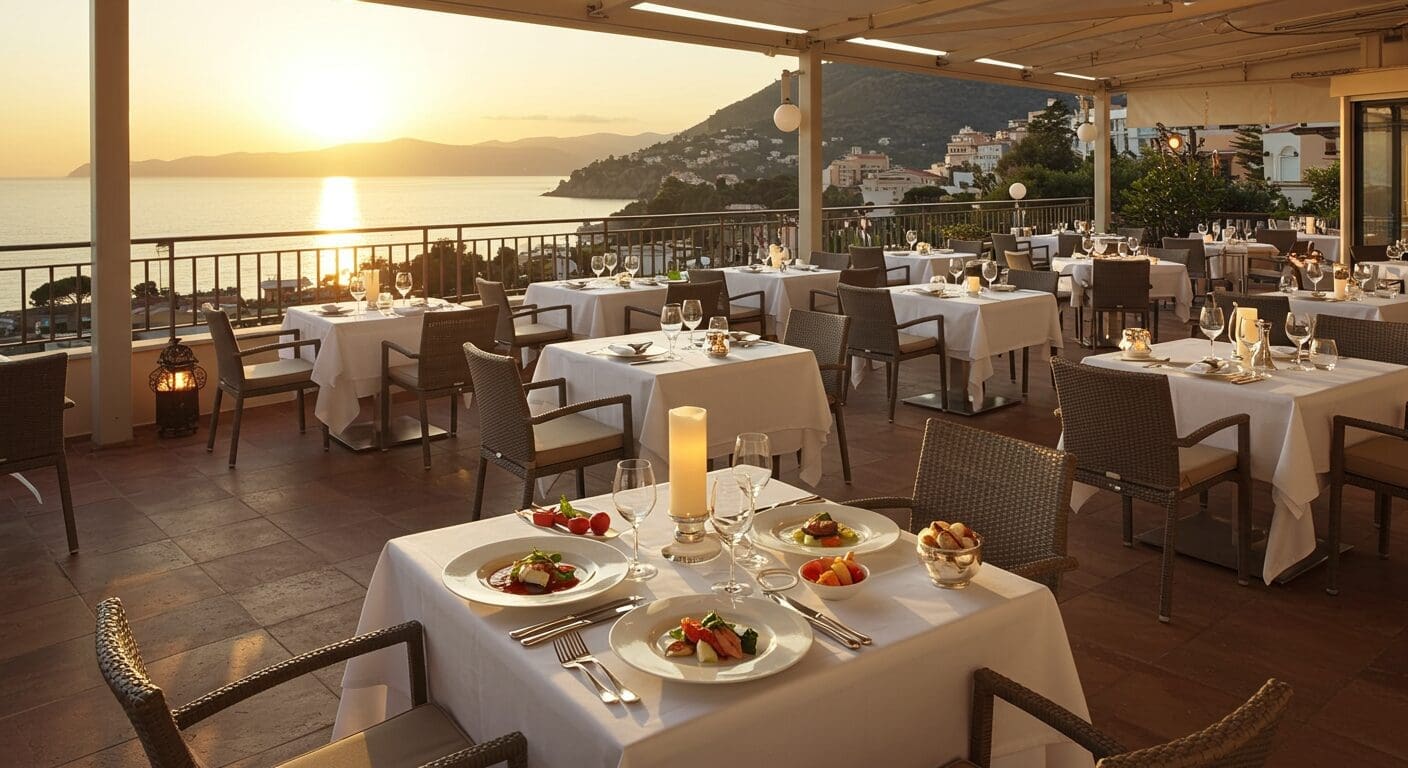
For a more elevated version of the same idea, some of the smarter hotel rooftop bars and terraces along the seafront offer the view without the sand. These are best deployed in the late afternoon, when the light on the Mediterranean does exactly what it’s supposed to do and the city behind you begins its slow, beautiful drift towards evening.
Food Markets: La Boqueria and Beyond
La Boqueria is the most famous food market in Spain, possibly in Europe, and it is exactly as extraordinary and exactly as overwhelmed as you’ve been told. Go early – before ten in the morning, ideally – and you will find a genuine working market of spectacular produce: salt cod stacked in architectural quantities, jamón ibérico being sliced with meditative focus, fruit so ripe it seems to be offering itself. Go at noon in August and you will be sharing the experience with several thousand other people having the same thought simultaneously. Both outcomes are real. Only one of them is enjoyable.
The smarter approach, increasingly adopted by those in the know, is to use La Boqueria as a visual education and save serious shopping for the neighbourhood markets that the city’s residents actually use. The Mercat de Santa Caterina in the Born district – designed with a rippling, mosaic-tiled roof that Gaudí himself might have approved of – operates with less theatre and more genuine purpose. The Mercat de l’Abaceria in Gràcia is older, earthier, and entirely focused on feeding the neighbourhood around it. Neither charges tourist prices. Neither is on most itineraries. Both are worth the minor effort of finding them.
What to Order: Dishes Every Visitor Should Know
A brief but necessary intervention on the subject of paella: the dish you want on the Catalan coast is not, strictly speaking, paella. It is fideuà (made with noodles rather than rice), or arrós a la cassola, or the extraordinary arrós negre mentioned above. Paella is a Valencian dish. Catalonia has its own rice traditions and they are equally good – possibly better, depending on who you ask and where you are in the argument.
Beyond rice, the canon includes pa amb tomàquet – bread rubbed with tomato and olive oil, which is the simplest thing in the world and somehow irreplaceable – and croquetes de bacallà (salt cod croquettes), which appear on almost every good menu and are a reliable indicator of kitchen quality. Botifarra, the local pork sausage, is to Catalonia what chorizo is to the rest of Spain: present, beloved, and not to be underestimated. Finish with crema catalana, the original version of the dish the French later claimed and renamed. The Catalans have not forgiven them.
Wine, Cava and Local Drinks
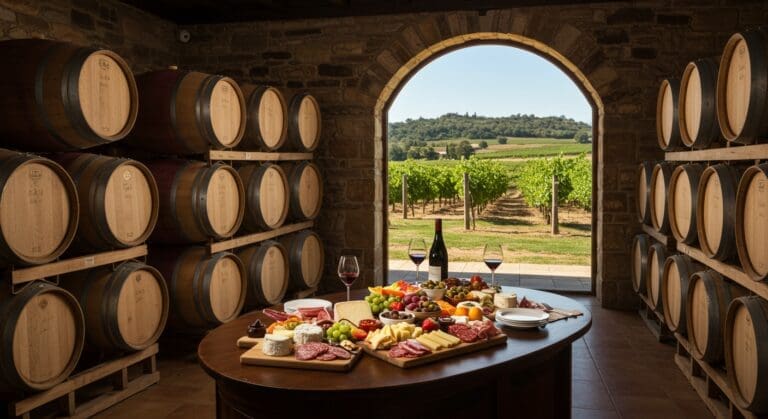
Catalonia produces some of Spain’s most interesting wine, a fact that often surprises visitors who arrive expecting only Rioja. The Penedès region, less than an hour from the city, is the spiritual home of Spanish cava – the sparkling wine that has been opening celebrations in this country since long before prosecco arrived and confused everyone. Order cava with seafood. Order it without seafood. Order it at eleven in the morning if the occasion warrants it. Nobody will think less of you.
For still wine, the Priorat region produces bold, mineral reds of real distinction, while the Empordà in the north makes a style of wine – often rosé, often served cool – that belongs specifically to this corner of the world and travels poorly out of context. In the warmer months, vermut – vermouth, served with soda, an olive, and a small portion of something salty – is the correct aperitivo. It is drunk at noon on a Sunday on terraces across the city, with a patience and an absence of urgency that the rest of the week rarely allows.
Reservation Tips and How to Eat Like a Local
The most important thing to understand about Barcelona dining is the schedule. Lunch is at two, not one. Dinner is at nine, possibly nine-thirty. Show up at seven-thirty for dinner and you will eat alone in a room being set up around you, which is its own particular experience. The city runs on its own timetable and has no intention of adjusting it.
For the top-tier restaurants – Lasarte, ABaC, Disfrutar, Cocina Hermanos Torres – reservations should be made weeks or months ahead, particularly for weekend dates or high summer. Disfrutar in particular operates with a level of demand that requires forward planning bordering on the strategic. Many of these restaurants open their booking windows on specific dates via their own websites; it is worth checking rather than relying solely on third-party platforms.
For neighbourhood restaurants and tapas bars, walk-in dining remains entirely possible, particularly at lunch and on weekday evenings. The Spanish appetite for spontaneity in this regard has not entirely been defeated by the booking app. Arrive slightly early, ask politely, and be prepared to wait at the bar – which, in most cases, is not the hardship it sounds.
One final note: tipping is not the obligation it is elsewhere. A few euros left for a good meal is appreciated; a percentage calculation is not expected. The service culture here is professional rather than performative, and it does not require your approval to function.
The Case for a Private Chef and a Villa Kitchen
After several days of dining out at the calibre described above, there is something genuinely pleasurable about reversing the arrangement entirely – sourcing ingredients from one of the city’s markets in the morning and having them transformed into something extraordinary in the kitchen of your own private residence by evening. For guests staying in a luxury villa in Barcelona, the private chef option is not a convenience so much as a natural extension of the city’s food culture: market-fresh, unhurried, personal. It is the kind of meal that is difficult to replicate in a restaurant, precisely because it has been prepared for you and only you. Which is, when you think about it, a rather good reason to stay in a villa in the first place.
When is the best time to visit Barcelona’s top restaurants?
Barcelona’s finest restaurants are open year-round, but demand peaks between June and September when the city is at its busiest. For the most in-demand tables – particularly at Disfrutar, Lasarte, and ABaC – this means booking even further ahead than you might expect, sometimes two to three months in advance for peak summer dates. Spring (April to May) and early autumn (September to October) offer a sweet spot: the weather is excellent, the city is busy but navigable, and securing a reservation at short notice is marginally less of a competitive sport.
What is the difference between tapas and pintxos in Barcelona?
Tapas are small dishes served as snacks or starters, typically ordered from a menu and brought to the table – a tradition with roots across Spain. Pintxos (sometimes spelled pinchos) are specifically Basque in origin: small bites served on bread, often displayed along the bar and eaten standing up. In Barcelona, you’ll find both, with the area around Poble Sec’s Carrer de Blai being particularly known for its pintxos bars. Neither is more authentically Catalan than the other – Catalonia has its own small-plate traditions, including the superb tapas offered at Michelin-starred Mont Bar – but knowing the distinction helps you order with confidence.
Is it possible to eat well in Barcelona without a reservation?
Entirely, yes – provided you’re not attempting to walk into Disfrutar on a Saturday evening in July. Barcelona’s neighbourhood restaurants, market bars, pintxos spots, and casual lunch venues operate with considerable flexibility for walk-in diners, particularly at lunch and on weekday evenings. The menú del día – the set lunch menu served across the city on weekdays – is one of the best value eating experiences in Europe and rarely requires anything more than arriving at a reasonable hour and sitting down. Reserve ahead for starred restaurants and popular spots; for everything else, the city remains pleasingly spontaneous.