
Best Restaurants in Corfu: Fine Dining, Local Gems & Where to Eat
Here is a confession that might surprise you: Corfu is not, primarily, a food destination. Ask most people why they choose the island and they will talk about the water, the old town, the Venetian architecture, the scent of kumquat in the air. Food tends to come third or fourth on the list, somewhere after “the light” and “it’s not Mykonos.” And yet, quietly, without much fuss or fanfare, Corfu has assembled one of the most genuinely compelling dining scenes in the Greek islands – a scene that draws on centuries of Venetian, French, and British occupation to produce a cuisine that is distinctly, stubbornly its own. Spend a week eating well here and you will leave wondering why nobody told you sooner. This guide is your advance notice.
The Fine Dining Scene: Corfu’s Culinary Ambitions
There is no Michelin star in Corfu – yet. But the absence of a red guide on the shelf does not mean the island is short on culinary ambition. What it does have is something arguably more interesting: a small collection of restaurants that have developed their own identity rather than chasing external validation. The fine dining scene here is driven by chefs who are deeply connected to the island’s ingredients, its history, and its particular hybrid of influences. The result is food that feels rooted rather than performed.
The name every serious food traveller needs to know is Etrusco, located in Kato Korakiana in the Corfiot countryside. This is the island’s undisputed standard-bearer – ranked consistently among Greece’s finest restaurants and awarded four stars at the FNL Best Restaurant Awards, as well as second place in The List 2024. Chef Ettore Botrini works from a restored countryside mansion surrounded by organic gardens, many of which supply the kitchen directly. His cooking honours his Italian-Corfiot heritage without being enslaved to it – the tasting menu shifts with the seasons and with the chef’s own curiosity, which is precisely as it should be. One guest described it as “quite possibly the best restaurant in the entire country.” That is not a casual claim. It is also, based on the evidence, not an exaggerated one. Book well in advance. Seriously – well in advance.
For those who prefer their fine dining with a backdrop of cobblestones and candlelight, Venetian Well in Corfu Old Town offers something quite different in feel but equally serious in execution. Positioned near Kremasti Square in a beautifully restored Venetian-era building, the restaurant opens onto a courtyard where a historic well provides an unlikely centrepiece. The menu is a thoughtful fusion of Mediterranean and Corfiot cuisine – fresh, precise, and never trying too hard to impress. The wine cellar is a particular point of pride, running to over 700 labels across Greek, French, and Italian producers. The tasting menu comes warmly recommended by regular guests: “every course was beautifully balanced and flowed perfectly, making it feel like a real dining experience rather than just a meal.” That distinction – experience versus meal – is worth sitting with.
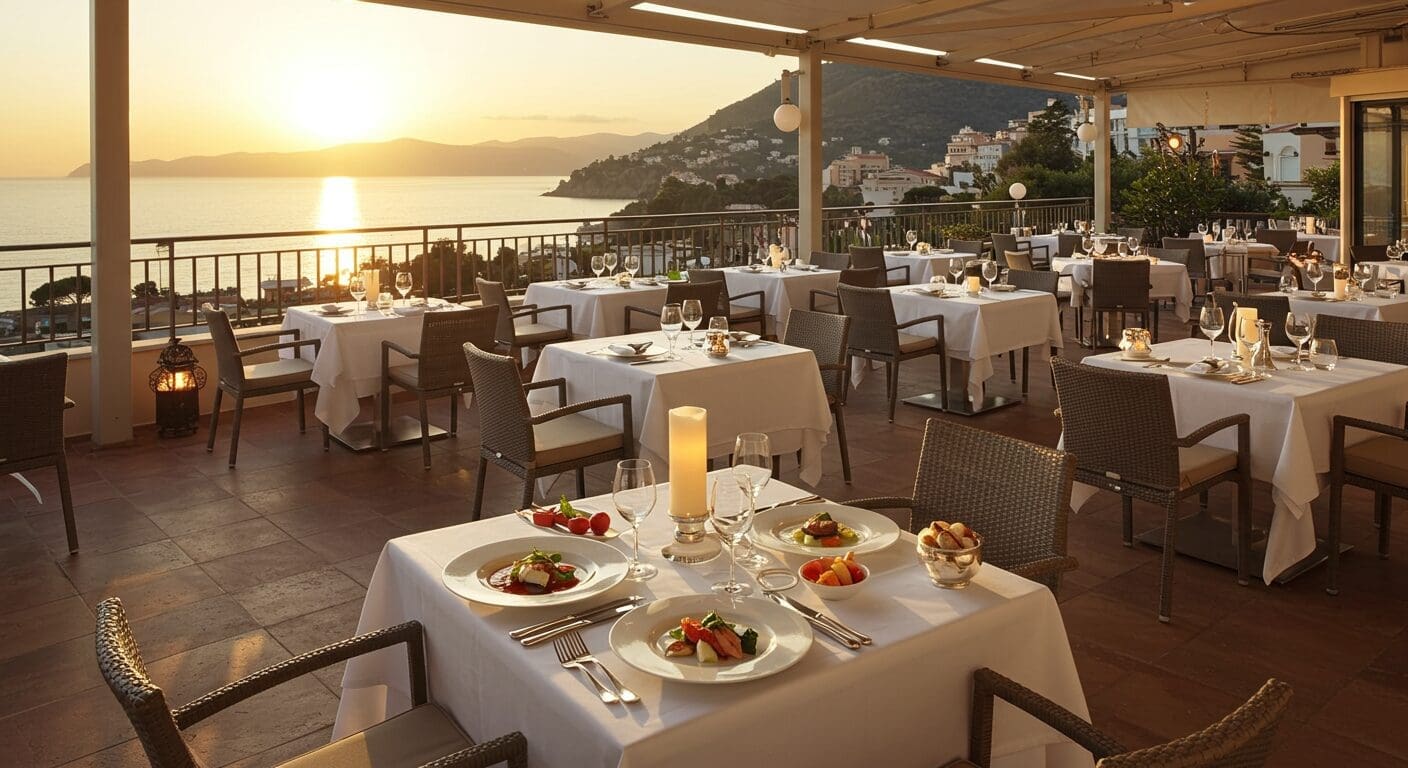
Completing the upper tier of Corfu’s fine dining constellation is Appagio at the Nido Hotel. Chef Sotiris Evangelou – who has his connections to the Etrusco family of restaurants – takes classic island dishes and reimagines them through modern technique without stripping away what made them interesting in the first place. The al fresco terrace looks out toward the Ionian Sea, which shifts from deep blue to something closer to hammered gold as the evening progresses. It is the kind of setting that makes you order another glass of wine purely on principle.
The newest arrival worth your attention is Terra Corfiata, which opened in 2024 in the hills above Nisaki and has wasted no time in becoming one of the best-reviewed restaurants on the island. The views across the hillside toward the sea are exactly what you come to Corfu for, and the kitchen delivers food that is genuinely exceptional rather than merely photogenic. Watch this one closely.
Local Tavernas: Where Corfu Actually Eats
For all the excellence of the island’s fine dining establishments, some of the most memorable meals in Corfu happen in places with paper tablecloths, wine served in carafes, and a menu that has not changed since 1987. This is not a criticism. If anything, it is a recommendation.
The Corfiot taverna is a specific and wonderful institution. Unlike the tourist-facing tavernas that cluster around ports and ferry terminals offering suspiciously identical menus, the genuine article tends to be slightly out of the way, family-run, and entirely uninterested in your dietary preferences. Look for places where the locals are eating – particularly older locals, who have strong opinions about these things and no patience for mediocrity. The villages of the north – Agios Markos, Spartilas, Strinilas – are worth a drive inland specifically for their tavernas, which serve honest, slow-cooked food at prices that will make you reconsider everything you thought you knew about Greek restaurant economics.
What to order: sofrito is the dish that defines Corfu, and it appears nowhere else in quite the same way. Thin slices of beef are slow-cooked in white wine, garlic, and parsley until they achieve a tenderness that seems almost implausible. Pastitsada – meat (traditionally rooster, though beef is common) braised in a rich tomato and spice sauce, served over thick pasta – is the Sunday dish, the celebration dish, the dish that tells you something true about the island’s Venetian inheritance. Bianco, a simple white fish stew with garlic and lemon, is the kind of thing you eat once and then spend the next year trying to recreate at home. Order all three if you have enough time and sufficient elasticity in your plans for the afternoon.
Beach Clubs and Casual Dining: Eating with Your Feet in the Sand
Corfu’s coastline – particularly along the northeast, where the water turns colours that seem slightly implausible under direct sunlight – has attracted a generation of beach clubs that take their food considerably more seriously than the term “beach club” might suggest. These are not the kind of establishments where a club sandwich is the culinary apex. The better ones source local fish daily, serve chilled Greek rosé with the kind of quiet confidence that comes from knowing exactly what the moment requires, and provide the particular pleasure of eating well while surrounded by people who have clearly made the same excellent decision as you.
The north coast and the area around Kassiopi and Agios Stefanos have a concentration of spots worth knowing. For lunch specifically, look for places that display their fresh fish on ice near the entrance – this is both a quality signal and a mild theatre that never gets old. Grilled sea bream with olive oil and lemon, eaten at a table that is technically on a beach, is one of the simplest and most persuasive arguments for the Mediterranean way of life.
Casual dining in Corfu Town itself is a different proposition. The Liston – the elegant arcaded promenade built by the French along Napoleonic lines – is where you go for coffee and people-watching rather than serious food. But venture a few streets back into the maze of the old town and you will find small restaurants serving honest Corfiot cooking to a mixed crowd of locals and those tourists who have figured out that getting slightly lost is the best navigation strategy available.
Hidden Gems and the Places Worth Seeking Out
The best-kept secret about eating in Corfu is that the island rewards mild inconvenience. The restaurants that require a twenty-minute drive along a road that seems to narrow with each kilometre, or a walk down steps that are not on any map, or a recommendation from someone who has been coming here for fifteen years – these tend to be the ones you remember. The island’s interior, largely ignored by package tourists who rarely leave the coast, holds small villages where a single taverna serves as the social centre of the entire community and the cooking reflects exactly that.
Seek out spots that specialise in local kumquat products – Corfu is the only place in Europe where kumquats grow commercially, a fact the island wears with the quiet pride of someone who knows they have something nobody else does. The liqueur made from them is an acquired taste (acquire it), but the fruit also appears in sauces, preserves, and desserts in ways that are genuinely inventive.
The morning market in Corfu Town – concentrated around the area near the New Fortress – is worth an early start. Local producers bring vegetables, herbs, cheeses, and olives. The Corfiot olive oil in particular deserves attention; the island’s trees, many of them centuries old and planted during Venetian rule, produce oil with a character quite distinct from the rest of Greece. Buy a bottle. Buy two.
Wine, Spirits and What to Drink
Greek wine has been having a quietly triumphant decade, and Corfu is part of that story. The island produces its own wines from local varieties – look for Kakotrygis, a white grape that produces something crisp, mineral, and entirely at home with seafood. The wine list at Venetian Well, with its 700-plus labels, is a useful education in both Greek and wider Mediterranean producers, and the staff there are genuinely knowledgeable rather than merely enthusiastic.
Kumquat liqueur is the island’s signature spirit and it is served everywhere – as a digestif, as a mixer, occasionally as a welcome drink at hotels that know their audience. Tsitsibira is a ginger beer traditional to Corfu, slightly spiced and refreshing in ways that the island’s heat makes immediately apparent. It is one of those drinks that seems regional and minor until you are drinking it on a hot afternoon, at which point it seems entirely essential.
Ouzo is available everywhere and is fine, but it is not specifically Corfiot. If you want to drink like someone who lives here rather than someone who has just arrived, order tsipouro or stick to local wine. Your companions will notice. It is a small thing, but small things accumulate.
Reservation Tips and Practical Advice
Etrusco requires a reservation. Full stop. The restaurant is sought after, the setting is intimate, and the chef is doing serious work in a deliberate and unhurried way. Email ahead if you can – weeks ahead if your dates are in July or August. Venetian Well is similarly in demand during high season, particularly on weekends when the tables around that courtyard become some of the most coveted in the Aegean.
Terra Corfiata, being new, has slightly more availability – but its reputation is growing quickly and this will not remain the case for long. Book as soon as your dates are confirmed.
For tavernas and more casual spots, reservations are less critical but a phone call on the day is always courteous and occasionally necessary. The better places fill up, particularly on weekends and in August, when the island’s population effectively doubles and everyone suddenly wants the same table overlooking the same stretch of coast.
One practical note: many of Corfu’s finest dining experiences are not in the town itself but scattered across the island – Etrusco in the countryside, Terra Corfiata in the hills above Nisaki, beach restaurants along the northeast coast. A car is not optional here. It is the price of admission to eating well.
The Private Chef Option: Bringing the Restaurant to You
There is one dining experience in Corfu that requires no reservation at any restaurant, no drive along darkening country roads, and no negotiation over the last available table: dinner at your own villa, prepared by a private chef working in your kitchen with ingredients sourced that morning from the island’s markets and producers. It is, in all honesty, the most Corfiot way to eat – unhurried, personal, connected to the specific landscape you are sitting in.
Those staying in a luxury villa in Corfu through Excellence Luxury Villas can arrange private chef services as part of their stay, bringing the quality of the island’s best cooking directly to the table – which, ideally, is on a terrace somewhere with a view that makes you forget what you were going to say next. For more on what the island has to offer beyond the plate, see our full Corfu Travel Guide.