Corfu Travel Guide: Best Beaches, Restaurants & Luxury Villas
Here is something the guidebooks never quite get around to mentioning: Corfu smells different to every other Greek island. Not the sun-baked stone and salt of Santorini, not the arid scrub of the Cyclades. Corfu smells of olive trees and rain – genuinely, actual rain – because this is the greenest island in Greece, lush in a way that catches first-time visitors off guard. Four million olive trees blanket the hills. Venetian campaniles rise above terracotta rooftops. The interior is a tangle of cypress and citrus and myrtle. Lawrence Durrell lived here in the 1930s and wrote about it as if he’d found the only place on earth that understood him. He wasn’t entirely wrong. Corfu has that effect on people. They come for a week and start pricing up renovation projects on stone houses by day four.
The island draws an unusually wide range of travellers, and it rewards them all differently. Families who want privacy without sacrificing beauty find it in the north, where coves appear around corners like small gifts and a luxury villa in Corfu with a private pool means the children have everything they need without requiring anyone to negotiate a sun lounger before 7am. Couples marking a milestone – a significant birthday, an anniversary, the kind of trip you plan for two years and still can’t quite believe you’re on – find the north-east coast, with its pellucid water and vine-draped waterfront tavernas, almost implausibly romantic. Groups of friends discover that Corfu has more cultural depth than they expected and considerably better wine. And a quietly growing number of remote workers have discovered that the island’s connectivity has improved dramatically, that an Ionian morning on a private terrace is a genuinely productive environment, and that the commute from bedroom to laptop involves walking past a pool. Wellness-focused guests, meanwhile, find the landscape itself does much of the work – the walking trails, the clear water, the quality of the light at six in the evening. Corfu has the rare ability to be exactly what you needed without your having to specify in advance.
Getting to Corfu: The Part That’s Actually Easier Than You Think
Corfu International Airport – officially Ioannis Kapodistrias, named after the island’s most famous son – sits with eccentric confidence on a narrow strip of land between a lagoon and the sea, with the runway ending so close to the water that first-time arrivals occasionally grip their armrests. The landing is dramatic. The taxi into town is approximately eight minutes. These two facts alone put Corfu ahead of most competitors on the logistics front.
Direct flights operate from most major UK and European airports throughout the summer season, with British Airways, easyJet, Jet2 and TUI all running routes. From London, flying time is around three hours. From Athens, there are year-round connections with Olympic Air and Sky Express, making it an easy addition to a wider Greek itinerary. Charter flights proliferate from May through October, and during peak July and August you’ll have more options than you know what to do with.
Ferries operate from Brindisi, Ancona, and Venice on the Italian Adriatic coast, which suits those doing the full romantic overland approach – train to Venice, overnight boat, wake up in the Ionian. It is, admittedly, slower. But then that’s rather the point.
Once on the island, a hire car is strongly recommended. Corfu is sizeable – around 60 kilometres north to south – and while taxis are plentiful in and around Corfu Town, reaching the more secluded bays and villages of the north requires either wheels or considerable patience. The road network ranges from excellent to adventurous, often within the same kilometre. For guests staying in a luxury villa, many rental agencies will arrange car delivery directly to the property, which is the civilised way to do things.
Where to Eat in Corfu: From Molecular Wizardry to Mrs. Toula’s Bianco
Fine Dining
Let’s begin at the top, where Corfu’s dining scene has a claim that most islands can only dream of making. Etrusco, the Botrini family restaurant in the village of Kato Korakiana, has been voted the best restaurant in Greece for eleven consecutive years. Eleven. The Athens outpost holds a Michelin star. Here on Corfu, the setting – a glorious courtyard beneath ancient mulberry trees, white-striped tablecloths, the faint impression of a grand establishment that knows exactly what it’s doing – sets the tone before you’ve looked at the menu. Chef Ettore Botrini’s cooking is a considered collision of Italian and Greek sensibility, shot through with molecular technique that never feels like showing off. The tasting menus carry names like Equilibrium, First Face, and My Origins – evocative enough to make you want to order all three simultaneously. Book well ahead. This is not the kind of place that has a table free on Thursday because someone cancelled.
For something different in register but no less serious in ambition, The Venetian Well in Corfu Old Town occupies a beautifully restored Venetian-era building near Kremasti Square. Chef-patron Yannis Vlachos has spent years reimagining traditional Corfiot recipes through a genuinely modern gastronomic lens – the kind of cooking that honours the past without being tyrannised by it. The wine cellar is a particular distinction: over 700 labels spanning Greek, French and Italian producers, presented by a team who actually know what they’re talking about. The candlelit courtyard, overlooking the ancient well for which the restaurant is named, makes the whole experience feel like a scene from a film someone hasn’t made yet but definitely should.
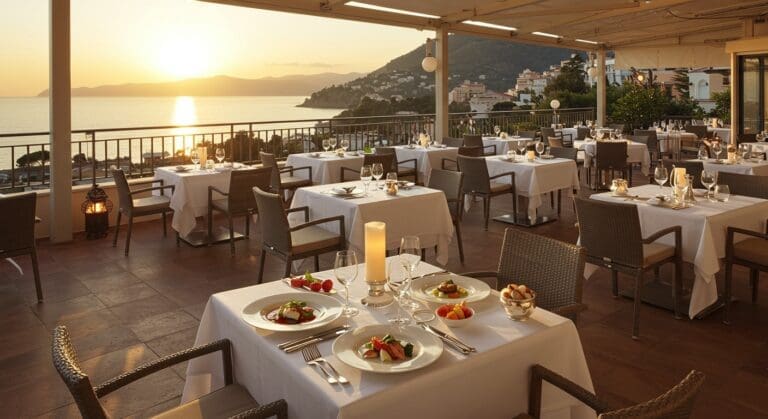
Appagio, within the Nido Hotel, presents a third distinct take on high-end Corfiot dining. Chef Sotiris Evangelou’s menu reads as a meditation on the island’s culinary heritage – classical in its bones, contemporary in its execution. The al fresco terrace, looking out across the Ionian toward the Albanian mountains, shifts from brilliant blue to hammered gold as evening settles. The food, wisely, keeps pace with the view.
Where the Locals Eat
Step away from the formal dining rooms and Corfu reveals a casual food culture of considerable charm. The island has its own distinct culinary identity – sofrito (veal in white wine sauce with garlic), pastitsada (slow-braised meat with spiced tomato sauce over pasta), bourdeto (white fish in fiery red pepper sauce) – that owes as much to centuries of Venetian influence as it does to the Greek mainland. You’ll find these dishes done properly in the unfussy tavernas of villages like Agios Markos, Doukades, and Lakones, where the menus are handwritten, the house wine comes in jugs, and no one is in a hurry about anything at all.
In Corfu Town itself, the market streets around the Liston – the elegant arcaded promenade modelled on Paris’s Rue de Rivoli, which tells you everything you need to know about the island’s aspirations – offer excellent produce shopping. Look for local kumquat liqueur (Corfu’s most singular export), thyme honey from the interior hills, and olive oil that will ruin you for the supermarket variety permanently.
Hidden Gems Worth Seeking Out
Agni Bay, on the north-east coast, is one of those places that reveals itself slowly. There’s no beach to speak of – just a small wooden jetty, a handful of boats, and three restaurants that have been feeding visitors and locals for decades. Of these, Toula’s Seaside is the one to seek out. Mrs. Toula has been running her kitchen since 1981, and her bianco – white fish poached with garlic, lemon, and potato in a broth so clean it almost seems implausible – is one of those dishes people mention unprompted years after eating it. The catch is daily. The setting is precisely as good as it sounds.
Up in the hills above Nisaki, Terra Corfiata offers something different again: hillside views over the north-east coast’s extraordinary blue-green water, a menu that leans into local tradition, and the particular pleasure of having found somewhere that most visitors have not. The drive up is worth the mild anxiety it produces.
The Coastline: Forty Shades of the Same Extraordinary Blue
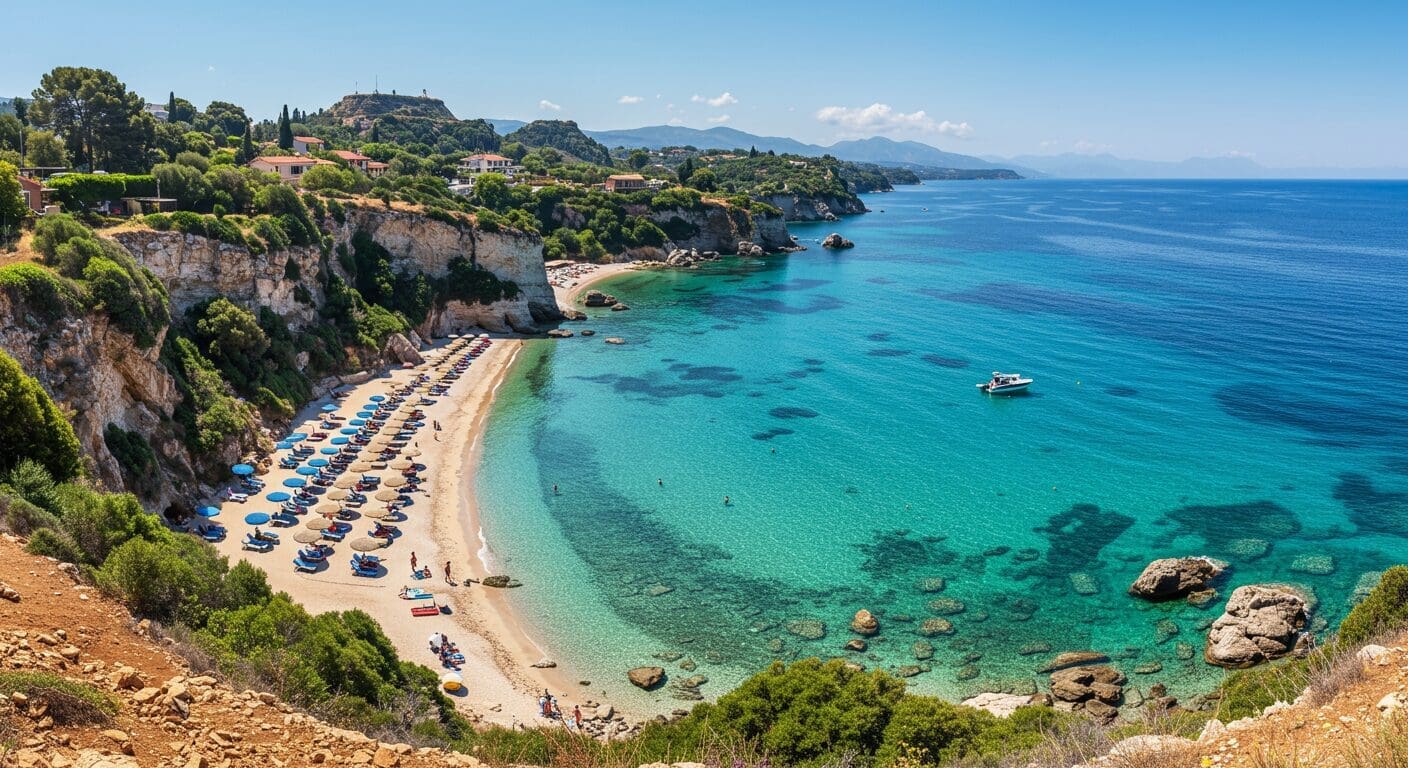
Corfu’s coastline is deeply varied – which is to say that the island doesn’t just have one character but approximately fifteen, depending on which direction you’re facing and what time of day it is. The north-east is the most celebrated, and justifiably so: this stretch from Kassiopi down through Kalami, Kouloura, and Agni is the Corfu of postcards, of literary pilgrimages, of people who rent the same villa for the fourteenth consecutive summer because they cannot quite bring themselves to try anywhere else. The water here is extraordinary – clear and deep, the kind of turquoise that seems computationally implausible. Kalami is where Lawrence Durrell wrote Prospero’s Cell, in a white house directly on the bay that you can still rent. Whether or not you’re a Durrell devotee, the bay itself justifies the visit.
The north coast has a different energy altogether. Sidari offers the curious Canal d’Amour – a series of sandstone formations through which couples are reportedly meant to swim together to ensure lasting love. The geology is genuinely impressive. The romantic mythology is charming in an entirely unsubstantiated way. Further west, Agios Georgios Pagon and Arillas face the open Ionian and catch extraordinary sunsets, the sky doing increasingly theatrical things over the Albanian mountains as the light fades.
The west coast is wilder – cliffs, dramatic drops, wide sandy beaches at Glyfada and Agios Gordios that attract a younger crowd and more persistent wind. Paleokastritsa, perhaps the island’s most famous coastal spot, sits in a series of small bays beneath a Venetian monastery and manages to remain beautiful despite the tour buses. Arrive early or late and you’ll see why people have been coming here since the nineteenth century.
The south is calmer and less visited – Kavos at the very tip is best left to those who consider a sticky floor a feature rather than a bug, but the beaches around Agios Georgios Argyradon and Marathias are wide, quiet, and offer the particular pleasure of uncrowded sand in high season, which on Corfu is something to be genuinely valued.
Things to Do in Corfu: Beyond the Sunlounger
Corfu Town is the cultural centrepiece and demands proper time – not an hour between lunch and the boat, but a proper half-day at minimum. The Old Town is a UNESCO World Heritage Site and earns that designation honestly: a layered cityscape of Venetian, French, and British architecture that reflects four centuries of occupation with remarkable equanimity. The two Venetian fortresses – the Old and New, Palaio and Neo Frourio – are genuinely worth climbing, both for the history and for the views across the Ionian toward the Greek mainland and the mountains of Epirus.
The Achilleion Palace, built in the 1890s by Empress Elisabeth of Austria and later acquired by Kaiser Wilhelm II, sits in the hills above Gastouri and offers a window into the kind of grand imperial excess that seems simultaneously fascinating and completely exhausting. The gardens are lovely. The statue of the Dying Achilles, bronze and melodramatic, is somehow the most nineteenth-century object you will ever encounter.
Day trips by boat to the Diapontia Islands – Othoni, Erikoussa, and Mathraki – are among the most underused options on the island. These small islands off the north-west tip of Corfu are so quiet and so unchanged that spending an afternoon there feels like a minor act of time travel. Organised excursions run from several north coast harbours.
For those who prefer their culture served with wine, the local kumquat distilleries welcome visitors, and the olive presses around Lefkimmi operate seasonally. The Corfu Reading Society, founded in 1836 and the oldest in Greece, has a library collection and occasional events that sit at the more esoteric end of island activity – but if you’re curious, they are extraordinarily welcoming.
Adventure on the Water and in the Hills: For Those Who Can’t Sit Still
The Ionian Sea is a sailing paradise, and Corfu sits at its northern gateway. Flotilla sailing – joining a loosely affiliated group of boats moving between anchorages – operates extensively from Gouvia Marina, which is well-equipped and well-positioned for exploring the surrounding islands. Kefalonia and Zakynthos are both accessible for longer passages, and the combination of reliable summer winds and sheltered anchorages makes this stretch of water genuinely forgiving for less experienced sailors. Private yacht charters – crewed or bareboat – can be arranged through several operators on the island and represent one of the finer ways to spend a week in this part of the world.
Diving around Corfu is rewarding without being world-class: the visibility is good, the sea life is varied, and there are several wrecks of varying vintage in accessible depths. PADI courses are available at multiple centres, and the sheltered bays of the north-east provide excellent conditions for beginners. Sea kayaking along the north-east coastline, through sea caves and around headlands, is among the most satisfying active pursuits on offer – the perspective from water level reveals coves and cliff faces that no road reaches.
The interior, largely ignored by visitors who came specifically for the coast, has a network of walking and cycling trails through olive groves and hill villages that provides a genuinely different experience of the island. The Corfu Trail – a 220-kilometre route crossing the island from north to south – exists for those who want to take their hiking seriously. The rest of us can walk sections of it and feel appropriately virtuous. The hills around Troumbeta Pass offer mountain biking terrain that surprises people who weren’t expecting any elevation. Horse riding through the olive groves of the interior is organised from several centres and is particularly good in the early morning, before the heat establishes itself.
Corfu with Children: The Holiday Where Everyone Actually Relaxes
Corfu is genuinely excellent for families, which is partly to do with the island itself and partly to do with the particular freedom that comes from having your own private space rather than navigating a hotel with three children and their accumulated equipment. A luxury villa in Corfu with a private pool removes the daily negotiation of beach logistics entirely. Breakfast happens when it happens. The pool is available when someone decides they want it. The schedule, mercifully, belongs to the family rather than the resort.
The island has several features that make it specifically good for children beyond the obvious presence of warm, clear water. The beaches of the north – Roda, Acharavi, and Agios Stefanos in particular – are sandy and shallow, with calm conditions and shallow entry that suits younger swimmers. The Waterpark at Aqualand in Agios Ioannis is one of the largest in Greece and can absorb an entire day with considerable enthusiasm. Corfu Town, with its forts, its narrow Venetian lanes, its horse-drawn carriages on the Spianada, has the capacity to make history feel like an adventure rather than education, which is arguably the best educational outcome anyway.
Multi-generational trips – the grandparents, the parents, the children, the chaos – work particularly well in a large private villa where different generations can have their own space, their own rhythm, and a shared terrace for the evening. The domestic staff option, available with many premium villa rentals, means that someone other than the parents is handling the practicalities. This is worth considerably more than it might initially appear.
The Weight of History: What Corfu Has Seen and What It’s Kept
Corfu’s history is, to put it diplomatically, eventful. The island has been ruled at various points by the Byzantines, the Normans, the Angevins, the Despotate of Epirus, the Venetians (for four centuries, the longest and most formative occupation), the French, and the British, before joining the Greek state in 1864. Each has left something behind. The Venetians left the fortresses, the aristocratic architecture, the olive trees they made obligatory to plant, and a culinary influence still visible on every menu. The French left the Liston arcade and a brief enthusiasm for Napoleonic urban planning. The British left cricket – there is still a functioning cricket ground on the Spianada in Corfu Town, the only one in Greece, which tells you everything about the British colonial impulse and its extraordinary capacity for self-replication.
The Museum of Asian Art in the Palace of St. Michael and St. George is an unexpectedly distinguished collection – one of the finest of its kind in Europe, accumulated largely through private donation, housed in the Regency-era palace built during the British Protectorate. The Byzantine Museum, in the church of Our Lady of Antivouniotissa, contains icons and ecclesiastical artefacts spanning the fifteenth to nineteenth centuries, displayed with genuine care in a beautiful medieval building.
The Easter celebrations in Corfu Town are among the most singular festivals in Greece – Orthodox Easter here involves the ceremonial smashing of clay pots from balconies on Holy Saturday morning (the tradition’s exact origins are debated, but it is executed with remarkable enthusiasm), and a candlelit procession of extraordinary atmosphere. If your dates align, this is worth building a trip around.
Shopping in Corfu: What to Take Home and What to Leave
Corfu Town’s shopping is concentrated in a relatively compact area and rewards slow exploration. The streets around the Old Town offer a range of craft and local produce shops that sit well above the usual souvenir register. Kumquat products – the small citrus fruit introduced to the island in the nineteenth century and now grown nowhere else in Europe – come in liqueur, marmalade, crystallised, and chocolate-dipped form, and all of them make excellent gifts. The olive oil from Corfiot producers deserves serious attention: some estates offer tasting and direct purchase, which is the most satisfying method if you can manage the logistics of getting large bottles home.
Gold and silver jewellery in Greek design is well-executed in several Corfu Town shops. Leather goods, linen, ceramics in local styles, and handwoven textiles can be found in the lanes of the Campiello – the oldest part of the medieval town, where the streets become narrow enough to make navigation genuinely interesting.
For food shopping, the central market on Dessilas Street offers local cheese, honey, preserved meats, and seasonal produce at prices that reflect the fact that this is where people actually shop, not where tourists are expected to. This distinction is worth keeping in mind.
The Practical Things: When to Go, What to Know, and How to Behave
The best time to visit Corfu depends largely on what you’re after. July and August are peak season: the island is busy, the water is at its warmest (around 26°C), and the social scene in the north-east coves reaches something approaching a sustained elegance. Book everything – villas, restaurants, boat trips – well in advance. May, June, and September are frequently better for those who want the warmth without the density: the sea is perfectly swimmable from late May, the olive groves are at their most atmospheric in September’s softer light, and restaurants are easier to book without a three-week lead time. October remains warm enough for outdoor dining and is particularly beautiful as the island quietens. April is increasingly popular with walkers and cyclists. The island is essentially dormant from November to March, with most tourism infrastructure closed – though the town itself continues and has its own particular quality in winter.
Currency is the euro. English is widely spoken in tourist areas, though making any attempt at Greek – even a handful of words – is met with a warmth that is entirely genuine rather than performative. Tipping is customary but not at the levels expected in the United States: five to ten percent in restaurants is appropriate; rounding up in taxis is the norm. Dress modestly when visiting churches and monasteries – this is both courteous and actually required at many sites. Tap water in Corfu Town is drinkable; elsewhere, bottled water is standard.
Safety is not a significant concern. Corfu is among the safer island destinations in the Mediterranean, and the primary hazards are of the entirely manageable variety: uneven cobblestones in the Old Town, overenthusiastic sun exposure, and the road through Paleokastritsa on a busy afternoon. Drive carefully and remember that some of the hairpin bends in the north were engineered in a more confident era.
Why a Private Luxury Villa in Corfu Changes Everything
There is a fundamental difference between staying in Corfu and experiencing it, and a private villa is most of that difference. Hotels on this island range from perfectly adequate to very good, but they share a common limitation: they are, structurally, someone else’s space into which you have been temporarily admitted. A private luxury villa inverts this arrangement entirely. The space is yours. The terrace, the pool, the view, the evening – yours. This is not a minor distinction.
For families, the mathematics are persuasive. A well-chosen villa with its own pool, a fully equipped kitchen, multiple living areas, and a private garden removes the constraints that hotels impose – the shared pool schedule, the restaurant meal times, the perpetual proximity to other people’s children and opinions. Parents who have spent a week in a luxury villa with a private pool will tell you, with the quiet certainty of the converted, that they cannot imagine doing it any other way.
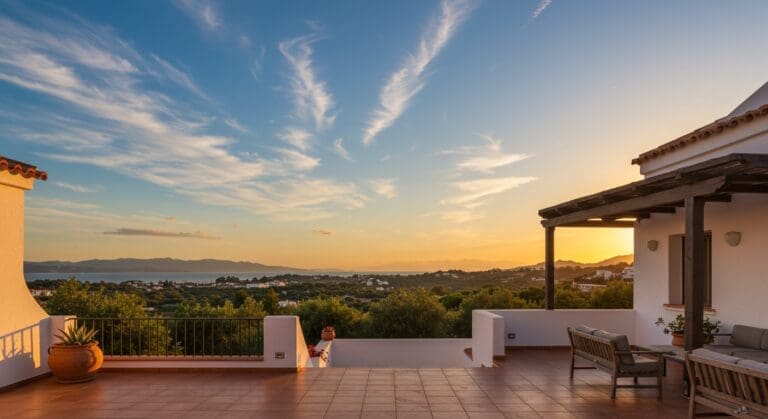
For couples, the privacy is of a different kind: the ability to have breakfast on a terrace overlooking the sea without an audience, to come and go without the performance of hotel lobbies, to feel that the island is, for this particular week, something approximating yours. Many of Corfu’s finest villas sit on the north-east coast, in positions that would be described as commanding if that word weren’t so overused, overlooking the precise stretch of turquoise water that makes the island’s reputation.
Groups of friends – particularly those organising milestone celebrations, reunion trips, or simply the annual gathering that has somehow been deferred for three years – find that a large villa with outdoor dining space, multiple bedrooms, and a well-equipped kitchen resolves the logistics that can otherwise undermine a group trip. A private chef service, available through most luxury villa concierge programmes, means that the evening meal becomes an event rather than a negotiation.
For remote workers, the picture has improved considerably. Connectivity in Corfu’s villa market has genuinely developed, with many premium properties offering fibre broadband and some running Starlink for properties in more remote locations. The time zone (EEST, two hours ahead of GMT in summer) suits those working with European clients particularly well. Working from a private terrace with an Ionian view is, on balance, preferable to a glass-walled office in Farringdon. This is not a controversial position.
Wellness-minded guests find that a luxury villa provides what spas charge considerable amounts to recreate: stillness, space, access to natural light, the rhythm of days organised around personal preference rather than schedule. Add a villa with an infinity pool, a gym space, and access to the island’s walking trails and coastline, and the infrastructure for a genuine restorative week is in place before you’ve made a single booking.
Excellence Luxury Villas offers a carefully curated collection of luxury villas in Corfu with private pool – from intimate north-east coast retreats to grand estate properties suited to large groups and multi-generational families, each selected with the understanding that where you stay is not a footnote to a holiday but the thing that determines how it feels.
More Corfu Travel Guides
- Best Restaurants in Corfu: Fine Dining, Local Gems & Where to Eat
- Best Beaches in Corfu: Hidden Coves, Beach Clubs & Coastal Secrets
- Corfu with Kids: The Ultimate Family Holiday Guide
- Best Time to Visit Corfu: Month by Month Weather, Crowds & Tips
- Corfu Luxury Itinerary: The Perfect 7-Day Guide
- Romantic Corfu: The Ultimate Couples & Honeymoon Guide
What is the best time to visit Corfu?
May, June, and September offer the most rewarding balance of warm weather, swimmable seas, and manageable visitor numbers. July and August are peak season – the water is at its warmest and the north-east coast is at its most social, but villas, restaurants, and boats should be booked well in advance. October remains warm enough for outdoor dining and has a particular atmospheric quality as the island quietens. April suits walkers and cyclists who prioritise landscape over swimming. December through March, most of the tourism infrastructure is closed.
How do I get to Corfu?
Corfu International Airport (Ioannis Kapodistrias) receives direct flights from most major UK and European cities throughout the summer season, with operators including British Airways, easyJet, Jet2, and TUI. From London, flying time is approximately three hours. Year-round connections operate from Athens with Olympic Air and Sky Express. Ferry services run from Brindisi, Ancona, and Venice on the Italian Adriatic coast for those approaching overland. Once on the island, a hire car is the most practical way to get around, particularly for reaching villas and beaches in the north and north-east.
Is Corfu good for families?
Corfu is genuinely excellent for families. The island offers a wide range of family-friendly beaches – particularly the calm, shallow shores of the north coast at Roda, Acharavi, and Agios Stefanos – alongside Aqualand waterpark, Corfu Town’s forts and historic lanes, boat trips to nearby islands, and calm Ionian waters ideal for young swimmers. Private luxury villas with pools remove the constraints of hotel schedules entirely, and larger properties accommodate multi-generational groups with separate living areas for different generations. Domestic staff and private chef services, available through premium villa rentals, make a significant practical difference for families with young children.
Why rent a luxury villa in Corfu?
A private luxury villa provides something no hotel can replicate: genuine privacy, space calibrated to your group, and a daily rhythm that belongs entirely to you. For families, the private pool alone transforms the holiday – no negotiating sun loungers, no shared facilities, no schedule imposed from outside. For couples, it means a terrace overlooking the Ionian Sea with no audience. For groups, it means a communal dining space, multiple bedrooms, and the option of a private chef making the evening meal an event in itself. The staff-to-guest ratio in a well-staffed villa consistently exceeds what any hotel offers, and the overall cost per person for a group is frequently comparable to or less than equivalent hotel accommodation.
Are there private villas in Corfu suitable for large groups or multi-generational families?
Yes – Corfu’s villa market includes a substantial number of large properties specifically suited to groups and multi-generational families. These range from six-bedroom estate villas with multiple private pools to larger compounds with separate guest wings, each with their own living areas and bathrooms. Many include outdoor dining terraces, fully equipped kitchens, games areas, and landscaped gardens. Private chef, housekeeping, and concierge services can be arranged to ensure that large-group practicalities are managed without anyone having to take charge. Excellence Luxury Villas can advise on the most suitable properties based on group size, composition, and preferred location.
Can I find a luxury villa in Corfu with good internet for remote working?
Connectivity in Corfu’s luxury villa market has improved significantly. Many premium properties now offer fibre broadband with speeds sufficient for video conferencing, large file transfers, and sustained remote work. In more rural or coastal locations where standard infrastructure is limited, a number of villas have installed Starlink satellite internet, which provides reliable high-speed connectivity regardless of location. When enquiring about a villa, it is worth confirming connection type and speed – Excellence Luxury Villas can provide this information as part of the selection process. The island’s time zone (two hours ahead of GMT in summer) suits those working with European clients particularly well.
What makes Corfu a good destination for a wellness retreat?
Corfu’s particular combination of landscape, light, and pace makes it naturally conducive to the kind of reset that dedicated wellness retreats sell at considerable expense. The island has extensive walking and hiking trails through olive groves and hill villages, calm Ionian waters ideal for sea swimming and kayaking, and a general quality of unhurriedness that does its own restorative work. Private villas with infinity pools, gym facilities, and outdoor yoga spaces provide the physical infrastructure for a wellness-focused stay. Several operators on the island offer yoga retreats, guided meditation walks, and therapeutic massage services that can be arranged in-villa. The diet – fresh seafood, local olive oil, abundant vegetables, the odd glass of excellent Greek wine – completes the picture in the most agreeable way possible.