District 1 Travel Guide: Best Restaurants, Culture & Luxury Villas
There are cities that overwhelm you on arrival and cities that seduce you slowly. District 1, the beating commercial and cultural heart of Ho Chi Minh City, manages something rarer still: it does both simultaneously. Paris has its grandeur, Tokyo has its precision, but neither city can replicate the particular sensory cocktail that hits you the moment you step onto Dong Khoi Street – the smell of pho broth drifting from a ground-floor kitchen, a Michelin-starred restaurant on the fifth floor above it, a French colonial facade peeling gracefully in the heat, and forty motorbikes threading past in what appears to be a carefully choreographed performance but is, in fact, just Tuesday. District 1 is the kind of place that makes you feel immediately, unreasonably alive. Which is either very exciting or very alarming, depending on how much sleep you got on the flight.
Who comes here and falls completely in love? Couples marking milestone anniversaries, drawn by the romance of candlelit rooftop restaurants and the city’s extraordinary energy after dark. Groups of friends who want a shared adventure that feels genuinely different – something with edge, history, and enough excellent food to sustain passionate argument about where to eat next. Remote workers who have discovered that Ho Chi Minh City’s digital infrastructure is, frankly, better than most European capitals, and that working from a beautifully appointed private villa in District 1 beats a co-working space in almost every conceivable way. Families seeking privacy and space away from hotel corridors will find that a private villa unlocks a version of the city that’s completely on their own terms. And wellness-focused travellers who understand that Vietnamese cooking – fragrant, herb-laden, light in ways that feel genuinely restorative – is its own kind of therapy.
Landing in Saigon: Getting Here Without the Faff
Ho Chi Minh City is served by Tan Son Nhat International Airport, which sits roughly 7 kilometres from District 1 – close enough that on a good run you can be in your villa within 20 minutes of clearing customs. On a bad run, with city traffic doing its thing, allow 45. The airport handles direct long-haul routes from many European hubs, with connections through the major Asian aviation centres – Singapore, Bangkok, Kuala Lumpur, Hong Kong – making it comfortably reachable from most of the world within a day’s travel.
Getting from the airport into District 1 is straightforward. Pre-booked private transfers are the smooth choice – your driver meets you in arrivals, your luggage disappears into the car, and you arrive without having negotiated anything. Grab and Gojek (Southeast Asia’s answer to Uber and its enthusiastic sibling) work reliably from the airport and throughout the city, and the metered airport taxis are legitimate. The main practical point: agree fares in advance or insist on the meter, and you’ll be fine. Once in District 1, Grab is the default mode for most visitors, supplemented by the satisfying chaos of xe om motorbike taxis for shorter hops. Walking is genuinely viable for the central core – the Dong Khoi corridor, the riverside, Ben Thanh Market – though crossing the road requires a particular Zen mindset. The trick, locals will tell you, is to walk slowly and steadily and trust the flow to route around you. It works. Do not run.
A City That Takes Eating Extremely Seriously
Fine Dining
Ho Chi Minh City arrived in the Michelin universe relatively recently but made itself immediately comfortable there. District 1 is where the city’s most ambitious restaurants have chosen to plant their flags, and the results are worth serious attention.
Anan Saigon, on Ton That Dam Street, holds the distinction of being the first restaurant in Ho Chi Minh City to receive a Michelin star – a milestone that surprised nobody who had eaten there and absolutely everyone who thought Vietnamese fine dining couldn’t exist outside of a lemongrass-and-spring-roll template. Chef Peter Cuong Franklin’s approach is to take the city’s street food DNA – the vendors, the alleys, the broth that has been simmering since before you were born – and reimagine it through a contemporary lens without losing any of the soul. The result is one of those rare restaurants where the tasting menu feels like a love letter to a place rather than a performance for its own sake. Book ahead. Several weeks ahead if you can manage it.
The Royal Pavilion, on the fourth floor of the Times Square Building, earned its first Michelin star in 2024. The dining room is a lavish affair – jade stonework, traditional gold-leaf Chinese murals, the kind of ornate interior that makes you sit up slightly straighter without quite knowing why. The Cantonese cooking is meticulous and the dim sum deserves its reputation. For a long, celebratory lunch, this is one of the finest tables in the city.
Sorae, on the 51st floor of the Bitexco Financial Tower, takes a different approach to altitude – using it purely for the view, which is one of those panoramas that makes a city suddenly make spatial sense. The Japanese menu specialises in sushi, sashimi, and grilled dishes, with an extensive sake collection for those who wish to conduct a thorough personal audit. The combination of premium Japanese technique and that sky-high perspective over Ho Chi Minh City at night is, in the very best sense, absurdly good.
Where the Locals Eat
The most important thing to understand about eating in District 1 is that price is not a reliable indicator of quality. Some of the most satisfying meals happen on plastic stools at street level, with a bowl of something deeply, complexly flavoured arriving in three minutes flat. The streets around Ben Thanh Market are the obvious starting point – noodle soups, bánh mì vendors, bun bo Hue, the clattering sociability of a Saigonese breakfast rush. Arrive early. The locals eat breakfast at hours that feel personally confrontational.
The Secret Garden Restaurant on Pasteur Street is something of a local institution. You find it by climbing several flights of stairs to a rooftop that feels entirely removed from the city below – wooden furniture, hanging lanterns, sprawling greenery, the nostalgic aesthetic of a Vietnamese countryside home somehow transplanted above the District 1 rush. It has accumulated a devoted following for its authentic cooking at prices that make you slightly suspicious, then grateful. The atmosphere on a weekday evening, when it’s full of Saigonese families rather than tourists, is exactly the kind of thing you travel to find.
Hidden Gems Worth Seeking Out
Pho Minh, listed in the Michelin Guide and tucked into a narrow alley off Pasteur Street, has been serving traditional beef noodle soup since 1945. That is not a typo. The broth is made to a recipe that has survived the French departure, the American War, reunification, and the arrival of artisanal coffee shops, and it has lost nothing in the process. Tenderloin, brisket, rich bone broth, fresh herbs – the full expression of a dish that is simultaneously Vietnam’s most democratic and most complex. Their freshly baked pâté chaud, a legacy of French colonial influence that Saigon absorbed and promptly made its own, should not be skipped. The alley will take you ten minutes to find. It is worth every one of them.
How District 1 Actually Works: Neighbourhoods and What to Find Where
District 1 is compact by the standards of a city with Ho Chi Minh City’s sprawl, but it packs an extraordinary variety of character into a relatively small footprint. Understanding its internal geography makes navigation significantly more enjoyable.
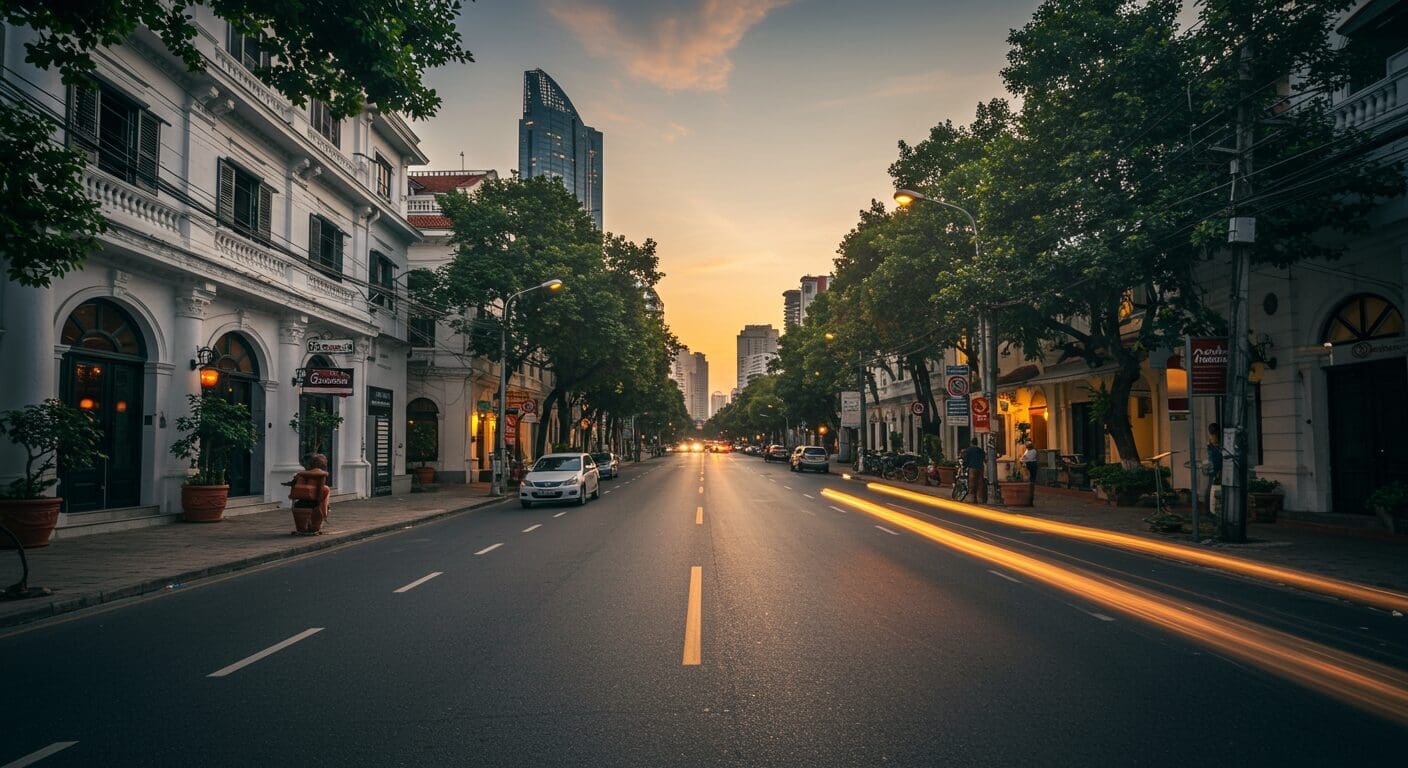
The Dong Khoi corridor is the colonial spine – the grand street that runs from Notre-Dame Cathedral down towards the Saigon River, lined with high-end boutiques, historic hotels, and the kind of architecture that makes you wonder, not for the last time, how the French managed to build something this good and govern so badly. The Continental Hotel and the Hotel Caravelle occupy opposite sides of a square that has witnessed more history than most cities manage in several centuries.
Ben Thanh Market, at the district’s western edge, is the tourist centrepiece – chaotic, colourful, and functioning as a fairly reliable crash course in Vietnamese commerce. The surrounding streets, particularly Bui Vien – known as the backpacker street – offer a different frequency entirely: loud, alive, and operating at a volume that suggests nobody involved has ever heard of an early night. It is excellent for people-watching from a safe distance of one cold beer.
The riverside area along Ton Duc Thang Street has been gradually polished into something approaching a promenade, with the Bitexco Financial Tower – its helipad jutting out at an angle that still looks like an architectural dare rather than a practical necessity – providing the skyline’s most recognisable punctuation mark. The streets immediately west of the river, around Nguyen Hue Walking Street, have become the city’s most photogenic public space: a wide pedestrian boulevard where Saigon dresses up on weekend evenings and the whole city seems to exhale simultaneously.
For a luxury holiday in District 1, the trick is to use these neighbourhoods as chapters rather than a checklist – to spend a morning in one mood and an afternoon in another, letting the city reveal itself at a pace that suits you rather than a tour itinerary.
Things to Do That Are Actually Worth Doing
The War Remnants Museum is non-negotiable. It is not comfortable viewing – it is not designed to be – but it is one of the most significant historical museums in Southeast Asia and it contextualises everything you see in the city around it with a depth that no guide can replicate. Allow two hours minimum and arrive in the morning before the heat becomes an argument against concentration.
The Reunification Palace – the former Presidential Palace, where the tanks rolled through the gate in April 1975 and the war effectively ended – is one of those rare sites where history and architecture combine to produce something genuinely extraordinary. The building has been left almost exactly as it was: the war rooms, the press briefing rooms, the rooftop helicopter pad, the underground bunkers. It feels less like a museum than a very large room in which someone has simply forgotten to update the calendar.
Cooking classes, conducted by local chefs in District 1’s culinary schools or as private experiences arranged through a villa concierge, offer one of the most practical souvenirs a city can give you – the ability to reproduce what you ate when you get home. The pho, the fresh spring rolls, the caramelised ginger fish: all learnable, all transportable. The results at home will be good but never quite right. You will keep trying. That is the whole point.
For evenings, the rooftop bar scene in District 1 is one of the great pleasures of the city. The Saigon skyline at dusk, viewed from altitude with something cold in hand, is the kind of experience that makes you reassess your relationship with cities you thought you already loved.
The Active Side of Saigon: Beyond the Boulevards
District 1 is an urban destination and makes no pretence otherwise – but Ho Chi Minh City and its surrounds offer considerably more active possibility than first appearances suggest. For those whose holidays require a physical component beyond walking to excellent restaurants, there is plenty to organise.
Cycling is increasingly viable within the city – dedicated routes have been developed along the riverside, and guided cycling tours through District 1’s colonial streets and the quieter residential backstreets of neighbouring districts offer a pace of exploration that cuts through the city’s noise rather than competing with it. Early morning rides, before the heat arrives and the traffic builds, are something of a Saigon ritual among those who know.
Day trips from District 1 open up a genuinely different range of activities. The Mekong Delta, reached in roughly two hours by road, offers boat tours through waterways that operate at a pace entirely at odds with the city you left that morning – floating markets, river villages, the particular silence of moving water through dense greenery. Cu Chi Tunnels, northwest of the city, offer a sobering and physically interesting exploration of the underground tunnel network used by Viet Cong forces – the claustrophobic crawl through the passages is, depending on your relationship with confined spaces, either fascinating or firmly not for you.
For those whose idea of adventure extends to open water, the Vietnamese coast is within manageable distance. Mui Ne, approximately four hours northeast, has become a kitesurfing destination of genuine international repute – consistent winds, a long beach, instruction available at multiple levels. Phu Quoc Island, accessible by short flight, adds diving, snorkelling, and white sand to the itinerary. These are natural extensions for a week-plus stay based in District 1.
District 1 With Children: Better Than You Think
Bringing children to Ho Chi Minh City is one of those decisions that looks more complicated in planning than it turns out to be in practice. District 1 is, in fact, extremely well suited to family travel, particularly when home base is a private villa rather than a hotel room that requires you to whisper after 8pm.
Vietnamese culture is openly, warmly child-friendly in a way that doesn’t require management or apology. Children in restaurants are simply part of the scenery, welcomed rather than merely tolerated. The food – fresh, varied, not aggressively spiced at the levels children typically resist – is accessible to younger palates far more easily than many Southeast Asian cuisines.
The Saigon Zoo and Botanical Garden, within easy reach of District 1, provides the reliable appeal that zoos have provided to families across generations. The interactive cultural experiences – cooking classes, cyclo tours through the historic streets, visits to traditional craft workshops – engage children in the destination in ways that a pool afternoon, however enjoyable, simply doesn’t. The War Remnants Museum should be assessed carefully against the ages and temperaments of children in the party; for older teenagers it can be genuinely formative, for younger children the content is challenging.
The private villa advantage for families travelling to District 1 is the one that hotels can never quite replicate: space to breathe, a private pool for the afternoon energy release that every family holiday requires around day three, and the ability to feed children at 6pm without coordinating with a dining room that doesn’t open until 7. The logistics of family travel simplify considerably when you are operating from your own private space rather than shared hotel infrastructure.
The Weight of History: Culture and Architecture in District 1
Ho Chi Minh City is one of those rare places where the 20th century is not yet history – it is memory, for enough people that the distinction matters. Walking District 1 is walking through layers of the most consequential recent history in Southeast Asia, written into the architecture, the street names, the very layout of a city that has been renamed, reimagined, and rebuilt without ever quite losing the traces of what came before.
The Notre-Dame Cathedral Basilica of Saigon, on Cong Xa Paris Street, stands as the most visibly dramatic piece of French colonial ambition in the city. Built with materials shipped from Marseille after France seized Saigon in 1859, it is an exercise in Romanesque architecture transplanted to the tropics with apparently no irony whatsoever. The twin bell towers, the red brick facade, the prominent statue of Our Lady of Peace in the square before it – the whole ensemble creates a moment of visual dissonance that somehow resolves into something genuinely beautiful. The cathedral is currently undergoing restoration works; it remains a landmark worth seeing in any state.
The Central Post Office on Paris Square, designed by Gustave Eiffel’s office and completed in 1891, is another colonial set piece – the vaulted interior, the period map murals on the walls, the portrait of Ho Chi Minh presiding over the stamp-buyers below. It is still a functioning post office, which gives it a quality of ordinary life that more conventional museums lack. Send a postcard. The recipient will be bewildered and quietly pleased.
The contemporary cultural life of District 1 runs alongside this historical weight rather than competing with it. The city’s gallery scene has grown considerably, particularly around the District 3 border area, with Vietnamese contemporary artists producing work that engages seriously with questions of identity, memory, and rapid modernisation. The Opera House on Lam Son Square hosts performances ranging from traditional Vietnamese music and theatre to international touring productions, in a building of spectacular colonial grandeur that was built in 1897 and has been fighting above its weight ever since.
Shopping in District 1: What to Buy and Where to Find It
District 1 contains multitudes when it comes to shopping – from the sensory intensity of Ben Thanh Market to the air-conditioned calm of the Dong Khoi luxury boutiques, with several extremely worthwhile stops in between.
Ben Thanh Market itself is the city’s most famous retail destination and the place where the phrase “fixed price” has the loosest possible meaning. Ao dai fabric, lacquerware, silk, handicrafts, coffee, spices, dried goods – it is all here, in quantities sufficient to suggest that the city’s entire productive capacity is funnelled into this single building. Bargaining is expected, good-humoured, and actually enjoyable once you surrender to the format. Arrive knowing what you want to pay and remembering that the difference between your first offer and their first offer is a ritual rather than a disagreement.
For more refined browsing, the Dong Khoi corridor and the streets immediately surrounding it house the better end of the shopping offer – established Vietnamese fashion designers with boutiques that wouldn’t look out of place in any major city, lacquerware and furniture galleries, jewellery studios working with Vietnamese gemstones, silk tailors who can produce something wearable within 48 hours if you can provide the reference and the fitting time. The Saigon Centre and Vincom Center on Le Thanh Ton Street offer familiar international retail alongside strong Vietnamese brand representation for those who prefer their shopping to involve escalators.
The best things to bring home from District 1 tend to be the ones with a story attached: a tailored piece made on Dong Khoi, a bag of single-origin Vietnamese coffee from a specialist roaster, a lacquer painting from a studio on Le Loi Street. The mass-market tourist items are fine for what they are. The things worth carrying home are the ones that require five minutes of conversation and occasional measuring tape.
What You Actually Need to Know Before You Go
Vietnam’s currency is the dong (VND), which operates at exchange rates that initially produce numbers so large they seem faintly theatrical – you will be dealing in hundreds of thousands on a daily basis, which requires a brief recalibration period before your brain accepts that 500,000 VND is approximately $20 rather than a significant investment. Cash is still widely used, particularly at street level and in markets; cards are increasingly accepted at restaurants, hotels, and larger shops. ATMs are plentiful in District 1. A small amount of cash on arrival makes the first hours considerably more practical.
The language is Vietnamese – tonal, complex, and not something you will acquire in a week. However, District 1 has a higher density of English speakers than almost anywhere else in the country, and the hospitality sector communicates comfortably in English. Learning a handful of basic phrases – xin chào (hello), cảm ơn (thank you), xin lỗi (sorry/excuse me) – will be received with disproportionate warmth and is worth the five minutes it takes to learn them.
Tipping is not traditionally part of Vietnamese culture but has become increasingly common in tourist-facing establishments. At restaurants, 5-10% is appreciated but not expected; at hotels and for private guided services, tip when the service has genuinely earned it. Nobody will think less of you for not tipping at street food stalls. They will, however, remember you if you are rude about the plastic stool.
The best time to visit District 1 is during the dry season, which runs from December to April. The humidity is lower, the rain is scarce, and the temperatures – high twenties to low thirties Celsius – are warm without being actively aggressive. The wet season from May through November brings afternoon downpours that are heavy but usually short; travelling in this period is entirely viable and often cheaper, with the added advantage of a city that feels rather less crowded. The single period to plan around, rather than into, is Tet – the Vietnamese Lunar New Year, typically in January or February – when much of the city closes down and heads home. The celebration itself is spectacular if you’re there for it; less so if your plan was to eat at your favourite restaurant every day.
Why a Private Villa Changes Everything About This City
Staying in a hotel in District 1 is a perfectly reasonable choice. The city has excellent ones. But a private villa changes the texture of a stay in ways that are immediately apparent and only accumulate as the week progresses. The most obvious difference is space – the ability to spread out, to have a living room that is actually yours, to wake up and take your coffee on a private terrace without negotiating the breakfast room queue at 8am. For groups of friends travelling together, or multi-generational families who need both shared and private space, the villa model is simply more coherent than a cluster of hotel rooms that requires a corridor meeting to agree on where to go next.
Privacy is the other dimension that hotels cannot provide. A private pool means the children are not competing with strangers for sunloungers. A private dining space means you can host the kind of long, unhurried meal that defines the best evenings abroad without anyone hovering with the bill. For couples on milestone trips – an anniversary, a honeymoon, a significant birthday that deserves more than a standard room – the sense of having a beautiful private space entirely to yourselves is worth considerably more than any upgrade a hotel can offer.
The connectivity question, particularly relevant for remote workers, is well answered by Ho Chi Minh City’s excellent digital infrastructure. Fibre broadband is standard in the better properties; luxury villas in District 1 are serviced by reliable high-speed internet that handles video calls, large file transfers, and the general demands of a working day without drama. The city’s combination of an extraordinary food and culture scene with genuinely functional connectivity has made it quietly popular among location-independent professionals who have noticed that working from a villa in Saigon is approximately as practical as working from home, and considerably more interesting.
Wellness amenities in luxury villa rentals across District 1 and its surrounding areas extend well beyond the private pool – though the private pool, in a city of this climate, is not something to dismiss. The better properties include dedicated gym spaces, facilities for in-villa spa treatments, and outdoor areas designed for the kind of morning yoga practice that looks implausible in a hotel room and entirely natural on a shaded private terrace. The food culture of the city, with its emphasis on fresh herbs, light proteins, and cooking that treats vegetables as the point rather than the afterthought, provides a natural complement to any wellness-focused approach to the holiday.
The concierge service available through a well-managed luxury villa rental in District 1 is the detail that transforms good logistics into excellent ones – restaurant reservations at places that are difficult to book, private guides for specific cultural interests, cooking class arrangements, transfers, day trip coordination. The kind of local knowledge that takes years to accumulate, made available from the day you arrive.
For those ready to experience District 1 at its finest, Excellence Luxury Villas offers a curated collection of private luxury rentals in District 1 – properties selected for quality, location, and the particular ability to make a great city feel like yours.
More District 1 Travel Guides
- Best Restaurants in District 1: Fine Dining, Local Gems & Where to Eat
- District 1 Food & Wine Guide: Local Cuisine, Markets & Wine Estates
- District 1 with Kids: The Ultimate Family Holiday Guide
- Best Time to Visit District 1: Month by Month Weather, Crowds & Tips
- District 1 Luxury Itinerary: The Perfect 7-Day Guide
- Romantic District 1: The Ultimate Couples & Honeymoon Guide
What is the best time to visit District 1?
The dry season from December to April is the most comfortable time to visit District 1, with lower humidity, minimal rainfall, and temperatures in the high twenties to low thirties Celsius. January and February can coincide with Tet (Vietnamese Lunar New Year), which is spectacular to witness but brings significant business closures – factor this into your plans. The wet season from May to November is viable for travel, typically cheaper, and brings only afternoon rain showers rather than sustained downpours. November and late April sit on the cusp of both seasons and often offer a good balance of reasonable weather and thinner crowds.
How do I get to District 1?
District 1 is served by Tan Son Nhat International Airport, approximately 7 kilometres from the district centre. Journey time is typically 20 to 45 minutes depending on traffic. Long-haul travellers from Europe and North America generally connect through major Asian hubs – Singapore, Bangkok, Kuala Lumpur, or Hong Kong – with several airlines also operating direct routes. Pre-booked private transfers are the smoothest arrival option; Grab and Gojek operate reliably from the airport and throughout the city. Once in District 1, the central core is walkable, with Grab recommended for longer distances or when the heat makes walking an argument.
Is District 1 good for families?
District 1 is an excellent choice for families, more so than its urban intensity might initially suggest. Vietnamese culture is genuinely child-welcoming, the food is accessible for younger palates, and the range of activities – cooking classes, cultural tours, the Zoo and Botanical Garden, day trips to the Mekong Delta – engages children of most ages meaningfully. The key recommendation for families is to base yourselves in a private villa rather than a hotel: the space, private pool, and flexible mealtimes remove most of the friction that makes city travel with children more complicated than it needs to be. The War Remnants Museum is worth assessing against the ages of children in the party; the content is challenging for younger children.
Why rent a luxury villa in District 1?
A luxury villa in District 1 gives you something a hotel room cannot: genuine private space, on your own schedule, in one of the world’s most stimulating cities. A private pool in Ho Chi Minh City’s climate is not a luxury detail but a practical necessity. The staff ratio in a well-serviced villa – including concierge access for restaurant reservations, private guides, and local arrangements – means the city’s best experiences are significantly easier to access. For groups, couples on milestone trips, or families who need space and flexibility, the villa format transforms the quality of the stay in ways that compound across the week.
Are there private villas in District 1 suitable for large groups or multi-generational families?
Yes. The luxury villa market across Ho Chi Minh City and District 1 includes properties suited to larger parties, with multiple bedrooms, separate living wings that offer privacy within the group, private pools, and dining facilities scaled for larger gatherings. Multi-generational families particularly benefit from villas with ground-floor bedroom access for older guests, pool areas that work across age groups, and staff support that handles the logistical complexity of coordinating a large group in an unfamiliar city. Specific property configurations – number of bedrooms, pool size, indoor-outdoor layout – can be matched to group requirements through Excellence Luxury Villas’ team.
Can I find a luxury villa in District 1 with good internet for remote working?
Ho Chi Minh City has notably strong digital infrastructure by international standards, and the better luxury villas in District 1 are serviced by fibre broadband that handles the demands of a full working day without difficulty. Video calls, large file transfers, and simultaneous use across multiple devices are all standard in well-specified properties. The time zone difference from Europe (typically 6-7 hours ahead) actually suits certain working patterns well – European afternoon meetings falling in Vietnamese evening hours, leaving the full day available for the city. It is one of the more underrated remote-working destinations in Southeast Asia, which means the secret is currently being kept by the people already there.
What makes District 1 a good destination for a wellness retreat?
District 1 supports wellness travel across multiple dimensions. Vietnamese cuisine – herb-rich, light, built around fresh ingredients and restorative broths – is genuinely good for you in ways that feel like pleasure rather than discipline. The city has an established spa culture, with traditional Vietnamese massage and treatment traditions available both at dedicated spa venues throughout District 1 and as in-villa services arranged through your property’s concierge. Luxury villas with private pools, garden spaces, and gym facilities provide the infrastructure for a wellness-focused routine that doesn’t require leaving the property. Day trips to the Mekong Delta or the Vietnamese coast add outdoor, active dimensions for those whose wellness extends beyond the treatment table.