Gloucestershire Travel Guide: Where to Stay, Eat & Explore in Luxury
Here is a confession that most travel writers would rather not make: Gloucestershire is not actually in the Cotswolds. Not entirely, anyway. The Cotswolds AONB does spill generously across its eastern border, and yes, those honey-coloured villages are very much part of the story here. But Gloucestershire is considerably stranger and more interesting than its reputation as a backdrop for Sunday supplement photographs suggests. It contains the Forest of Dean – ancient, slightly otherworldly, the kind of place where wild boar genuinely roam and grown adults cycle through the trees with an expression of barely suppressed joy. It contains Cheltenham, which is more cosmopolitan than it has any right to be for a spa town in the English Midlands. It contains the Vale of Gloucester, flat and quietly dramatic, and the Severn – one of Britain’s great rivers, which the county holds close like a secret. The received wisdom about Gloucestershire is that it is quintessentially English and therefore a little predictable. The received wisdom is wrong.
Which is precisely why it works so well for so many different kinds of traveller. Couples marking significant anniversaries find the combination of outstanding restaurants, gloriously private countryside villas and total digital silence to be something close to restorative. Families seeking genuine privacy – a house with a garden, a pool, space for children to be loud without apology – discover that Gloucestershire’s rural spread offers exactly that, without the queues and performance anxiety of more obvious destinations. Groups of friends who want to cook together, walk together and then sit around an enormous table arguing about wine have found their natural habitat. Remote workers who need reliable connectivity alongside an environment that doesn’t feel like an office have increasingly made Gloucestershire their base of operations – high-speed broadband has crept into even the most improbable old rectories. And for those who arrive with a wellness agenda – movement, clean air, good sleep, food made from things that actually grew in a field – the county delivers with a quiet confidence that asks for nothing in return.
How to Actually Get Here (Which is Easier Than the Postcodes Suggest)
Gloucestershire has a minor talent for appearing inaccessible on a map, particularly if you’re staring at a tangle of A-roads through the Cotswolds and wondering whether your hire car insurance covers dry-stone walls. In practice, it is one of the more reachable counties in England. Bristol Airport is the most useful gateway for international visitors – roughly 40 minutes from Cheltenham and serving direct routes from across Europe, the US and beyond. Birmingham Airport sits about an hour to the north and handles a broader spread of long-haul routes. Heathrow remains the default for transatlantic arrivals, at approximately 90 minutes via the M4 – which is optimistic, but not impossible if you avoid Friday afternoons with any seriousness of purpose.
By train, Cheltenham Spa has direct services from London Paddington in around two hours and ten minutes, and is well connected to Bristol, Birmingham and the wider network. It is a very civilised way to arrive, not least because it deposits you directly into the elegant Regency heart of town. Once here, however, a car is close to essential. The county’s greatest pleasures – the Forest of Dean, the high Cotswold escarpment, the Slad Valley, the villages of the north – are scattered across a landscape that public transport treats with only passing interest. Car hire at Bristol or Birmingham airports is efficient, and private chauffeur transfers can be arranged from any of the major airports for groups travelling with luggage and the reasonable expectation of a comfortable start.
Where to Eat: From a 29-Year Michelin Star to a Pub Laurie Lee Called Home
Fine Dining
Cheltenham punches considerably above its weight at the top end of the restaurant world, and has done so with sufficient consistency that it can now wear the achievement without seeming surprised by it. Le Champignon Sauvage has held its Michelin Star for twenty-nine consecutive years – a number that deserves a moment’s quiet reflection. Twenty-nine years. Run by husband-and-wife team David and Helen Everitt-Matthias since the late 1980s, it remains resolutely unpretentious: no theatre, no performance, no foam where foam is not required. Just exceptional French-influenced cooking, handled with the kind of authority that only comes from decades of doing exactly one thing extremely well. If you visit Gloucestershire and do not eat here, you will have made a choice you may need to explain later.
The more recent arrival is Lumière, also in Cheltenham, where Chef Jon and General Manager Helen have assembled something genuinely exciting. A Michelin Star gained – alongside AA Restaurant of the Year for England, three AA Rosettes and a place at number 66 in the SquareMeal UK Top 100 for 2025, making it the only Gloucestershire restaurant in that list. The AA inspector’s summary – “inspiring, cutting-edge cooking with vibrant flavours” – is the kind of line that tends to understate rather than oversell. Bookings are not, it should be noted, casually available. Plan ahead.
Where the Locals Eat
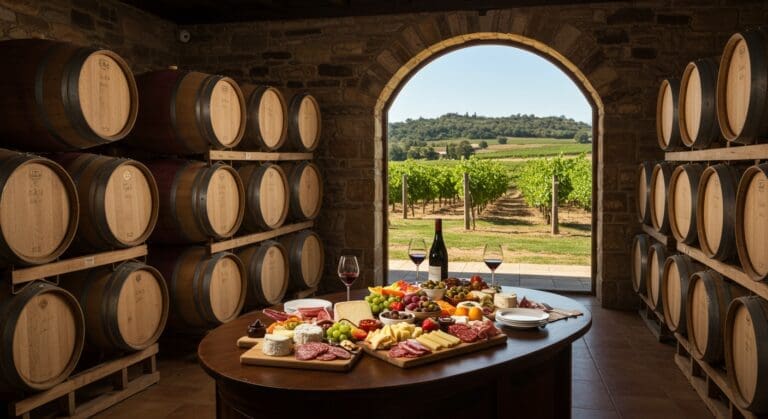
The Ivy Montpellier Brasserie occupies a particularly handsome position on Cheltenham’s Montpellier parade, and the interior – with its circular bar and racing-themed references to the town’s great equestrian obsession – is the sort of room that makes people want to stay for a second drink they hadn’t planned on. Consistently well-reviewed for service and atmosphere, it operates comfortably in that territory between occasion and everyday: reliable enough for a Tuesday lunch, special enough for something that matters. The Horse and Groom at Bourton-on-the-Hill, meanwhile, earned a Michelin Bib Gourmand in 2025 – the guide’s recognition of exceptional quality at accessible prices. A Cotswold pub done properly: dog-friendly, garden-blessed, British menu of sausage and mash and Sunday roasts with “cooking generous in both size and flavour,” as the Guide puts it. The kind of place where you book a table for lunch and realise at four o’clock that you haven’t moved.
Hidden Gems Worth Seeking Out
The Woolpack Inn at Slad, near Stroud, requires a small commitment of navigation and an absence of GPS anxiety, but rewards both generously. Laurie Lee – who wrote Cider with Rosie about the valley it overlooks – drank here, which is either a wonderful piece of literary heritage or a good excuse, depending on your perspective. The view across the Slad Valley is the kind that rewards arriving with time enough to sit and look at it without immediately photographing it. The food has what reviewers describe as “a real Italian twist” and makes use of fresh, seasonal ingredients in the manner of a kitchen that knows what it’s doing. Beyond these, Stroud’s Saturday farmers’ market is one of the best in the country – and that is not hollow praise in a nation that takes its farmers’ markets very seriously indeed. Fresh bread, local cheese, Gloucester Old Spot produce, and the occasional slightly evangelistic conversation about sourdough starter.
Understanding Gloucestershire’s Landscape: It Is Not One Thing
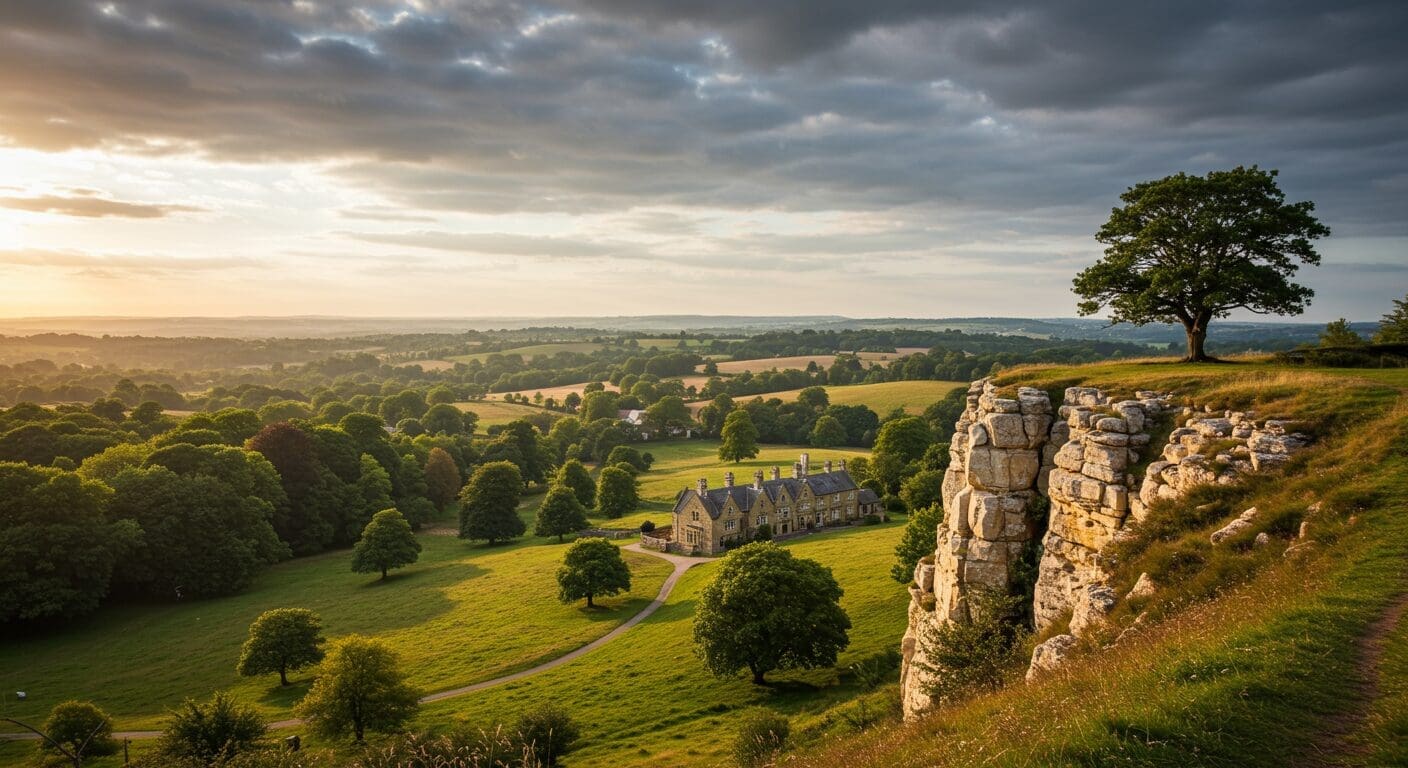
The county’s great virtue, and occasionally its great inconvenience for those who want a single coherent visual identity, is that it refuses to be reducible. The eastern edge rises into the Cotswolds – rolling limestone uplands, wide skies, those villages of warm stone that photographers have been visiting since the 1920s and show no sign of abandoning. Chipping Campden, Bourton-on-the-Water, Stow-on-the-Wold: all here, all genuinely worth the attention they receive, though best experienced on a weekday outside high summer when the ratio of visitors to residents reaches levels that even very polite English people find slightly testing.
Move west and the landscape shifts entirely. The Cotswold escarpment drops into the Vale of Gloucester – wide, agricultural, calm in the way that only genuinely flat land can be. The city of Gloucester sits at its heart, cathedral-crowned and deserving of more visitors than it typically receives. Further west still, the River Severn marks a natural boundary before the land rises again into the Forest of Dean: 110 square kilometres of ancient woodland that has been managed and inhabited since before the Romans arrived and left their various opinions about it. Wild boar were reintroduced here in the early 2000s and have thrived with what one might charitably describe as enthusiasm. The Forest has its own microculture – the Freeminers of Dean still hold ancient rights to mine coal and iron ore, a distinction preserved by a 1838 Act of Parliament that nobody has seen fit to revoke. It is that kind of place.
Between these zones, smaller landscapes assert themselves: the Slad Valley, green and deep and literary; the Golden Valley near Stroud, which earned its name in the medieval wool trade; the Severn Vale wetlands, haunted in the right light and extraordinary for wildlife. A luxury holiday in Gloucestershire is, among other things, an education in the variety that one English county can contain.
What to Do: Walking, Racing, Cheese Rolling and Things in Between
The Cheltenham Festivals are the county’s great recurring occasions. The National Hunt Racing Festival in March – the Cheltenham Festival – is one of the defining events of the British sporting calendar: four days of racing that draws 250,000 people, fills every decent room within thirty miles, and generates an atmosphere unlike anything else in British sport. Tickets and accommodation require planning of the advance variety. The Cheltenham Literature Festival each October is the world’s oldest and has maintained its position as one of the most significant, drawing writers from across the globe for ten days of talks, debates and readings. The Jazz Festival in May and the Music Festival in June complete a calendar that any city three times Cheltenham’s size would be proud of.
Sudeley Castle, near Winchcombe, is a Tudor palace with one of the finest gardens in the region and the additional distinction of being the burial place of Katherine Parr – the last of Henry VIII’s wives, and the one who had the good sense to outlive him, briefly. Berkeley Castle, to the south-west, holds the less comfortable distinction of being where Edward II was murdered in 1327. It is all very English. The Gloucester Cathedral nave is Norman and extraordinary, and the cloisters appeared as Hogwarts corridors in the early Harry Potter films – a fact that can be either acknowledged or tactfully suppressed depending on your companions.
The Cotswold Way – a 102-mile national trail running the length of the escarpment – provides walking of exceptional quality at whatever length you choose to engage with it. Day walks from Cleeve Hill (the highest point in the Cotswolds), or longer sections from Chipping Campden to Bath, with Gloucestershire offering some of the trail’s finest miles. The Forest of Dean has its own network of waymarked trails, sculpture walks and mountain bike routes that make it one of the more quietly remarkable outdoor destinations in southern Britain.
And then there is Cooper’s Hill. Every late May Bank Holiday, competitors hurl themselves down an almost vertical slope in pursuit of a seven-pound wheel of Double Gloucester cheese. This is not metaphorical. It is an entirely real event, unsanctioned by health and safety consensus, and one of the most joyfully absurd traditions in British public life. Spectating is strongly recommended over participation.
Adventure and the Outdoors: More Serious Than You Might Expect
The Forest of Dean has become one of the UK’s leading mountain biking destinations, with Pedalabikeaway and the Forestry England trail network offering routes from gentle family circuits to genuinely technical downhill trails. The Go Ape high ropes course in the Forest provides aerial adventure for those who prefer their adrenaline with harnesses attached. Rock climbing is available at Symonds Yat Rock, on the Wye Valley border, with routes on limestone that attract climbers of varying ambition.
Kayaking and canoe hire on the River Wye – which forms the county’s western boundary before the Severn takes over – provides a day of paddling through one of England’s most unspoilt river gorges, with optional stops at riverside pubs that present themselves at what feels like deliberately convenient intervals. Wild swimming has developed a significant following at various spots along the Cotswold rivers, particularly around the Coln and Windrush valleys, where the water runs clear and cold in ways that either feel exhilarating or extremely ill-advised depending on one’s constitution.
Horse riding through the Cotswolds or the Forest of Dean is available at several centres, and there is something to be said for covering this landscape at a pace that actually allows you to look at it. Hot air ballooning over the Cotswold escarpment at dawn is the kind of experience that risks becoming a cliché but delivers every time, particularly when the autumn mist sits in the valleys and the hilltops emerge above it like islands. Golf is well represented, with Cotswold Hills Golf Club and Cleeve Hill Golf Course offering parkland and downland courses respectively, the latter with views that make concentration on the actual game somewhat challenging.
Gloucestershire for Families: Space, Freedom and Remarkably Little Queuing
The family proposition in Gloucestershire rests on a foundation that hotels cannot provide and holiday parks only approximate: genuine space, private outdoor areas, and the freedom that comes from having a home rather than two adjoining rooms with a connecting door. A luxury villa in the Cotswolds or the Forest of Dean – a large farmhouse with gardens, perhaps a pool, certainly a kitchen worth using – provides the kind of holiday that families with children of varying ages and competing requirements can actually agree was a good idea. Children who need to run have somewhere to run. Teenagers who need Wi-Fi and a degree of separation from their parents have it. Adults who would like to sit outside with a glass of wine after eight o’clock without anyone asking them to keep the noise down are welcome to do exactly that.
The Cotswold Farm Park at Guiting Power was founded by Joe Henson – father of the television presenter Adam – and has been introducing children to rare breeds and agricultural life for decades. It is one of the better rural days out in the county, honest rather than performative, and genuinely educational in the way that children don’t notice. The Cotswold Wildlife Park near Burford offers considerably more exotic company: rhinos, giraffes, red pandas and a narrow-gauge railway that operates with a reliability parents learn to appreciate. Puzzlewood in the Forest of Dean is ancient woodland with a labyrinthine quality that has attracted film crews (Star Wars, Doctor Who, various others) precisely because it looks as though it was designed by someone who had never seen ordinary woodland.
Winchcombe’s Sudeley Castle has adventure playgrounds within the castle grounds, and the combination of Tudor history and outdoor play occupies children across a wider age range than most. For swimming beyond whatever pool your villa provides, there are open-air lidos at Cirencester and Cheltenham – both period pieces in the best sense, and both significantly more pleasant on a warm July afternoon than any indoor alternative.
History, Architecture and Wool: How Gloucestershire Got Rich
The answer, in a single word, is wool. Medieval Gloucestershire was among the wealthiest regions in England because its sheep – particularly on the Cotswold uplands, where the “Cotswold Lion” breed had been producing heavy fleeces since at least the twelfth century – made it so. The money is everywhere visible: in the extraordinary “wool churches” of Chipping Campden, Northleach and Cirencester, where merchants funded naves and towers of architectural ambition that their successors have been maintaining with varying success ever since. Cirencester itself was Roman Corinium – the second largest city in Roman Britain – and the Corinium Museum holds one of the finest collections of Roman mosaic work in the country, displayed with intelligence and without excessive self-congratulation.
Gloucester’s cathedral is Norman at its core, Gothic in its elaborations, and contains the tomb of Edward II, whose murder at Berkeley Castle was sufficiently significant to attract pilgrims and donations that funded much of what you see today. The fan vaulting in the cloisters is among the earliest in England and worth the quiet moment of upward gazing it demands. Tewkesbury Abbey, further north, contains Norman columns of a scale that makes every subsequent visit to similarly described architecture feel slightly disappointing by comparison.
The Regency architecture of Cheltenham – built rapidly in the early nineteenth century when the town’s mineral springs attracted fashionable society and the money it brought – gives the town a coherence and elegance that has survived remarkably well. Montpellier and the Promenade are the set pieces, but the residential streets of Pittville and Bayshill reward genuine wandering. The annual Cheltenham Paint Festival brings contemporary street art to the town each September, which creates the interesting visual effect of enormous murals appearing beside Grade II listed ironwork, and somehow working.
Shopping: Antiques, Wool and Things That Were Made Here
Cheltenham is the obvious starting point for serious shopping, with the independent boutiques of Montpellier and the Suffolks quarter offering a range that puts most equivalently sized towns to shame. Antiques are threaded through the county in ways that reward deviation: Stow-on-the-Wold has an exceptional concentration of dealers along its high street and in surrounding lanes, and prices have softened enough in recent years that browsing with intent is a reasonable activity rather than mere aspiration. Burford, just over the Oxfordshire border but culturally very much of this region, has antique shops of a certain knowing quality and at least one tea room with opinions about scones.
The Cotswold revival in artisan production has yielded some genuinely distinctive things to bring home. Cotswold Woollen Weavers at Filkins has been producing fabric on Victorian power looms since the 1980s, and their throws, rugs and scarves are made to a standard that survives unpacking. Stroud market on Saturday mornings is worth the journey for local cheese alone – Single Gloucester and Double Gloucester both originate here and taste measurably better within the county than they do anywhere else, a phenomenon that has not been scientifically explained but is widely observed. Sloe gin, local honey, Gloucestershire Old Spot charcuterie and artisan pottery complete the picture of a county that has taken the “local produce” imperative and done something coherent with it.
The Practical Information That Actually Matters
Gloucestershire is in the United Kingdom, which means pounds sterling, left-hand driving, and a climate that requires packing both a linen shirt and a waterproof in the same bag without either being a waste of space. The best time to visit depends significantly on what you’re here for. May and June offer the longest evenings, the wildflowers on the escarpment and the fewest visitors relative to the quality of the experience. July and August are warmer but bring peak occupancy to the more visited villages, where the coach-to-resident ratio can become anthropologically interesting. September and October provide arguably the finest conditions: cooler, less crowded, autumn colour arriving in the Forest of Dean and along the Wye Valley, and a quality of golden afternoon light that operates as a form of mild deception about the winter ahead.
The Cheltenham Festival in March fills the county entirely. If you are attending, book everything well in advance. If you are not attending but happen to arrive during it, plan around the traffic with philosophical acceptance. Tipping in restaurants follows the standard UK convention: ten to fifteen percent is customary, service charges increasingly appear on bills, and you are entitled to remove them if service genuinely did not warrant it, though in the establishments listed here this scenario is unlikely to arise. The currency is sterling. English is spoken. The locals are welcoming to visitors who reciprocate the warmth. Mobile signal in the Forest of Dean and the more remote Cotswold valleys can be patchy; treat this as an opportunity rather than an inconvenience.
Why a Private Villa Is the Right Way to Do Gloucestershire
There is a hotel argument to be made for Gloucestershire – several very good ones, in fact, from Cheltenham’s Regency townhouses to converted Cotswold manor hotels with spa facilities and the kind of breakfast buffets that test personal discipline before nine in the morning. But a private luxury villa does something that even the best hotel cannot: it gives you the county on your own terms. A farmhouse on the Cotswold escarpment, a converted barn in the Forest of Dean, a Georgian manor house with walled gardens within reach of Cheltenham – these are not simply places to sleep but the substance of the holiday itself.
For families, the arithmetic of a villa with five or six bedrooms, a private pool and grounds enough for children to conduct their various operations without disturbing anyone makes economic and practical sense that hotels struggle to match. For groups of friends, a large villa with a serious kitchen becomes the natural headquarters: you cook together, eat together, walk out in the morning and return in the evening to a space that is entirely yours. For couples on milestone trips, the seclusion of a rural Cotswolds villa – no corridor noise, no strangers at adjacent tables, no performance of being on holiday in public – creates a quality of privacy that translates directly into the relaxation that such trips are meant to deliver.
Wellness travellers have discovered that the combination of clean Cotswold air, access to walking routes from the door, a private pool for morning lengths and an environment that operates at considerably less velocity than wherever they came from produces results that no structured retreat programme can quite replicate. Remote workers who have tested the proposition report that reliable broadband in quality rural properties, combined with a study or dedicated workspace and the sort of view that makes the three o’clock slump considerably more bearable, creates a working week of unusual quality. Several have returned. Some have begun making enquiries about longer stays.
Excellence Luxury Villas has a carefully curated collection of properties across the county – from contemporary barn conversions with oak frames and underfloor heating to stone manor houses with croquet lawns and orangeries that catch the afternoon light in ways that feel almost deliberate. Browse our full collection of luxury holiday villas in Gloucestershire and find the property that makes this extraordinary county entirely your own.
More Gloucestershire Travel Guides
- Best Restaurants in Gloucestershire: Fine Dining, Local Gems & Where to Eat
- Gloucestershire Food & Wine Guide: Local Cuisine, Markets & Wine Estates
- Gloucestershire with Kids: The Ultimate Family Holiday Guide
- Best Time to Visit Gloucestershire: Month by Month Weather, Crowds & Tips
- Gloucestershire Luxury Itinerary: The Perfect 7-Day Guide
- Romantic Gloucestershire: The Ultimate Couples & Honeymoon Guide
What is the best time to visit Gloucestershire?
May, June, September and October offer the best balance of weather, light and manageable visitor numbers. May and June bring long evenings, wildflowers on the Cotswold escarpment and a freshness to the landscape that July and August crowds tend to obscure. Autumn – particularly September and October – is arguably the finest season of all: the Forest of Dean and Wye Valley turn extraordinary colours, the temperatures are pleasant for walking, and the summer visitors have largely dispersed. The Cheltenham National Hunt Festival in March is essential for racing enthusiasts but books the county out entirely – plan accordingly or plan around it.
How do I get to Gloucestershire?
Bristol Airport is the most convenient gateway for most visitors, sitting approximately 40 minutes from Cheltenham and served by direct routes from across Europe and beyond. Birmingham Airport, around an hour to the north, handles a wider range of long-haul routes. Heathrow is the default for transatlantic arrivals, at roughly 90 minutes by road via the M4. By train, Cheltenham Spa has direct services from London Paddington in approximately two hours ten minutes, and is well connected to Bristol and Birmingham. Once in the county, a car is highly recommended – the best of Gloucestershire is spread across a diverse landscape that public transport visits with limited enthusiasm.
Is Gloucestershire good for families?
Exceptionally so, particularly for families who want space, freedom and variety rather than a resort structure. The county offers a remarkable range of child-friendly activities: the Cotswold Farm Park, Cotswold Wildlife Park, Puzzlewood in the Forest of Dean, Sudeley Castle with adventure playground, and open-air lidos at Cheltenham and Cirencester. Private villa rental is especially well-suited to families – large properties with gardens, private pools and proper kitchens provide the practical infrastructure that makes holidays with children genuinely restful rather than logistically stressful. Younger children and teenagers alike find sufficient to occupy them, which is not something all destinations can honestly claim.
Why rent a luxury villa in Gloucestershire?
A private villa gives you Gloucestershire on entirely your own terms – something hotels, however good, cannot replicate. The privacy is absolute: no corridor traffic, no shared spaces, no performing being-on-holiday in public. The space is genuinely generous: multiple bedrooms, proper reception rooms, kitchens designed for real cooking, gardens or grounds where children can operate freely. The staff-to-guest ratio in premium villa properties – with optional catering, house management and concierge services – frequently exceeds what hotels provide. And in a county whose greatest pleasures are inherently rural and dispersed, having a beautiful private base to return to each evening transforms the experience entirely. A villa is not simply accommodation; it is the holiday itself.
Are there private villas in Gloucestershire suitable for large groups or multi-generational families?
Yes, and this is one of the county’s particular strengths. Gloucestershire has a significant stock of large historic properties – manor houses, farmhouse complexes, converted estate buildings – that comfortably accommodate ten to twenty guests across multiple bedrooms and separate wings. These work exceptionally well for multi-generational families: grandparents, parents and children can share a house while maintaining the degrees of separation that make family harmony possible. Private pools, large dining rooms, separate sitting rooms, grounds for outdoor activities and catering staff who can handle large-group meals are all available within the premium villa market. Excellence Luxury Villas can advise on properties specifically suited to larger parties and particular configuration requirements.
Can I find a luxury villa in Gloucestershire with good internet for remote working?
Increasingly, yes. Reliable high-speed broadband has reached a significant portion of even rural Gloucestershire properties, and premium villa rentals specifically catering to remote workers are equipped with fibre connections, dedicated workspaces and the kind of ergonomic provision that makes a working day genuinely productive. Some more remote properties in the Forest of Dean and the higher Cotswolds have adopted Starlink satellite broadband where terrestrial connections remain limited – download speeds are typically sufficient for video conferencing, cloud working and all standard professional applications. If connectivity is a priority, it is worth confirming speeds with the property manager at booking. In our experience, the quality of the view from the desk more than compensates for any minor technical compromises.
What makes Gloucestershire a good destination for a wellness retreat?
The county operates as a natural reset: clean air, genuine quiet, landscapes designed – entirely by accident – for the kind of slow, attentive movement that wellness professionals have been recommending for years. Walking routes from the door of most rural villas, cold-water swimming in clear Cotswold rivers, cycling through the Forest of Dean and yoga in a barn conversion with floor-to-ceiling countryside views are all readily available. Private villas with pools allow for morning swimming without an audience. Several premium properties include hot tubs, infrared saunas and home gym spaces. Stroud and Cheltenham both have independent wellness practitioners and spa facilities of quality. The pace of Gloucestershire life – which is unhurried by both geography and temperament – does the rest.