Istria County Travel Guide: Where to Stay, Eat & Explore in Luxury
There is a particular hour in Istria – somewhere between the last of the afternoon heat and the moment the crickets decide to make their opinions known – when the air smells of warm stone, wild rosemary, and something you can’t quite place until someone tells you it’s truffle. It’s not subtle. Nothing about Istrian truffle season is subtle. But that smell, drifting down from the oak forests above Motovun as the light goes amber and the hilltop towns glow like something out of a Renaissance painting that hasn’t been discovered yet, is the exact moment you understand why people come here and quietly cancel their plans to leave.
Istria is Europe at its most quietly accomplished. This Croatian peninsula, pointed like a misshapen arrowhead into the northern Adriatic, has been drawing a specific kind of traveller for years – the sort who has done Tuscany, loved it, but would rather not share a piazza with forty tour buses this time around. It suits couples marking significant anniversaries who want candlelit dinners without the performance of it all, and families who’ve graduated from resort holidays to something with space, privacy, a private pool, and a kitchen big enough to actually use. It draws friend groups in their forties who’ve rediscovered the pleasures of cooking together and staying up too late with good wine. Remote workers increasingly find it near-ideal – the infrastructure is better than it has any right to be, the scenery is genuinely restorative, and the pace of life makes the concept of a deadline feel vaguely theoretical. And for anyone serious about wellness – not the Instagram-filter kind, but the real, slow, outdoor, good-food, deep-sleep variety – Istria delivers with very little fuss.
Getting Here Is Half the Pleasure (The Other Half Is the Drive Through the Interior)
The closest major airport to most of Istria is Pula, a compact and perfectly functional airport with direct flights from London, Amsterdam, Frankfurt, Vienna, and a growing number of European cities, particularly in summer. It’s the kind of airport where you collect your luggage and you’re in a rental car within twenty minutes. Nobody has built a second terminal yet. This remains a point in its favour.
Trieste Airport in Italy is a useful alternative, particularly for the northern Istrian towns like Poreč, Rovinj, and Novigrad – it sits just across the border and is often served by budget carriers with competitive pricing. Ljubljana Airport in Slovenia is another option worth checking, especially if you’re heading for the inland hill towns. Zagreb is possible but adds roughly three hours of driving, which is only worth it if you want to explore the Croatian capital en route.
Once you’re here, a hire car is not optional – it’s essential, and you will be glad of it. Istria’s pleasures are distributed: a restaurant in a village of 200 people, a beach only accessible via a gravel track, a hilltop town you passed by accident that turned out to be the highlight of the trip. The roads are generally good, the signage is comprehensible, and driving the inland routes through vineyards and truffle forest between Motovun, Grožnjan, and Oprtalj is one of those journeys where the destination is beside the point. Budget roughly forty-five minutes to two hours from Pula Airport to most luxury villa locations in Istria, depending on where in the county you’re based.
Where to Eat in Istria: A Region That Treats Food as Serious Business
Fine Dining
Istria’s fine dining scene operates with a confidence that’s earned rather than assumed. The region has quietly become one of the most exciting culinary destinations in the Mediterranean, built on a combination of extraordinary local ingredients – white truffles, Malvasia wine, Istrian olive oil, Adriatic seafood, and a culinary tradition that blends Italian, Croatian, and Central European influences into something entirely its own.
The standard-bearer is Restaurant Monte in Rovinj, Croatia’s first Michelin-starred restaurant and still its most compelling argument for the country’s place in any serious food conversation. Perched in the old town in the shadow of the Basilica of Saint Euphemia, Monte offers three, four, and six-course tasting menus constructed from ingredients sourced directly from the local farmer’s market – so what appears on the plate depends, pleasingly, on what was good that morning. Wine pairing is available for those who prefer not to make decisions after a certain point in the evening. Book well ahead. This is not the restaurant you discover spontaneously.
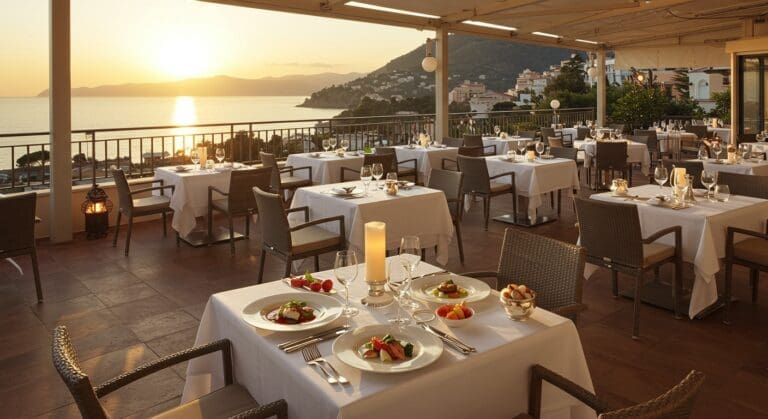
Stancija Meneghetti in the Bale area is a different proposition – a thirty-acre estate of olive groves and vineyards surrounding a white stone mansion, with a fine dining restaurant that changes its menu regularly and pairs food with its own olive oils and wines. Dining on the garden terrace as the sun drops behind the vines is the kind of experience that makes every other dinner feel slightly inadequate by comparison. The estate also produces wine and oil of its own, which helpfully solves the question of what to bring home.
For elevated seafood in the northern part of the county, Damir & Ornella in Novigrad has become a pilgrimage destination for food-focused travellers. The restaurant’s reputation for creative, refined Mediterranean-inspired seafood – think sashimi sensibility applied to Adriatic fish – has spread well beyond Croatia’s borders. It requires advance reservations and repays them handsomely.
Where the Locals Eat
Away from the Michelin circuit, Istrian dining is generous, unfussy, and anchored in the seasons. Konobas – traditional Croatian taverns, usually family-run – are the backbone of everyday eating here, and the best ones serve dishes that haven’t changed in decades because nobody has found a reason to improve them. Fuži pasta with truffle. Maneštra, a thick bean and vegetable soup. Grilled fish with olive oil so good it barely needs accompaniment. Local markets in Rovinj, Poreč, and Pula are worth visiting early in the morning, when the produce is at its best and the atmosphere is authentically about food rather than tourism.
Wine bars have proliferated in recent years, particularly in Rovinj and the coastal towns, and Istrian Malvasia – a white wine with a pleasantly mineral, almost saline quality – is the bottle to explore. It pairs with almost everything and costs considerably less than its quality warrants. The region also produces Teran, a robust red with an iron-rich edge, which is not for the faint-hearted but is extremely good with grilled meat on a cool evening.
Hidden Gems Worth Seeking Out
Batelina, a short drive from Pula in the village of Banjole, is the kind of place that divides the restaurant world into before and after. Run by a family of fishermen, it serves what many locals and food writers consider the best seafood in Croatia – not just the Adriatic standards, but genuinely unusual preparations that reflect what was caught that morning and a kitchen that treats fish tripe brodetto and shark-liver pâté as entirely normal menu items. They are, here, and they are excellent. Batelina doesn’t make it easy – no website that works properly, no online booking system worth trusting, a need to call ahead – but this is, if anything, evidence that its priorities are correct.
Restaurant Zigante in Livade, positioned in the truffle heartland between Motovun and Oprtalj, is the place most serious about what Istria does better than anywhere else on earth. Giancarlo Zigante and his dog Diana unearthed the largest white truffle in recorded history in these hills in 1999, and the restaurant that followed has spent the subsequent years doing justice to the discovery. Every season, every menu: fresh truffle. The preparation varies. The quality does not.
The Shape of Istria: Coast, Hills, and the Places Between
Istria divides itself naturally into two quite different experiences, and the mistake most first-time visitors make is confining themselves to one. The coast – particularly the western shore running from Umag in the north through Novigrad, Poreč, and Rovinj down to Pula in the south – is a sequence of small towns built by the Venetians over centuries of rule, recognisable by their campaniles, their loggia, their stone streets worn smooth by use. Rovinj is the most immediately arresting of them: a cluster of buildings rising from a small peninsula into the Adriatic, with a fishing harbour below and the baroque tower of Saint Euphemia visible from almost everywhere. It is undeniably beautiful. It also gets busy in July and August, which is worth factoring into your planning.
Poreč has the Euphrasian Basilica, a UNESCO World Heritage Site whose sixth-century mosaics rank among the finest Byzantine artworks outside Ravenna. Most visitors give it forty minutes. It deserves two hours and a second look. Pula at the southern tip has a Roman amphitheatre of extraordinary completeness, still used for concerts in summer, and a compact old town that rewards unhurried exploration.
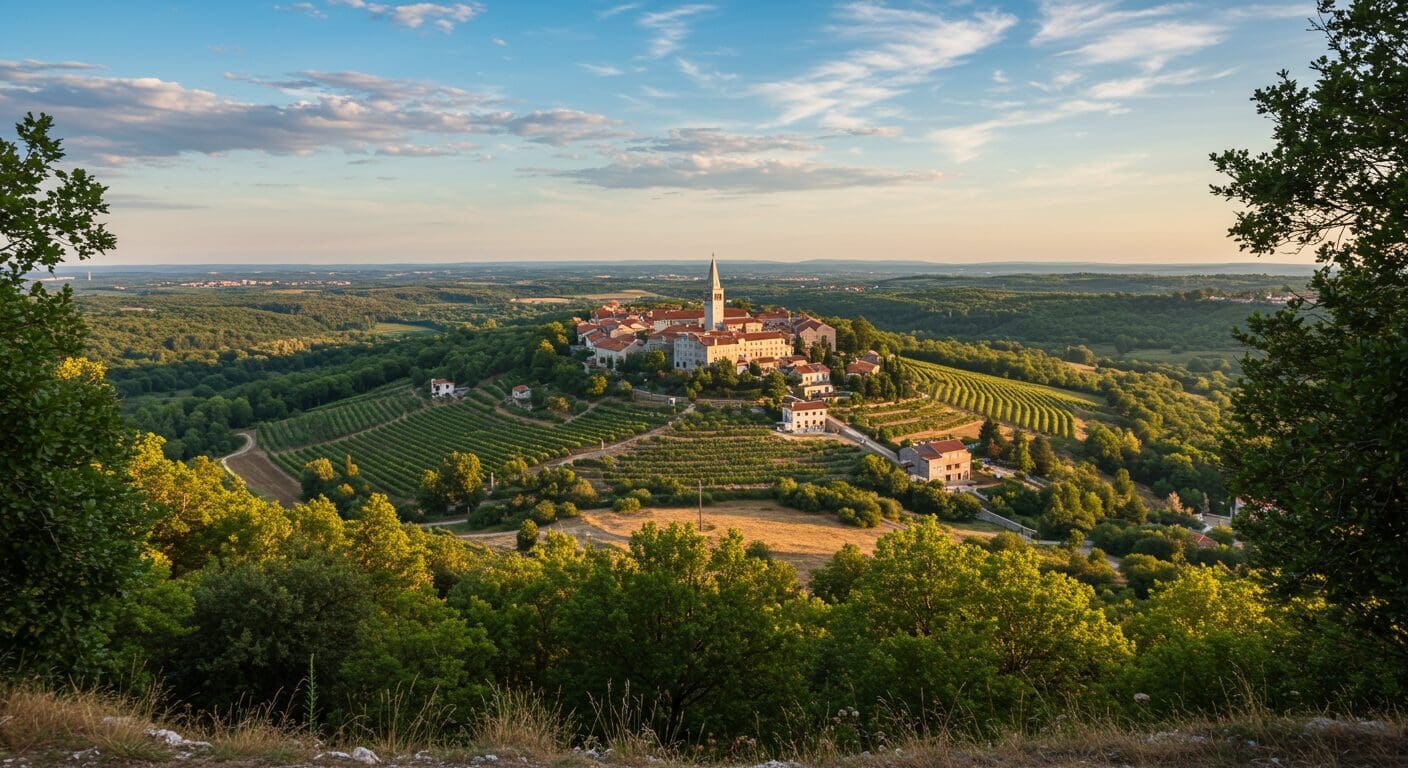
The interior is where Istria becomes something else entirely. Hilltop medieval towns – Motovun, Grožnjan, Oprtalj, Buzet, Hum – sit above valleys of oak forest, vineyard, and olive grove, connected by roads that insist on taking their time. Motovun, accessible via a winding road above the Mirna Valley, has become well-known enough to attract day-trippers in summer but retains its architectural integrity and, at dawn or dusk when the tour vans have departed, its atmosphere. Grožnjan was colonised by artists in the 1960s when its crumbling buildings were offered rent-free to anyone willing to restore them. The arrangement worked. It is now a village of studios, galleries, and a summer music festival, and it remains one of the more quietly eccentric corners of the Adriatic.
Hum claims the title of the world’s smallest town, a designation it defends with a population of between twenty and thirty souls depending on the season. The sign at the entrance says it. The residents appear to be fine with the attention.
Things to Do in Istria That Aren’t Just Looking at Things (Though That Also Works)
Truffle hunting is the definitive Istrian experience for anyone with a genuine interest in food – or indeed in watching a very focused dog behave as though the fate of the universe depends on a particular patch of undergrowth. The forests around Motovun and the Mirna Valley are the epicentre of Istrian truffle culture, and several estates and family operations offer guided hunts paired with tastings and meals. The white truffle season runs roughly September to December; black truffles are available year-round. A morning truffle hunt followed by a lunch built around the morning’s findings is one of those experiences that sounds like a luxury holiday cliché right up until you’re actually doing it, at which point it becomes simply excellent.
Cooking classes have proliferated as Istria’s culinary reputation has grown, and the best ones are run by families who have been making the same dishes for generations and are quietly amused by how excited visitors get about them. Learning to make fuži pasta by hand, or understanding how Istrian olive oil differs from other regional varieties, adds a dimension to eating here that persists long after you’ve gone home.
Wine tourism is increasingly sophisticated. Istria’s wine estates – Roxanich, Kozlović, Cattunar, Trapan, and others – have invested seriously in visitor experiences, and the Istrian Wine Road is a well-marked route through vineyard country that lends itself to an afternoon of stops. Indigenous varieties like Malvasia Istriana and Teran are the focus, and the amber wines produced by some of the more experimental estates are drawing serious attention from the international natural wine community.
The Brijuni Islands, accessible by ferry from Fažana near Pula, are a national park archipelago with Roman ruins, a safari park, and an atmosphere of unusual calm. They were Tito’s personal retreat during his presidency, which gives them a certain strange biographical weight alongside the peacocks and the ancient olive trees. A day trip is well worth the brief boat crossing.
Active Istria: The Region as a Serious Sports Destination
Cycling has become central to Istria’s identity as an active destination, and with good reason. The peninsula has invested heavily in trail infrastructure, and the range is exceptional – coastal paths suitable for leisurely riding, intermediate routes through vineyard-covered hills, and the more demanding climbs into the interior that attract serious road cyclists from across Europe. The Parenzana trail, tracing the route of a former narrow-gauge railway from Trieste to Poreč, is a particularly enjoyable multi-day option that passes through villages, over viaducts, and through scenery that keeps improving. Bike hire is widely available, and organised cycling holidays with support vehicles are easy to arrange.
Hiking is underrated here, partly because the visual drama of Istria’s interior – the Učka massif rising to over 1,400 metres, the Mirna and Raša valleys, the karst plateaux of the eastern interior – gets overshadowed by the coastal glamour. The Učka Nature Park offers trails with Adriatic views that, on a clear day, extend to Venice. Serious hikers can plan multi-day routes through landscapes that see a fraction of the foot traffic of better-known walking destinations.
The Adriatic delivers on water sports. Sea kayaking along the coastal cliffs south of Rovinj, through sea caves and past small uninhabited islands, is one of the more satisfying ways to spend a morning. Scuba diving is well-organised around Pula, Rovinj, and the Brijuni area, with sites ranging from accessible reef dives to deeper wrecks including several wartime vessels. Visibility in the northern Adriatic is excellent, particularly outside the peak summer months. Sailing is an obvious pleasure given the coast, and charter boats are available from most major harbours; the Lim Channel, a fjord-like inlet north of Rovinj, is a particularly distinctive stretch of water.
Windsurfing and kitesurfing conditions are best at certain coastal spots, particularly around Premantura at the southern tip of the peninsula, where the bora wind creates consistent conditions. Stand-up paddleboarding is widely available and gentle enough for mixed-ability groups who want to be on the water without committing to anything competitive.
Istria with Children: Better Than You Might Expect, Worse Than the Adults Were Hoping For (That Last Part Is a Lie)
Families with children find Istria unexpectedly accommodating. The Croatian coastline’s shallow, clear water and generally calm sea conditions make it safe for younger swimmers, and the absence of big-resort infrastructure means children are actually integrated into the rhythm of local life rather than corralled into activity programmes. This is, depending on your children, either a feature or a liability.
The Brijuni Islands safari park entertains children with genuine enthusiasm, and the Roman ruins there add an educational dimension that most children will accept without complaint if framed correctly. Pula’s amphitheatre is the kind of thing that even a nine-year-old finds impressive – it is, after all, a near-intact Roman structure from the first century AD that they still hold concerts in. The framing practically does itself.
Inland Istria offers truffle hunting experiences that work well for older children – the dogs are the real draw, frankly – and the hilltop towns reward family exploration without requiring long distances on foot. The car-free old towns of Rovinj and Novigrad are sensible for small children, and the ice cream is excellent throughout the region.
For families, the private villa option transforms the holiday in practical terms. A villa with a private pool means no timetable, no shared sunbeds, no negotiating with a pool attendant about whether this particular lounger is reserved. Children can swim when they want, eat when they’re hungry, and go to bed at a time that suits the family rather than a hotel’s dinner service. Space for toys, baby equipment, high chairs, and the general infrastructure of travelling with children is built into the arrangement. Several properties in the Excellence Luxury Villas portfolio include play equipment, shallow pool sections, and secure gardens – the kind of specifics worth filtering for when browsing.
History Written in Stone: Two Thousand Years in a Small Peninsula
Istria’s history is a long argument about who it belongs to, and the answer keeps changing. The Roman Empire arrived in the second century BC and left behind infrastructure of such quality that parts of it are still in use – the Pula amphitheatre being the most dramatic example, but the triumphal arch of the Sergii and the Temple of Augustus are equally compelling evidence of an occupation that took architecture seriously.
The Byzantine period left Poreč’s Euphrasian Basilica, whose gold-ground mosaics are a direct counterpart to those in Ravenna and Istanbul. Venetian rule, lasting from the early medieval period to the Napoleonic conquest in 1797, shaped the character of the coastal towns so thoroughly that wandering Rovinj or Piran still feels like a version of Venice edited for competitiveness. The campaniles, the loggia, the street layouts, the café culture – all of it carries Venetian DNA.
The twentieth century was turbulent in ways that still ripple. The peninsula was administered by Italy between the wars, and Italian remains a co-official language alongside Croatian in much of Istria today. Place names often have both versions. Menus sometimes do too. This dual linguistic inheritance gives the region a cultural texture that’s distinctively its own – neither straightforwardly Croatian nor Italian, but something that draws from both without fully belonging to either.
The annual Rovinj Summer Festival and the various truffle festivals in Buzet and Livade are the most accessible entry points for visitors interested in local traditions, combining music, food, and a general civic pleasure in being somewhere that people want to be.
What to Bring Home from Istria (And No, You Cannot Fit a Hilltop Town in Your Luggage)
Truffle products are the obvious answer and also the correct one. Truffle oil, truffle salt, jarred truffle paste, and dried truffle shavings travel well and maintain their quality. The Zigante shop in Livade and its outlets in various Istrian towns is the most comprehensive source, and prices are considerably lower than what you’d pay for equivalent products in a London deli. White truffle products are seasonal and more expensive; black truffle preparations are available year-round and remarkably good value.
Istrian olive oil deserves more attention than it gets outside the region. Several estates produce oils of exceptional quality from indigenous olive varieties – the Buje and Poreč areas in particular have established international reputations in olive oil competitions. Buying directly from a producer or estate is both the best way to ensure quality and a more interesting experience than a supermarket shelf.
Istrian wines – bottles of Malvasia, Teran, or one of the interesting orange wines from the natural wine producers – are worth the effort of packing carefully. Most premium producers are not widely available outside Croatia, which makes them genuinely worth bringing back. Kozlović, Roxanich, and Trapan are names to look for.
The smaller hilltop towns – Grožnjan particularly, with its artist community – have independent galleries and craft studios selling work of genuine quality. Ceramics, paintings, and textile work produced locally make more interesting souvenirs than the lavender products that appear on every coastal market stall, however well-intentioned.
Practical Things That Are Actually Useful to Know
Croatia joined the Eurozone in January 2023, so the euro is the currency throughout Istria. This removed the mild administrative inconvenience of the kuna and makes budgeting considerably simpler for visitors from most European countries. Card payments are widely accepted in restaurants, shops, and markets, though some smaller konobas and market stalls remain cash-oriented – carrying a modest amount of cash is sensible.
The official languages are Croatian and, in much of Istria, Italian as a co-official regional language. English is widely spoken in tourist-facing contexts – restaurants, accommodation, activity operators – particularly in the coastal towns. In smaller inland villages, some Italian or even a few words of Croatian will occasionally be appreciated, though nobody will be rude about it.
The best time to visit depends on what you want from the trip. June and September are the months most experienced Istria travellers quietly recommend: warm enough for swimming, not so hot as to make exploring the inland towns a significant commitment, and considerably less crowded than July and August. July and August are peak season for a reason – the weather is reliably excellent, the sea is at its warmest, and the social atmosphere of the coastal towns is at full pitch – but accommodation books up well in advance and popular restaurants require planning. The shoulder seasons of May and October offer a quieter, more local version of Istria and are particularly good for anyone interested in food, cycling, or walking. Truffle season in autumn adds a compelling reason to consider October and November.
Tipping is not compulsory but is appreciated and increasingly common in tourist-oriented restaurants, where ten percent is a reasonable benchmark. Safety is not a serious concern; Istria has very low crime rates by any reasonable measure. Driving standards vary, as they do everywhere in the Mediterranean, and the occasional narrow road in hilltop towns requires some patience. Sun protection in summer is not optional – the Adriatic light is more intense than visitors from northern climates typically expect.
Why a Private Villa in Istria Makes More Sense Than Any Alternative You’re Considering
There are good hotels in Istria. There are even excellent ones. But a luxury villa here does something that even the finest hotel cannot, which is give you Istria on your own terms – your own pace, your own pool, your own kitchen stocked from the morning market, your own terrace from which to watch the light change over the olive groves without anyone asking if you’d like to see the dessert menu.
The geography of Istria is, frankly, ideal for villa holidays. The combination of coastal and inland options means you can position yourself differently depending on what matters: a hillside property above Rovinj or Poreč puts you within twenty minutes of the coast while offering privacy and altitude that hotels in town cannot provide. An inland villa in truffle country gives you direct access to the forests, the wine roads, and the hilltop towns without the coastal crowds. Many properties in the Excellence Luxury Villas collection have private pools, outdoor dining spaces, and views that justify the entire holiday on their own.
For families, the advantages are multiplicative. The pool is yours. The garden is yours. The kitchen is yours when a restaurant meal feels like one commitment too many and everyone just wants pasta at nine o’clock. For groups of friends, villa life enables the kind of holiday – late dinners, impromptu cooking sessions, shared bottles of Malvasia on a terrace – that a hotel simply cannot accommodate with equivalent ease. For couples, privacy and space create a quality of experience that no amount of hotel upgrade can replicate.
Remote workers have discovered Istria for reasons beyond its obvious attractions. Properties increasingly offer fast, reliable broadband – in some cases Starlink connectivity – and a working setup that combines a proper desk with a swimming pool sixty seconds away. The work-life balance arithmetic becomes more favourable almost immediately.
Wellness-focused guests find villa life in Istria particularly well-suited to what they’re actually looking for, as opposed to what a spa brochure suggests they should be looking for. The slow mornings, the outdoor pool, the walking-distance access to some of the finest food in Europe, the clean air and quiet nights – these are not amenities in any conventional sense. They’re the whole point. Several properties include dedicated wellness infrastructure: outdoor gyms, yoga terraces, sauna facilities. But the real wellness offering here is the peninsula itself.
Browse our collection of luxury villas in Istria County with private pool and find the property that suits your specific version of the perfect trip.
More Istria County Travel Guides
- Best Restaurants in Istria County: Fine Dining, Local Gems & Where to Eat
- Istria County Food & Wine Guide: Local Cuisine, Markets & Wine Estates
- Istria County with Kids: The Ultimate Family Holiday Guide
- Best Time to Visit Istria County: Month by Month Weather, Crowds & Tips
- Istria County Luxury Itinerary: The Perfect 7-Day Guide
- Romantic Istria County: The Ultimate Couples & Honeymoon Guide
What is the best time to visit Istria County?
June and September are the sweet spot for most travellers – warm enough for swimming and outdoor dining, significantly less crowded than the July and August peak, and with excellent availability at the better restaurants. July and August offer the most reliable beach weather and the most animated coastal atmosphere, but demand planning ahead for accommodation and tables. May and October are ideal for cycling, hiking, and food-focused trips. October and November bring white truffle season, which is a compelling reason to visit in its own right. Winter is quiet and mild by northern European standards, and the hilltop towns have an atmosphere that’s genuinely different from the summer version.
How do I get to Istria County?
Pula Airport is the most convenient entry point, with direct flights from London, Amsterdam, Frankfurt, Vienna, and numerous other European cities, particularly in summer. Trieste Airport in Italy is a strong alternative for northern Istria – it’s close to the border and well-served by budget carriers. Ljubljana Airport in Slovenia is useful for travellers heading to the inland towns. Zagreb Airport is possible but adds significant driving time. From Pula Airport, most villa destinations in Istria are between thirty minutes and two hours by car. A rental car is strongly recommended – public transport within Istria is limited and the best experiences require flexibility to explore.
Is Istria County good for families?
Genuinely yes. The Adriatic coastline offers shallow, calm, clear water that’s safe for children, and the region’s scale means families can mix beach days with cultural visits without covering enormous distances. The Brijuni Islands safari park and Roman ruins work well for older children; the car-free old towns of Rovinj and Novigrad are manageable for younger ones. Truffle hunting experiences with trained dogs are a reliable hit with children old enough to appreciate what’s happening. Private villa accommodation with a pool and secure garden transforms the logistics of travelling with children considerably – no shared pool timetables, no hotel breakfast rush, and a kitchen for the evenings when everyone is too tired for a restaurant.
Why rent a luxury villa in Istria County?
A private villa gives you Istria at your own pace, which is the best pace. You have a private pool, outdoor space for dining, a kitchen to use as much or as little as you choose, and a level of privacy that no hotel room or even hotel suite can match. For families, the practical advantages are significant – children can swim freely, eat when they’re hungry, and go to bed without disrupting a restaurant. For couples, the seclusion creates a quality of experience that’s genuinely different from even the finest hotel. Staff and concierge services available with premium properties mean the logistical pleasures of a hotel are available alongside the privacy of a private home. The staff-to-guest ratio in a well-staffed villa typically exceeds anything a hotel offers at equivalent price points.
Are there private villas in Istria County suitable for large groups or multi-generational families?
Yes, and Istria is particularly well-suited to this kind of trip. Larger villa properties in the region often include multiple bedroom wings, separate guest annexes, and outdoor living areas substantial enough for ten to sixteen people to coexist without friction. Private pools, multiple dining terraces, and separate living spaces allow different generations to spend time together or apart according to preference – which is, in practice, what makes multi-generational holidays work. Some properties include additional staff such as private chefs and housekeeping, which removes the domestic logistics from what is supposed to be a holiday. The Excellence Luxury Villas portfolio includes properties specifically suited to large group bookings, and the team can advise on which configurations work best for different group compositions.
Can I find a luxury villa in Istria County with good internet for remote working?
Croatia’s digital infrastructure has improved significantly in recent years, and Istria in particular – partly due to its popularity with international visitors and a growing remote-working community – tends to have better connectivity than comparable rural destinations in southern Europe. Many premium villa properties now offer fibre broadband or Starlink satellite connectivity, delivering speeds suitable for video conferencing, large file transfers, and everything else a working professional needs. When booking, it’s worth specifying your connectivity requirements directly – the Excellence Luxury Villas team can confirm speeds and setup at individual properties. Dedicated workspace, whether a home office or simply a well-positioned desk with good natural light, is an increasingly standard feature at the premium end of the market.
What makes Istria County a good destination for a wellness retreat?
Istria’s wellness offer is grounded in things that actually work: exceptional food built on fresh, local, largely unprocessed ingredients; outdoor activities ranging from coastal kayaking to mountain hiking; clean air, clean water, and a pace of life that makes sustained relaxation feel natural rather than forced. The accommodation side supports this well – many luxury villas include private pools, outdoor yoga terraces, sauna facilities, and gardens designed for unhurried outdoor living. The hilltop towns and inland forest trails offer walking and cycling routes that are restorative in the original sense of the word. Several spa facilities operate in the region’s hotels and estates, and in-villa massage and wellness treatments can be arranged through most concierge services. The combination of physical activity, outstanding cuisine, and genuine quiet makes Istria one of the more honest wellness destinations in the Mediterranean.