Umbria Travel Guide: Villages, Wine, Food & Luxury Villas
What if the most beautiful region in Italy was the one everyone kept overlooking? Not because it lacks anything – quite the opposite – but because its more famous neighbour to the north has spent decades hoarding the brochure covers and the Instagram reels, leaving Umbria to get on quietly with being extraordinary. Tuscany gets the blockbuster billing. Umbria gets the actual magic. Rolling green hills that seem to have been painted by someone with too much time and genuine talent. Medieval hill towns that haven’t been theme-parked into submission. Truffles, wine, olive oil and a pace of life so deliberately unhurried it starts to feel like a philosophy. If you’ve been considering a luxury holiday in Umbria and haven’t yet pulled the trigger, this guide is the answer to the question you’ve been quietly asking yourself: is it really worth it? It is. Embarrassingly so.
Umbria works for an unusually broad cast of travellers, which is part of its quiet genius. Couples marking a significant anniversary or honeymoon find here the kind of unhurried romance that busy coastal resorts simply cannot manufacture – dinner on a terrace as the valley turns gold, nobody rushing you anywhere. Families seeking genuine privacy, with children who need space to actually run rather than perform being on holiday, discover that a villa with land and a private pool is basically the perfect containment system (affectionate containment, obviously). Groups of friends who’ve been trying to coordinate a proper trip for three years tend to settle on Umbria because it offers enough to do without demanding a schedule, and enough beauty to justify doing nothing at all. Remote workers drawn to reliable connectivity alongside serious scenery are increasingly finding Umbria’s hilltop villas – many now equipped with high-speed broadband – a genuinely productive alternative to a city office. And wellness-focused travellers, people who want to eat thoughtfully, walk properly, and sleep as though they mean it, tend to arrive for a week and quietly rebook before they leave.
Getting Here Is Easier Than Umbria Would Have You Believe
Umbria is landlocked, which surprises some people – Italy, after all, is a country almost entirely surrounded by coastline. But the lack of a beach is rather the point. The nearest major international hub is Rome Fiumicino (FCO), roughly two hours south by car or train, and perfectly practical. Milan Malpensa is an option for northern European connections, though the drive south adds considerably to the day. For those flying from the UK or northern Europe, the small Perugia San Francesco d’Assisi airport handles a modest number of direct routes – Ryanair runs seasonal services – but it’s the kind of airport where you collect your bag before you’ve quite finished your coffee, which is either charming or alarming depending on your travel temperament.
Florence’s Amerigo Vespucci airport is another strong entry point, particularly for those wanting to combine a luxury villas Umbria trip with a few days in the city first. The drive south from Florence through the Valdichiana valley and down into Umbria takes around ninety minutes and is, frankly, not a bad start to any holiday. Pisa is also viable for certain itineraries.
Once you’re in Umbria, a car is not optional – it’s essential. This is hill country with villages perched on ridgelines and wineries down lanes that don’t appear on maps. Trains connect the major towns – Perugia, Assisi, Orvieto, Spoleto – but the real Umbria, the farmhouses and valleys and producers you actually came for, requires wheels. Hire something comfortable and try not to be intimidated by the Italian approach to overtaking on mountain roads. They know what they’re doing. Probably.
Eating in Umbria: Where the Food Actually Matches the Scenery
Fine Dining
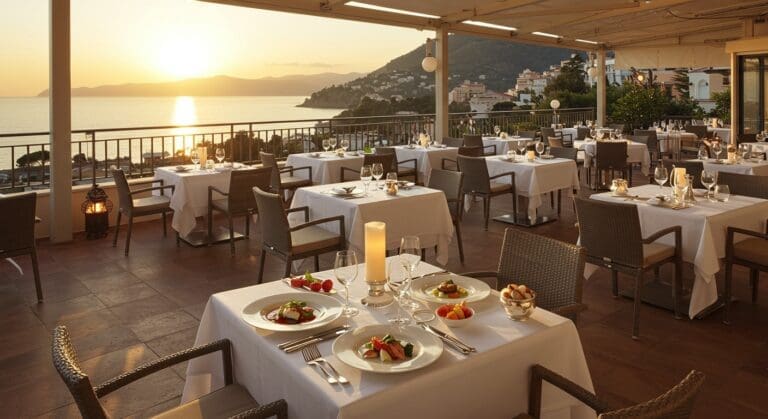
Umbria’s fine dining scene is smaller than its quality deserves, which means the restaurants that do carry Michelin recognition wear it without the usual self-consciousness. The undisputed patriarch is Casa Vissani in Baschi, on the shores of Lake Corbara – a restaurant that began in 1963 as a family trattoria and has since become something close to a national institution. Chef Gianfranco Vissani earned his second Michelin star in 1999 and has never particularly needed to shout about it since. The restaurant operates across two experiences: TerritOri Vissani, which celebrates traditional Umbrian cooking with the kind of generous conviviality that makes you feel immediately welcome, and the Vissani Gourmet Restaurant, which offers tasting menus of real precision and ambition. Both dining rooms open onto a panoramic terrace above the lake. If you make one reservation in Umbria, it should probably be this one. Book early. They know exactly how good they are.
In Norcia – a town already synonymous with exceptional food, particularly its legendary black truffles and mountain-cured meats – Vespasia holds a Michelin star and, unusually, a Michelin sustainability star alongside it. The kitchen works in close relationship with local producers and farmers, and the results are dishes that feel like portraits of the landscape: lamb ravioli with caramelised Cannara onion, braised veal shank with chickpeas from the Sibillini Mountains finished with rosemary. The cooking here is deeply rooted but never backwards-looking – it’s tradition made vital.
Elementi Fine Dining in Torgiano, set within the wine-producing heartland of the region, takes its philosophy seriously – “the tireless pursuit of truth, well-being, and harmony” – without letting that earnestness make the food dull. One signature dish, carp in porchetta from Lake Trasimeno with nettles, manages to be both impeccably Umbrian and quietly surprising. It’s the kind of place that confirms what you’d already suspected: this region takes its ingredients personally.
In Perugia, Ada Gourmet offers something genuinely distinctive – a restaurant that sits right against the ancient Etruscan walls and then proceeds to cook food that blurs the border between Umbria and Puglia. Chef Ada Stifani, originally from Lecce, brings the flavours of Italy’s south into a northern Umbrian context with impressive confidence. The wine cellar, housed in a former secret underground passageway beneath the restaurant, is worth visiting on its own terms. The sommelier knows it too, though mercifully without the theatrical pouring ceremony some cellars insist upon.
Where the Locals Eat
The real everyday Umbrian table exists somewhere between a slow lunch and a philosophical position. Every market town has its osteria – usually a room with wooden furniture, a handwritten menu on a blackboard, and a house wine that arrives without being asked for and is frequently excellent. Norcia’s salumerie are as much eating destinations as shopping ones: you buy a little of everything, find a bench in the piazza, and have one of the better lunches of your life for about nine euros. The market at Perugia’s Piazza Matteotti rewards early risers with seasonal produce, local cheeses, and the particular pleasure of watching Umbrians argue cheerfully about olive oil.
Cannara, a small town southeast of Perugia, is home to one of Italy’s most celebrated onion festivals – the Sagra della Cipolla every September – which sounds eccentric until you taste a Cannara onion, at which point it makes complete sense. The region’s eno-gastronomic calendar is dotted with these local sagre: truffle festivals, lentil celebrations, festivals dedicated to specific varieties of legume with the kind of focused devotion usually reserved for religion.
Hidden Gems Worth Seeking Out
Osteria a Priori in Perugia has earned a devoted following among those who value substance over ceremony. Tucked into the old city, it approaches local ingredients with the kind of seriousness that doesn’t require white tablecloths to communicate. The wine list leans heavily into Umbrian and central Italian producers, many of them small, most of them excellent. It’s the kind of place where regulars don’t bother with the menu. That’s generally a good sign.
Beyond the cities, the farmhouse agriturismo model produces some of Umbria’s most memorable meals – tables set under pergolas, olive oil from the trees outside, pasta made that morning. These aren’t destinations that appear in international guides, which is precisely their charm. Ask your villa manager. They will know exactly where to send you.
Into the Green Heart: Umbria’s Landscapes, Villages and Back Roads
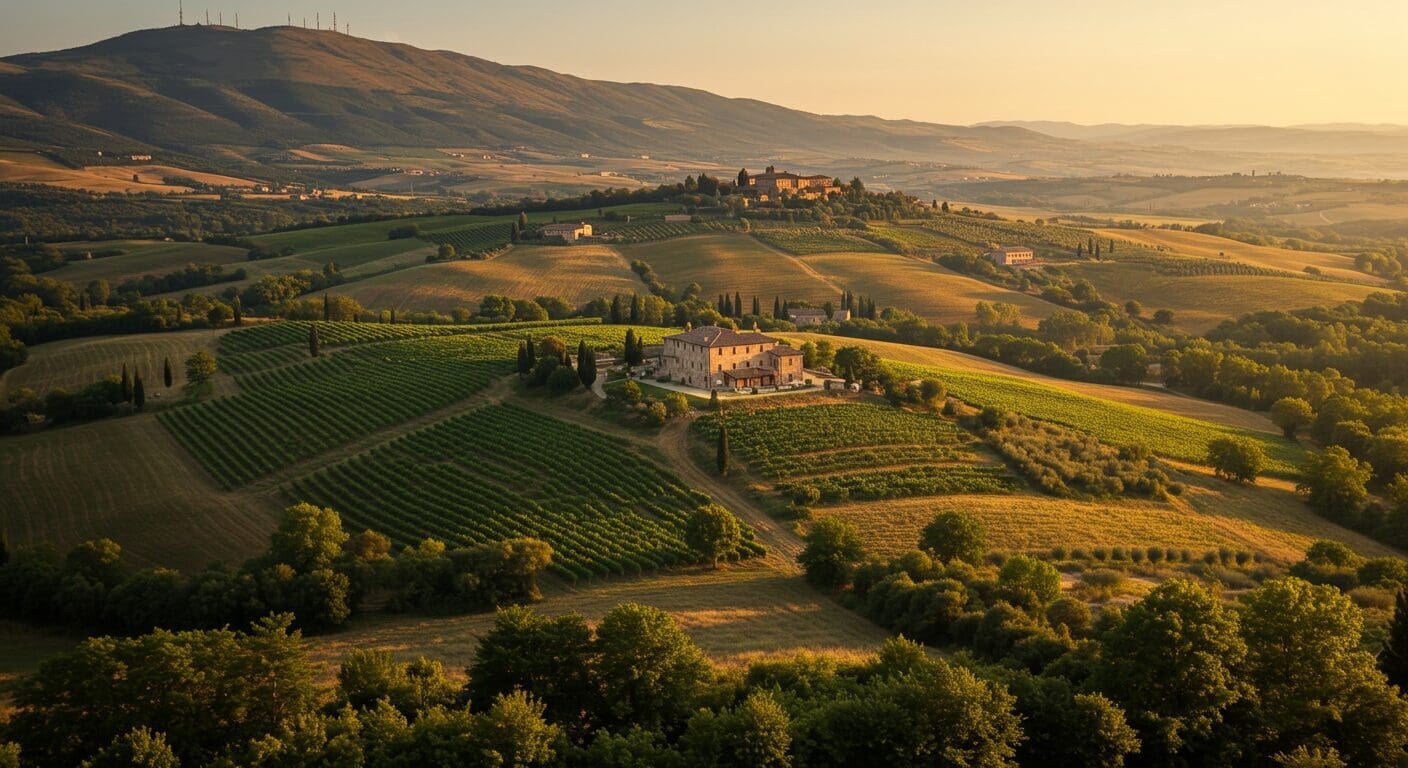
Umbria calls itself il cuore verde d’Italia – the green heart of Italy – and the description is earned rather than merely adopted for tourism purposes. This is a genuinely, durably green landscape: soft hills planted with olives and vines, river valleys threaded with cypresses, and hilltop towns that have occupied their ridgelines for so long they seem to have grown there organically. The palette shifts with the season – silver-grey in winter, luminous green through spring, baked gold by August, then softening again to bronze and amber come October.
The main geographic anchors are Lake Trasimeno to the west – Italy’s fourth largest lake, shallow and serene, with three islands and a shoreline of reeds and fishing villages – and the Valnerina valley running through the eastern Apennines toward Norcia. Between them, a landscape of remarkable variety: the flat plains around Foligno and Spoleto planted with wheat and sunflowers; the high plateau of the Piano Grande above Castelluccio, which in late June fills with wild flowers in a display so concentrated it looks photoshopped; and the thickly forested slopes of Monte Subasio above Assisi, where the silence on a weekday morning is absolute.
The hill towns are the obvious draws, and correctly so. Orvieto, rising from a volcanic tufa cliff above the Paglia river valley, is one of Italy’s great dramatic entrances – particularly arriving by the funicular from the station below, the cathedral’s golden façade appearing above the roofline like a revelation. Spoleto, more compact and less touristed, rewards an afternoon’s wandering with its Roman theatre, Lombard castle and the extraordinary Ponte delle Torri – a medieval aqueduct-bridge that strides across a deep gorge above the town with the casual confidence of something that’s been there since 1230 and intends to remain. Todi, perched high above a plain of vines and olives, was once voted “the world’s most liveable town” by an American university, a distinction it presumably accepts with Umbrian understatement.
The back roads between these towns are the actual holiday. The SS3 Flaminia south of Spoleto carves through the Nera gorge. The road east from Norcia to Castelluccio climbs through beech forest and emerges onto a plateau that genuinely feels like the edge of something. Drive them slowly, preferably in the early morning or late afternoon when the light is doing its best work.
Things to Do in Umbria That You’ll Actually Want to Do Again
Umbria’s activities menu is longer than the region’s modesty would suggest. The best things to do in Umbria divide neatly between the active and the contemplative, though the two overlap more often than you’d expect – a truffle hunt, after all, is both vigorous exercise and a masterclass in paying attention.
Truffle hunting is genuinely not to be missed. Umbria, alongside the Périgord region of the Dordogne, produces some of the world’s most sought-after black truffles, and the area around Norcia and Spoleto is their particular territory. Guided hunts with certified truffle hunters and their dogs take you into oak woodland at dawn and demonstrate, with some conviction, why a fungus that grows underground with no particular marketing strategy can command prices that seem designed to cause mild distress. The experience ends with a tasting that makes all of it make sense.
Wine tourism here is low-key but high quality. Torgiano, home to the Lungarotti winery and one of Umbria’s few DOCG designations, offers cellar visits and tastings in surroundings that combine agricultural seriousness with genuine hospitality. Montefalco, the hilltop town famous for its Sagrantino grape – a variety found almost nowhere else in the world – has more wine producers per square kilometre than seems statistically reasonable. The Sagrantino di Montefalco DOCG is tannic, powerful and demands food. Fortunately this is Umbria. Food is never far away.
Cooking classes are available throughout the region – some at agriturismi, some with private chefs who can come to your villa. Learning to make pasta by hand, specifically the dense, egg-rich pasta of central Italy, is a skill that will serve you for years. The lesson itself tends to involve a considerable amount of wine consumed before noon, which the Umbrians regard as entirely normal. They’re probably right.
Assisi demands its own day, or possibly two. The Basilica of San Francesco is one of the great medieval buildings of Europe – its upper and lower churches decorated by Cimabue and Giotto in a sequence of frescoes that constitutes something like the birth of Western painting. Go early. The crowds arrive by late morning and the atmosphere shifts accordingly.
Adventures in the Apennines: Hiking, Cycling and Moving Through the Landscape
Umbria is not the Alps, and it doesn’t pretend to be. What it offers instead is a landscape ideal for human-scale adventure – long-distance trails, cycling routes through vine country, rivers perfect for kayaking, and enough altitude variation to make you feel like you’ve earned your dinner without requiring a mountaineering qualification.
The Grande Sentiero Umbria links many of the region’s key towns and landscapes in a long-distance walking route of around 400 kilometres. Most visitors do sections rather than the whole, and even a single day’s walking above Assisi on Monte Subasio, or through the Valnerina toward the Cascata delle Marmore, demonstrates exactly what the fuss is about. The Cascata delle Marmore is worth a specific mention: a three-tiered waterfall dropping 165 metres into the Nera valley, constructed – improbably – by the ancient Romans in 271 BC as a drainage solution. It remains one of Europe’s tallest waterfalls. The Romans were not particularly modest in their ambitions.
Cycling in Umbria has grown considerably in sophistication over the past decade. Road cyclists will find challenging climbs around Monte Subasio and the roads above Montefalco, while gravel cyclists have taken enthusiastically to the white strade bianche – unpaved farm roads – that connect estates and villages through the countryside in a network that pre-dates tarmac by several centuries. Guided cycling holidays, supported by van and with luggage transfers between villages, have become a well-organised cottage industry. Electric bikes are widely available for those who want the views without the gradient.
The Tiber, Nera and Topino rivers offer kayaking and canoe routes of varying ambition, and the canyoning in the Valnerina gorge is genuinely exciting without requiring professional qualifications. Horse riding through the Umbrian hills is available from several stables near Perugia and in the area around Todi – the region’s equestrian traditions run deep, and the bridleways through olive groves and oak woodland are among the quieter pleasures on offer.
Umbria for Families: Where Private Space Makes Everything Better
The case for bringing children to Umbria is stronger than it might initially appear to parents who associate Italian cultural travel with the phrase “don’t touch that.” Umbria, more than almost anywhere else in central Italy, accommodates families with genuine warmth rather than a policy document. Italians like children. They expect children to be present at meals, at festivals, in piazzas at nine in the evening eating gelato. The social contract here includes small people, and that makes a difference.
A private villa with a pool changes the family travel equation completely – this is worth stating plainly. Villa life means breakfast at whatever time actually works, a pool available the moment someone decides they’re hot, meals that accommodate the seven-year-old’s opinions about pasta without requiring a negotiation with a waiter. The private grounds absorb children’s need for space in a way that no hotel corridor ever has. Children old enough to remember a holiday will remember this one.
In terms of specific experiences: Perugia’s Eurochocolate festival each October is a reliable hit with children aged roughly four through to adults who find the concept of a three-day chocolate exhibition perfectly reasonable. The interactive archaeological museum in Perugia handles ancient Etruscan and Roman history in formats that hold a child’s attention. The drive up to Castelluccio for wildflower season involves getting out of the car and running around a plateau that seems to go on forever – which is, in its way, exactly what children need from a holiday in the countryside.
The lake at Trasimeno has shallow, gentle shores that are safe for young swimmers, with boat trips to the islands providing the nautical adventure component of the itinerary. The island of Maggiore has a small medieval village and absolutely no cars. Even the eight-year-old will concede that’s quite cool.
Umbria’s Deep History: Etruscans, Saints and Centuries of Quiet Brilliance
Umbria was inhabited and significant long before Rome became Rome’s favourite subject. The Umbri were one of the oldest peoples of the Italian peninsula, pre-dating the Roman conquest, and the Etruscans settled the western part of the region with a sophistication that still feels, when you stand in Perugia’s ancient city core and look up at the Arco Etrusco, genuinely humbling. The arch, built around the 3rd century BC, is still doing its job. The Etruscans were, among other things, excellent engineers.
Roman Umbria added the Via Flaminia – the great road south to Rome – and a catalogue of amphitheatres, temples and urban infrastructure that Spoleto and Bevagna have done an admirable job of preserving. The medieval period then layered over this with extraordinary energy: the Lombard dukes, the Papal States, the free communes and the extraordinary flowering of religious architecture that gave Umbria Assisi, Orvieto Cathedral and the Basilica of Santa Chiara.
Assisi is, of course, the spiritual heart of the region – the birthplace of Saint Francis and the site of one of the most important pilgrimage destinations in the Christian world. The crowds can be formidable in summer, but the town repays careful engagement: the Basilica’s frescoes are among the most important works of art in Italy, and the Eremo delle Carceri – Francis’s hermitage above the town, reached by a path through oak forest – is as affecting in its simplicity as the Basilica is in its grandeur. The contrast is, you suspect, entirely intentional.
Perugia’s National Gallery of Umbria houses Perugino and early Raphael in a collection that would be transformative in any European city. Here it’s surprisingly manageable. The annual Umbria Jazz festival each July, one of the most respected jazz events in Europe, fills the city’s piazzas and medieval venues with music that goes on until it’s technically the following day. The combination of medieval architecture and late-night jazz is one of Italy’s more distinctive cultural proposals.
Shopping in Umbria: What to Buy and Where to Find It
Umbria produces things worth buying with a directness that makes shopping feel less like commerce and more like participation. The region’s craft and food traditions are genuinely alive rather than preserved for tourist purposes, which changes the quality of what’s on offer considerably.
Deruta, a small town south of Perugia on the road toward Todi, is the home of Umbrian ceramics – a tradition stretching back to the Renaissance, producing the distinctive majolica with its cobalt blues, burnt oranges and intricate geometric patterns. The town’s main street is so thoroughly devoted to ceramics workshops and showrooms that it achieves a kind of focused intensity. The quality varies, as it does everywhere, but the top workshops produce work that is both beautiful and genuinely handmade. Shipping is available. The plates in question do survive the journey.
Textiles from Città di Castello in the Tiber Valley are produced on handlooms using linen and hemp in patterns that date back to the 14th century. The Tela Umbra cooperative has been operating since 1908, and its workshop-showroom in the town centre is one of the more quietly impressive things in the region. Table linens, runners and fabric by the metre – the kind of thing you buy thinking it’s a reasonable souvenir and find yourself treasuring.
For food, the obvious and correct answer is: bring home as much as you can legally transport. Umbrian truffles (fresh or in products), cured meats from Norcia, lentils from Castelluccio, Sagrantino wine, extra-virgin olive oil pressed from Umbria’s celebrated Moraiolo and Frantoio olives. The food markets in Perugia and Orvieto are the best starting points, though every town of any size has its norcineria – the pork butcher’s shop, often looking unchanged since 1950, where the salami situation is handled with extreme seriousness.
Practical Umbria: What You Actually Need to Know Before You Go
Italy uses the euro, tips are appreciated but not demanded (leaving a few euros at the end of a meal is warmly received without being structurally required), and the official language is Italian – though tourist English is widely spoken in the main towns and at quality restaurants. In smaller villages and at local agriturismi, Italian goes further. Even modest efforts are met with real warmth.
The best time to visit Umbria for a luxury holiday depends on what you’re after. Late spring – May and early June – delivers the countryside at its most animated: green and flowering, warm enough for the pool, cool enough for long walks. Truffle season at its most dramatic runs autumn through to winter, with the prized Norcia black truffle peaking December through March. September and October balance warm weather, vendemmia (grape harvest) activity and significantly thinner crowds than August. July and August are hot – often very hot inland – and the roads around Assisi and Orvieto see volume that detracts from the experience. December through February brings quiet, cold, frost on the hillsides, and the region almost entirely to yourself.
Safety in Umbria is not a serious concern in the conventional sense – this is one of Italy’s quietest and most rural regions. The usual common-sense precautions in city centres (Perugia, particularly around the university area in the evening) apply. The roads, particularly mountain roads in rain or frost, require appropriate attention. A 4WD is worth specifying if your villa is reached by a strade bianche or accessed via a steep lane – some are, and it matters.
Umbria observes its religious and civic traditions with genuine commitment. Assisi during Calendimaggio (May) and the Festa di San Francesco (October 3-4) attracts significant numbers. Perugia during Umbria Jazz (July) becomes a different city. Plan around these or plan specifically for them, but don’t ignore them. They’re part of what the region actually is.
Why a Luxury Villa in Umbria Makes Every Other Option Feel Like a Compromise
There is a version of Umbria available from a hotel room – pleasant, perfectly adequate, with a buffet breakfast and a pool shared with strangers in matching robes. And then there is the version available from a private villa on a hillside above the valley, with a pool that belongs only to your party, dinner served on a terrace as the fireflies appear over the olive grove below, and nobody anywhere nearby requiring anything of you whatsoever. These are meaningfully different experiences, and it’s worth being honest about that.
The landscape of Umbria – genuinely rural, genuinely historic, genuinely private – is one of the few places in Italy where a villa isn’t simply a nicer room but an entirely different mode of travel. A property with its own grounds, its own pool, its own kitchen stocked with local produce, operates at a pace that hotels categorically cannot replicate. You eat when you want. You swim when you want. You spend the afternoon doing nothing of consequence in an ancient stone courtyard and this is, in fact, the whole point.
For families, the private villa removes every friction point that makes travelling with children an exercise in negotiation. For groups of friends finally managing the trip they’ve been planning since 2019, a large villa with multiple bedrooms and communal spaces provides the right balance of togetherness and the option to be briefly alone. For couples on a milestone trip, privacy and space and a setting of real beauty create the conditions for the kind of holiday that doesn’t need to be explained to anyone.
Wellness-focused guests find Umbria’s villa offer particularly aligned with their needs. The combination of outdoor pools, extensive grounds for morning walks, access to local spas – the Hotel Borgobrufa near Torgiano is particularly well regarded – and the region’s genuinely clean, unprocessed food culture makes a villa stay here feel restorative in a way that is hard to manufacture at a resort. The air quality alone is notable. Umbria is consistently ranked among Italy’s least polluted regions. Your lungs will notice.
Remote workers, increasingly well-catered for by properties with reliable high-speed connectivity – and in some cases Starlink – find that Umbria’s combination of reliable infrastructure and radical beauty makes the working day feel considerably less like something to be endured. There are worse places to take a call than a stone terrace with a view across a valley you can’t quite believe is real.
Excellence Luxury Villas offers a carefully curated collection of over 27,000 properties worldwide, including a superb range of luxury villas in Umbria with private pool – from restored medieval farmhouses with original stone fireplaces to contemporary estates with infinity pools above the valley. Browse the full collection and speak to one of our Umbria specialists about finding the right property for your group, your timing, and the kind of holiday you actually want.
More Umbria Travel Guides
- Best Restaurants in Umbria: Fine Dining, Local Gems & Where to Eat
- Umbria Food & Wine Guide: Local Cuisine, Markets & Wine Estates
- Umbria with Kids: The Ultimate Family Holiday Guide
- Best Time to Visit Umbria: Month by Month Weather, Crowds & Tips
- Umbria Luxury Itinerary: The Perfect 7-Day Guide
- Romantic Umbria: The Ultimate Couples & Honeymoon Guide
What is the best time to visit Umbria?
Late spring (May to early June) and autumn (September to October) are the most rewarding times to visit Umbria. The weather is warm but not oppressive, the landscape is at its most vivid, and the crowds are a fraction of what August brings. For truffle enthusiasts, winter – particularly December through March – is when Norcia’s black truffles are at their peak. Summer is viable but hot; July and August in the inland hill towns can be fierce, and Assisi in particular gets very busy. December through February is cold and quiet, and if you want the region largely to yourself, it’s surprisingly atmospheric.
How do I get to Umbria?
The most practical entry point for most international travellers is Rome Fiumicino (FCO), approximately two hours south of Umbria by road or rail. Florence airport is another strong option, roughly ninety minutes north, and works well for those combining the trip with time in the city. Perugia’s San Francesco d’Assisi airport handles a small number of direct European routes, including seasonal services from the UK, and is the most convenient option if it covers your origin airport. Once in the region, a hire car is essential – Umbria’s countryside, villages and producers are not accessible by public transport in any meaningful way.
Is Umbria good for families?
Genuinely yes – and in ways that might surprise you. Italians include children naturally in daily life, which creates a relaxed atmosphere in restaurants and public spaces. The practical advantages of a private villa with pool for families are considerable: flexible mealtimes, safe outdoor space, no negotiating corridors or shared facilities with strangers. Specific family-friendly highlights include Lake Trasimeno’s gentle shores, the drive to Castelluccio for wildflower season, Perugia’s Eurochocolate festival in October, and Assisi’s accessible mix of art and history. The countryside villa format is particularly well-suited to multi-generational groups who need a range of activities and plenty of space.
Why rent a luxury villa in Umbria?
Because the landscape and culture of Umbria are fundamentally suited to private, unhurried experience rather than hotel schedules and shared facilities. A luxury villa here means a private pool with views across the valley, meals at your own pace, and the freedom to treat the countryside as your own for the duration. For groups and families, the space-to-cost ratio of a well-appointed villa comprehensively outperforms hotels. Many properties come with staff – housekeeping, private chefs, concierge services – providing the support of a hotel with none of its compromises. The combination of privacy, space, and genuine beauty is particularly hard to replicate in Umbria by any other means.
Are there private villas in Umbria suitable for large groups or multi-generational families?
Yes, and Umbria is particularly well-supplied with them. The region’s tradition of large stone farmhouses and agricultural estates – many converted over the past thirty years into high-specification villa properties – produces a good number of properties sleeping ten, twelve or more guests across multiple bedrooms, often with separate wings or annexes that provide privacy within the group. Private pools are standard at the luxury end. Many larger properties include staff quarters, full catering kitchens, outdoor dining areas, and grounds extensive enough that different generations can genuinely occupy different spaces. Excellence Luxury Villas can advise on specific properties suited to large group configurations.
Can I find a luxury villa in Umbria with good internet for remote working?
Increasingly, yes. Connectivity in rural Umbria has improved significantly, and many premium villa properties now offer high-speed fibre broadband or Starlink satellite internet as standard – particularly those managed by professional agencies catering to the international market. It’s worth confirming connectivity specifications when booking if reliable internet is a practical requirement. The combination of a fast connection, a stone terrace with valley views, and no commute whatsoever is, most remote workers report, rather better than the office. Dedicated workspace – a quiet study or outdoor terrace away from the main pool area – is available at many larger properties.
What makes Umbria a good destination for a wellness retreat?
Several things converge to make Umb