Kalkan Food & Wine Guide: Local Cuisine, Markets & Wine Estates
The first mistake most visitors make when they arrive in Kalkan is assuming the food will be an afterthought. They’ve come for the Aegean light, the infinity pools, the blue-on-blue view that seems almost too composed to be real. Food, they figure, will be fine. Adequate. Holiday-good. Then they sit down to a plate of slow-cooked lamb with pomegranate molasses at a terrace restaurant above the old harbour, or discover that the tomatoes in their salad were growing in someone’s garden approximately forty minutes ago, and something quietly recalibrates. Kalkan doesn’t announce its culinary credentials. It doesn’t need to. The food here – rooted in the Lycian coastal tradition, shaped by altitude, olive groves, mountain herbs and a very long memory – simply gets on with the business of being exceptional.
This is your complete Kalkan food and wine guide: a deep dive into local cuisine, the best markets, wine estates worth seeking out, and the experiences that will make dinner the highlight of your day. Which, given the views, is saying something.
Understanding Lycian Coastal Cuisine
Kalkan sits in the Kaş district of Antalya province, on a stretch of coast where the Taurus Mountains meet the Mediterranean with very little ceremony. That geography – dramatic, vertiginous, ancient – shapes everything on the plate. This is not the same food you’ll find in Istanbul or even Bodrum. Lycian cuisine is leaner, earthier, more reliant on what can be grown on rocky hillsides and caught in deep blue water. It rewards the curious.
The foundations are olive oil, pulses, wild herbs and fresh seafood. Meze here is not a preamble to dinner – it is the event. Expect dishes you won’t recognise from the laminated menus of airport-adjacent Turkish restaurants back home: ezme of roasted aubergine finished with sour pomegranate, slow-cooked white beans with tomato and the faintest hit of chilli, hummus made from dried chickpeas that taste nothing like the tub you’ve been eating all year, deep-fried courgette flowers with a filling of herb-flecked white cheese. Each one arrives with bread that has been baked the same morning, for dipping purposes that no one feels the need to apologise for.
The region’s Aegean and Mediterranean influences meet on the same table without any obvious tension. Fresh herbs – mint, dill, flat-leaf parsley, wild thyme – appear in quantities that would be considered aggressive elsewhere but here feel entirely correct. Local cooks have an instinct, developed over generations, for when a dish is finished and when it still needs something. That something is usually more olive oil.
The Signature Dishes You Must Eat in Kalkan
Start with the lamb. Kuzu tandir – slow-cooked in a clay pot or pit, sometimes for six hours or more – is the region’s great centrepiece dish, yielding and deeply flavoured in a way that no amount of high-heat cooking achieves. The meat falls apart under a fork. It asks nothing of you except your full attention.
Fish is equally serious. Red mullet from the local waters, grilled over charcoal and served with little more than lemon and a scattering of fresh herbs, is one of those dishes that makes all previous red mullet feel like a rehearsal. Sea bass, bream and the various small fry of the Aegean all make appearances, each treated with restraint that speaks of confidence rather than laziness. Ahtapot – octopus – is often prepared in the traditional manner: beaten on rocks until tender, then grilled or braised with wine and herbs.
Inland, the mountain villages contribute their own specialities. Gözleme – thin flatbreads folded around fillings of cheese, potato, spinach or minced meat – are cooked to order on a griddle, traditionally by women who have been making them since approximately birth and will make them, with superior efficiency, long after the last food tourist has photographed them. The cheese used locally, white and slightly salty with the clean flavour of goat or sheep milk, turns up throughout the region’s cooking and deserves its own appreciation.
Dessert tends toward the honey-soaked and the nut-laden. Baklava made with local pistachios is the obvious choice, though the regional interpretation – lighter on syrup, heavier on nuts – is more interesting than the versions you may have encountered elsewhere. Fresh figs, served with local kaymak (clotted cream), are the kind of simple thing that only works because every ingredient is doing something remarkable.
Olive Oil: The Liquid Architecture of Kalkan’s Food
It would be possible to structure your entire Kalkan experience around olive oil. This is not as eccentric as it sounds. The region around Kalkan is old olive country – some groves here date back thousands of years, the trees gnarled and silver-leafed and seemingly indifferent to the passage of time. The oil they produce is pressed in late autumn when the olives reach their peak, typically cold-pressed within hours of harvest, and the result is a product of genuine quality: grassy, peppery at the back of the throat, luminously green in the first weeks after pressing.
Local producers sell direct from their properties in the surrounding villages, and picking up a bottle or two – ideally with some knowledge of the harvest year and pressing method – makes for one of the more satisfying small luxuries a Kalkan trip can offer. Some villa concierges and tour operators can arrange visits to working olive groves during harvest season (October through December), where you can see the process from tree to press and come away with oil that hasn’t yet been near a supermarket shelf. Which, as souvenirs go, beats a fridge magnet considerably.
For those visiting outside harvest season, local food markets and the better delicatessens in the old town carry reliably good examples. Look for oil labelled with the specific grove or village of origin rather than broadly regional blends – the difference in character is notable, and the provenance matters both to flavour and to the people who produced it.
Kalkan’s Food Markets: Where to Shop Like a Local
Kalkan’s weekly market is the most direct route into how this region actually eats, as opposed to how it presents itself to visitors. Held in the town on Thursdays, the market draws producers from the surrounding mountain villages with seasonal vegetables, dried pulses, herbs, honeys, cheeses and olives in varieties and quantities that make supermarket shopping feel like a conceptual exercise.
The produce is genuinely seasonal – this is not a curated farmers’ market experience where everything looks beautiful and costs accordingly. Prices are low, the social interaction is vigorous, and turning up with any expectation of efficient supermarket-style navigation will only lead to mutual frustration. Go slowly, point enthusiastically, and accept that the woman selling dried figs will probably give you several to try before you’ve decided whether you want any. You will want some.
Spring brings wild greens: bitter herbs and leaves gathered from the hillsides above the town, sold loose by the bunch for making into börek pastries or simply wilted in olive oil with garlic. Summer is tomatoes and peppers in every possible permutation, plus watermelons of a sweetness that seems implausible until you eat one. Autumn brings pomegranates, walnuts, dried fruits and the first pressing of olive oil. Winter, for those visiting in the off-season, reveals a quieter market but one often richer in the preserved and fermented goods – pickled everything, dried herbs, local cheeses aged to a sharper register – that local kitchens depend on through the cooler months.
The old town’s permanent shops offer their own version of market shopping: small grocers and delis carrying local products including wild thyme honey from the mountain region, fig jam, dried herbs by the paper bag, and an occasionally bewildering selection of olives. The prepared food stalls near the harbour are worth investigating for morning börek and the small sweet pastries that accompany a glass of tea with far more authority than any croissant manages.
Turkish Wine: Better Than You’ve Been Led to Believe
If there’s one area where received wisdom most reliably fails the visiting food lover, it’s Turkish wine. The reflexive assumption – that Turkey is a wine producer of limited seriousness, that you should stick to the beer and the rakı – is both outdated and, in the context of this region’s food, actively unhelpful. Turkey has been making wine for somewhere in the region of seven thousand years. It is not a beginner.
The country’s wine industry has undergone a significant transformation over the past two decades, driven by producers who trained in France, invested in their vineyards, and refused to be satisfied with the serviceable. The result is a genuine fine wine culture, particularly concentrated around Thrace, the Aegean coast, and Cappadocia – all of which produce bottles worth approaching with the same seriousness you’d give a French regional or an Italian DOC wine.
The indigenous grape varieties are where the real interest lies. Öküzgözü and Boğazkere, both from eastern Anatolia, produce reds of structure and depth – the latter with tannins serious enough to have a conversation about. Kalecik Karası, often compared loosely to Pinot Noir in weight if not quite in character, produces lighter, more perfumed reds suited to the kinds of fish and meze-heavy meals Kalkan specialises in. On the white side, Emir from Cappadocia produces crisp, mineral-driven wines that handle heat better than most visitors do; Narince has a broader, more textured profile well suited to richer meze dishes.
Wine Estates and Producers Worth Knowing
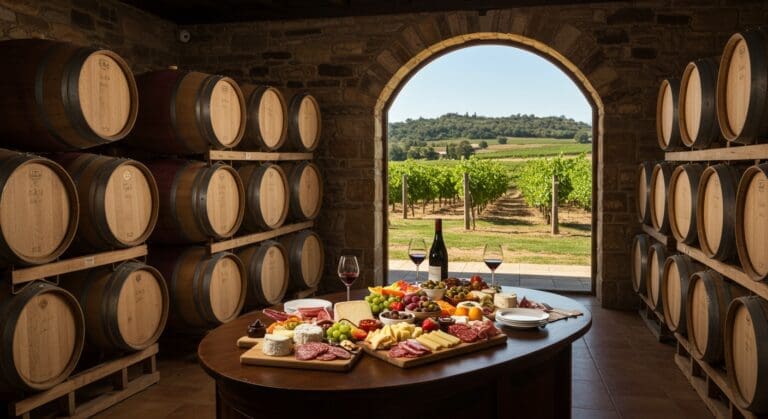
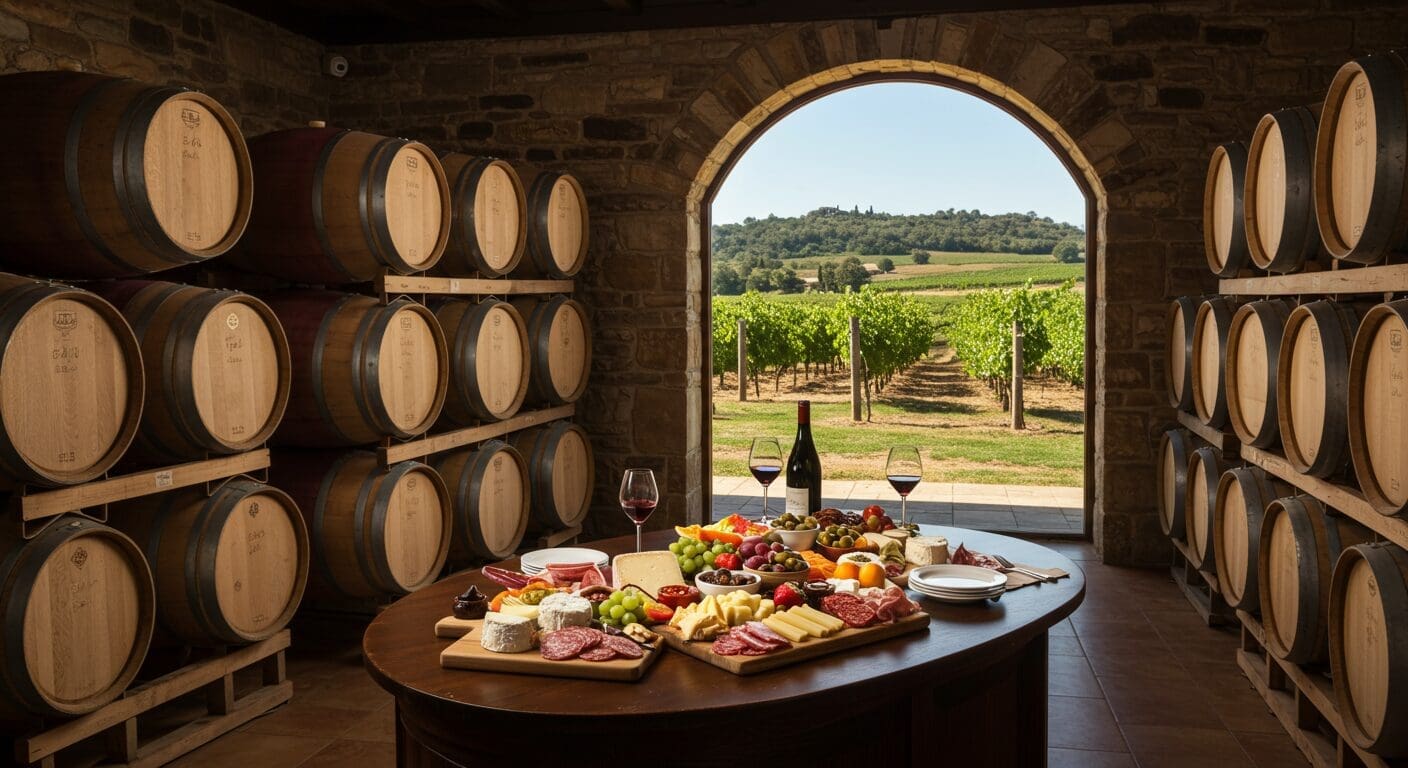
While Kalkan itself doesn’t sit in a major wine-producing zone, it is well-placed for access to serious Aegean wine producers, and several of the region’s better restaurants have taken the trouble to build wine lists that honour the local industry properly. The Aegean’s wine estates are increasingly worth visiting as destinations in their own right – many now offer formal tastings, cellar tours, and vineyard lunches in settings that would not look out of place in Provence or Tuscany. They tend to be rather quieter, which is part of the appeal.
Producers such as Urla Winery, south of İzmir, and Chateau Kavaklıdere – one of Turkey’s oldest and most respected wine houses – represent the more established face of the Turkish wine scene, with distribution wide enough that you may encounter their bottles in Kalkan restaurants. More recent independent producers have been pushing the quality threshold upward with small-batch releases of indigenous varieties that are beginning to attract international attention. If your itinerary allows for a day trip north along the Aegean coast, engaging a local guide or driver with genuine wine knowledge rather than simple logistics is worth the additional arrangement.
For those who prefer their wine discovery to happen at the dinner table, the better restaurants in Kalkan – particularly those on the rooftop terraces with their characteristic view of the old harbour and the bay beyond – carry lists that reward the curious. Ask for indigenous varieties, specify that you’re interested in smaller producers, and be open to recommendations from staff who, if the restaurant is worth its prices, will know what they’re pouring.
Cooking Classes and Food Experiences in Kalkan
Learning to cook Turkish food in situ is one of those experiences that sounds more effortful than it proves to be. The techniques involved in traditional Aegean and Lycian cooking are neither obscure nor punishing – the challenge, if there is one, is understanding the logic of a cuisine that relies on instinct, seasonal availability and a certain philosophical willingness to be guided by the ingredients rather than the recipe. A good Kalkan cooking class gets at exactly that.
Classes tend to follow a format that begins at the Thursday market or a local grocery, selecting ingredients with some guidance on what to look for and why. The cooking itself typically takes place in a domestic kitchen or converted space, working through a sequence of meze dishes before moving to a main course and, if time allows, a dessert. You will learn to make börek pastry in a way that makes all your subsequent encounters with it more interesting. You will probably be corrected on your olive oil quantities. (The correction will be in the direction of more.)
Private cooking experiences can often be arranged through villa concierge services or specialist operators – hiring a local chef to cook with and for you in your villa kitchen over the course of an afternoon is one of the better ways to spend a Kalkan day when the sun has made the idea of further historical investigation less appealing than it seemed at breakfast. The result is dinner in your own villa, with a considerably enlarged understanding of what you’re eating.
Dining on the Rooftops: The Kalkan Experience
Kalkan’s old town – the Ottoman-era merchant quarter that cascades down toward the harbour in a geometry of whitewashed walls and terracotta rooflines – has given the town its greatest accidental culinary asset: the rooftop terrace. Dining here is an architectural experience as much as a gastronomic one. The view over the bay and toward the islands shifts from golden to rose to deep blue as evening progresses, and it would be easy to spend the first twenty minutes doing nothing but looking. Most people do. The waiters have seen this before and pace themselves accordingly.
The restaurants occupying these terraces vary in ambition and execution, and the food ranges from very good to genuinely excellent. The best demonstrate a commitment to local sourcing and seasonal cooking that goes well beyond the fashionable. Fresh fish is the obvious focus – the day’s catch, grilled or baked with herbs, served simply with the kind of restraint that only makes sense when the fish is this fresh. But the meze culture here is equally compelling, and the intelligent approach is to build a meal of seven or eight small plates rather than rushing to a main course that the meze will only upstage anyway.
Wine pairings on these terraces have improved considerably. Local and Aegean white wines – particularly those made from Emir or blends incorporating Muscat – handle the heat and the fresh seafood with notable grace. The evening ritual of a long meze dinner, local wine, and that view, is not something you will feel any pressure to abbreviate.
The Best Food Experiences Money Can Buy in Kalkan
For those for whom cost is a secondary consideration to quality, Kalkan’s food scene offers several experiences that justify the category. Private gulet dining – chartering a traditional wooden boat and having a private chef prepare a meal on board in a secluded bay – is exactly as good as it sounds and considerably less complicated to arrange than you might expect. The combination of swimming in water of extraordinary clarity, followed by a long lunch of fresh seafood and cold wine on a sun-drenched deck, is one of the region’s more effective arguments for the concept of luxury travel.
Private chef experiences in villas are increasingly standard at the upper end of the market, and Kalkan’s concentration of high-specification villa properties means that a fully equipped kitchen staffed by a local professional is a realistic option for most nights of a stay rather than a special occasion. The ability to eat dinner at a table above your own infinity pool, with a view that costs nothing extra, reconfigures the usual calculus of restaurant versus home dining entirely in favour of the latter. Breakfast alone – local honey, fresh bread, village cheese, olives, tomatoes and a pot of strong tea – delivered to a terrace in the early morning before the day heats up, is worth building a travel itinerary around.
For a deeper engagement with the food culture, some operators offer bespoke food and wine tours combining market visits, producer meetings, cooking sessions and curated dinners across several days – structured enough to be educational, loose enough to accommodate the kind of extended lunch that becomes the memory you actually keep. Read more about planning your trip in our Kalkan Travel Guide for the full picture of what the region offers.
Find Your Perfect Base for a Kalkan Food Escape
Everything described in this guide is best experienced from a villa with its own kitchen, its own terrace, and the kind of space that allows a holiday to unfold at its own pace. Kalkan’s villa properties range from intimate hillside retreats to grand multi-bedroom estates with infinity pools, outdoor dining areas and the kind of morning views that make you feel considerably more optimistic about the day ahead than is perhaps entirely rational.
Browse our collection of luxury villas in Kalkan to find the right base for your stay – whether you’re planning to cook in, dine out on rooftop terraces, explore local markets at dawn, or simply eat very well and very slowly for as many days as you can justify. The food here will give you plenty of reasons to extend the trip. The view will give you several more.