Kensington Travel Guide: Where to Stay, Eat & Explore in Luxury
There are places in the world that do grandeur loudly – think Monaco, or the more performative arrondissements of Paris – and then there is Kensington, which has been doing it quietly, confidently, and with considerably better manners for the better part of three centuries. What Kensington has that nowhere else quite manages is the rare combination of genuine cultural weight and genuine residential calm: museums of genuine international significance sitting beside garden squares where the most dramatic thing happening is a dog refusing to fetch. It is a neighbourhood that has never needed to announce itself, and that restraint, in a city as loud as London, is its own form of distinction.
This is, in short, a destination that rewards a certain kind of traveller – and several very different kinds at that. Families seeking privacy and space rather than the shoebox rooms of a central London hotel will find Kensington’s wide residential streets and access to Hyde Park and Kensington Gardens genuinely transformative. Couples marking a milestone anniversary will appreciate a neighbourhood where a Michelin-starred dinner on a Tuesday feels entirely unremarkable. Groups of friends who want culture in the day and excellent wine in the evening will struggle to find a better base in the whole of the United Kingdom. Remote workers needing reliable high-speed connectivity alongside the discipline of a beautiful environment have found Kensington to be a quietly ideal solution – proximity to London’s business districts, without any of the noise. And for wellness-focused guests who want long morning walks through royal parks, clean food, and the kind of unhurried pace that the rest of London actively discourages, Kensington offers precisely that. It is one of those rare places that suits almost everyone without quite feeling like it’s trying to.
Getting to Kensington Without the Usual Chaos
London is served by five airports, which sounds impressive until you are sitting in traffic on the M25 wondering which circle of hell this particular one is. The good news is that Kensington is among the most accessible parts of London from all of them, and – crucially – from the ones that actually matter.
Heathrow is the obvious choice, and for once the obvious choice is correct. It sits roughly 12 miles west of Kensington, making it the closest major airport to the neighbourhood by some distance. The Elizabeth line – London’s newest and most civilised rail addition – now connects Heathrow directly to central London in around 30 minutes, with Paddington just a short cab ride from Kensington. A private transfer from Heathrow to a Kensington villa takes between 30 and 50 minutes depending on traffic, and is the choice of anyone who has checked in more than one suitcase.
Gatwick is the second choice for many transatlantic and European routes – roughly 30 miles south, with Gatwick Express trains running to Victoria in around 30 minutes, from where Kensington is easily reachable by cab or the District line. London City Airport, beloved of business travellers for its extraordinary proximity to the City, is farther from Kensington in spirit than in miles, but still perfectly manageable.
Once you are in Kensington, you will quickly discover that you barely need to leave it. The neighbourhood is superbly served by the District and Circle lines on the Underground, with High Street Kensington and Kensington (Olympia) stations providing excellent coverage. For anything requiring more speed or comfort, black cabs and rideshare apps are abundant. And for a remarkable number of Kensington’s best experiences – the parks, the museums, the restaurants on Kensington Church Street – the answer is simply to walk.
Where to Eat in Kensington: From Michelin Stars to Proper Italian Lunches
Fine Dining
Kensington’s fine dining scene is one of the best-kept secrets in a city that is not particularly short of them. The neighbourhood’s residential character means its best restaurants have the feel of places that have been quietly getting on with excellence for years, without needing the validation of a queue around the block.
Kitchen W8, on Abingdon Road, is the jewel in the crown. A joint venture between chef Philip Howard – long one of London’s most respected figures – and restaurateur Rebecca Mascarenhas, with Mark Kempson leading the kitchen, it is the kind of Michelin-starred restaurant that people who find Michelin-starred restaurants exhausting tend to love. The interior is soft-toned and unhurried. The cuisine celebrates English and French culinary traditions with a precision that never tips into showing off. It has become a genuine Kensington institution, which in this neighbourhood means something: the locals are discerning and not easily impressed.
Clarke’s, a short walk away on Kensington Church Street, has been doing something equally impressive since 1984. Sally Clarke’s flagship restaurant helped define what modern British cooking could look like, and it has never really stopped. The daily-changing menu – inspired equally by British seasonal produce and Clarke’s Mediterranean travels – is served in a beautifully restrained room: whitewashed walls, polished hardwood floors, garden views. The food is simple, fresh, and elegant in the way that only food conceived by someone who really understands ingredients can be. Simple, in Clarke’s hands, is the hardest thing in the world to pull off.
Where the Locals Eat
For all its refinement, Kensington has a lively, sociable dining culture that extends well beyond the white-tablecloth bracket. Dishoom’s Kensington outpost, tucked into a corner of the neighbourhood, is arguably the chain’s most atmospheric branch – a tribute to Bombay’s 1940s jazz age, complete with art deco interiors that make you want to order a cocktail immediately and stay until someone suggests you leave. The signature black daal – slow-cooked for 24 hours and absurdly rich with butter – is the kind of thing people travel across London for. On Wednesday evenings there is live piano; on Thursdays and Fridays a band plays swing. It is, by any reasonable measure, more fun than it has any right to be at a restaurant famous for lentils.
Jacuzzi, by the Big Mamma group at 94 Kensington High Street, occupies three floors and appears to have been decorated by someone who asked themselves what would happen if a Milanese trattoria and a botanical garden had a very opulent child. Flora cascades through the interior; caviar appears on the menu at prices that are, by London standards, almost reasonable; the Italian food arrives in portions that will catch you off guard. It straddles the line between high camp and high class with an impressive lack of effort. It is also extremely good fun, which is not always a given on the High Street.
Hidden Gems Worth Seeking Out
Locanda Ottoemezzo, named after Fellini’s 1963 film, is exactly the kind of restaurant that Kensington regulars mention in hushed tones, then immediately regret mentioning. Tucked away on Thackeray Street, it is small, genuinely Italian in the way that does not require air quotes, and decorated with vintage cinema posters that feel like they belong there rather than having been ordered from a prop house. The menu is a study in authenticity: the kind of cooking that makes you wonder how a dish this good has managed to remain this quiet. The answer, in Kensington, is usually that the right people already know about it and have made an arrangement with the universe to keep it that way.
Exploring Kensington: A Neighbourhood That Keeps Revealing Itself
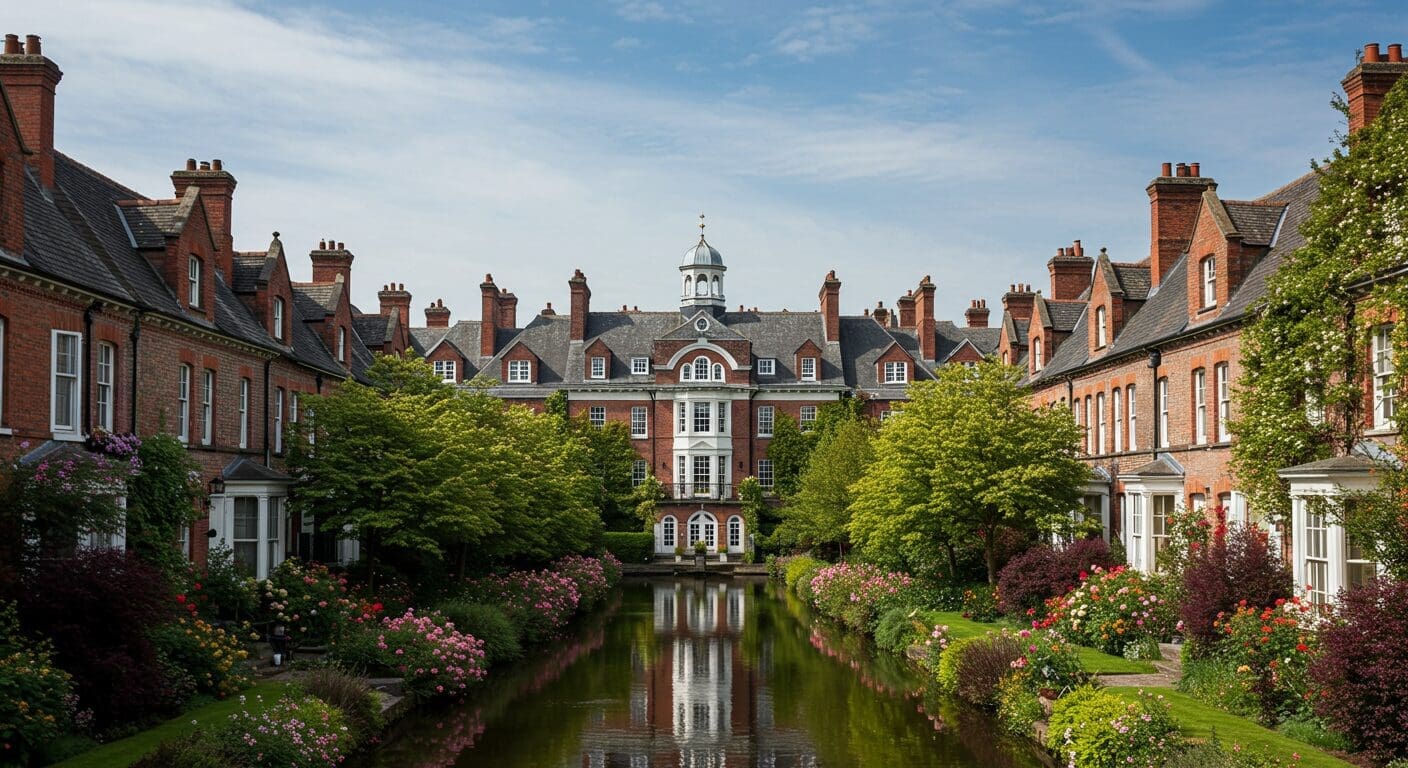
Kensington occupies the Royal Borough of Kensington and Chelsea – a designation that sounds ceremonial until you realise how much it shapes the experience of the place. This is a neighbourhood of genuine architectural beauty: white stucco terraces, red-brick mansion blocks, garden squares maintained with the quiet ferocity of people who take their privet hedges very seriously. The streets have names that appear in Victorian novels because they appeared in Victorian novels first.
The neighbourhood divides loosely into several distinct characters. Kensington High Street is the commercial spine – busy, well-served, home to everything from independent boutiques to the flagship department stores. North of the High Street, the streets become quieter and considerably grander: Kensington Palace Gardens, lined with embassies and the kind of properties that do not display price tags, is sometimes called Billionaires’ Row with the particular mixture of awe and understatement that the British excel at. South of the High Street, Earl’s Court Road and the surrounding streets offer a more bohemian register – wine bars, independent restaurants, the feeling of a neighbourhood that has been quietly cool for longer than most places have existed.
Kensington Gardens and Hyde Park together form one of the great urban green spaces in Europe. At over 600 acres combined, they offer everything from the formal symmetry of the Italian Gardens near Lancaster Gate to the wild informality of the meadows south of the Serpentine. Kensington Palace sits at the western end of the Gardens with the directness of a building that has never needed to explain why it is there. The Long Water, the Round Pond, the Albert Memorial in its gilded improbability – this is a landscape that reveals itself slowly and rewards return visits.
What to Do in Kensington: Three Square Miles, Approximately Forever’s Worth of Activity
The most significant cultural concentration in Kensington – and one of the most significant in the world – is the so-called Museum Mile along Exhibition Road. This is a consequence of Prince Albert’s magnificent obsession following the Great Exhibition of 1851: the idea that the profits should fund a permanent centre of arts, science and culture in perpetuity. The result, over the following decades, was three institutions of extraordinary scope placed essentially next to each other, which means that visitors routinely have to make the agonising decision of which world-class museum to visit first.
The Victoria and Albert Museum is the world’s leading museum of art and design – 2 million objects spanning 5,000 years of human creativity, from ancient Chinese ceramics to Renaissance sculptures, medieval treasures to 20th-century fashion. It is the kind of museum where you go in with a plan and emerge four hours later having seen almost none of it, having been stopped by something entirely unexpected in every corridor. The Natural History Museum, just around the corner, announces itself with a blue whale skeleton suspended from the ceiling of its cathedral-like entrance hall – a piece of theatre that works on adults and children equally. Over 80 million specimens are housed here. The Science Museum, completing the triumvirate, covers the full sweep of human technological achievement and manages to make it feel genuinely exciting rather than educational. This last detail is harder than it sounds.
Beyond the museums, Kensington Palace – home to various members of the Royal Family and open to the public – offers a genuinely fascinating glimpse into the history of the monarchy, with well-curated exhibitions that have improved considerably over the years. The Serpentine Galleries, housed in a former tea pavilion in Hyde Park, are among London’s most respected contemporary art spaces – free to enter and programming work that consistently justifies the critical attention.
Active Kensington: Parks, Cycling, and the Serpentine at Dawn
Kensington does not immediately suggest itself as an adventure sports destination, and this is, on balance, accurate. What it does offer is a surprisingly rich active life for those who look for it, particularly within the royal parks.
Cycling through Hyde Park and Kensington Gardens in the early morning, before the tourists and the joggers and the people walking while looking at their phones arrive in force, is one of London’s genuinely great pleasures. The Serpentine Road is closed to traffic, the light through the trees at dawn is something the city rarely gets credit for, and the sense of having claimed a small but significant portion of London for yourself is disproportionately satisfying. Santander Cycles, London’s bike-share scheme, has docking stations throughout the area and represents excellent value.
The Serpentine Lido offers outdoor swimming from May to September in the southern portion of Hyde Park. The Serpentine Swimming Club, founded in 1864, holds a Christmas Day race that attracts hardy souls in novelty hats every year. It is not for everyone. The Hyde Park Stables, just off the Bayswater Road, offer horse riding along the famous Rotten Row – a bridleway that has been in use since William III lit it with 300 oil lamps in the 1690s to deter highwaymen, thereby inventing the concept of the well-lit evening ride.
Tennis courts are available in Hyde Park, along with boating on the Serpentine for those who prefer their exercise to involve minimal cardiovascular effort. For more structured fitness, Kensington has several well-equipped private members’ clubs and gyms, many of which accept temporary or visitor memberships. The park-based boot camp culture is vigorous and entirely optional.
Kensington with Children: Why This Is One of London’s Best Family Neighbourhoods
There is a version of a London family holiday that involves small children standing in very long queues and weeping, and then adults standing in slightly different queues and also weeping. Kensington, done properly, is almost nothing like this.
The concentration of world-class museums along Exhibition Road is the obvious starting point, and it genuinely cannot be overstated. The Natural History Museum alone is capable of absorbing a child for an entire day – the dinosaur skeletons, the earthquake simulator, the wildlife photography exhibition, the sheer scale of the building. The Science Museum, next door, has interactive galleries specifically designed for younger visitors. The V&A has a dedicated activity programme. All three are free to enter. The fact that they are within comfortable walking distance of each other – and of Hyde Park, where children can run off whatever energy remains – makes the logistics of a family day genuinely manageable rather than theoretically manageable.
Hyde Park and Kensington Gardens are exceptional family spaces. The Princess Diana Memorial Playground in Kensington Gardens, themed around Peter Pan, is one of London’s best children’s playgrounds by some distance and is free to use. The Round Pond is ideal for model boats. The Diana Memorial Fountain in Hyde Park is, depending on your child’s attitude to paddling in public, either a wonderful interactive water feature or a source of immediate soaked socks. Both outcomes are valid.
Staying in a luxury villa in Kensington with a private outdoor space transforms the family holiday experience in ways that a hotel simply cannot replicate. The ability to have children’s mealtimes on your own schedule, to have separate spaces for adults once the children are asleep, and to have room – actual room – to exist as a family rather than a series of individual people in a very small space makes an enormous difference over a week or ten days. Families returning to Kensington tend to return to villas.
Kensington’s Cultural Depth: History, Architecture, and the Institutions That Define It
Kensington’s cultural identity is inseparable from its Victorian inheritance. The Great Exhibition of 1851, held in Hyde Park under a vast iron and glass structure – the Crystal Palace – was Prince Albert’s attempt to showcase the achievements of the industrial world and raise funds for a permanent cultural quarter. The exhibition attracted over six million visitors and generated enough profit to purchase 86 acres of land in South Kensington, on which the museums, the Royal Albert Hall, the Royal College of Music, and Imperial College London were subsequently built. This concentration of cultural and intellectual institutions in a single neighbourhood remains without parallel in Britain, and arguably in England as a whole.
The Royal Albert Hall, opened in 1871, is one of the world’s great performance venues – home to the BBC Proms every summer, to classical concerts, rock gigs, comedy, boxing, and an annual programme that defies easy categorisation. Checking what is on during your stay and booking accordingly is among the better uses of ten minutes of pre-trip planning.
Kensington Palace, built in 1605 and expanded by Christopher Wren for William III, has been a royal residence for over three centuries. Queen Victoria was born here in 1819 and received news of her accession to the throne here in 1837 – a scene the palace recreates with well-executed theatrical flair. The State Rooms are magnificent, and the changing exhibition programme keeps return visits worth making.
Architecturally, Kensington rewards slow walking and upward glances. The red-brick Dutch-influenced buildings of the late Victorian era, the white stucco of the earlier Georgian and Regency terraces, the art nouveau flourishes on some of the mansion blocks – it is a neighbourhood that accumulated its character over centuries and wears it without apparent effort. The contrast with the glass towers visible from Hyde Park to the east is, depending on your architectural sympathies, either stimulating or vindicating.
Shopping in Kensington: From High Street Heritage to Quiet Specialist Streets
Kensington is not a shopping destination in the way that, say, the United States has conditioned the world to understand shopping destinations. There is no single overwhelming luxury retail complex, no street dedicated exclusively to showing off. What there is instead is a genuinely varied retail landscape spread across several distinct areas, each with its own character.
Kensington High Street offers the familiar anchors of British retail – John Lewis is here in department store form, along with a well-curated selection of fashion chains and the kind of independent shops that survive because the neighbourhood actually uses them rather than just appreciating that they exist. The Design Museum at the western end of the High Street has a shop worth visiting in its own right – books, objects and design products that are consistently well-chosen and make the kind of gifts that require no explanation.
Kensington Church Street is one of London’s best-known antiques streets, with dealers specialising in everything from Georgian furniture to 20th-century studio ceramics. It is the sort of street where you can spend an hour not buying anything and still feel it was time well spent. Portobello Road in nearby Notting Hill – a short walk or cab ride – is the more famous antiques market, and justifiably so on Saturday mornings, when the full market is operating and the atmosphere is genuinely electric beneath the painted Victorian shopfronts.
For books, Daunt Books on Holland Park Avenue is among the most beautiful bookshops in London – an Edwardian building with oak galleries and skylights, and a travel section organised by country rather than author, which is either brilliant or infuriating depending on what you came in for. For wine, Jeroboams on Holland Park Avenue has been serving the neighbourhood’s cellar needs since 1985. For food to bring back to a villa kitchen, Whole Foods on Kensington High Street is well-stocked and, if you have recently been reminded of London property prices, relatively unsurprising in its own costs.
Practical Kensington: The Things Worth Knowing Before You Arrive
The currency is pounds sterling. Tipping is expected in restaurants – 12.5% service charge is commonly added automatically, and it is worth checking before adding more. Taxis: London black cabs are metered and regulated; the fare from Heathrow to Kensington will be somewhere in the range of £50-80 depending on traffic, which in London means depending on what time it is, what day it is, whether there is a match on, or whether the universe has decided today is not your day.
The best time to visit Kensington is, in all honesty, a matter of what you are after. London in summer (June to August) is warm, lively, occasionally genuinely hot, and extremely busy. The parks are magnificent, the Serpentine Lido is open, and the cultural programme is at its most intensive. Spring (April and May) offers the royal parks in bloom, considerably thinner crowds, and the particular pleasure of a London that has remembered it is allowed to be pleasant. Autumn, particularly September and October, has a strong case: the light is extraordinary, the summer visitors have departed, and the cultural season – exhibitions, theatre, classical music – is at its richest. Winter is cold, sometimes grey, and completely underrated by people who have not experienced Kensington under a proper frost, when the gardens empty out and the neighbourhood retreats into a warm amber self-sufficiency that is quietly lovely.
Language is English. The local variant is polite, indirect, and capable of expressing deep dissatisfaction through the phrase “that’s interesting.” Safety in Kensington is excellent by any reasonable comparison – it is one of the most secure residential areas in London. The local etiquette requires, above all, a willingness to queue without complaint and to acknowledge that other people exist, which covers most situations adequately.
Why a Luxury Villa in Kensington Is a Different Holiday Entirely
The standard hotel proposition in a neighbourhood like Kensington is not without its merits. There are excellent hotels here – some very good ones, in fact, with impressive bathrooms and room service that arrives largely when expected. But staying in a luxury villa in Kensington does something a hotel cannot do: it makes the neighbourhood yours in a way that is qualitatively different from checking in and checking out.
Space is the most obvious advantage, and in London it is not a trivial one. A private villa with multiple bedrooms, a proper kitchen, living rooms that actually accommodate a group of people without it feeling like a waiting room, and a private outdoor space or garden transforms what it means to be in one of the world’s most expensive cities. Families of five or six people suddenly have somewhere to actually be together – or apart, which is equally important on longer trips. Multi-generational groups, which hotels manage with varying degrees of success and varying degrees of additional charges, work naturally in a villa context where the logistics of separate generations simply… resolve themselves.
The privacy consideration in Kensington specifically is significant. This is a neighbourhood of quiet, residential streets where a well-chosen villa offers a degree of seclusion that would be impossible in any hotel in a comparable location. For guests who value discretion – visiting executives, high-profile travellers, families with young children who go to bed at 7pm regardless of what London has going on outside – a villa with its own front door is not a luxury but a necessity.
Remote workers have found Kensington villas to be an excellent arrangement: fast, reliable broadband is standard in premium properties, dedicated workspace can be specified when booking, and the ability to separate the working day from the living day – to close a door – matters more than most people admit until they have tried working from a hotel room for three days. The neighbourhood’s excellent cafés and co-working spaces nearby offer additional options for those who need a change of environment mid-afternoon.
Wellness-focused guests benefit from the combination of private villa amenities – gyms, treatment rooms, outdoor spaces, the ability to organise an in-villa masseur or private chef without the choreography required in a hotel – and Kensington’s extraordinary position adjacent to the royal parks. A 6am walk through Kensington Gardens before the city wakes up, followed by breakfast prepared in a private kitchen, is not something a hotel can offer regardless of its star rating.
The concierge and staffing options available through a well-appointed Kensington villa extend the experience considerably further: private chefs who can cook to dietary requirements without making it feel like a medical consultation, house managers who make the logistics of a London trip genuinely disappear, and access to reservations and tickets that would otherwise require considerable ingenuity. This is the quiet infrastructure of the very best kind of travel – the kind where things simply happen and you are not entirely sure how.
If Kensington has convinced you – and it should have – explore our full collection of luxury villas in Kensington with private pool and find the one that suits your group, your trip, and your particular idea of how a week in London ought to feel.
More Kensington Travel Guides
- Best Restaurants in Kensington: Fine Dining, Local Gems & Where to Eat
- Kensington Food & Wine Guide: Local Cuisine, Markets & Wine Estates
- Kensington with Kids: The Ultimate Family Holiday Guide
- Best Time to Visit Kensington: Month by Month Weather, Crowds & Tips
- Kensington Luxury Itinerary: The Perfect 7-Day Guide
- Romantic Kensington: The Ultimate Couples & Honeymoon Guide
What is the best time to visit Kensington?
Kensington rewards visits at almost any time of year, but the sweet spots are late spring (April to May), when the royal parks are in bloom and the crowds are manageable, and autumn (September to October), when London’s cultural season is at its strongest and the summer visitors have largely departed. Summer offers warmth, long evenings, and the Serpentine Lido, but also the highest density of tourists around the museum quarter. Winter is underrated – cold, yes, but the parks are gloriously quiet, prices are lower, and the neighbourhood settles into a residential calm that is genuinely appealing. For families, the school holiday periods (particularly late July and August) are easiest logistically, though busier. For couples or groups without school-age children, a late September or early October visit offers perhaps the most satisfying balance of weather, culture and atmosphere.
How do I get to Kensington?
Heathrow Airport is the closest and most convenient option, approximately 12 miles west of Kensington. The Elizabeth line provides a fast connection to Paddington in around 30 minutes, from where Kensington is easily reached by taxi or the District line. A private transfer from Heathrow to a Kensington villa typically takes between 30 and 50 minutes, traffic permitting. Gatwick Airport, around 30 miles south, connects to Victoria via the Gatwick Express in approximately 30 minutes, and Victoria to Kensington is a short cab ride. London City Airport is farther from Kensington geographically but well connected via the Underground. Once in the neighbourhood, walking is genuinely the best option for most journeys – Kensington is compact, well-signed, and considerably more pleasant on foot than from the back of a cab stuck on the High Street.
Is Kensington good for families?
Genuinely excellent, and not in the way that means “tolerates children.” The concentration of world-class free museums along Exhibition Road – the Natural History Museum, the V&A, and the Science Museum – is unmatched anywhere in London for family appeal. Hyde Park and Kensington Gardens between them offer over 600 acres of green space, including the outstanding Princess Diana Memorial Playground in Kensington Gardens, the Serpentine for boating, and enough open space for children to run without anyone minding. The neighbourhood is safe, walkable, and very well served by restaurants that welcome families. Staying in a private luxury villa rather than a hotel dramatically improves the family experience – separate spaces, private gardens or terraces, full kitchens for flexible mealtimes, and the ability to accommodate different age groups without the hotel corridor becoming a thoroughfare.
Why rent a luxury villa in Kensington?
Because the experience of Kensington from inside a private villa is fundamentally different from the experience of it through a hotel window. The space alone – multiple bedrooms, proper living areas, a kitchen, a private outdoor space – changes how a trip feels and functions. Privacy is significant in a neighbourhood where the right villa on a quiet residential street offers a degree of seclusion that no hotel can match. For groups and families, the staff-to-guest ratio in a well-appointed villa – a house manager, a private chef arranged on request, concierge access to reservations and tickets – means that the logistics of a London trip, which can be considerable, simply disappear. And the ability to have Kensington’s parks, museums and restaurants at your doorstep while returning each evening to somewhere that is unambiguously yours is, once experienced, quite difficult to give up.
Are there private villas in Kensington suitable for large groups or multi-generational families?
Yes – Kensington’s residential architecture, which includes substantial Victorian and Edwardian terraced houses and mansion apartments, lends itself well to larger group stays. Premium villa properties in the neighbourhood range from four to eight or more bedrooms, with layouts that offer genuine separation between different generations or groups – separate floors, independent living areas, and private outdoor spaces. For multi-generational families in particular, the villa format works far better than a hotel block-booking: grandparents and grandchildren can share a property without sharing the same room, meals can be taken together or independently, and the logistics of a large group in one of the world’s most expensive cities become considerably more straightforward when you have your own front door and your own kitchen.
Can I find a luxury villa in Kensington with good internet for remote working?
Premium villa properties in Kensington are equipped with fast, reliable broadband as standard – fibre connectivity is widely available across the Royal Borough. Many higher-specification properties include dedicated workspace areas, which matters more than people anticipate when they are making a booking and somewhat more than they expect by day three of working from a dining table. The neighbourhood’s excellent independent cafés – several within easy walking distance of any Kensington villa – provide good working environments and reliable Wi-Fi for those who need a change of scene during the working day. Kensington’s location provides easy access to London’s business and financial districts for those combining remote work with in-person meetings, making it a genuinely practical as well as pleasant base for extended working stays.
What makes Kensington a good destination for a wellness retreat?
The combination of immediate access to one of Europe’s great urban green spaces and the amenities available within a premium Kensington villa creates the conditions for a genuinely restorative stay. Hyde Park and Kensington Gardens offer over 600 acres for morning walks, runs, cycling, and outdoor swimming in the Serpentine Lido during the warmer months – all without leaving the neighbourhood. Luxury villas in Kensington can be specified with in-house gyms, and in-villa wellness services – personal trainers, yoga instructors, massage therapists – are straightforwardly arranged through a villa concierge. The neighbourhood’s restaurant scene, which includes strong options for clean, seasonal and plant-forward eating (Clarke’s daily seasonal menu being an excellent example), supports mindful eating without effort. The pace of Kensington itself – residential, unhurried, genuinely quieter than most of inner London – contributes more to a sense of restoration than its central location might suggest.